|

by Bert Olivier
December 16, 2025
from
Brownstone Website
Spanish version
Italian version
|
Scholarly analysis explicitly describes Nineteen
Eighty-Four (1984) as a "technocratic dystopia," as a
counterpoint to H.G. Wells' concept of,
benevolent scientific planners...
Wells directly referenced "Technocracy" in 'The
Shape of Things to Come,' describing it as an
attempt to restate economics on a physical-energy basis
and imagining scientific elites governing a rationally
ordered world, a vision very close to
technocratic ideology.
Orwell said that Wells,
"confused mechanical progress with justice, liberty,
and common decency."
Totalitarianism
concerns the masses.
The
movie,
The Matrix, emphasizes
a vision of control that is miniaturized and applied to
each individual:
instead of one visible dictator over a mass.
Each
person lives inside a personalized, fully enclosing
system that captures body, perception, and narrative one
by one.
So,
why won't writers today call 1984 a
Technocratic dystopia?
If you can't see the enemy, you
cannot defeat it.
That
enemy has infected
Washington, DC, like a plague.
It is Technocracy.
In
our book, The Final Betrayal, we lay it out chapter and
verse.
Source |
Has Orwell's
'1984'
become Reality...?
To some readers it may seem like a rhetorical question to ask
whether the narrative of George Orwell's dystopian novel, Nineteen
Eighty-Four (or
1984), first published in Britain in 1949, has
somehow left its pages and settled, like an ominous miasma, over the
contours of social reality.
Yet, closer inspection - which means
avoiding compromised mainstream news outlets - discloses a
disquieting state of affairs.
Everywhere we look in Western countries, from the
United Kingdom, through Europe to America (and even India,
whose 'Orwellian digital ID system' was lavishly praised by British
prime minister Keir Starmer recently), what meets the eye is a set
of social conditions exhibiting varying stages of precisely the
no-longer-fictional totalitarian state depicted by Orwell in 1984.
Needless to stress, this constitutes a warning against
totalitarianism with its unapologetic manipulation of information
and mass surveillance.
I am by no means the first person to perceive the
ominous contours of Orwell's nightmarish vision taking shape before
our very eyes.
Back in 2023 Jack Watson did, too, when he wrote (among
other things):
Thoughtcrime is another of Orwell's
conjectures that has come true.
When I first read 1984,
I would never have thought that this made up word would be taken
seriously; nobody should have the right to ask what you are
thinking.
Obviously, nobody can read your mind and surely you
could not be arrested simply for thinking? However, I was dead
wrong...
A
woman was arrested recently for silently praying in her head
and, extraordinarily, prosecutors were asked to provide evidence
of her 'thoughtcrime.'
Needless to say, they did not have any.
But knowing that we can now be accused of, essentially, thinking
the 'wrong' thoughts is a worrying development.
Freedom of speech
is already under threat, but this goes beyond free speech. This
is about free thought...!
Everybody should have a right to think
what they want, and they should not feel obliged or forced to
express certain beliefs or only think certain thoughts.
Most people would know that
totalitarianism is
not a desirable social or political set of circumstances.
Even the
word sounds ominous, but that is probably only to those who already
know what it denotes. I have written on it before,
in different contexts,
but it is now more relevant than ever.
We should remind ourselves
what Orwell wrote in that uncannily premonitory novel.
Considering the rapidly expanding and
intensifying, electronically mediated strategies of surveillance
being implemented globally - no doubt aimed at inculcating in
citizens a subliminal awareness that privacy is fast becoming but a
distant memory - the following excerpt from Orwell's text strikes
one as disturbingly prophetic, considering the time it was written (1984,
p.30):
Behind Winston's back the voice from the
telescreen was still babbling away about pig-iron and the
overfulfilment of the Ninth Three-Year Plan.
The telescreen
received and transmitted simultaneously.
Any sound that Winston
made, above the level of a very low whisper, would be picked up
by it, moreover, so long as he remained within the field of
vision which the metal plaque commanded, he could be seen as
well as heard.
There was of course no way of knowing whether you
were being watched at any given moment.
How often, or on what
system, the Thought Police plugged in on any individual wire was
guesswork. It was even conceivable that they watched everybody
all the time.
But at any rate they could plug in your wire
whenever they wanted to.
You had to live - did live, from habit
that became instinct - in the assumption that every sound you
made was overheard, and, except in darkness, every movement
scrutinized.
Before adducing compelling instances of the
contemporary, real-world surveillance equivalents of 1984's
'telescreen,' which have become sufficiently 'normal' to be accepted
without much in the form of protest, and to refresh your memory
further, here's Hannah Arendt, in The
Origins of Totalitarianism (New edition, Harcourt, Brace
Jovanovich 1979, p. 438):
Total domination, which strives to organize
the infinite plurality and differentiation of human beings as if
all of humanity were just one individual, is possible only if
each and every person can be reduced to a never-changing
identity of reactions, so that each of these bundles of
reactions can be exchanged at random for any other.
The problem
is to fabricate something that does not exist, namely, a kind of
human species resembling other animal species whose only
'freedom' would consist in 'preserving the species.'
As Italian thinker
Giorgio
Agamben would
say:
totalitarianism reduces every singular human being to 'bare
life;' nothing more, and after having been subjected to its
mind-numbing techniques for a certain time, people start acting
accordingly, as if they lack the capacity to manifest their
natality (unique, singular birth) and plurality (the fact that all people
are singular and irreplaceable).
The final blow to our humanity
comes when totalitarian rule's coup de grȃce is delivered
(Arendt 1979, quoting David Rousseton conditions in Nazi
concentration camps, m p. 451):
The next decisive step in the preparation of
living corpses is the murder of the moral person in man.
This is
done in the main by making martyrdom, for the first time in
history, impossible:
'How many people here still believe that a
protest has even historic importance?
This skepticism is the
real masterpiece of the SS. Their great accomplishment.
They
have corrupted all human solidarity. Here the night has fallen
on the future. When no witnesses are left, there can be no
testimony.
To demonstrate when death can no longer be postponed
is an attempt to give death a meaning, to act beyond one's own
death.
In order to be successful, a gesture must have social
meaning...'
Surveying the present social scene globally
against this backdrop yields interesting, albeit disturbing results.
For example, Niamh Harris reports that
German MEP Christine Anderson and British politician Nigel Farage
have both warned that,
globalists are frantically trying to establish
a fully fledged surveillance state 'before too many people wake up'
to this state of affairs.
Anderson - whose caution is echoed by Farage - points to the irony that people are waking up precisely because globalist
efforts to hasten the installation of a totalitarian surveillance
state are accelerating and becoming conspicuous.
Hence, the more the
process is ramped up, the louder critical voices become (and
protests are likely to occur), and correlatively, the more anxious
the neo-fascists become, to close the net around citizens of the
world.
She warns that:
'Digital identity [is] not so your life is
easier. It's so government has total control over you.'
'Digital currency [is] the crème de la crème
of all control mechanisms...What do you think is going to happen
the next time you refuse to take an mRNA shot?
With the flip of
a switch, they just cancel your account. You cannot buy food
anymore. You cannot do anything anymore.'
Given these warnings, a case in point concerns
well-known globalist
Tony Blair's recent
attempt to assuage people's fears about digital ID-systems.
Needless
to point out, his commendation of the system (because of its
'amazing benefits'), in conjunction with AI and facial recognition
capacity, is disingenuous in the extreme, as is palpably evident
from his words (quoted
from Wide Awake Media on X):
'Facial recognition can now spot suspects in
real time from live video...[It] helps identify suspects quickly
in busy places like train stations and events.'
'AI will go even
further - spotting crime patterns, guiding patrols and
streamlining decisions... This is where technology, like digital
ID, becomes critical.'
Wide Awake Media's laconic comment on Blair's
words (alluding to the already dystopian surveillance practices in
the United Kingdom) says it all:
'Imagine this kind of system in the
hands of a government that imprisons people for memes and jokes.'
It requires no genius to grasp that these
examples of attempts at furthering the totalitarian agenda of
complete surveillance, coupled with inescapable control mechanisms
such as
CBDCs, are rooted in the structural dynamics of the
(no-longer-fictional)
society of Big Brother, as evocatively
depicted by Orwell more than 75 years ago.
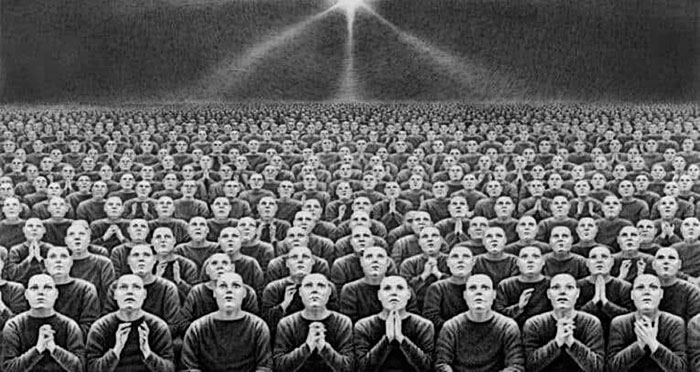
Except that - given the
advent of the network society of electronically mediated actions and
behavior - such surveillance and control are at a level of
efficiency and pervasiveness that Big Brother could only dream of.
This is unmistakable when one peruses reports
such as this one,
which alerts one to the fact that, in
Britain today,
surveillance
technology enables the neo-fascist authorities to identify, arrest,
and imprison individuals for so-called 'crimes' which echo the thoughtcrimes of Orwell's 1984, except that, by comparison,
they seem trivial to the nth degree.
As the article in question
states,
Following a number of high-profile arrests
for speech-related crimes, Britain is seen as far as the White
House as a realm of tinpot, two-tier woke tyranny, where authors
of errant tweets can expect to spend more time in prison than
sex pests and pedophiles and which commentators and comedians
should avoid - lest they be whisked straight from
arrivals to a holding cell having offended Left-wing
orthodoxies.
Lucy Connolly, a mother and childminder who
received a 31-month prison sentence for 'inciting racial hatred'
over a single (quickly deleted) tweet posted in the wake of the Southport
Murders, is just one of many Brits that the state has
pursued for such crimes in recent years.
British police
presently make 30
arrests per day for online speech offences, with many of these
treated far more seriously than violent, sexual, or acquisitive
crimes.
Connolly's was one of 44 convictions for 'stirring up
racial hatred' last year...
Those, like
Tony Blair, who are trying their best
to justify surveillance as being 'beneficial,' even go as far as
employing Orwell's terminology to assuage the fears of the public
who would be at the receiving end of such vaunted 'protection.'
In
this vein, in 2022 outgoing mayor of New York City, Eric Adams, was reported as
claiming that:
Americans will learn to love the
Chinese-style surveillance state, according to New York City
Democrat Mayor Eric Adams who responded to criticism over
increasing the use of facial recognition technology by
declaring,
'Big Brother is protecting you!'
Adams made the disturbing comments in
response to elected officials who expressed concerns that using
such technology is turning society into an authoritarian
surveillance state.
Not everyone was enamored of the mayor's
reassurance, however:
Albert Fox Cahn, the head of the
Surveillance Technology Oversight Project (STOP), responded by
warning that facial recognition technology would be weaponized to crack down on 'every aspect of dissent' in
the city.
'These are technologies that would be
chilling in anyone's hands.
But to give an agency with such
a horrifying record of surveillance abuse even more power,
at a time when they face dwindling oversight, is a recipe
for disaster,' he said.
Part of the problem faced by freedom-loving
citizens everywhere is the uncritical acceptance by many - although
by no means all - people, that constantly changing technology is
somehow self-justifying.
It is not, as a simple
thought-experiment confirms...
If someone tells you that, compared to
its 18th-century French Revolution precursor, today there
is a much more efficient, 'electronic guillotine' available, which
terminates a person's life quickly, humanely, and painlessly, and
could solve the overpopulation problem by euthanizing people over 60
years of age, should you agree?
Of course not...
For one thing, older people have
the same right to life as anyone else, and many of one's most
productive, and enjoyable years come after 60. Hence, there
is absolutely no ground for accepting or justifying new technology
as 'beneficial,' simply because it is supposedly 'more efficient.'
Yet, everyone of globalist persuasion seems to
believe that, to persuade the 'sheeple' to enter the corral of
digital imprisonment, all they need to do is to glorify the
technology involved - lying through their teeth, of course.
But lest I forget, according to the 1984 playbook,
which all and sundry among the globalist neo-fascists seem to have
adopted (stupidly believing that no one would notice), everything we
have been taught in the world that preceded the attempt to establish
their vaunted
New World Order, has been turned on its head, so that
'falsehood' (lying) has now become 'truth.'
If this sounds
far-fetched, take a look at the globalists' disingenuous
pronouncements through the lens of 1984 (p. 6):
The Ministry of Truth - Minitrue, in
Newspeak
- was startlingly different from any other object in sight. It
was an enormous pyramidal structure of glittering white
concrete, soaring up, terrace after terrace, 300 meters into the
air.
From where Winston stood it was just possible to read,
picked out on its white face in elegant lettering, the three
slogans of the Party:
WAR IS PEACE
FREEDOM IS SLAVERY
IGNORANCE IS STRENGTH
The 'Newspeak' of today does exactly the same
thing, as anyone who frequents the alternative media easily
discovers.
Hence, if those among us who cherish our freedoms wish to
preserve them, we had better be wide awake to any and all the
continuing attempts to impose terminal limitations, or should I
say, permanent termination, on them, all in the name of
putative 'benefits, safety, and convenience.'
If we don't, we shall
have only ourselves to blame if legislators of various stripes
succeed in imposing them on us by stealth...
|