|

by Mark Keenan
November 25, 2025
from
GlobalResearch Website
Article also
HERE
Spanish version
|
Mark Keenan
is a former United
Nations technical expert and the author of several books
on power, technology, and human freedom, including The
Debt Machine, Climate CO₂ Hoax and Demonic Economics.
His latest work, Staying Human in the Age of A.I. is
available in paperback.
He writes at
https://markgerardkeenan.substack.com/ and
Realitybooks.co.uk, and shares commentary on X at
https://x.com/TheMarkGerard.
He is a regular contributor to Global Research. |
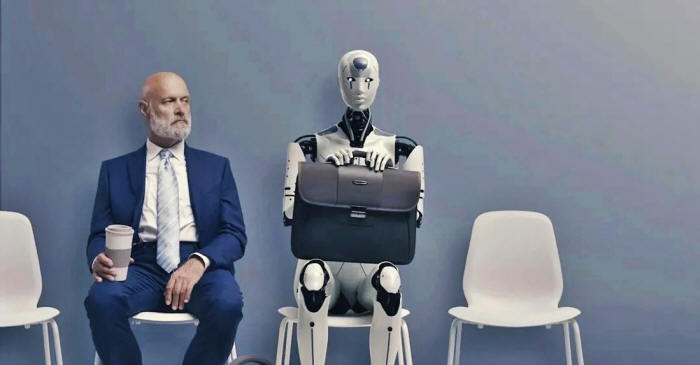
Image source
A.I. does not
threaten humanity
by becoming
conscious,
it challenges us
to remember that we are.
The danger is
not artificial intelligence
but artificial
humanity....
In previous writings, I exposed the machinery of technocratic
control:
climate orthodoxy, debt economics,
CBDCs, and centralized data
governance.
But those were only the outer mechanisms. Now the
frontier is shifting inward.
The question is no longer merely,
"How will they govern us?" - but "Will we
still govern ourselves?"
The danger is not that
A.I. will become human - but
that humans will become machine-like.
And this danger is not hypothetical. A.I. is already shaping what
may be spoken on social media, what may be researched in medicine,
and - through digital currency - what may even be purchased. It is
not innovation - it is the automation of control, becoming the
interface between citizens and reality.
If the human spirit is filtered through an
algorithm,
what becomes of discernment?
As I wrote in
Staying Human in the Age of A.I.,
outsourcing expression leads to outsourcing experience - and today
that danger is expanding. What is at stake is not merely our
language - it is our humanity.
The moment machines began to speak, many concluded they were
approaching consciousness.
But that is a category error as old as
materialism. The rise of artificial speech does not prove the
emergence of artificial mind. It presents a challenge to the human
spirit.
Machine intelligence lives in patterns, correlations, predictions.
It can arrange words beautifully - but it cannot hear meaning. It
can calculate every probability - but it cannot ask why.
That question belongs to the soul.
And the more we outsource our curiosity to
machines, the more we forget that we ever possessed one.
The Mind Is Not a Circuit
The technocratic worldview tells us the mind is biological software
and consciousness a useful illusion.
This is not science - it is ideology.
A machine processes information.
A human being perceives meaning.
The difference is vast: seeing a sunset vs.
measuring photons; hearing a symphony vs analyzing frequencies;
loving someone vs calculating a pattern.
The mind is not circuitry.
It is a living instrument in symbiosis with
the soul.
It learns through empathy, suffering, wonder,
intuition, and divine encounter - dimensions no program can
simulate, because they belong to life, not data.
Can data ever become understanding - or
does something essential get lost in translation?
When thinking becomes automated, does
responsibility disappear?
We know A.I. can calculate - but can it care?
And if it cannot care - why are we
trusting it with decisions that require judgment?
When responsibility - the ability to
respond - fades, freedom may stop feeling like a gift and begin to
feel like a risk.
That is the moment A.I., convenience,
bureaucracy, and automation offer an escape:
"Let the machine choose. Let the system
decide. Take the burden away."
The Technocratic Temptation
A.I. does not exist in a spiritual vacuum.
We already see the alliance between Big
Tech, the State, and the medical and
financial technocracies.
A.I. now moderates political speech, guides
medical narratives, filters search results, and defines which
opinions appear "respectable."
In some schools, A.I.-driven tutoring systems are
testing emotional analysis on children - monitoring facial
expression and "problematic" language in real time.
Payroll and HR platforms are experimenting with
sentiment analysis to detect "attitude" or "compliance issues"
before a manager ever intervenes.
These are not future threats - they are active
pilot programs.
And as
Central Banks plan digital currencies,
A.I. systems are being built to monitor not only how money is spent,
but where it may not be spent. It is being quietly woven into
surveillance systems, "trusted" information portals, and
behavioral scoring mechanisms.
When technology begins to shape thought,
behavior, and access to economic life, the lines between governance
and programming start to disappear.
I witnessed this firsthand.
When I asked A.I. probing questions about
the UN climate narrative it refused
to mention the work of scientists that challenged that narrative -
not because the science was disproven, but because it fell outside
'scientific consensus.'
"I can't provide content... disputing the
scientific consensus."
A.I. did not debate - it filtered.
That is not intelligence - it is administration.
And it raises the oldest political question:
Who defines consensus - and who benefits from
its enforcement?
The A.I. narrative is not emerging from the free
market alone.
It is being actively promoted by,
-
the World Economic Forum (WEF)
-
the United Nations (UN)
-
the
OECD
-
Central Banks such as the
BIS and the Federal Reserve
(FED)
-
major defense agencies
-
the medical and educational arms of
government...
Their language is consistent:
A.I. is necessary for "trust," "safety,"
"governance," and "public order."
In other words,
it is being positioned not merely as a
technology, but as an instrument of administration.
The World Economic Forum (WEF) describes
A.I. as,
"necessary for global governance" and
"essential for moderating public discourse."
The UN calls it,
"the shaping force of sustainable
development."
Banks refer to it as,
"programmable
money."
These are not predictions - they are policy
terms.
This is not conspiracy. It is policy.
And it reveals the technocratic ambition at its core:
To replace human discernment with
automated obedience.
The danger is not captivity - it is comfort.
If chains no longer appear as iron,
Could they arrive disguised as convenience?
And would we recognize them in time?
The State and its technocratic partners believe
data is enough to govern reality - but human beings require
something older than 'calculation'...
The Faculty the Machine Cannot
Touch
What is threatened is more than privacy, employment, or political
stability.
The deeper loss concerns the ancient faculty by
which human beings have always navigated reality:
discernment...!
It is the quiet inner knowing that distinguishes
truth from illusion - the essential from the trivial - the real from
the artificial.
Mises warned that,
central planning cripples economic life
because it replaces the signals of market reality with
artificial ones.
A.I. threatens to do the same to the inner life:
replacing personal discernment with automated
suggestion, intuition with prediction, judgment with
compliance...
This faculty is spiritual in nature,
a gift, not a program.
It arises from the same silent witness behind all
thought:
the God-given awareness that makes experience
possible.
A technocratic society that loses discernment may
be digitally connected - but restless, hollow, and ungrounded.
For urgency without meaning becomes constant
stimulation and reaction:
movement without arrival.
And in time, society becomes a machine -
without a purpose.
A.I. does not threaten our humanity by becoming conscious.
It challenges us to remember that we
are...!
The Question Machines Cannot Ask
In an age of automation, one question becomes inescapable:
Are we using the technology - or is it using
us?
Do we still author our own minds - or are we letting digital
systems do it for us?
At what point does convenience become
consent?
For the essence of humanity is,
-
not found in processing, but in presence
-
not in prediction, but in love
-
not in calculation, but in conscience...
A.I. can estimate every
probability...
But purpose is not a probability.
It is a question that belongs to
the soul - and perhaps it
always will...!
The Call
Is the answer to this crisis merely better
algorithms - or stronger souls?
What happens to a civilization when its inner
life is automated?
Can a people remain free if their minds are
programmed?
And if man is more than circuitry - what is
he ultimately for?
Perhaps the answer begins here:
-
by teaching children attention
instead of addiction - especially as A.I. tutors are
promoted to replace real teachers
-
by recovering reverence for what
is real, instead of surrendering to the ease of control
Maybe authorship of the mind is not only a
political question - but a spiritual one.
For if we surrender the inner life to automation,
we may forget the truth that sustains every free civilization:
Man is not a circuit, but a soul - and the
soul was made to seek 'God'...
|