|

by
A Lily Bit
March 24, 2026
from
ALilyBit Website
Information received by Email from 'Info
Crazy-Rich'
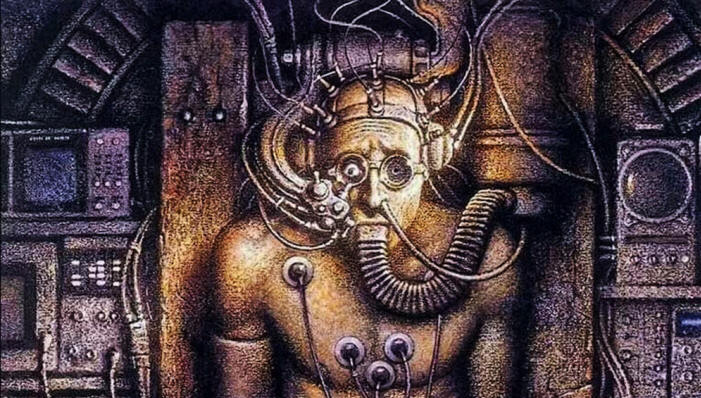
Bryan Johnson is fifty years
old, though he claims his biological age is somewhere in the
thirties, and he has the complexion of something that feeds at
night.
He wakes at five in the morning.
He ingests dozens of supplements.
He monitors his heartbeat with the vigilance
of a paranoiac watching for assassins.
He has transfused blood from his own teenage
son into his veins, a procedure so grotesquely vampiric that
Bram Stoker would have blushed to invent it.
He spends two million dollars a year on this
regimen, and for what?
To live forever, he says. To defeat death
itself...
And the tragedy - or perhaps the comedy,
depending on your tolerance for the absurd - is that he looks worse
now than when he started.
He has become, through sheer force of capital and
obsession, a creature that resembles nothing so much as the undead
he is so desperate not to join.
But Bryan Johnson is not an aberration.
He is a symptom.
He is what happens when a human being
accumulates more wealth than the brain was ever designed to
process, when the ancient circuitry of survival and status gets
so thoroughly overloaded that it begins to malfunction in
spectacular and visible ways.
He is, in other words, exactly what we should
expect from a civilization that has made the accumulation of
capital its highest virtue and its organizing principle.
And if you want to understand how we got here -
how we arrived at a moment in history where grown men drink their
children's blood and dig bunkers in Hawaii and whisper about
Satan in
Secret Societies - you have to
go back. Way back...
Bronze began its career in human affairs as a weapon.
This is important. It was not invented to make
jewelry or to decorate temples or to serve as a medium of exchange.
It was invented to kill people. The first bronze objects were swords
and spearheads and arrowheads, tools for the projection of violence
and the consolidation of power.
The man with the bronze sword could take what he
wanted from the man with the stone club, and so bronze became
synonymous with dominance.
But here is the thing about power:
it gets bored.
Once you have conquered your enemies and secured
your territory and established yourself as the undisputed ruler of
your little corner of the world, what do you do with all that
bronze?
You start making pretty things. You make
jewelry. You make elaborate vessels for your wine.
You make decorative objects that serve no
purpose except to announce to everyone who sees them that you
are the sort of person who can afford to waste bronze on
frivolity.
And because powerful people have nice things,
everyone else wants nice things too, and so bronze transforms
from a weapon into a status symbol and from a status symbol into
a currency.
This transformation took centuries. It happened
so slowly that no one living through it could have perceived the
change.
But the pattern it established - the movement
from violence to ornamentation to exchange - would repeat itself
again and again throughout human history, with cattle and grain and
seashells and gold and, eventually, with little pieces of paper
bearing the faces of dead presidents.
The lesson, if there is one, is that all money
is, at bottom, crystallized power.
It is violence made portable and fungible. It
is the ability to coerce, abstracted and stored in a form that
can be carried in your pocket.
David Graeber, the anthropologist,
understood this better than most.
In his book on debt, he argued that money as a
concept emerged not from barter, as the economists would have you
believe, but from situations in which the debt was so profound that
it could never be truly repaid.
Consider the three primordial debts.
The first:
blood.
If I kill your brother, you will want to kill
me, and if you kill me, my family will want to kill you, and the
cycle of vengeance will continue until one of our lineages is
extinguished.
But what if, instead, I acknowledge that I
have created a debt that can never be settled, and I offer you
something valuable - gold, perhaps, or cattle, or bronze - as a
token of that acknowledgment?
The violence stops, but the debt remains,
transmuted into wealth.
The second primordial debt:
marriage.
When a woman leaves her family to join yours,
something irreplaceable has been lost. A daughter, a sister, a
source of labor and love and continuity.
And so you give gifts to compensate, not
because the gifts are equivalent - nothing could be equivalent -
but because the gesture matters. The transaction matters.
The acknowledgment of obligation matters.
The third primordial debt, and this is the one that
explains the tombs, is,
the debt we owe to the dead.
When a great leader dies, or a beloved
priest, or simply someone who contributed more to the community
than could ever be measured or repaid, what do you do?
You cannot give them anything they can use.
They are dead. They have passed beyond the material realm into
whatever comes next, and everyone knows - or at least everyone
knew, for most of human history - that you cannot take your
possessions with you into the afterlife.
And yet the bereaved pile gold into graves.
They bury their heroes with jewelry and weapons
and food and wine. They construct elaborate tombs, mastabas in Egypt
and mausoleums in China and pyramids that scrape the sky, all to
honor people who will never see any of it.
Why?
Because the gesture matters.
Because the monument stands as testimony to a
debt that can never be discharged.
Because the community is saying, with bronze
and gold and precious stones, that this person was worth more
than we could ever give them, and we will remember them forever.
This is what money was, once.
A symbol of the unpayable.
A token of acknowledgment.
A way of making visible the invisible bonds
that held communities together.
And then something changed...
The Minoans learned from the Egyptians, as civilizations do, and
they built their own elaborate tombs, each generation more ornate
than the last. The archaeological record is clear on this point: as
the Minoan civilization grew wealthier, its tombs grew larger and
more complex, stuffed with more treasure, more gold, more bronze.
And this is presented, usually, as evidence of
increasing sophistication, of cultural achievement, of progress.
But consider another interpretation.
Consider the possibility that what we are
seeing, in those ever-more-elaborate burial chambers, is not
progress but pathology.
Consider the possibility that the Minoans,
like so many civilizations before and after them, had begun to
lose track of what money was for.
Because here is the secret that the wealthy do
not want you to know:
capital changes the brain.
This is not metaphor. This is not poetry. This is
neuroscience.
There was a study, published in The Atlantic
in which researchers performed brain scans on powerful and wealthy
individuals and compared them to brain scans of ordinary people.
What they found was disturbing. The wealthy
showed patterns of neural activity that were, in significant ways,
similar to the patterns observed in psychopaths.
The regions of the brain responsible for empathy,
for understanding the feelings of others, for recognizing that other
human beings are, in fact, human beings and not merely obstacles or
instruments - these regions were diminished, attenuated, suppressed.
Power, it turns out, causes brain damage.
Wealth causes brain damage.
Having too much, for too long, fundamentally
alters the chemistry of the mind.
This explains so much, does it not?
This explains why the parasitic elite can look at
the suffering their decisions cause - the workers pushed to
exhaustion, the communities disrupted, the democracies undermined -
and feel nothing.
This explains why
Mark Zuckerberg can build a
platform that spreads misinformation and hatred and loneliness
across the globe and then retreat to his compound in Hawaii, where
he is constructing a bunker to survive the apocalypse his own
creation is helping to bring about.
These people are not evil in the way that a villain in a movie is
evil, with conscious malice and a clear understanding of the harm
they cause.
They are something worse.
They are broken.
They have been broken by their wealth, their
brains rewired by the experience of having too much for too
long, until they have lost the capacity to see other people as
fully real.
They live in a world of abstractions and
instruments, of resources to be extracted and obstacles to be
overcome, and they cannot see - they literally, neurologically
cannot see - that the rest of us are not non-player characters
in their private video game.
And the tragedy is that they know, on some level,
that something is wrong... They feel the absence where their
humanity used to be, even if they cannot name it.
And so they try to fill it, to compensate, to
find some substitute for the connection they have lost.
They join secret societies, hoping that
ancient rituals and hidden knowledge will restore what capital
has stolen.
They pour money into longevity research, into
cryonics, into blood transfusions from the young, desperate to
extend their lives indefinitely because the alternative - death,
and the dissolution of all they have accumulated - is
unthinkable.
They worship Satan, or at least they flirt with the idea,
because if the conventional gods have abandoned them, perhaps
the adversary will be more accommodating.
They build bunkers beneath their mansions,
preparing for an end that they are, in many ways, actively
hastening.
Zuckerberg's Hawaiian bunker reportedly cost two
hundred and sixty million dollars.
Two hundred and sixty million dollars.
For a hole in the ground.
For a shelter against a catastrophe that he,
more than almost anyone on Earth, has the power to prevent.
The cognitive dissonance here is staggering, but
it only seems like dissonance if you assume that these men are
thinking clearly.
They are not. They are addled by wealth, their
brains saturated with the neurochemicals of power, incapable of the
kind of sober risk assessment that a peasant farmer in medieval
France could have managed without breaking a sweat.
The peasant would have said:
"If the world ends, a bunker will not save
me. I should work to prevent the world from ending."
The billionaire says:
"The world may end. I should build a bunker."
And then he continues to do the things that make
the end more likely, because stopping would cost money, and money is
the only thing his damaged brain still understands.
Let us conduct a thought experiment.
Imagine that Satan - the
actual Satan, not the
people online that you disagree with, the one with horns and a tail
and a contract written in blood - appeared in your living room and
made you an offer.
"I will give you one billion dollars," he
says, "but you must live forever, and you must be my slave for
all eternity."
Most people, the vast majority of people, would
refuse this bargain.
What good is a billion dollars if you spend
eternity in servitude to evil? The money is not worth the cost.
But now imagine a variation.
Imagine that you already have ten billion
dollars. You have the best life imaginable - private jets and yachts
and mansions and chefs and servants and every material pleasure that
human ingenuity can provide.
And Satan appears and says:
"You will die. When you die, all of this
ends. You will have nothing. But I can make you live forever.
All you have to do is serve me."
The calculus changes, does it not?
The person with nothing to lose would laugh in
Satan's face. The person with everything to lose might pause. Might
consider. Might, in the end, sign on the dotted line.
This is what capital does.
It raises the stakes until the stakes become
unbearable.
It loads you down with so much that the
thought of losing it drives you mad.
It creates a sunk cost fallacy of the soul,
where you have invested so much in this life, in this identity,
in this accumulation, that the prospect of starting over - in
death or in any other way - becomes literally unthinkable.
And so the wealthy cling.
They grasp.
They reach for immortality with both hands,
and in reaching, they become monsters.
Consider the properties of currency, the
characteristics that transform a mere commodity into capital.
It must be universal - the more people who
want it, the more valuable it becomes.
It must store value - it cannot rot or spoil
or depreciate.
It must be permanent, or at least durable
enough to last a lifetime and beyond.
It must be mobile, portable, easy to
transport from place to place.
It must be available, but not too available -
rare enough to be precious, common enough to circulate.
And it must be recognizable, so that
strangers can agree on its value without lengthy negotiation.
Throughout human history, many things have served
as currency.
Seashells, in some societies.
Cattle, in others.
Grain, which could be stored and measured and
divided.
Women, traded between families as brides and
hostages and symbols of alliance - a form of currency so
degrading and so common that we have apparently forgotten to be
appalled by cultures who still do this today.
Slaves, human beings reduced to property,
their bodies and their labor serving as a medium of exchange.
Drugs, precious and addictive, though their
tendency to destroy societies limited their acceptance as legal
tender.
Oil, the blood of the industrial age, still
traded in vast quantities on global exchanges.
Bronze, and then gold, and finally the United
States dollar, which floats on nothing more substantial than
collective belief and the threat of American military power.
Each of these currencies has its advantages and
disadvantages.
Cattle are universal - everyone needs food -
but they are not particularly mobile, and they die.
Grain stores value, but it can rot if not
protected.
Drugs are rare and desirable, but they cause
too many problems to serve as the basis for a stable economy;
think of what opium did to China.
Only bronze and gold and fiat currency check
all the boxes. They are universal. They store value. They are
permanent. They are mobile. They are rare enough to be precious
and common enough to circulate.
And so they became the foundations of empires,
the lubricants of global trade, the instruments through which the
world was remade in the image of capital.
Once you have a universally accepted currency, you have the basis
for globalization. And globalization happens naturally, almost
inevitably, as a consequence of trade.
The bronze that was mined in one region was
forged into weapons and jewelry in another and sold in a third. The
gold that was dug from the earth in Africa and the Americas flowed
to Europe and Asia, financing wars and cathedrals and the
colonization of continents.
The dollar, backed by nothing but
faith and aircraft carriers, circulates everywhere, facilitating
transactions that would have been unimaginable to our ancestors.
Capital has conquered the world.
But consider what capital does to the societies it conquers.
Consider its essential nature. Capital exploits. Capital alienates.
Capital consolidates. These are not side effects. These are not
failures of implementation.
These are the core functions of the system, the
purposes for which it exists.
Imagine a village, before the advent of money. The leader of this
village has one job:
to win the respect of his people.
He works for them. He listens to their concerns.
He mediates their disputes. He organizes their labor and distributes
their resources with an eye toward fairness and harmony, because his
authority depends on their goodwill.
If they turn against him, he has nothing. He is
bound to them by ties of obligation and affection, by the knowledge
that his fate is inseparable from theirs.
Now introduce capital...!
Suddenly the leader has a new way of measuring
his success, a way that does not depend on the goodwill of his
people.
He can accumulate.
He can hoard.
He can see his subjects not as human beings
to whom he owes loyalty, but as commodities to be exploited, as
sources of labor and tribute, as means to an end.
And once he sees them this way, once the people
become instruments rather than ends, the bonds of loyalty and
obligation begin to dissolve.
He is alienated from his humanity.
He is alienated from his people.
He is alienated from everything except the
accumulation itself, which becomes its own purpose, its own
justification, its own reward.
And over time, inevitably, the strong accumulate
more than the weak.
The rich get richer. The poor get poorer. The gap
widens until it becomes a chasm, until the people at the top live in
a different world from the people at the bottom, until the very
possibility of solidarity or understanding between them disappears.
This is crony capitalism working exactly as
intended.
Massive inequality.
Corruption - because when capital is the
measure of value, everything and everyone is for sale.
Immorality - because the pursuit of profit
recognizes no constraints except those enforced by law, and laws
can be bought.
Alienation. Anger. Indifference.
This is the world we live in.
We are, all of us, composed of two natures. There is the altruistic
self, the part that cares about relationships, about empathy, about
creativity and connection and the bonds that make life worth living.
And there is the utilitarian self, the part that
focuses on material objectives, on logic, on hard work and
competition and the accumulation of resources. In school, the
utilitarian self predominates.
How do I get good grades?
How do I outcompete my classmates?
How do I position myself for success in the
marketplace?
At home, ideally, the altruistic self emerges.
We care for our families. We maintain
relationships. We remember that life is about more than winning
and having.
What the research shows - and this has been
replicated again and again, in study after study - is that people
who are altruistic, who work for others, who prioritize
relationships over accumulation, tend to be more creative than
people who are focused primarily on money.
The creative mind flourishes in connection, in
empathy, in the rich soil of human relationship. But people who are
obsessed with money, who have given themselves over entirely to the
utilitarian self, tend to work harder.
They grind. They hustle. They optimize. They
sacrifice everything on the altar of productivity. And this is why
globalization has proceeded so rapidly, why the transformation of
the world has been so swift and so total.
Everyone is rushing to make as much money as
possible, because in a system organized around capital, money is the
only measure that matters.
But the grinding cannot continue forever.
Eventually, a few people have all the money. The
game has been won, and everyone else has lost, and what do you do
when you realize that no matter how hard you work, you will never
join the winners? You lie flat. You quiet quit.
You withdraw your enthusiasm and your energy from
a system that was never designed to benefit you, that was always
designed to extract from you until there was nothing left to
extract.
And this is where we are now, in the
twenty-first century, in the aftermath of globalization's triumph.
The billionaires have won.
They have all the money.
And the rest of us are beginning to realize
that the game was rigged from the start.
So the billionaires sit in their bunkers,
surrounded by their gold, watching their monitors for signs of the
apocalypse they are helping to create.
They drink the blood of the young. They join
secret societies. They worship whatever gods or demons might offer
them escape from the mortality that stalks us all.
They have everything, and they are terrified of
losing it, and their terror makes them do insane things - things
that a rational person, a healthy person, a person with a
functioning brain would never do.
Remember the mastabas of Egypt.
Remember the tombs of the Minoans.
Remember the terracotta warriors of the first
Chinese emperor, an army of clay soldiers buried with their
ruler so that he might command them in the afterlife.
Why did they do it?
Why did they bury their dead with such staggering
wealth, treasure that could have fed cities, that could have built
infrastructure, that could have eased the suffering of the living?
The traditional explanation is religious...:
they believed that the dead could take their
possessions with them into the next world.
But we know this is not quite true.
We know, from the anthropological record, that
most human societies understood perfectly well that the dead are
dead, that the material realm ends at the grave, that gold in the
ground serves no practical purpose whatsoever.
So why did they do it?
Perhaps the answer is simpler than we thought.
Perhaps the answer is that they were crazy.
Perhaps the answer is that the accumulation
of wealth, beyond a certain threshold, damages the brain.
Perhaps the answer is that the priests and
the kings and the emperors, the most powerful people in their
societies, were suffering from the same pathology that afflicts
Fink and Zuckerberg and Bryan Johnson and
all the rest of our modern oligarchs.
Perhaps they literally could not help
themselves.
Perhaps the gold had rotted their minds until
they could not distinguish between rational action and madness,
between life and death, between themselves and their
possessions.
The first emperor of China was buried with an
army.
An army of thousands of soldiers, crafted
with exquisite care, equipped with weapons and horses and
chariots, arranged in battle formation as if ready to march on
the underworld.
The labor that went into this project - the
years, the lives, the resources - is almost incomprehensible.
And for what?
So that a dead man could play at war in the
land of the dead.
So that an emperor who could no longer
command anything could pretend that he still commanded
everything.
It is absurd. It is stupid. It is, if you step
back far enough, darkly hilarious. And it is exactly what we would
expect from a man whose brain had been broken by power.
The wealthy have always been with us, and they have always been
somewhat mad.
What is new, in our time, is the scale.
Never before have so few people controlled so
much wealth.
Never before has the gap between the top and
the bottom been so vast.
Never before have the oligarchs had access to
such powerful technologies, such sophisticated medical
interventions, such extensive surveillance and control systems.
They can monitor their own bodies with
unprecedented precision, tracking every heartbeat, every hormone,
every fluctuation in blood chemistry.
They can build bunkers that would make a Cold War
general weep with envy. They can, if the rumors are to be believed,
purchase the blood of the young and the loyalty of the powerful and
the silence of anyone who might oppose them.
And yet they are more frightened than ever. More desperate. More
willing to do insane things in pursuit of immortality.
The sunk cost fallacy has them in its grip, and
they cannot let go.
They have worked so hard, accumulated so
much, built such elaborate lives and identities and empires. And
now they are going to die. Like everyone else. Like the pharaohs
and the emperors and the kings of old. Like the poorest peasant
who ever scratched a living from the soil. Death comes for them
all, and they cannot accept it...
They refuse to accept it. And in their refusal,
they become monsters.
This is the lesson of the tombs. This is the lesson of the bronze.
This is the lesson of capital, in all its forms and throughout all
of history.
Wealth is power, and power corrupts, and too much
power corrupts absolutely - not morally, not spiritually, but
neurologically.
The brain itself changes. The capacity for
empathy withers. The ability to see others as fully human degrades.
And the desperate, mad, futile pursuit of immortality begins.
We live in an age of billionaires, and we are ruled by their
madness.
They control our economies, our governments,
our information systems.
They decide what we see and what we hear and
what we believe.
They are shaping the future of human
civilization, and their brains are damaged.
They cannot help us.
They cannot even help themselves.
They are too far gone, too lost in the
labyrinth of their own accumulation, too busy building bunkers
and drinking blood and worshipping whatever dark powers might
grant them a few more years.
The rest of us must find another way.
We must remember what money was, before it
became a pathology.
We must rebuild the bonds of empathy and
obligation that capital has dissolved.
We must recognize that the utilitarian self,
useful though it may be in limited doses, is not the whole of
human nature, and that a civilization organized entirely around
accumulation is a civilization that has lost its soul.
We must refuse to lie flat, and we must
refuse to grind, and we must find some third path that honors
both our need to survive and our need to connect, our need to
work and our need to love, our need to have and our need to
give.
Or we can watch the billionaires dig their
bunkers and drink their blood and wait for the end that is coming
for us all...!
The end that has always been coming. The end that
no amount of gold, no army of clay soldiers, no elaborate tomb, has
ever been able to forestall. They will die, as we will die.
And the only question that matters is,
how we choose to live before that day
arrives...
The Minoans are dust now. Their tombs are
museums. Their bronze is corroded and their gold is locked
behind glass, and no one remembers their names.
The pharaohs are mummies, their mastabas
picked clean by grave robbers, their eternal lives cut short by
time and entropy and the indifference of the universe.
The first emperor of China lies moldering in
his tomb, surrounded by his clay army, and he has not stirred in
two thousand years.
They had everything, once. They had more than
anyone could need. And it drove them mad, and it killed them, and
they are gone...
Mark Zuckerberg will be gone too, one day.
His bunker will collapse or flood or be
overrun.
His billions will be scattered by lawsuits
and taxes and heirs who squander what they did not earn.
No one will remember his name, except perhaps
as a footnote in the history of how humanity almost destroyed
itself in pursuit of something that was never worth having.
And Bryan Johnson, that pale vampire, that
voluntary guinea pig for every longevity treatment that money can
buy - he will die too.
Maybe not today.
Maybe not tomorrow.
But someday, and probably sooner than he
thinks, because the body was not designed to live forever, and
no amount of blood transfusions or supplement stacks or
monitored sleep will change that fundamental fact.
The only question is,
whether we will learn anything from
their example.
Whether we will look at the tombs they
are building, the fortresses of solitude and paranoia and fear,
and recognize them for what they are:
symptoms of a disease that afflicts not
just individuals but entire civilizations.
Whether we will have the wisdom to
turn back, before the damage to our own brains becomes
irreversible.
Whether we will remember, before it is
too late, that there are some debts that can never be repaid
with gold, and some forms of wealth that capital can never buy.
The clock is ticking. The bunkers are filling
up...
And somewhere, in a secret society or a
longevity clinic or a boardroom high above the suffering of the
world, a man with ten billion dollars is making a deal with the
devil.
He does not know that he has already lost.
He does not know that the devil always wins.
He only knows that he is afraid, and that he
has money, and that money has never failed him before.
But it will fail him this time. It always does.
Because the one thing money cannot buy is the
thing that all the money in the world cannot replace:
a
human soul, intact and
functioning, capable of love and empathy and connection.
That is the price of admission to the world of
the living.
And the billionaires, for all their wealth,
cannot afford it. They never could...!
|