|
by Elena Danaan received via Email on November 03, 2026 sent by Novel Writer in PDF Format
The Hub was not conceived simply as a gigantic space station.
It emerged as a consequence of the
liberation of the Solar System and the political agreements
that followed it.
Representatives of the Earth Alliance, terrestrial military and commercial interests, the Galactic Federation of Worlds and other extraterrestrial organizations met in a Jupiter facility to establish rules governing humanity's future activity beyond Earth.
Those agreements dealt with such matters as territorial sovereignty, security zones, technological cooperation and, importantly, future interstellar commerce.
This becomes essential later because the Hub does not operate as an unrestricted galactic marketplace.
Organizations wishing to conduct business there
must comply with commercial rules originating in the 2021 Jupiter
Agreements.
The Nebu, Ciakahrr and Dark Fleet infrastructures were progressively dismantled across Luna, Mars, Antarctica and elsewhere during 2021–2022.
This matters because the Hub represents almost the opposite of the previous system.
Instead of secret agreements between human organizations and extraterrestrial groups operating outside public or planetary accountability, the new system establishes regulated interaction under the authority of the emerging Earth/Sol administration.
The Hub therefore becomes one of the physical
manifestations of the transition from an occupied Sol system to an
increasingly sovereign one.
There was already considerable extraterrestrial infrastructure around, such as the enormous Ashtar Galactic Command facility associated with Jupiter, called Shar, which coordinated military operations with the Galactic Federation of Worlds.
There is also, an important interstellar portal or stargate near Jupiter, and that becomes one of the main reasons for locating the new Hub there.
Visitors arriving through the Jupiter portal needed somewhere to be received, processed, accommodated and allowed to conduct diplomatic and commercial exchanges without simply entering the inhabited regions of Sol.
Another practical problem came up:
The decision was therefore made to move this new
commercial and diplomatic infrastructure away from Ganymede and
construct an entirely new station in space.
Its purpose was ambitious:
Another important element was the Hub, is not a purely Terran engineering project.
Thor Han reportedly explained that Earth's available construction materials were inadequate for some of the requirements of such a station, particularly the need to accommodate different gravitational and environmental conditions.
Consequently, materials and technology were contributed by multiple extraterrestrial civilizations.
The Earth Alliance nevertheless participated by supplying personnel and some materials, while two Terran corporations associated with the Jupiter Agreements also contributed.
The terrestrial military presence reportedly included personnel connected with,
This is significant because the arrangement was deliberately transitional.
Others were helping humanity build the Hub, but
Humanity of Earth was eventually supposed to run it.
The Alteans of the Intergalactic Confederation donated one of their motherships to become the central core nucleus of the station.
This also gave the Hub a second purpose:
The technologies belonging to the Galactic
Federation of Worlds and the
Intergalactic Confederation
would eventually become accessible first to selected Earth military
organizations and later, progressively, to scientists and civilians.
Modules were connected by bridges, forming the first major ring around the central structure. Much of the material originated from Sirius B and Meton in the Proxima Centauri system.
However, the structure did not remain a simple wheel.
By November 2023, I personally visited the construction site aboard an Anakh vessel.
The station was developing into something much more three-dimensional:
Considering the fact that the station sits close to one of Sol's principal interstellar entrances and is simultaneously a port, customs zone, diplomatic center and trading city, the security architecture is multinational and multispecies.
Protection is attributed principally to the Earth
Alliance, with additional security associated with the Galactic
Federation of Worlds, Intergalactic Confederation, and Ashtar
Galactic Command/Shar.
But simply being wealthy or powerful supposedly did not entitle an organization to participate.
The Hub's commercial system is having several important rules:
Those taxes are intended eventually to benefit Terra's civilian economy rather than enrich individual private corporations.
The Galactic Guild of Merchants is also having a presence there, as it does at similar hubs elsewhere in the galaxy. This makes the Hub much more than a spaceport.
The Jupiter Hub does not ultimately belong to the United States, the Galactic Federation, or even exclusively to Earth.
Initially, the Earth Alliance is supposed to assume responsibility for its security and administration but that arrangement is transitional.
As other civilizations and settlements throughout the Solar System become politically organized, administration is supposed to evolve toward a broader Sol civilization/community:
That is why calling it the Sol Hub
actually captures its intended long-term function better than
"Jupiter Hub." Jupiter only describes where it is, while Sol
describes whom it is ultimately for.
...and described it as operating under the secure supervision of Ashtar Command military factions and the Earth Alliance, strongly implying that the station had become operational even if construction, enlargement and development were continuing.
I would not describe the Hub as having a single "completion date."
It appears more like a city:
The liberation campaigns removed the old extraterrestrial occupation infrastructure, the Jupiter Agreements established rules for what would replace it and the Hub provides now the physical place where that new system can function.
***
The Hub has emerged as its replacement: a
regulated gateway where Sol meets the rest of the galaxy and,
eventually, where humanity is expected to meet that galaxy openly.
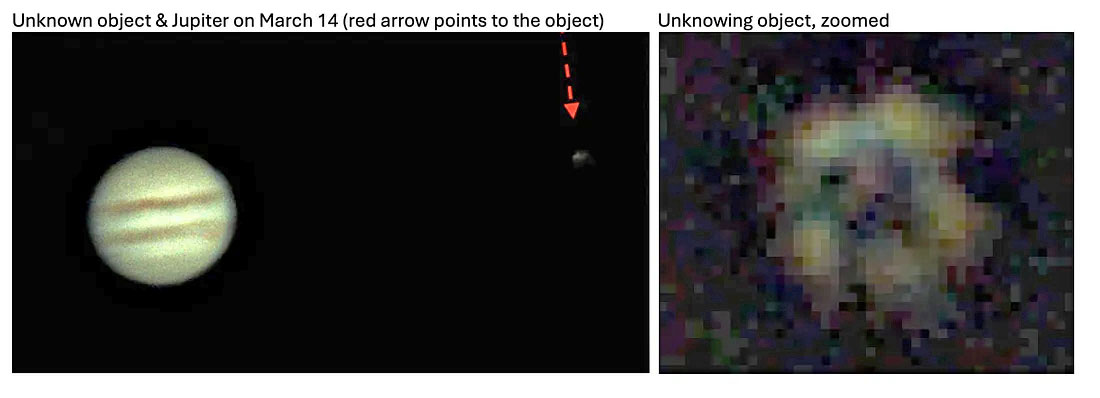
An unusual object right near the planet Jupiter that did not look like a typical satellite and it was confirmed that it is not an image artifact, but a real object that is present in each frame.
His first thought was that it was simply one of the Jupiter's Moons (Galilean Satellites). But the more he analyzed the data, the more it became clear that it was not a moon of Jupiter.
While a satellite moon shows the usual pixel colors typical for the planet - sand, beige, green, and gray - the unknown object displays almost the full rainbow:
By brightness, the unknown object is more than two times weaker than the a moon satellite (he measured the other satellites as well - they are all around 4,000 photons per pixel).
The shape of the light distribution is also different:
|