|

by Tibi Puiu
September 23, 2025
from
ZMEScience Website
|
Tibi Puiu
is a science journalist and co-founder of ZME
Science. He writes mainly about emerging tech, physics,
climate, and space.
In his spare time,
he likes to make weird music on his computer and groom
felines.
He has a B.Sc in
mechanical engineering and an M.Sc in renewable energy
systems. |
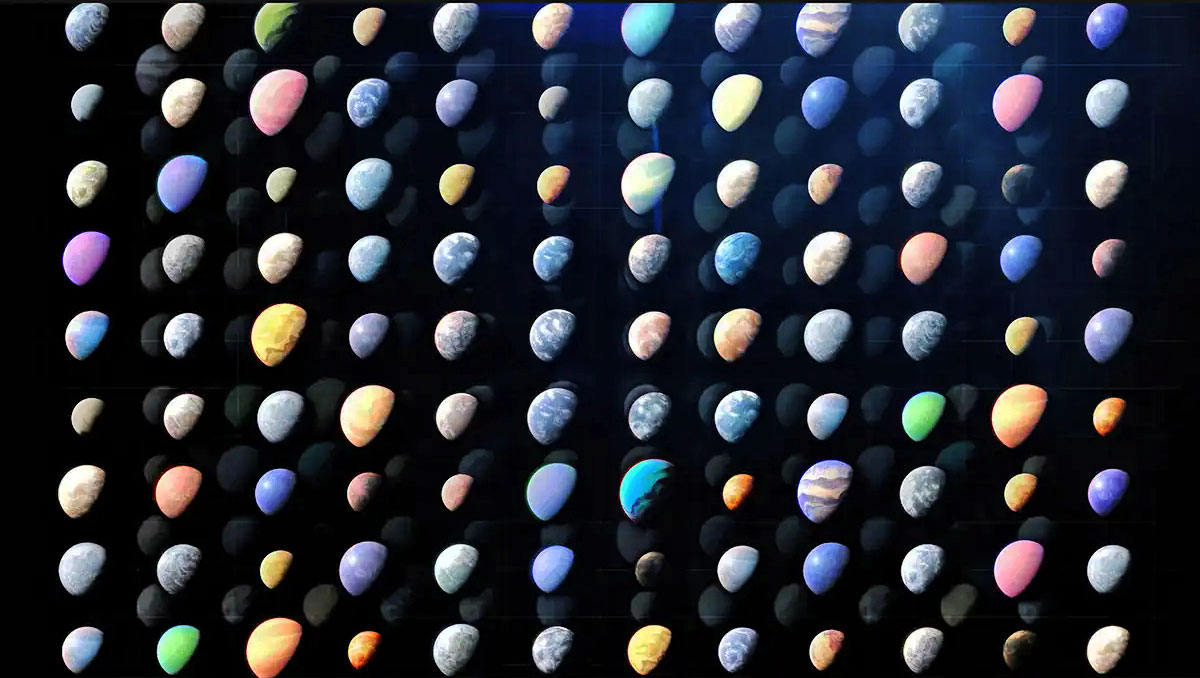
Artist's concept showing some of
the weird and
wonderful exoplanets
that have been
discovered so far,
as the total
confirmed number hits 6,000.
Credit: NASA's
Goddard Space Flight Center.
Scientists are
celebrating
6,000 Confirmed
Alien Worlds.
Thousands more
are on the way...
Thirty years ago, astronomers didn't know if planets around other
stars were common.
Today, NASA says we've confirmed 6,000
exoplanets
- a staggering number considering the first definitive discovery
only happened in the 1990s. Each of those worlds is a place with its
own physics, chemistry, and history.
Each is a reminder that our solar system isn't
the only way to build a planetary family.
"This milestone represents decades of cosmic
exploration driven by NASA space telescopes, exploration that
has completely changed the way humanity views the night sky,"
said Shawn Domagal-Goldman, acting director of NASA's
Astrophysics Division, in a statement.
"Step by step, from discovery to
characterization, NASA missions have built the foundation to
answering a fundamental question:
Are we alone...?"
From Pulsars to Planet Catalogs
The age of exoplanets
began in 1992 with two tiny worlds
discovered orbiting a pulsar, the super-dense remnant of a dead
star.
In 1995, astronomers Michel Mayor and
Didier Queloz
detected 51 Pegasi b, the first
planet found around a Sun-like star.
That discovery won them a Nobel Prize.
Fast-forward to today: we've gone from one lonely
planet to a catalog of thousands.
The pace is accelerating.
In 2015, NASA's Kepler telescope had
confirmed its 1,000th exoplanet.
By 2022, the tally hit 5,000.
Just three years later, we're at 6,000 - and
there are more than 8,000 candidates waiting for confirmation.
But the science is messy.
As NASA noted, there isn't a single "6,000th
planet." Confirmations happen on a rolling basis as teams across the
globe compare data and rule out false positives.
"We really need the whole community working
together if we want to maximize our investments in these
missions that are churning out exoplanets candidates," said
Aurora Kesseli, deputy science lead for the NASA
Exoplanet Archive, in a press statement.
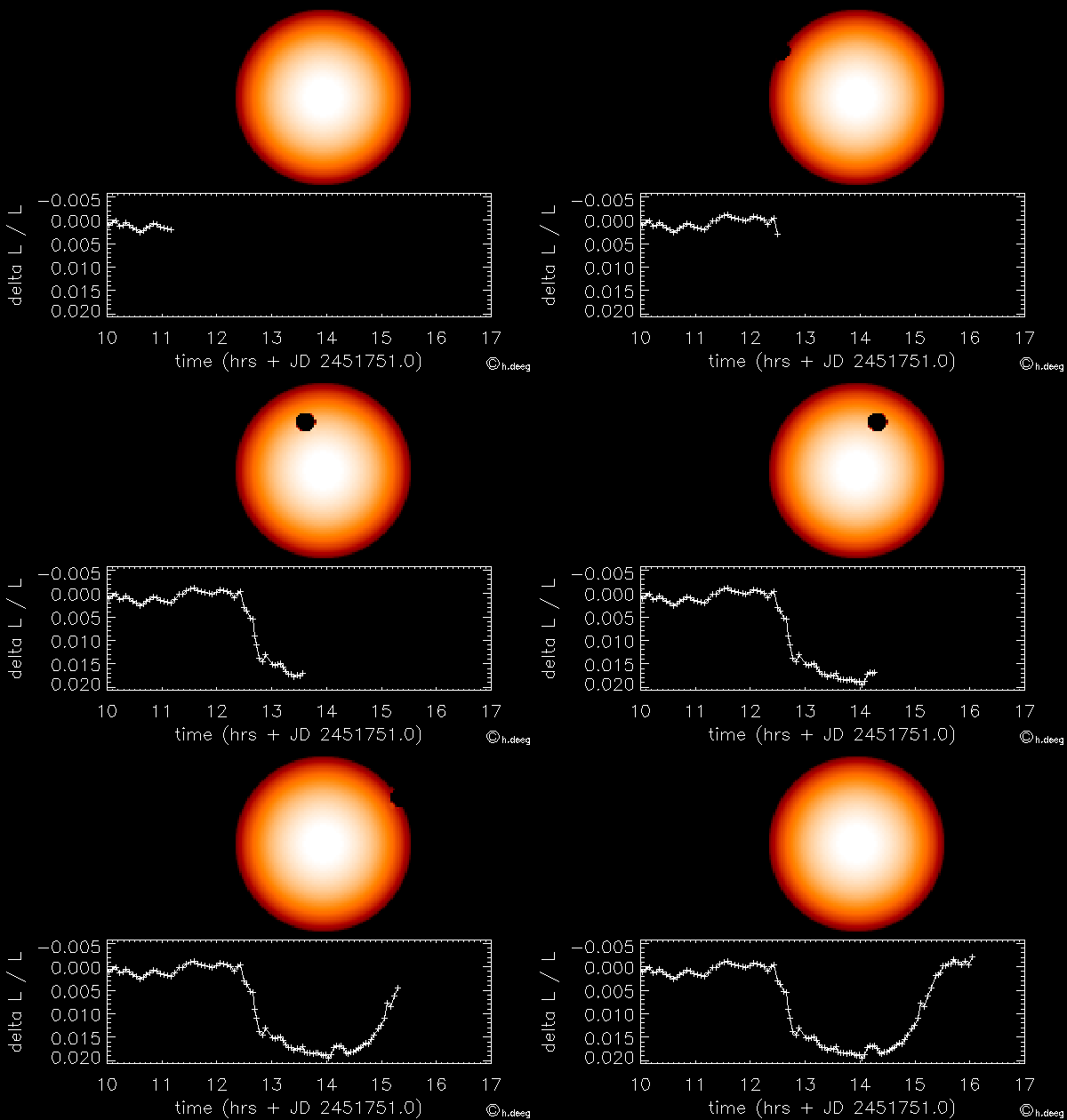
The transit method.
Credit: Plato
Mission.
The tools for planet hunting have also evolved
Most discoveries come from the
transit method, when a planet
crosses in front of its star and dims the light.
Others come from the radial velocity method,
detecting the tiny wobbles of a star as it's tugged by an orbiting
planet. A few rare worlds have been spotted directly, usually
massive gas giants glowing in infrared.
NASA's TESS mission alone has added
hundreds, while the retired Kepler
delivered thousands.
A Growing Catalog of Alien Worlds
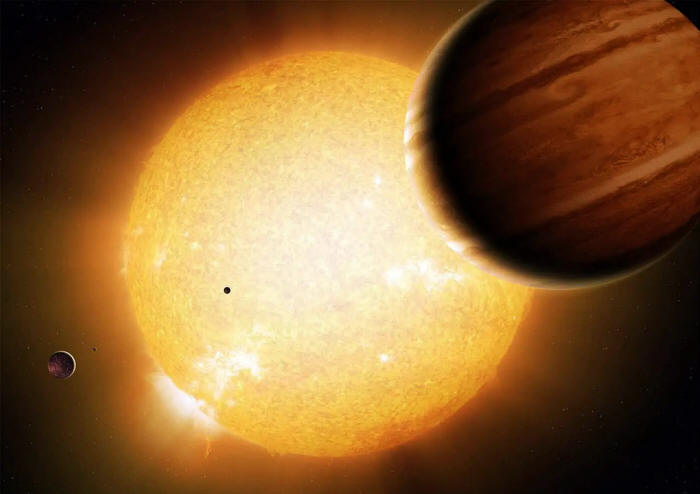 . .
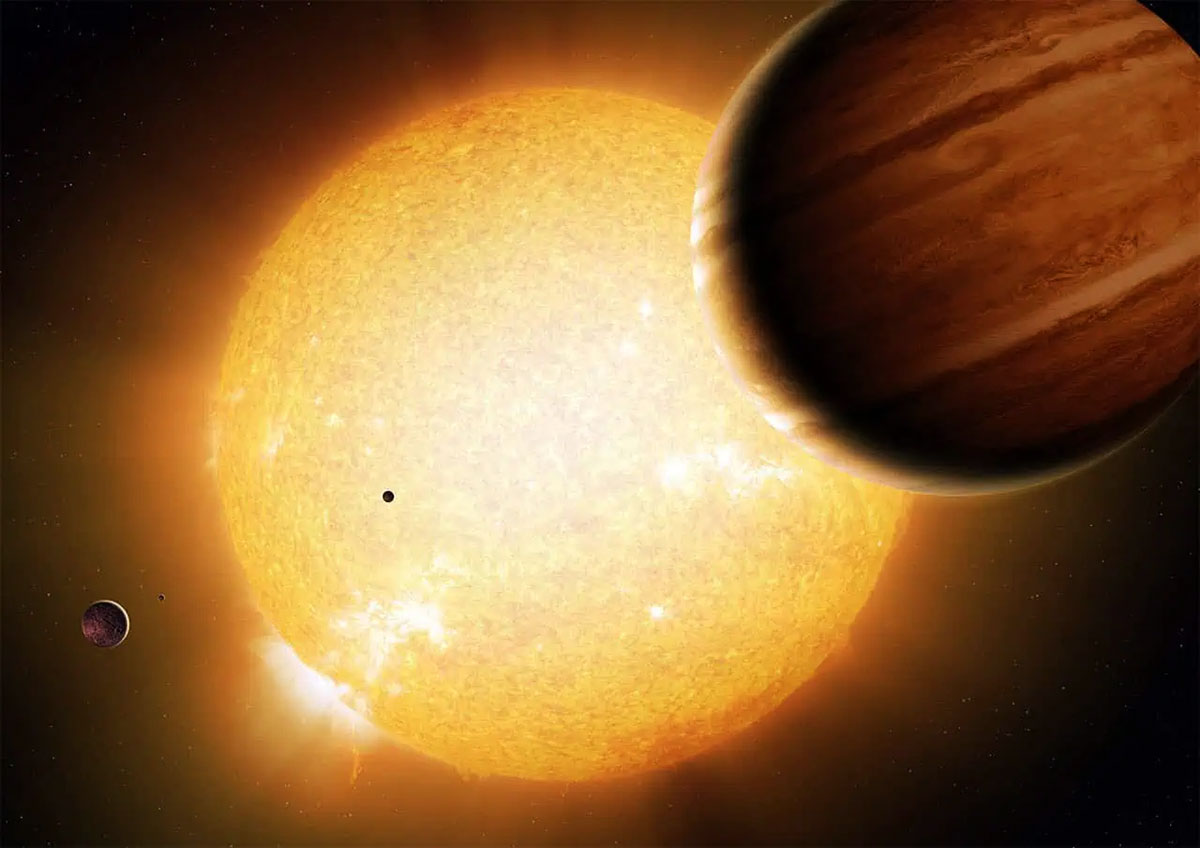
An artist's portrayal of a Warm
Jupiter gas-giant planet (right)
in orbit around
its parent star, along with smaller companion planets.
Credit: Detlev
Van Ravenswaay.
The 6,000 planets confirmed thus far revealed a menagerie of worlds
stranger than anything science fiction writers dared to imagine.
There are,
-
hot Jupiters
-
massive gas giants that whip around their
stars in days
-
roasting in blistering heat
-
some planets are tidally locked, one side
permanently fried while the other remains in endless night
Astronomers have even proposed that certain
worlds may
rain molten glass or iron.
Others are super-Earths and mini-Neptunes, categories missing from
our own solar system but apparently common in the galaxy.
Some are "puffy" exoplanets,
no denser than styrofoam.
Some may be cloaked in oceans or shrouded in
toxic atmospheres.
And NASA's catalog already includes 700 rocky
worlds and more than 2,000 Neptune-like planets.
A few even orbit dead stars or drift freely
through space with no star at all; these are known as
rogue planets.
"Each of the different types of planets we
discover gives us information about the conditions under which
planets can form and, ultimately, how common planets like Earth
might be, and where we should be looking for them," said Dawn
Gelino, head of NASA's
Exoplanet Exploration Program.
"If we want to find out if we're 'alone'
[sic] in the universe, all of this knowledge is essential."
And yet, as NASA admitted in its milestone video,
"There's one we haven't found - a planet just
like ours. At least, not yet."
The Hunt for Earth 2.0
Now that we've proven planets are everywhere - astronomers estimate
every star has at least one - the search is narrowing.
The next
chapter is all about habitable worlds...!
NASA's
James Webb Space Telescope is already probing atmospheres for
biosignatures, or the chemical fingerprints that might hint at life.
Meanwhile, the
Nancy Grace Roman Space Telescope
(launching in 2027) will use microlensing to discover thousands more
planets, including Earth-sized ones.
Europe's PLATO mission, set for
2026, will zero in on rocky planets orbiting Sun-like stars. And the
proposed Habitable Worlds Observatory (HWO) could finally give us the
power to image Earth-like exoplanets directly.
Even China is stepping in with its
Earth 2.0 Space Telescope,
launching in 2028 to survey Earth-sized planets. The race is no
longer just about finding as many exoplanets as possible:
it's
about finding another 'pale blue dot'...
The fact that we've found 6,000 exoplanets in just three decades is
wild.
But compared to the hundreds of billions of
planets thought to exist in the Milky Way, we've barely scratched
the surface. Each discovery is another reminder that our universe is
teeming with strange and beautiful worlds.
And somewhere out there, one might look back at
us.
Timeline of Exoplanet Discovery
Milestones
1992
1995
-
First planet around a Sun-like star: 51
Pegasi b.
-
Discovery by Michel Mayor and Didier
Queloz, later awarded the Nobel Prize.
2009
2015
-
Kepler confirms its 1,000th exoplanet.
-
Marks the beginning of large-scale
statistical studies of planetary systems.
2016
-
Record year: nearly 1,500 new exoplanets
confirmed.
-
Includes the discovery of Proxima
Centauri b, Earth's closest known neighbor.
2017
2018
-
NASA's TESS (Transiting Exoplanet Survey
Satellite) launches.
-
Begins an all-sky survey for exoplanets
around bright, nearby stars.
2022
2023-2025
2025
-
NASA announces 6,000 confirmed
exoplanets.
-
Over 8,000 candidates still awaiting
confirmation.
2026–2028 (Upcoming)
-
ESA's PLATO mission (2026): will search
for rocky planets around Sun-like stars.
-
Nancy Grace Roman Space Telescope (2027):
will use microlensing to discover thousands more worlds.
-
China's Earth 2.0 Telescope (2028): will
hunt for Earth-sized planets.
|