|
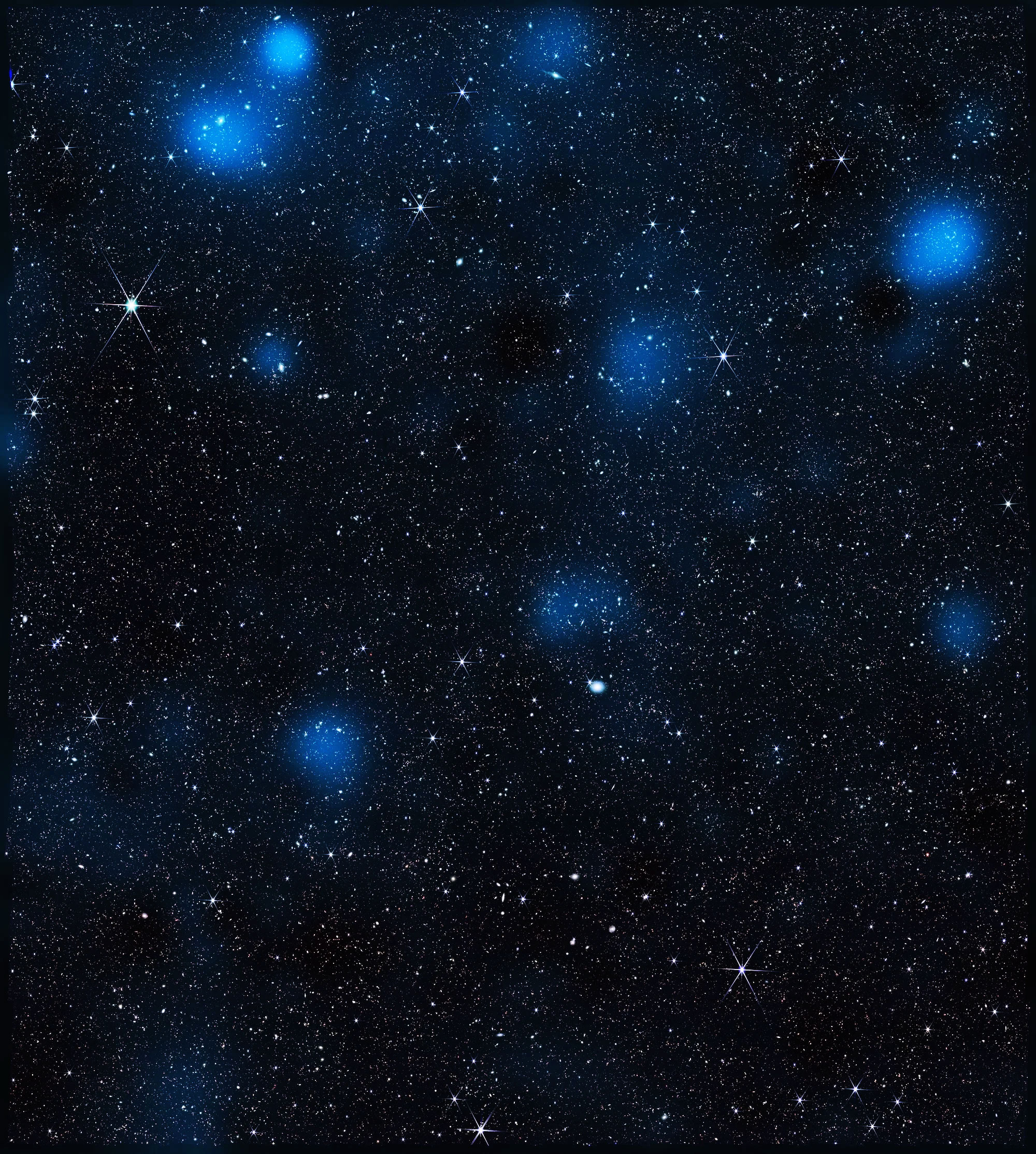
this image from NASA's James Webb Space Telescope (JWST) is overlaid with a map of dark matter, represented in blue. Researchers used JWST data to find the invisible substance via its gravitational influence
on regular
matter. puzzled out minuscule distortions in images of faraway galaxies taken by JWST in order to chart the invisible...
But luckily for everyone marveling at JWST's crisp snapshots of faraway galaxies, this dense haze is totally invisible.
Think of dark matter as scaffolding for all the luminous, normal stuff out there - with the former outweighing the latter five times over - like a gravitational glue that holds everything else together.
But scientists have no idea what this "glue" is made of and have yet to detect it directly:
For something so integral to all we see, it's astonishingly hidden from our cosmic view.
Now astronomers have traced dark matter's ghostly contours in the foreground of one of JWST's deep-sky images.
They've turned a survey of the Cosmic Evolution Survey (COSMOS) field - one of the sky's best-studied patches - into the most finely detailed dark matter map in existence.
With it, they hope to learn more about how galaxies depend on its presence.
A study (An Ultra-high-resolution Map of 'Dark' Matter) reporting the results appears today in Nature Astronomy.
Gaze upon any JWST image of some faraway galaxy:
For JWST's images, this effect is imperceptible to the eye, which is why it's called, But the images encode all the dark matter between the far-off object and the telescope.
No one knew how to decode this warping, however, until around the start of the third millennium.
...says Catherine Heymans, a professor of astrophysics at the University of Edinburgh and Scotland's astronomer royal.
Heymans and her peers proved them wrong, launching the field of "weak lensing" that has since shed more light on dark matter.
Heymans helped build the first dark matter map of the COSMOS field using JWST's predecessor, the Hubble Space Telescope.
Two decades later Scognamiglio's team of cosmic cartographers has updated that map using the heaps more galaxies JWST's images contain.
The new map spans an area on the sky only twice as big as the full moon - a quarter of the original's size - but it's far more detailed, pinpointing blobs of dark matter that are too small for Hubble to discern.
And JWST's larger, more sensitive optics can collect light from farther out in the universe - and thus further back in cosmic time. So it can see weak lensing caused by dark matter clumps from 10 billion or 11 billion years ago, when the universe was most prodigiously forming stars and galaxies.
Studying these clumps - which likely host clusters of adolescent galaxies - is a rare chance to learn more about what dark matter's role was in that epoch, called "cosmic noon," and how the universe has evolved ever since.
Next the team wants to infer the various distances of the structures that the researchers have glimpsed and to use them to make the map more dynamic and three-dimensional.
For now, the map as is puts one of the universe's most elusive sculptors starkly in view.
In the coming years, astronomers' dark matter maps will be massively extended - though with less fine-grained detail.
Weak lensing is part of the stated mission of newer space telescopes such as the,
Ground-based projects such as the Dark Energy Survey, which released a new trove of data last week, and the Vera C. Rubin Observatory also use weak lensing to study the universe's expansion.
A generation after the trailblazing Hubble dark matter map, Scognamiglio is proud to help extend its legacy.
|