|

by
Courtenay Turner
May 19, 2026
from
CourtenayTurner Website

|
My co-author and I will continue
to hammer on tokenization because it is the monster
on the loose, the clear and present danger.
It is
redefining ownership from the bottom up.
Your
"sovereign property" will be subverted and turned
into "user rights" where "you will own nothing."
In
reality, Tokenization of all assets is the biggest
heist in the history of the world.
Source |
The SEC is about to authorize
a second, parallel path
for putting
U.S. equities on-chain
- one that does not have
to be the equity at
all.
Read alongside the DTCC rollout,
this is not a competition
between models.
It is a pincer...
The Move the Market Refused to
Hear
In Part I,
The Tokenization of Everything, I described the asset
layer:
programmable digital instruments inside a regulated,
bank-integrated ecosystem, where ownership quietly mutates into
conditional permission.
In Part II,
The Proof of Persona, I described the persona layer:
identity, eligibility, attention, and eventually body-derived
signals rendered into ledger-native attestations.
In Part III,
The Tokenization Chokepoint, I documented what the DTCC
announced on May 4, 2026 - the rollout of the institutional asset
layer, scheduled for July production trades and an October launch,
with fifty of the world's largest financial firms in the working
group.
The
DTCC rail was, I argued, the institutional
half of the architecture:
the same legal entitlement, wrapped in a
programmable, freezable, force-transferable, sanctions-screened
compliance envelope.
"Same rights, same protections, same
entitlements" on paper.
Programmable, reversible, permissioned by
design in the actual code.
I closed Part III by saying the rollout begins in
July, the architecture is not yet closed, and the argument cannot
wait.
Two weeks later, the other shoe dropped.
On May 19, 2026, Forbes published Zennon Kapron's
piece, America
is About to
Have Two Stock Markets for the Same Company.
Bloomberg had
reported the day before that the SEC's "innovation exemption" for
tokenized stocks could land within the week.
The agency, under Chair
Paul Atkins' "Project Crypto," is preparing to bless a
second path for putting U.S. equities on-chain - and the
second path is not the same product as the first.
The institutional rail captures the spine of U.S.
capital markets through DTCC. The crypto-native rail captures
retail, offshore, and 24/7 price discovery through Robinhood,
Kraken, Bybit, Backed, xStocks, BNB Chain, and the rest. Together,
the two rails do not compete. They enclose.
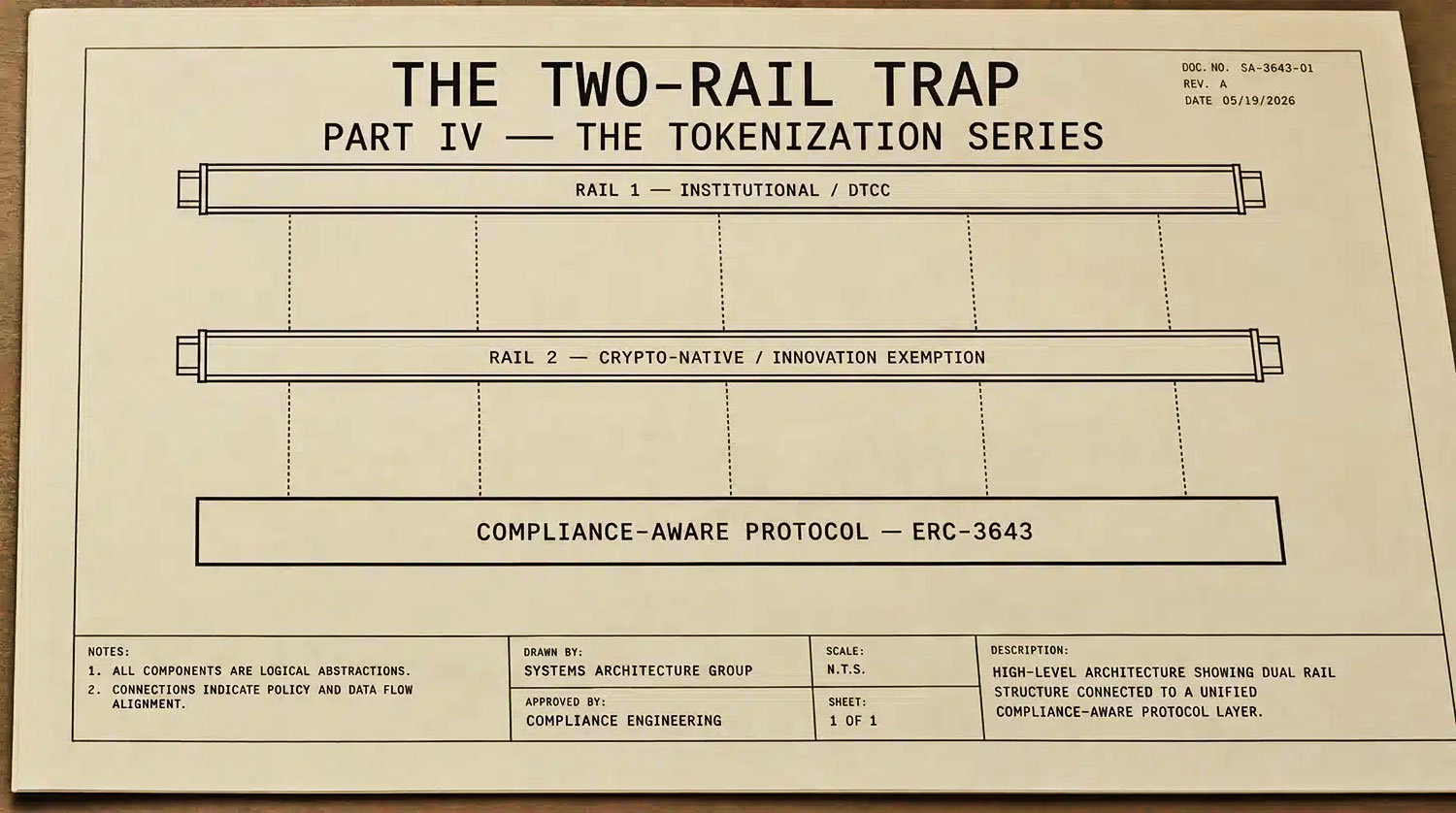
This is Part IV.
This is the pincer...!
What the
Innovation Exemption Actually Does
Atkins did not hide what he was building.
In his July 31, 2025
speech at the America First Policy Institute - formally titled
American Leadership in the Digital Finance Revolution - he told the
audience that,
"firms - from household names on Wall Street to
unicorn tech companies in Silicon Valley - are lined up at our doors
with requests to tokenize," and that the SEC would "provide relief
where appropriate to assure that Americans are not left behind."
He
laid out the design of the exemption in the same speech: periodic
reports to the Commission, whitelisting or verified-pool
functionality, and adherence to a "token standard that incorporates
compliance features, such as ERC-3643."
ERC-3643 was the only token standard Atkins cited by name in the
speech.
That detail matters, because it is the same ERC-3643 that DTC explicitly names in its request letter to the SEC's Division of
Trading and Markets as a "compliance aware" protocol satisfying the
requirements for "distribution control" and "transaction
reversibility."
It is the same token standard at the core of the DTCC architecture I described in Part III.
DTCC is itself a member
of the ERC-3643 Association governance body. Both rails - the Wall
Street rail and the crypto-native rail - are not merely converging
on the same permissioned, reversible, OFAC-screenable token
primitive in the abstract. They are converging on the same named
standard, with the same compliance-aware affordances, with the same
governance association in the background.
That is not coincidence. That is interface standardization.
Different chains, different protocols at the edges, but the same
compliance grammar at the center.
The crypto-native rail also has its own legal scaffolding.
On
January 28, 2026, the SEC's Divisions of Corporation Finance,
Investment Management, and Trading and Markets jointly published a
staff statement dividing tokenized securities into two categories:
those tokenized by or on behalf of the issuer, and those tokenized
by third parties unaffiliated with the issuer.
The staff further
specified that third-party wrappers come in two sub-flavors -
custodial wrappers (where the issuer of the token holds the
underlying security in custody and the token represents a claim
against the custodian) and synthetic wrappers (where the token
tracks the price of the underlying without holding it at all).
For
the third-party category, the staff wrote that the rights and
benefits associated with the crypto asset,
"may or may not be
materially different from those of the underlying security" and "may
or may not confer upon the holder of the crypto asset any rights as
a holder of the underlying security."
Read that sentence twice.
The SEC is preparing to bless a market in things that look like
Apple stock, trade against the price of Apple stock, and do not have
to be Apple stock.
Things that may carry voting rights, or may not.
Things that may represent ownership, or may not.
Things that may be
security-based swaps, linked securities, or tokenized security
entitlements - three different legal animals as defined by the SEC's
own staff - depending on which wrapper the issuer (or the third
party) chose to mint.
Brett Redfearn, the former SEC Division of Trading and Markets
director who now runs the tokenization firm Securitize, put the
consequence plainly in the Forbes piece.
If third parties can
tokenize Apple or Amazon without the issuer at the table, there is
no theoretical limit on how many wrappers of the same company exist
at once. Multiple parallel wrappers means investors are uncertain
what their shares are worth at any given moment, and price discovery
has no single canonical reference.
That is not a Reg NMS purist
talking. That is a critique from inside the tokenization industry.
"Same Rights" Was Always Only Half
the Architecture
In Part III, I tried to be precise about the DTCC rail.
The
institutional reassurance - same legal entitlement, same Article 8
protections, same dividends, same voting rights - is real on its own
terms. The SEC's December 11, 2025 no-action letter was explicit
about it. The legal wrapper preserves the entitlement.
What I argued was that the technical wrapper introduced an entirely
new control surface beneath the legal wrapper. Both are true at
once. That was the point.
The innovation exemption now closes the other half of the loop.
Where the DTCC rail tells you that the legal entitlement survives
tokenization in full, the crypto-native rail tells you, in the SEC
staff's own words, that the legal entitlement may or may not survive
at all.
Two onshore market structures for the same equity, with two
completely different relationships to ownership.
Here is what this looks like in practice, once both rails are
running:
Rail one (DTCC):
Your equity exists as a token in a Registered
Wallet on an approved chain, under a compliance-aware protocol,
subject to root-wallet override and LedgerScan surveillance.
The
legal entitlement is preserved. The exercise of it depends entirely
on the system's recognition of your wallet, your protocol, and your
standing. Programmable compliance with full legal rights.
Rail two (the innovation exemption):
Your equity exists as a token
on a crypto-native platform, possibly minted by a third party who
has no relationship to the issuer, possibly conferring no
shareholder rights at all, possibly classified as a security-based
swap, a synthetic linked security, or a tokenized security
entitlement - three different legal animals - depending on the
wrapper.
Programmable compliance with optional legal rights.
Both rails are permissioned. Both rails are reversible. Both rails
are surveilled. Both rails are sanctions-screenable. Both rails are
built on the same compliance-aware protocol standards.
The only difference is how much of the underlying ownership claim
makes it through the wrapper.
That is not two stock markets for the same company.
That is two
cages for the same equity, sized for two different captives.

Two cages for the same equity.
Rail One preserves the entitlement
inside a programmable envelope.
Rail Two dispenses with the
entitlement and offers price exposure instead.
Why the Pincer Works
The two-rail architecture is what makes the rollout structurally
complete, and it is why it should be read as a single design choice
rather than two separate ones.
The institutional rail captures the bulk of regulated capital -
pensions, retirement accounts, mutual funds, sovereign wealth, bank
treasury books - by preserving "same rights, same protections."
It
is conservative-by-design because the constituency that holds $114
trillion through DTC is not going to migrate into a platform that
strips voting rights and dividend entitlements. They need the legal
wrapper to remain intact, and DTCC delivers it. Slow, walled,
regulated, programmable.
The crypto-native rail captures everything the institutional rail
leaves on the table. Retail traders who want 24/7 settlement.
Offshore capital that already migrated to xStocks, Backed, Kraken,
Bybit, Robinhood EU, BNB Chain.
Yield-chasing flows that want
fractionalization, automated market makers, and frictionless
cross-platform liquidity. People who do not care whether their
"Apple token" actually represents Apple stock as long as it tracks
the price. Fast, open, light-touch, programmable.
Mark Greenberg, Kraken's global head of consumer, told DL News in
September that,
"the future of capital markets will not be one-size
fits all" and that "the real technological breakthrough lies in permissionless, interoperable platforms like xStocks."
Translate
that. Kraken's pitch is that an Apple token trading 24/7 with no
settlement friction will pull volume away from an Apple share that
clears T+1 through NSCC, regardless of whether the holder of the
open-rail token actually owns the underlying.
Price discovery, not
legal ownership, is the value proposition.
That is the exact inversion I named in Part I. Possession becomes a
system-recognized entitlement. The legal claim is decoupled from the
trading venue. The economic exposure is decoupled from the rights of
the shareholder.
And once the crypto-native rail captures price
discovery - once the Apple token on Solana or Canton or BNB Chain
becomes the most liquid venue for trading Apple - the DTCC rail and
the issuer's transfer agent become a back-office formality. The
"real" market is wherever the price moves.
ESMA, the European securities regulator, has publicly warned that
tokenized equity wrappers carry a "risk of misunderstanding" for
retail investors who may not realize their tokens do not confer
shareholder rights.
That warning has been issued in Europe, where
the wrappers are already live. It is about to land harder once the
same wrappers are available onshore in the United States - with the SEC's blessing - and once the legal-rights gradient between rail one
and rail two becomes invisible to anyone who is not a securities
lawyer.
This is the operational form of the subscription society I described
in Part I. The cage is not built by coercion. It is built by
dependency, by gradient, by convenience, and by the quiet retirement
of the alternative. The DTCC rail is the dependency. The
crypto-native rail is the convenience.
The alternative - a
non-programmable, non-tokenized, name-on-the-books equity holding -
is the thing being quietly retired.
The CLARITY Act Is the Legislative
Half of the Two-Rail Design
The administrative half of the architecture is what I have been
documenting - the December 2025 DTC no-action letter, the January
28, 2026 joint staff statement, the imminent innovation exemption.
The administrative half can move fast because it does not require
Congress to do anything.
Staff discretion, Commission letters,
principles-based safeguards, three-year pilots - the entire
vocabulary of Project Crypto is designed to construct durable
infrastructure under the umbrella of "we're just clarifying existing
law."
The legislative half is the CLARITY Act.
I named CLARITY in Part I as part of the legislative scaffolding for
tokenization, alongside the GENIUS Act. I have not yet given it the
structural treatment it deserves in this series, because until the
innovation exemption surfaced this week, the question of how the two
halves interlock was still partly speculative.
It is no longer
speculative. The two halves are interlocking in public, in front of
the same Congress that voted GENIUS through last year, on the same
timeline as the rollout I documented in Part III.
The Digital Asset Market Clarity Act - H.R. 3633 in the 119th
Congress - passed the House in 2025. The Senate Agriculture
Committee marked it up in January 2026.
On May 14, 2026 - five days
before the Forbes piece that opened this essay - the Senate Banking
Committee advanced the bill in a 15-9 bipartisan vote, with all
thirteen Republicans joined by Democrats Ruben Gallego and Angela
Alsobrooks, both of whom stated that their support was conditional
and might not translate to floor votes.
The same day, Senator Chris
Van Hollen - co-author of the April 27 letter to Atkins about the
innovation exemption - saw his ethics amendment, which would have
barred senior government officials from holding certain crypto
business interests, defeated 11-13 in committee.
The bill now heads
to the full Senate floor, where it needs 60 votes to overcome a
filibuster. The Banking and Agriculture versions will also have to
be reconciled before a final floor vote.
The practical deadline is
August 2026, before midterm campaigning closes the legislative
calendar.
As of mid-May 2026, Polymarket has been trading the
"Clarity Act signed into law in 2026" market in the 65-75% range,
with the probability spiking around the Senate Banking markup; a
White House adviser publicly floated July 4 as a possible signing
target.
What CLARITY does, structurally, is sort every digital asset into
one of three regulatory boxes:
-
Digital commodities (Bitcoin, Ether, Solana, and tokens whose
networks are deemed "mature" or sufficiently decentralized) go to
the CFTC for spot and cash-market oversight.
-
Investment contract assets (tokens sold like an early-stage equity
round, where a centralized team raises capital against future
deliverables) stay with the SEC under the existing securities
framework.
-
Stablecoins (dollar-pegged tokens used to move money) get joint SEC/CFTC
oversight, building on the GENIUS Act's licensing regime.
Read that taxonomy against the SEC staff's two-category framework
for tokenized securities - issuer-tokenized vs.
third-party-tokenized, with third-party in custodial and synthetic
sub-forms - and the architectural fit becomes obvious.
Issuer-tokenized equities (the DTCC rail, with full Article 8
entitlement preservation) are unambiguously securities. They stay
with the SEC. The administrative architecture I documented in Part
III governs them.
Third-party custodial wrappers - where a platform like Backed or
xStocks holds the underlying security in custody and mints a token
that represents a claim against the custodian - sit at the seam.
The
SEC staff statement frames them as still securities, but the token
holder's rights run against the intermediary, not the issuer.
Under
CLARITY, the classification depends on whether the wrapping platform
is treated as the issuer of an investment contract asset (SEC) or as
a venue for a digital commodity (CFTC).
Third-party synthetic wrappers - tokens that track the price of
Apple stock without actually holding any Apple stock - are where the
architecture gets murkiest, and where I want to mark the line
between what the statute says and what I am projecting.
The CLARITY
Act's commodity classification is, on its face, about whether the
underlying network is sufficiently decentralized or "mature," not
about whether a particular wrapper confers shareholder rights.
A
synthetic equity-tracker might already be a security-based swap
under existing Dodd-Frank rules, which would keep it within SEC
jurisdiction regardless of how CLARITY's three-box taxonomy is read.
So the cleanest legal reading is that synthetic wrappers stay with
the SEC.
What I am interpreting, and want to be explicit about: my argument
is not that CLARITY's text directly reclassifies synthetic wrappers
as CFTC commodities.
My argument is that the combination of CLARITY's broad commodity-classification expansion, the SEC staff's
January 28 framing of third-party wrappers as instruments whose
rights "may or may not confer" anything against the issuer, and the
innovation exemption's lighter-touch treatment of crypto-native
platforms creates an interpretive gradient.
Wrappers that confer
full shareholder rights stay unambiguously with the SEC.
Wrappers
that confer no rights, that resemble price-tracking commodities more
than equity claims, and that trade on crypto-native venues styled as
digital-commodity infrastructure are the most contested ground in
the federal jurisdiction map - and the gravitational pull of CLARITY's CFTC expansion, combined with Project Crypto's posture
toward lighter-touch oversight, is toward the CFTC end of that
gradient.
That is interpretation, not statutory text. But it is the
interpretation the design choices invite. The legal-rights gradient
I described in the previous section is not just a market-structure
gradient. It is - at least at the boundary cases - a regulator
gradient.
That is not an accidental drafting outcome. That is the design.
It is also the design that NASAA - the North American Securities
Administrators Association, representing state securities regulators
across all 50 states, D.C., the territories, and Canadian and
Mexican jurisdictions - flagged formally in a January 13, 2026
comment letter to Senate Banking Chair Tim Scott and Ranking Member
Elizabeth Warren.
NASAA wrote that it was "unable to support the
CLARITY Act in its current form" because "provisions contained in
Title I will weaken existing state authority to combat investor harm
stemming from cases of fraud and abuse in digital assets
transactions."
The letter identified "fundamental internal
inconsistencies" in the bill's definitions - particularly the
unworkable separation between "network token" (a digital commodity
under the CLARITY Act) and "ancillary asset" (a network-token
subcategory whose value depends on entrepreneurial or managerial
efforts of others, a Howey-test condition). NASAA warned plainly:
"Fraudsters will exploit any new conditions and limits to these
concepts. Given the epidemic of fraud being perpetrated against
American investors, especially older investors, Congress should not
pursue policies that will make it easier for scam artists to get
away with their crimes and harder for law enforcement and regulators
to act."
This is a slightly different concern than the Warren/Van Hollen letter on the innovation exemption - NASAA's focus is on
state anti-fraud authority and the preservation of the
investment-contract definition under NSMIA, where Warren/Van Hollen
targeted the federal exemption pathway - but it lands on the same
structural worry: market participants drifting outside the
protections of the securities laws through definitional architecture
rather than substantive change.
The state regulators and the Senate
Democrats are flagging the same architectural risk from two
different directions. Neither alone is sufficient to stop the
architecture.
Together, they constitute the institutional skeleton
of an opposition that does not yet exist as a coalition.
The GENIUS Act gave Atkins the stablecoin rail.
The CLARITY Act
would give him the commodity rail and seal the SEC/CFTC
jurisdictional reallocation against future Commission turnover. The
innovation exemption is the proof-of-concept; CLARITY would be the
durable statutory backing that prevents a future Democratic SEC from
rolling it back.
That is why the timing matters. Atkins' term as
Chair expires June 2026. CLARITY's window to clear the Senate
effectively closes in August 2026. Both deadlines fall before the
November midterms.
This is what I meant in Part I when I called GENIUS and CLARITY the
iron scaffolding of a technocratic system. The bills are the rails.
The no-action letter and the innovation exemption are the trains.
ERC-3643 is the gauge. And the constituency that designed the
architecture is racing to lay all three before the political
composition that authorized it changes.
The legislative half also clarifies what is, and is not, fixable
through public comment on an SEC release. The innovation exemption
can be modified or revoked by a future Commission.
CLARITY, once
signed, cannot. The two halves of the design are doing different
things on different timelines, and the legislative half is the
harder one to undo.
Reg NMS Is Not Collateral Damage - It Is the Target
The slower-moving consequence of the innovation exemption, Kapron
notes, is a rewrite of the rules that built the modern U.S. equity
market structure. National Market System protections - best
execution, the consolidated tape, the principle that one stock has
one canonical market - were built on the premise that a regulated
trading venue is the architecture worth defending.
Atkins
co-authored the original dissent to Reg NMS in 2005 and said in his
July 2025 speech that accommodating tokenized trading "may require
us to explore amendments to Reg NMS."
He said it in public. The market chose not to hear it.
The Forbes piece treats the dismantling of Reg NMS as a
market-structure cost - fragmentation, price-discovery uncertainty,
settlement-mechanic divergence. I read it differently, and I think
the design choice reads more clearly through the frame I have been
using across this series:
a single canonical market for each equity
is exactly what you have to dissolve in order to make the
programmable, permissioned, surveilled rail durable.
If one stock has one canonical market, then the canonical market is
the gravitational center of price discovery, shareholder activism,
transfer-agent accountability, and Reg NMS surveillance. The
legal-rights wrapper and the trading-venue wrapper are the same
wrapper. The issuer has somewhere to sue. The shareholder has
somewhere to vote. The regulator has somewhere to look.
If a stock has many wrappers - some preserving rights, some not,
some on crypto-native chains, some on permissioned institutional
ledgers, some custodied, some synthetic, some swaps, some
entitlements - then there is no canonical market. There is a swarm
of correlated venues, and the question of which one is "real"
becomes a function of liquidity rather than law.

One equity, many wrappers,
no canonical market.
The fragmentation is
not a bug,
it is the design choice.
In that environment, the role of the regulator subtly shifts.
The
SEC stops policing a market and starts certifying protocols. The DTC
stops being a depository for shares and starts being a custodian for
tokenized entitlements.
The exchanges stop competing on execution
quality and start competing on settlement speed and credential
schemas. And every one of these venues - institutional and
crypto-native alike - runs on compliance-aware token standards with
root-wallet authority, reversibility, surveillance, and OFAC
screening baked into the protocol.
The political question is no longer "where can you trade Apple." It
is "whose compliance envelope are you trading inside."
Once that
becomes the question, sovereignty over capital allocation has
migrated out of the regulated exchange and into the protocol
designers, the compliance-aware standard-setters, and the
institutions that operate the root wallets.
This is what I meant in Part I when I wrote that decision-making
shifts from democratic processes to elites and code. The innovation
exemption is the part of the architecture where the code starts
writing the law.
Where Loop 2 Plugs In
In Part III I argued that the DTCC rail completes Loop 1 - the asset
layer - and lays the rail for Loop 2, the persona layer. The
credential gate today is institutional: a wallet is Registered
because a DTC Participant vouches for it under existing KYC/AML
obligations.
The short logical step is from "verified by KYC" to
"verified by attestations of identity, residency, accreditation,
sanctions standing, and tax status" to "verified by ledger-native,
soulbound, or body-derived attestations satisfying the system's
eligibility schema."
The innovation exemption accelerates this rail-laying, because it
brings the same credential question to the crypto-native rail under
explicit SEC blessing. Atkins' July 2025 design language - "whitelisting
or verified-pool functionality" - is the persona layer in regulatory
English.
The crypto-native rail is not, as its evangelists pitch it,
a permissionless system. It is a permissioned system whose
permissioning gate is the verified pool, the white-listed
buyer/seller, the compliance-aware token standard with distribution
control.
The same vocabulary as the DTCC rail. The same affordances.
The same trajectory.
Once both rails are live, the question of which attestations a
wallet must satisfy to participate in either rail becomes the entire
game.
It is the same question I posed in Part II, now embedded in
the official equity market on both sides:
"This wallet is verified because the holder has presented identity,
residency, accreditation, sanctions standing, and tax attestations."
→
"This wallet is verified because the holder has presented
ledger-native, soulbound, or body-derived attestations satisfying
the system's eligibility schema."
I am not claiming that integration is happening today. I am
claiming, again, that the rail is now built such that it can.
The DTCC rail laid one half of the asset-layer architecture in May. The
innovation exemption is about to lay the other half. Between them,
every public-company equity in the Russell 1000 will have a
programmable, permissioned, surveilled representation onshore - and
the credential layer that decides who is eligible to touch it is the
obvious next interface to standardize.
Layer 1 controls the asset. Layer 2 decides who is eligible to touch
it. Both rails of Layer 1 are now scheduled. Layer 2 has somewhere
to plug in.
What This Does Not Prove
Because the temptation in this terrain is to overshoot, let me be
explicit, as I was in Part III, about the boundary between evidence,
interpretation, and projection.
What the evidence shows:
-
The SEC's January 28, 2026 joint staff statement (Corporation
Finance, Investment Management, and Trading and Markets) defining
two categories of tokenized securities, with the second (third-party
wrappers, in both custodial and synthetic sub-forms) explicitly
framed as "may or may not" confer shareholder rights.
-
Bloomberg's May 18, 2026 reporting - surfaced in CoinDesk,
Unchained, PYMNTS, and elsewhere - that an innovation exemption for
tokenized stocks under Chair Atkins' Project Crypto could land
within the week.
-
Atkins' July 31, 2025 speech at the America First Policy Institute,
American Leadership in the Digital Finance Revolution, laying out
the design of the exemption: periodic reports, whitelisting or
verified-pool functionality, and adherence to "a token standard that
incorporates compliance features, such as ERC-3643" - the only token
standard named in the speech, and the same standard DTC names in its
request letter to the SEC's Division of Trading and Markets.
-
DTCC's membership in the ERC-3643 Association governance body,
confirming that the institutional rail and the named crypto-native
compliance standard share an organizational backbone, not merely a
technical one.
-
Atkins and Commissioner Peirce's February 2026 sketch of a temporary
framework that would include volume caps, white-listed buyers and
sellers, and automated market makers operating under
principles-based safeguards.
-
Atkins' explicit statement that accommodating tokenized trading "may
require us to explore amendments to Reg NMS."
-
The documented growth of the offshore tokenized-stock model: from
under $30M aggregate market cap at the start of 2025 to roughly
$1.2B by year-end, with xStocks alone surpassing $25B in cumulative
transaction volume across that period.
-
The April 27, 2026 letter from Senators Warren and Van Hollen
demanding an answer on whether further exemptions would "allow
market participants to easily escape the securities laws using
crypto," with a May 8 deadline that the Commission answered by
signaling this week's release.
-
The fact that OpenAI and Anthropic have already publicly disavowed
unauthorized tokenized products linked to their valuations on
offshore platforms - establishing the precedent that named,
large-cap issuers will, in fact, push back when their equity is
wrapped without consent.
-
The CLARITY Act (H.R. 3633) passing the House in 2025, Senate
Agriculture Committee marking it up in January 2026, and Senate
Banking Committee advancing it 15-9 on May 14, 2026 (with Van
Hollen's ethics amendment defeated 11-13 the same day), heading next
to a full Senate floor vote requiring 60 votes to overcome a
filibuster, with a practical August 2026 ceiling.
-
NASAA's January 13, 2026 comment letter formally opposing the
CLARITY Act in its current form on the grounds that Title I "will
weaken existing state authority to combat investor harm" and that
the bill's definitional inconsistencies between "network token" and
"ancillary asset" will allow fraudsters to "exploit any new
conditions and limits to these concepts."
What the evidence does not prove:
-
That every U.S. equity will be tokenized on the crypto-native rail.
-
That third-party wrappers will dominate price discovery for Russell
1000 names.
-
That the innovation exemption is being designed in explicit
coordination with the DTCC rail. (The architectural convergence on
ERC-3643 and compliance-aware standards is documented; the
coordination is inferred from the convergence.)
-
That any individual platform - Kraken, Robinhood, Bybit, Backed,
xStocks - is pursuing the architectural extensions I have described.
What I am interpreting:
-
That the DTCC rail and the innovation exemption rail, read together,
constitute a single architectural design choice: programmable,
permissioned, compliance-aware tokenization of U.S. equities across
both institutional and retail-facing venues.
-
That the deliberate fragmentation of legal-rights wrappers
(entitlement-preserving on the DTCC rail; "may or may not" on the
crypto-native rail) is the structural mechanism by which Reg NMS
protections become unenforceable and price discovery migrates to
whichever venue offers the most convenience.
-
That "innovation" - in this design - means a permissioned blockchain
wrapper that bypasses traditional broker-dealer registration, while
preserving the institution's ability to whitelist, reverse, freeze,
and screen at the protocol level.
That is enough to warrant scrutiny. It does not require maximalist
claims to be alarming.
The Polite Language of Enclosure,
Reprise
The rollout will not be sold as enclosure. It will be sold as
investor choice.
Investor choice between two rails. Investor choice between a 24/7
token wrapper and a T+1 settled share. Investor choice between a
fractionalized synthetic and a custodied entitlement. Investor
choice between a crypto-native AMM and a Nasdaq order book. Investor
choice between a token that confers shareholder rights and one that
does not.
This is the same rhetorical pattern I named in Part III. Control
systems that offer no convenience are easy to refuse. Control
systems that offer menu items - pick your rail, pick your wrapper,
pick your settlement speed, pick your compliance gradient - are
adopted voluntarily until opting out becomes impractical. Then the
menu becomes the market. Then the menu becomes the only place
ordinary participation in equity markets, retirement accounts,
brokerage relationships, and 401(k) plans is possible. Then the
question of whether you "consent" to programmable, freezable,
reversible, root-wallet-overridable ownership - or to a third-party
wrapper that may not confer ownership at all - becomes academic,
because the unprogrammed alternative has been quietly retired.
The innovation exemption is the menu expansion. The DTCC rollout is
the kitchen. The compliance-aware protocol is the recipe. Across
both rails, the meal is the same.
And the slowest, most defensible version of the cage - the one I
named in Part I, deepened in Part II, documented in Part III, and
now see operationalized through both the institutional and
crypto-native rails simultaneously - is the cage built by
dependency, by gradient, and by the polite withdrawal of any
non-programmable alternative.

The architecture does not refute the imago Dei.
It routes around it.
Personhood becomes an attestation.
Property becomes an entry.
Standing becomes a permission.
The Question Hiding Inside the
Technical One, Reprise
Beneath the engineering of the two rails is the same political
question I named in Part II, and beneath the political question is
the same metaphysical one.
Do persons exist prior to the system, or are persons constituted by
it? Does property precede the ledger, or does the ledger confer
property? Are rights inherent in the human person, or are they
permissions issued by a validation regime that decides which
wallets, which credentials, and which signatures qualify?
The DTCC rail answers that question one way: the legal entitlement
survives, but its exercise becomes contingent on the system's
recognition. The innovation exemption answers it more aggressively:
the legal entitlement may not survive at all, and the holder of the
token may have nothing more than a synthetic price-tracking
instrument with no rights against the issuer of the underlying
equity.
Both answers operationalize the same metaphysical premise. Ownership
is what the ledger says it is. Standing is what the protocol can
certify. Rights are what the verified pool admits. The Declaration
of Independence's premise - that persons are real prior to systems,
that dignity is intrinsic, that rights are not granted by the state
- is not refuted in either rail. It is simply rendered
unintelligible by the architecture. The system does not have to
argue against inherent rights. It has to make the question of
inherent rights non-actionable inside the only venues where capital
flows.
That is the deeper move I have been tracking across this series. The
Creator–creation distinction, the imago Dei claim, the realist
metaphysics that grounds the Declaration's argument - these are not
being attacked directly. They are being routed around, by an
architecture that treats personhood as an attestation, property as
an entry, and standing as a permission.
The two-rail design is what makes that routing complete. The
institutional rail preserves legal rights inside a programmable
envelope. The crypto-native rail dispenses with legal rights
altogether and offers price exposure instead. Together, they answer
the question of what a person is by not asking it - by making the
question irrelevant to the venues where ordinary financial life
occurs.
The Architecture Is Still Open. The Leverage Has Shifted.
The leverage points I named in Part III remain. They are now joined
by new ones specific to the innovation exemption.
The exemption itself is administrative. Like the December 2025 DTC
no-action letter, the innovation exemption is not statute. It is
staff and Commission discretion, granted under defined
representations, subject to modification or revocation. Public
comment to the Commission's public comment channels is the most
direct lever there is. As I noted in Part III, the SEC has only
three sitting commissioners - Atkins, Peirce, and Uyeda, all
Republicans - following Crenshaw's departure in early January 2026.
Federal law caps any single party at three seats; the two Democratic
seats remain vacant. That cap is also a leverage point: a
non-Republican commissioner, once nominated and seated, would almost
certainly dissent from an architecture this aggressive. Atkins' own
term as Chair expires in June 2026, and Peirce's commissioner term
technically expired in June 2025 (she serves on a permitted
holdover). The Commission composition that will close out this
rollout is not necessarily the Commission that started it. Comments
anchored in the architecture (third-party wrapping without issuer
consent, the "may or may not" gradient, the deliberate fragmentation
of legal-rights wrappers, the Reg NMS implications) will carry
weight that generic anti-crypto sentiment will not - and will land
in a Commission whose composition is itself in motion.
Issuer pushback matters more, not less, and the precedent exists.
The third-party wrapper design is the part of the exemption that
explicitly bypasses the issuer. The Russell 1000 CEOs whose stock is
about to be wrapped - without their consent - on crypto-native
platforms have direct standing to object. Boards have fiduciary
duties. Transfer agents have contracts. Shareholder activists have
Rule 14a-8 proposals available to put tokenization eligibility on
the annual ballot. The political cost of a handful of major issuers
refusing to acknowledge third-party wrappers as legitimate
representations of their equity would be substantial. And this is
not hypothetical: both OpenAI and Anthropic have already publicly
disavowed unauthorized tokenized products linked to their valuations
on offshore platforms. The precedent for issuer objection is
established. It needs to scale to Russell 1000 publics with active
boards and proxy seasons in front of them.
Congressional oversight - and the CLARITY Senate floor vote - is in
play. Atkins has said in public that the exemption "may require us
to explore amendments to Reg NMS." Reg NMS is the rulebook that
built the modern U.S. equity market structure. Congress has standing
to demand hearings on whether the SEC has the authority to dissolve
that architecture through staff exemption rather than statutory
rewrite. More urgently, the CLARITY Act cleared Senate Banking 15-9
on May 14, 2026, but it is not yet law. It still needs 60 votes on
the Senate floor and reconciliation between the Banking and
Agriculture versions. The two Democratic Banking votes (Gallego and
Alsobrooks) were conditional. Van Hollen's ethics amendment was
defeated 11-13 in committee but can be reintroduced on the floor.
NASAA's January 13, 2026 comment letter has already named the
architectural concern from the state-regulator side; the Warren/Van
Hollen April 27 letter named it from the Senate-minority side. A
coordinated state-regulator and Senate-minority pressure campaign on
the Senate floor schedule - using the August 2026 calendar ceiling
as the forcing function, the conditional Democratic votes as the
working surface, and a reintroduced Van Hollen amendment as the
wedge - is the single highest-leverage intervention available before
the architecture is statutorily sealed.
State law remains operative. The Uniform Commercial Code's Article 8
- which the DTC no-action letter explicitly relies on - is state
law, not federal. State legislatures in Delaware (where most public
corporations are domiciled), Texas, and Florida (which have been
actively legislating on property-rights and anti-CBDC frameworks)
can pass clarifying statutes that require any force-transfer of a
securities entitlement to occur only by court order, that prohibit
third-party tokenized wrappers from being marketed to retail
investors without explicit disclosure that the wrapper confers no
shareholder rights, or that require any tokenized representation of
a domiciled corporation's stock to obtain board consent.
Retail brokerage and platform pressure. The crypto-native rail will
live or die based on which retail platforms route order flow into
it. Direct pressure on Schwab, Robinhood, Fidelity, Vanguard, and
the rest of the working group - demanding that any third-party
wrapper offered to retail customers carry a plain-English disclosure
that the token may not confer any shareholder rights - is the
fastest market-based lever available. It does not require a single
regulator to act first.
The intellectual fight. Every line of the exemption is being drafted
by humans who answer to professional and reputational incentives.
The architectural critiques landed in Part III on the desks of the
lawyers writing the DTC request letter and the staff who issued the
no-action letter. The same critiques, sharpened by the two-rail
framing, need to land on the desks of the staff drafting the
innovation exemption - before the relief is published, not after.
The deadline I named in Part III still applies. The DTCC production
trades begin in July. The innovation exemption will be published, on
current reporting, within days. Both rails are about to move from
blueprint to live infrastructure. The window for shaping the
architecture is now measured in weeks, not months.
What I would not bet on, again, is that a parallel decentralized
system will route around all of this. The two-rail design is
engineered to absorb the offshore model, to bring xStocks-style
wrappers onshore under the SEC's seal, and to narrow the unregulated
parallel system over time rather than enlarge it. The fight is not
at the edges. It is at the center, before the center hardens.
Conclusion: One Equity, Two Cages,
No Escape Hatch
The central issue, across all four parts of this series, has not
been blockchain. It has not been crypto. It has not been efficiency,
settlement speed, or modernization. It has been whether the
architecture of ownership - and eventually of personhood - is being
rebuilt around programmable compliance, with control surfaces
concentrated in institutions that the public neither elected nor
effectively oversees.
The DTCC announcement on May 4 showed the institutional half of that
rebuild moving from concept to schedule. The innovation exemption,
now imminent, completes the rebuild by extending programmable,
permissioned, compliance-aware tokenization to the crypto-native
rail - under the SEC's seal, with third-party wrappers explicitly
authorized, with shareholder rights explicitly optional, and with
Reg NMS explicitly on the table for amendment.
That is not two competing markets. That is one architecture with two
captures: the institutional rail for regulated capital under "same
rights, same protections," and the crypto-native rail for retail and
offshore capital under "may or may not confer any rights." Both
rails permissioned. Both rails surveilled. Both rails reversible.
Both rails built on the same compliance-aware token standards. Both
rails operated, ultimately, by institutions whose root-wallet
authority is the actual source of ownership recognition.
The legal-rights gradient between the two rails is the bait. The
compliance architecture underneath both is the trap.
Once both rails are live - and they will be, within months, unless
the architecture is contested in the design space that still remains
- the question of what a share of a U.S. public company actually is
becomes a function of which rail you traded it on, which wrapper you
held it under, which protocol the issuer (or the third party) chose
to mint, and which root-key holder has the authority to reverse,
freeze, or force-transfer your position.
That is not market modernization. That is the operational rollout of
the asset layer I described in Part I, with the persona layer
described in Part II now visibly preparing to plug into both rails
of the Layer 1 that Part III documented and this essay extends.
The argument is no longer about whether tokenization is coming. It
is about whether the two-rail design is the architecture we accept -
and whether, behind every wrapper and every attestation, there
remains a human being who is real before the ledger reads them.
The rollout begins in July. The exemption lands within days. The
argument cannot wait.
References
Primary sources
-
Zennon Kapron, "America
Is About To Have Two Stock Markets For The Same Company,"
Forbes Digital Assets, May 19, 2026.
-
Bloomberg reporting (May 18, 2026),
surfaced via CoinDesk
and elsewhere, that the SEC's innovation exemption for
tokenized stocks under Project Crypto could be published
within days.
-
SEC Division of Trading and Markets,
No-Action Letter to The Depository Trust Company,
December 11, 2025 (naming ERC-3643 as a compliance-aware
protocol).
-
SEC Divisions of Corporation Finance,
Investment Management, and Trading and Markets, joint
Statement on Tokenized Securities, January 28, 2026.
-
SEC Chair Paul Atkins,
American Leadership in the Digital Finance Revolution,
speech at the America First Policy Institute, July 31, 2025
(Project Crypto, ERC-3643 the only standard named, Reg NMS
amendments).
-
Senators Elizabeth Warren and Chris Van
Hollen,
letter to Chair Atkins, April 27, 2026.
-
SEC,
Statement on Departure of Commissioner Caroline Crenshaw,
January 2026.
-
DTCC press release, "DTCC
Advances Development of New Tokenization Service, Convenes
50+ Firms to Drive Digital Assets Adoption," May 4,
2026.
-
H.R. 3633, Digital Asset Market Clarity Act of 2025,
119th Congress.
-
Senate Banking Committee,
Digital Asset Market Clarity Act section-by-section summary.
-
NASAA,
Statement of Concerns Regarding the Digital Asset Market
Clarity Act, January 13, 2026.
-
CoinDesk, "Crypto
industry cheers Senate Clarity Act markup date as market
structure push resumes," May 9, 2026.
-
Senate Banking Committee,
Chairman Scott, Senate Banking Committee Advance Clarity Act
in Historic Bipartisan Vote, May 14, 2026.
-
CoinDesk,
Clarity Act clears U.S. Senate committee, on its way to a
final test in Congress, May 14, 2026.
-
Polymarket,
Clarity Act signed into law in 2026? (market live since
January 11, 2026
Background and context
|