|
 - -
by Lucas Leiroz
March 13, 2026
from
Strategic-Culture Website
© Photo: SCF
Brief
reflections on
techno-military pseudomorphosis...
Many people find it difficult to understand the current global
situation as a possible Third World War.
This is largely due to the automatic correlation of the
term "world war" with the massacres of the twentieth
century...
For most people, a world war is synonymous with images of piles of
bodies, destruction on an industrial scale, and prolonged conflicts
that consumed tens of millions of lives.
Until such images appeared, few would believe that something similar
was actually taking place.
Yet this correlation is misleading.
Massacres such as those of the two World Wars were a historical
anomaly, not the rule.
Throughout history, the vast majority of conflicts have occurred
on a much smaller scale of death, and what we witnessed in the
years 1914-1918 and 1939-1945 is unlikely to be repeated except
under conditions of equally profound technological revolutions.
The explanation is simple:
the World Wars of the last century resulted from the collision
of two incompatible realities.
On the one hand, there was modern military technology -
heavy artillery, combat aviation, tanks, automatic machine
guns.
On the other, military thinking was still guided by
pre-modern methods inherited from earlier European wars.
The clash between these two forces produced unprecedented human
catastrophes.
A clear example can be seen in the
Second World War.
When observing the military movements of the time, we find a
paradox:
enormous numbers of soldiers engaged in frontal combat, almost
as if they were medieval armies, yet equipped with technologies
of mass destruction.
Tanks and heavy artillery were employed within linear formations
typical of older battles.
The result could only be an industrial-scale massacre of human
lives.
Ernst Jünger, in his
memories of the
First World War, describes this
transformation of the battlefield into a veritable factory of
corpses.
We can relate this phenomenon to the concept of pseudomorphosis
developed by
Oswald Spengler, according to
which,
the techniques, values, and customs of one civilization
interfere with the development of another that absorbs them.
Moving from anthropology to military studies, one
might say that,
industrial technology arrived abruptly within the armies, while
military mentality evolved much more slowly.
The result was a war mechanized in its destructive capacity, yet
pre-industrial in its strategy and tactics.
Today, however, the situation is different.
Military thinking has evolved considerably.
The devastating impact of the World Wars taught military
planners that massive frontal offensives are not only
ineffective against modern technology but potentially suicidal.
Contemporary conflicts, with their heavy use of missiles,
drones, and small units of soldiers, reflect decades of
technological and strategic adaptation, aligning military
mentality with present technical realities.
Let's imagine, for instance, if Russian and Ukrainian forces
attempted today to replicate the massive frontal assault formations
of the Second World War.
With ballistic missiles and drones readily available, the result
would be an instantaneous massacre...
Yet such a scenario does not occur because the major contemporary
armies fully understand these risks and limit their strategies to
methods compatible with the available technology.
Even so, the risk of a new military pseudomorphosis
has not completely disappeared.
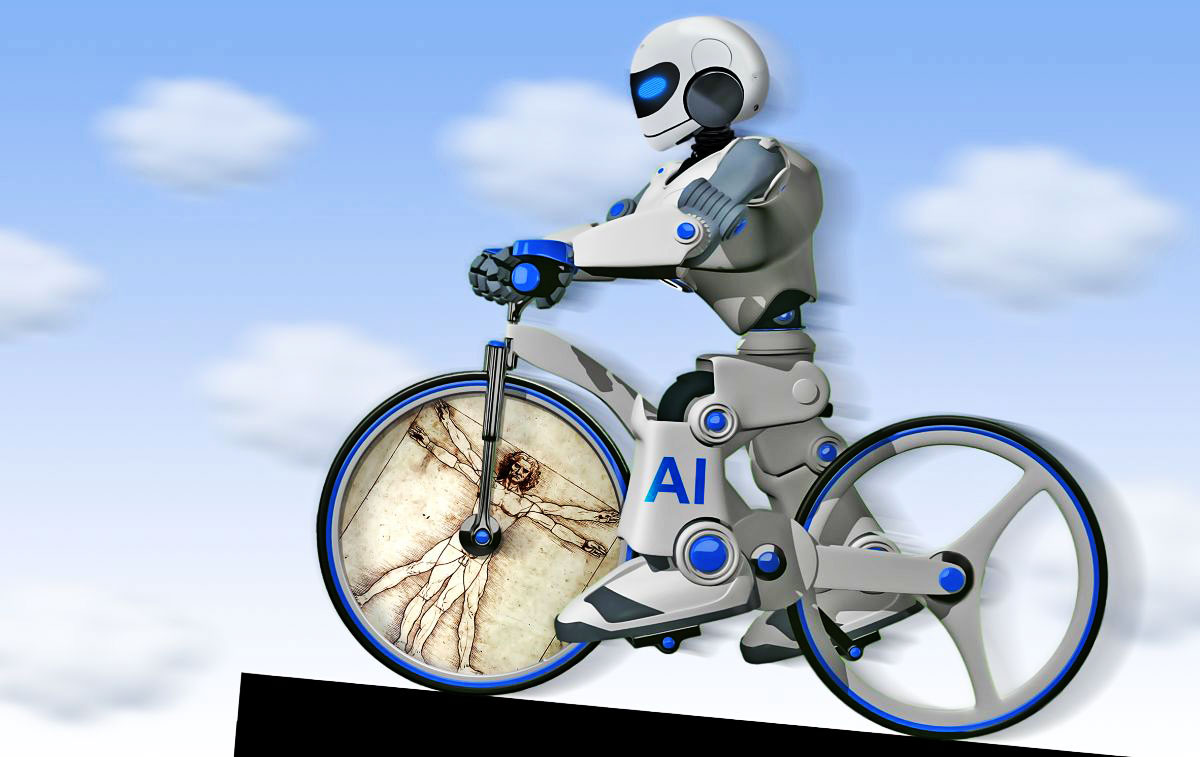
Artificial intelligence (A.I.)
represents the most significant potential technological shift since
the twentieth century and has the power to transform warfare
drastically.
If autonomous attack systems were implemented without adequate
strategic preparation, we might witness something comparable to the
massacres of the past.
For now, however, contemporary wars remain within comprehensible
limits. The possibility of death tolls comparable to those of the
World Wars arises primarily in
nuclear scenarios, not in
conventional conflicts.
In other words,
the World Wars were a historical anomaly, the product of
an extremely rare conjunction between advanced technology and
archaic mentality - not a model easily replicated in future
wars.
Understanding this is crucial...!
The concept of a world war should not be confined to
the images of the past.
The current World War III, fought from the
steppes of Donbas to the
mountains of Iran, resembles
nothing from the twentieth century.
It is more technological, more strategic, and, paradoxically,
less lethal...
Yet it will still bring changes and consequences as profound as
those brought by the Allied victory in 1945.
|