|
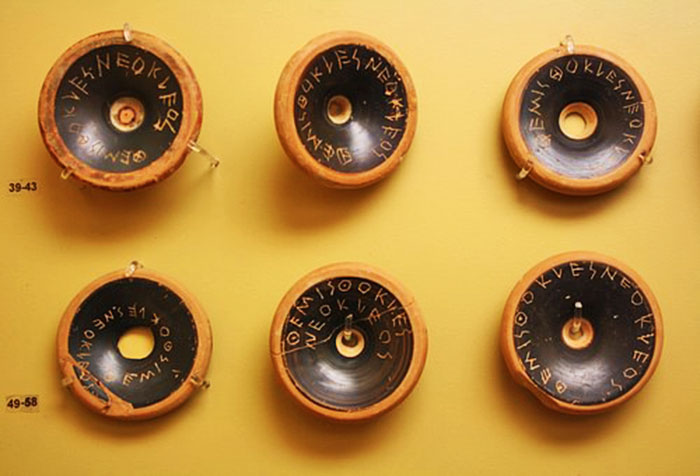
Mark Cartwright (CC BY-NC-SA)
Some of the greatest names in Greek history fell victim to the process, although, as the votes were often not personal but based on policies, many were able to resume politics after they had served the statuary 10 years away from their home city.
Nevertheless, ostracism was the supreme example of the power of the ordinary people, the demos, to combat abuses of power in the Athenian democracy.
First, the decision to hold a vote on ostracism was presented to the popular assembly of Athens, the ekklesia, which met on the hill of Pnyx. There up to 6,000 male citizens voted to proceed or not.
If agreed, a special meeting known as the ostracophoria was organized in the agora on a particular day in the eighth prytany in the year (which was divided into ten such units).
The voting was supervised by the executive council of 500 (boule) and the 9 highest administrative officials, the archons (archontes).
Citizens voted against a particular candidate by
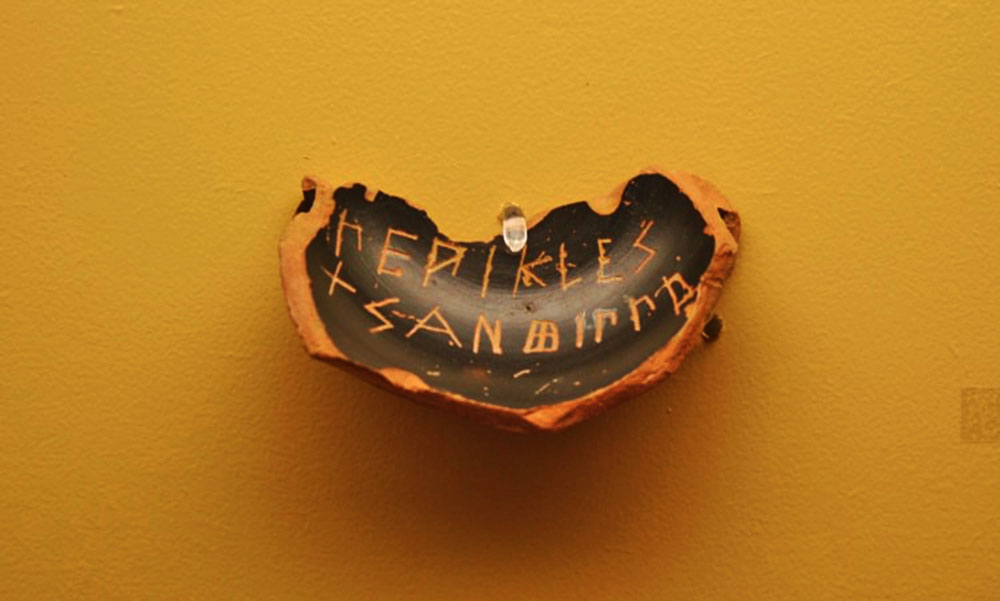
scratching his name on a piece of pottery, an ostrakon.
Voting was done anonymously. Officials known as phylai then
collected the ostraka and made sure that nobody voted twice.
The man was given 10 days to organize his affairs and then he must leave the city and never return to the region of Attica for a period of 10 years.
Interestingly, the individual did not lose their
citizenship and nor was their personal property confiscated.
Mark Cartwright (CC BY-NC-SA)
This perhaps indicates that votes were very often cast against the policies of an individual rather than them personally and that voting against one individual gave support to their rival and his policies.
However, there must surely have been cases when, without any formal charges or speeches, the assembly was swayed by popularism and voted against individuals without good reason.
Plutarch in his Aristides biography famously recounts,
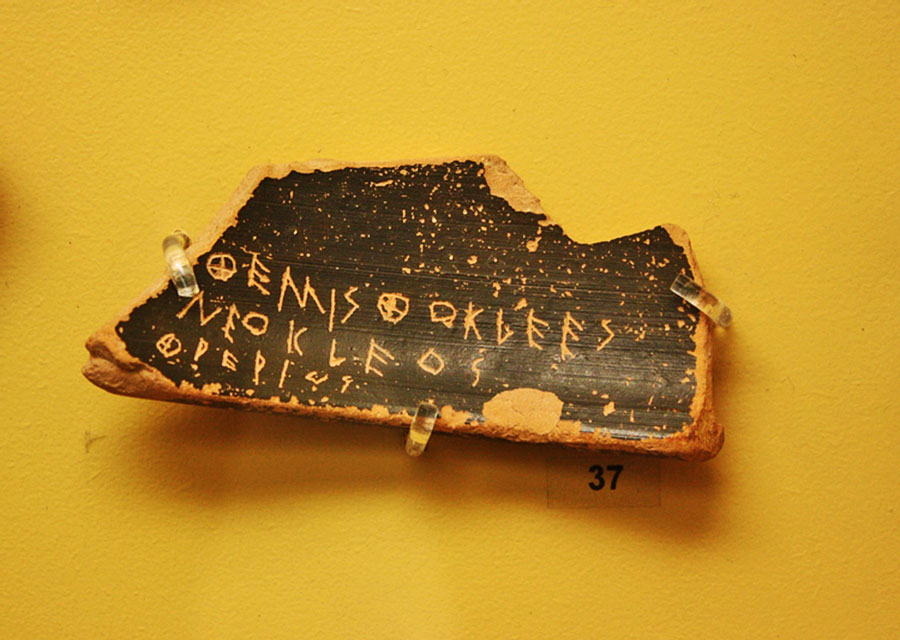
Another suspicious abuse is the finding of 190 ostraka in a well near the acropolis of Athens, all with the name of Themistocles scratched on them but done so by recognizably few hands.
some of the most illustrious names in Greek history
fell victim to the process of
ostracism....
Famous (or
Infamous) Exiles
However, the first actual ostracism was not held until c. 487 BCE.
Then, a certain Hipparchus, son of Charmus, and related to the tyrant Hippias, claimed the dubious distinction of being the first recorded exile using this method. Megacles and Callias, son of Cratius, followed in the next two years.
These early exiles were probably guilty of
supporting Persia and opposing the increasingly democratic
government in Athens.
Over the next decades, some of the most illustrious names in Greek history then fell victim to the process, as shown in the 12,000 ostraka which have survived from antiquity:
Mark Cartwright (CC BY-NC-SA)
He had hoped to use the process to exile one of his two great rivals, Alcibiades or Nicias, but, joining forces, the two managed to get Hyperbolus voted out of the city instead.
After that, there were no more cases, even if the process still remained legally possible until the 4th century BCE.
Political rivals turned instead to the process of graphe paranomon where anyone could make a formal accusation against an individual and claim their proposals were unconstitutional.
Later sources suggest that ostracism was also carried out in Argos, Megara, Miletos, and Syracuse but there is scant archaeological evidence for this.
The 1st-century BCE historian Diodorus of Sicily describes a type of ostracism in the latter city where, briefly, olive leaves were used instead of pottery sherds in a similar process to ostracism known as petalismos...
|