|

by Joel Bowman
April 07, 2026
from
JoelBowman Website
"Carthago
delenda est."
(Carthage
must be destroyed.)
Cato the Elder
(234-149 BC)
Comes word from the Commander-in-Chief of the Armed Forces of the
United States of America... via Truth Social...:
"A whole civilization will die tonight, never
to be brought back again. I don't want that to happen, but it
probably will."
According to Mr.
Trump's "ultimatum," the
Iranians have until tonight to reopen the Strait of Hormuz. (8 p.m.
ET is the official "deadline.")
What must it feel like, we shudder,
to lay waste to a "whole civilization"... to
witness the fear and trembling of your fellow primates... to see
them bow down before you, as a god among men, bringer of death
and destruction...?
According to
Polybius's account, when the
great Roman general,
Scipio Aemilianus, saw the
ancient city of
Carthage reduced to ashes at his
feet, he is said to have wept openly for his enemies.
After a somber pause, he quoted from Homer:
"A day will come when sacred Troy shall
perish, and Priam and his people shall be slain."
And when one amongst the crowd asked him what he
meant, he turned and reflected:
"I feel a terror and dread, lest someone
should one day give the same order about my own city."
We wonder,
what gives Mr. Trump pause... what
demons visit him in the quiet of the night... plaguing his
conscience, stealing his breath away, inspiring "terror and
dread" for the fate of 'his own empire'...?
Or does he sleep the sleep of the pure... the angelic... the
imbecilic...?
Hmm...
Prizes, Pomp and Parity
When we
left you last week, we were tracing
the parallels between Pax Americana and its ancient namesake,
Pax Romana.
In both eras, while those within the imperial
gates enjoyed long stretches of relative peace (with notable
exceptions), the god of Mars reigned supreme beyond
them.
Fought for trade, for treasure, and for
glory, Rome's military campaigns sometimes brought great
bounties - as in the
Dacian Wars, where the vast
gold mines of modern-day Romania were emptied into the empire's
coffers.
More often, they were a drain on the imperial
purse and on public morale, tearing at the fabric of the Republic
itself.
Skirmishes across the Arabian desert, seemingly
endless battles with Germanic "barbarians," and campaigns as far
north as
Hadrian's Wall in Britain all cost
the empire dearly... but none so much as the clashes with its great
power rival in the east, centered in what some readers will
recognize as
modern day Iran.
Rome's contest with the
Parthian Empire predates the
so-called Pax Romana by several decades... and runs straight
through it, like a heavy pilum cast across the centuries.
By the time Rome turned in earnest toward
Parthia, nearly a century after the destruction of Carthage in the
Third Punic War, the great
existential struggle of the Republic was over.
Yet even as Augustus declared 'peace', Rome was already
entangled in a rivalry it could neither decisively win nor easily
abandon... one that would endure for nearly three centuries, and
slowly, almost imperceptibly, wear the empire down...
And yet, the warning signs were there from the very outset.
Indeed, the first clues were open to witness
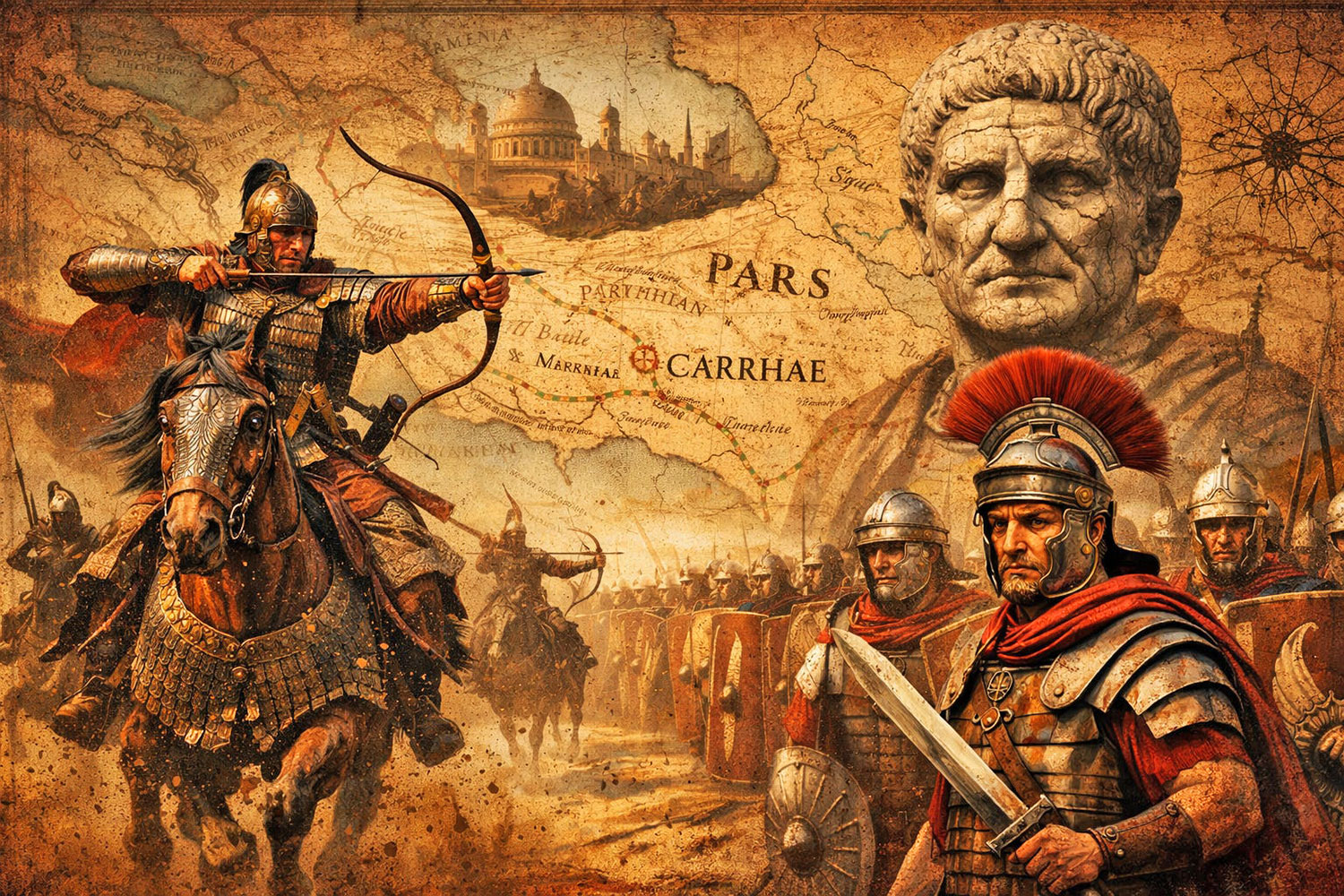
during the disastrous
Battle of Carrhae, in 53BC.
Spearheading the Attack
Wealthy, ambitious and ruthless,
Marcus Licinius Crassus was the
third tenor in Rome's
First Triumvirate, along with
Julius Caesar and Pompey.
The lesser known of the three statesmen, it
might be said that Crassus invaded Parthia seeking prizes, pomp
and parity...
Of these spoils, he was to win none.
Ignoring advice to advance carefully and methodically along
the winding Euphrates River (where supply and support could be
maintained), Crassus instead set out to chase a swift and
spectacular victory.
Cutting inland into open, arid terrain, he soon
found himself drawn deep into enemy territory, where his Roman
infantry were greeted by the mighty Parthian cavalry.
Suddenly exposed, Crassus's men assumed a defensive "hollow square"
formation, a sound enough strategy against opposing infantry... but
disastrous against mounted archers and armored
cataphracts.
With camel trains providing them an endless
supply of arrows, the Parthian cavalry circled the Roman defenses
with near impunity, raining arrows on their heads under the
scorching noonday sun.
At one point, Crassus's own son, Publius Crassus, led a
cavalry charge to break the siege.
When he returned sometime later, his head was
borne aloft on a Parthian spear, which was displayed on
horseback along the frontlines for all the Roman soldiers to
see.
Writing 150 years after the blood had dried,
Plutarch relayed the event as a classic triumph of
hubris over prudence...:
"[Crassus - 'Trump'] paid no attention to
those who advised him well, but was led on by his own
hopes."
Added
Cassius Dio:
"Crassus showed neither foresight
in planning nor safety in execution [...] He was ignorant
of the country and the enemy, yet he advanced as if against a
weak foe."
Heart of
Darkness
By the end of the first day, 20,000 Romans had been slaughtered...
another 10,000 captured.
The hollow square closing in on him, and the possibility of retreat
fast fading with the sun, Crassus tried desperately to negotiate a
withdrawal.
Alas, the meeting quickly turned violent, and
Crassus soon met 'his maker'...
Stories (likely apocryphal) describe
the Parthians rewarding their
attacker's lust for wealth and glory by giving him his 'Midas
fill'...
Again, from Cassius Dio:
"The Parthians, mocking his love of wealth,
poured molten gold into his mouth"...
So began, at the very edge of the Parthian
Empire, what would become nearly three centuries of intermittent
struggle between two great powers.
Rome would, in time, push further east -
capturing cities, even sacking capitals - but each advance only drew
them deeper, until they reached the beating heart of Parthia... and
the very limits of their power...
|