|

by Jacob Bell
October 05, 2026
from
ClassicalWisdom Website

Brazilian Epicureans...?
The Greek
Philosopher's Key to Happiness...
One
of the best things about living in Argentina is Brazil.
I
kid - but in all seriousness, while I love the Paris of
the South, the Argentines can be at times... charmingly
neurotic.
Boasting the highest rate of therapy per capita, they
could be collectively seen as a 'glass half empty'
culture.
When explaining why we live here (which we have to do
often), the Argentines will simply reply with how
horrible everything is... the doom and gloom of yet
another crisis... and then try their best to dissuade us
from ever saying anything positive ever again.
The Brazilians, however, are the exact opposite. A few
hours north and the smiles suddenly appear with the warm
sunshine.
People regularly dance in the streets on their way to
the ocean, with caipirinhas and brightly colored sarongs
flowing.
Here every body is a beach body and everybody is on the
beach.
Locals living their best life...
Of course the striking thing is that by many accounts
Brazilians are often poorer than the Argentines.
There is a higher rate of violent crime.
There are more diseases... and parasites.
So
why are they happy?
I can't say for sure, but it seems to me there is an
element of 'Epicureanism' about the culture.
The appreciation of a cold drink on a hot day.
The enjoyment of a fresh plate of shrimp and rice.
The delight in the rhythm of the music, the sway of
the hips.
Of
course I'm talking about Epicureanism with a 'capital E'
- the ancient sort and not the commonly misunderstood
concept you see today in apps and advertising.
But what exactly did the Hellenistic philosopher say and
do?
Anya Leonard
Founder and Director
Classical Wisdom
There is probably no other ancient Greek philosopher who has been so
misunderstood in our modern era.
Nowadays his philosophy is associated with
excess and drinking and food apps... but the reality is, he
preached the exact opposite...
Indeed,
his name should connote moderation, science,
atheism, death...and happiness?
Who are we talking about?
None other than
Epicurus.
A radical thinker of his time, Epicurus was a philosopher of the
Hellenistic period, living from 341-271 BCE. Living in accordance
with his philosophy, which came to be known as Epicureanism,
he lived a rather simple, peaceful, and relaxing life.
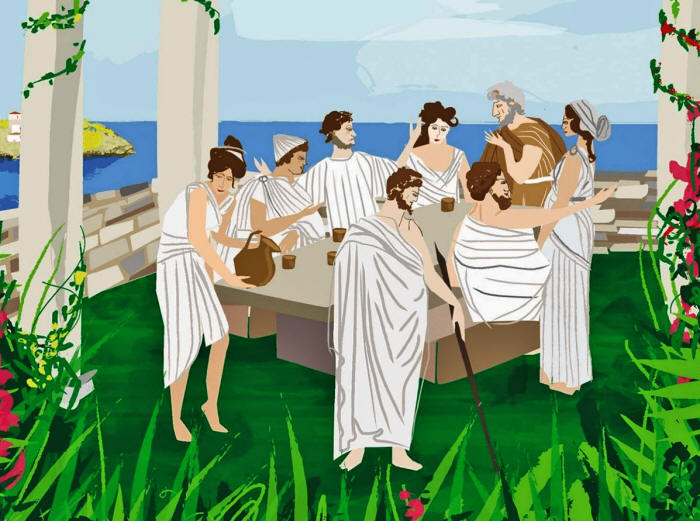
He utilized his garden as a classroom, and relied
heavily on donations to survive.
Aside from the occasional college party, Epicurus and his students
lived mostly on bread and water...
The Epicureans adopted empiricism as their theory of
knowledge and atomistic materialism as their theory of the cosmos.
They developed an egoistic hedonism
as their theory of ethical values, and aside from specific cases,
the Epicureans ignored politics and valued friendship above all
other human relations, even familial ones...
If you ever thought that
friends
were god's apology for family,
then you might actually be
a follower of Epicurus.
Epicurus developed his philosophy with a practical aim in mind, and
so employed the use of logic and rationality as a means to
happiness, rather than as tools for uncovering the truth for truth's
sake.
Rejecting the importance of mathematics and
purely scientific pursuits, he was interested in logic insofar as it
served physics, and interested in physics insofar as it served
ethics.
Epicurus,
-
viewed many philosophers with a feeling
of antipathy
-
denounced religious dogmatism
-
railed against the skeptics
-
argued for a secular world
In sum, it's surprising that he didn't meet the
same ending as Socrates...!
For the Epicureans, the senses are fundamental and at
the basis of our knowledge.
Senses have dominion over reason, because
reason relies first on sense perception.
We can only reason about something once we
have gathered data from our senses about the thing in question.
According to Epicurean theory,
we should then judge this information
according to our feelings or passion, and we
should choose that which gives us pleasure, and avoid
that which gives us pain.
Does this mean that we have a justified
theory of excessive drinking and eating...?
Don't grab for that second bottle of wine just
yet.
Although Epicurus outlines a hedonistic ethic, it is a
sophisticated theory that encourages moderation.
After all, we won't be happy tomorrow when we
wake up to a throbbing head, sour stomach, and purple lips...
especially if there is photographic evidence.
First identifying with Aristotle's notion
that happiness is the highest good, Epicurus then couples
this with the idea of pleasure, concluding that pleasure is
the only manner from which to obtain happiness.
Epicurus' view of choosing the best pleasure
consists in contemplating the future and choosing the option that
will provide sustaining contentment and absence of pain.
We must look to the future to determine what
will be the cause of more pleasure and less pain.
With this in mind, in the final analysis,
we will gain more pleasure from moderating
our intake of wine, and we will endure less pain by going to the
dentist and getting that toothache taken care of... you know,
before you need that root canal.

Just as important to the Epicurean ethic is a
reduction of desires...
If we want less, we will be happy with less.
The Epicurean path to happiness is not a
result of an excess of external pleasures or material goods.
Live simply, and without an excess of wealth or
luxury, says Epicurus, and with that proclamation he very
well may lay claim to the title of "first western minimalist!"
Moderation, temperance, and cheerfulness are
Epicurean virtues; unbridled luxury and feverish desire
Epicurean vices.
In a seeming contradiction to a hedonistic ethic,
Epicurus believed that,
it was more pleasurable to do a kindness for
someone rather than receive one.
He also held that,
we should attempt friendship with all of
mankind, and if this is not possible, at least don't make
enemies, and if this fails, and we make an enemy, avoid
interacting with them.
Friendship was the highest human
relationship for Epicurus because,
it provided security, tranquility, and
pleasure.
He also urged against the rat race,
because,
a race for wealth, fame, or power would
destroy tranquility and peace by placing the contestant at the
mercy of chance, public opinion, and disrupt the enjoyment of
friendship.
For similar reasons, a man who seeks to be happy
should stay out of politics unless he
has such an urge to a political career that he couldn't be happy
without it... and let's be honest... those people probably shouldn't
be politicians in the first place.
Being concerned with the pragmatic value of philosophy, and against
truth for truth's sake, it may again seem contradicting that
Epicurus held so many proto-scientific views.
He adopted, with a few changes,
Democritus' atomistic theory of
the cosmos.
Epicurus believed that the universe was made
up of the void (empty space) and an infinite number of
small indivisible bits of matter in motion called atoms.
These bits of matter make up the world by
coming together to form the objects of the world, including us.
Because of this, Epicurus also believed that
the mind
could be found in the body, and he argued against the idea of an
immaterial soul that might live on once our body has died.
He sought to discredit the mythological concepts of the world and
its creation, and so proposed a purely mechanical explanation
for our world coming into existence.
Through the use of mechanical and atomic
explanations of the natural world, he denied any interference of
gods within human affairs.
He also claimed that,
our world is just one of an infinite
number of worlds, and that worlds come into
existence, grow for awhile, decline, and eventually perish.
With this, Epicurus became one of the
first proponents of the
multi-verse theory...!
Now, you might be wondering,
How do these theories align with the idea of
happiness being the highest good man can achieve?
How can these theories help us live a better,
happier life?
After all, Epicurus has seemed to abandon the
idea of god as a creator, the immaterial-eternal soul,
and the idea of an afterlife.
Well, for Epicurus, the
existence of gods interfering in our world,
and the possibility of punishment after death, was a
great source of anxiety.
Therefore,
by justifying the world without need of a
god, soul, or afterlife, he believed that he would relieve
himself and others of this anxiety.
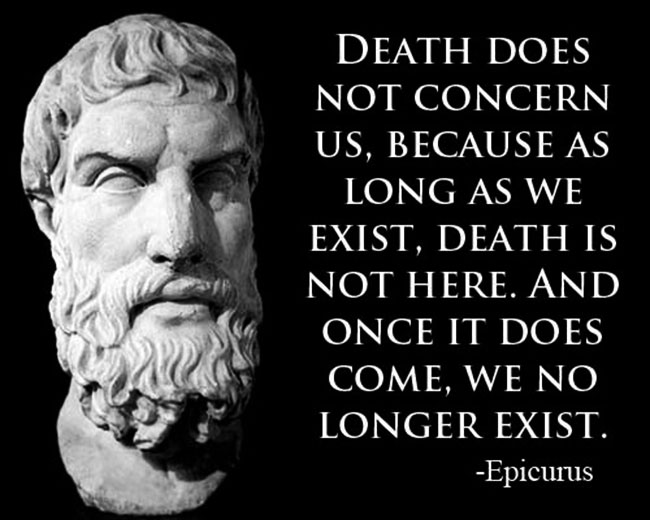
Furthermore, he argued
that death is nothing to be
fearful about, because it does not concern us.
Defending this notion, Epicurus stated that,
"death is nothing to us; for that which is
dissolved is devoid of sensation, and that which is devoid of
sensation is nothing to us".
Imagine the eternity before your birth... the
eternity of nothingness...
That doesn't seem scary; you didn't experience
that nothingness. That same kind of eternity is what comes
after death, according to Epicurus, and so we shouldn't be afraid of
that either.
In addressing his peers, Epicurus announces the benefits of
his secular system of philosophy:
"...They anticipate or have forebodings of
the eternal terror related in the myths, or even fear the
absence of sensation in death as if it concerned them...
But tranquility belongs to him who frees
himself of all these misconceptions and has a continuous
remembrance of the whole and the most important truths."
And here, as I address you all, these most
important truths, more than any food app or extra bottle of wine,
can give us "true happiness"...
|