|
Similar report in spanish
Quanta Magazine that combines more lifelike properties than ever before, proof of concept that it's possible to bring nonliving materials to life, or something close to it, in the lab...
The lab-made synthetic cell grew, replicated its DNA, and divided, demonstrating the basic functions of a cell cycle.
The cell is not alive by any definition. It can't survive without constant deliveries of food and ribosomes, the machinery needed to make proteins.
It has no defenses or a good waste removal system. But it's the strongest demonstration yet that it is possible to generate life from nonlife, a goal that synthetic biologists have been chasing for decades.
Since these cells were pieced together from scratch, and all the molecular parts were crafted in the lab, scientists can tinker with the system and switch components in and out.
The paper was posted on the scientific preprint site biorxiv.org on July 2.
With such flexibility, this kind of synthetic cell could eventually be coaxed to create new materials, such as biofuels and drugs, and help researchers study disease.
The synthetic biologist Kate Adamala coaxed a cellular soup of nonliving biomolecules enclosed in a membrane to act somewhat like a living thing,
even growing and
dividing into daughter cells.
It could also give scientists insight into some of their deepest existential questions:
Or, as Adamala put it:
Building Life
Some 4 billion years ago, a bunch of nonliving molecules got together to form the first protocells.
Then, over time, evolutionary processes emerged that let these cells change and diversify into many different types, decorating a barren world with all manner of strange beings.
A purely chemical world blossomed into a biological one.
Scientists cannot agree on how this shift from nonlife to life, or abiogenesis, happened, but some have turned their sights on trying it out for themselves in the lab.
For decades, researchers have taken different approaches to this challenge.
Some, like the synthetic biologist John Glass at the J. Craig Venter Institute, are stripping down bacterial cells to their smallest, barest genomes to reveal a cell's minimum requirements to stay alive.
Others, like Otto, try to build cells with molecules that differ from those found in Earth biology.
Adamala also works from the ground up, but with biological molecules found in nature today.
She found an instruction manual in what all known cells have in common:
They transcribe their DNA into RNA and then make proteins to carry out these tasks and others that keep a cell running, such as metabolizing molecules for energy.
All of this is done inside a lipid membrane, which holds all the necessary materials in one place. Adamala's team needed to build their synthetic cell a genome and supply it with all the materials to carry out those tasks.
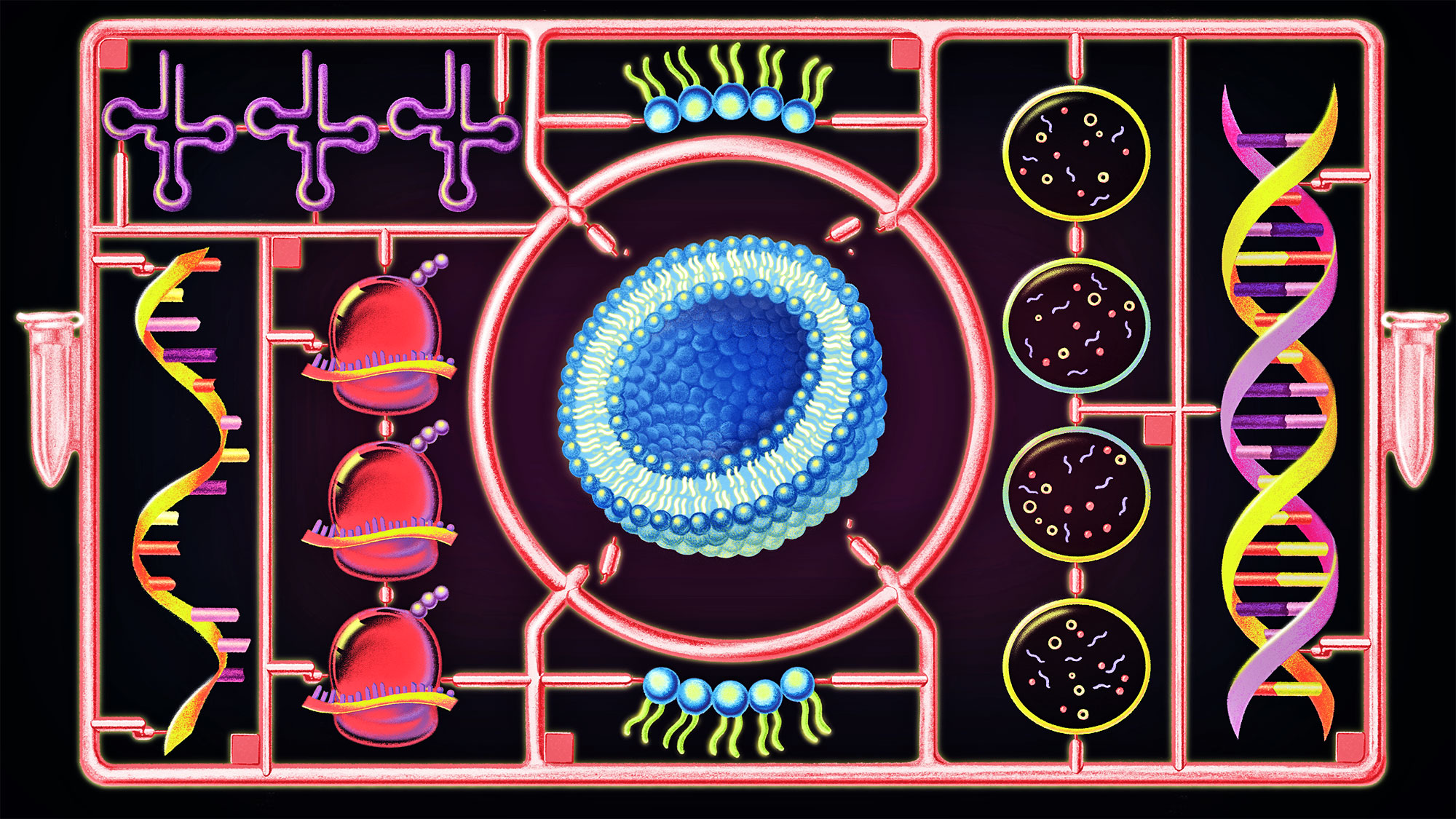
They developed and optimized different ingredients, most inspired by other labs, before combining them together inside liposomes - hollow sacs enclosed by a simple lipid membrane.
This would serve as the cellular body.
They started with a cell's most fundamental system:
They adopted a DNA replication system, pioneered by the synthetic biologists Hannes Mutschler and Christophe Danelon, and tweaked it to work alongside other systems, including a commercial pack of 36 enzymes that let the cell read DNA and make proteins.
Adamala's team fiddled with their cellular brew, switching genes in and out and adjusting concentrations of various molecules, to get the crucial information-carrying and protein-making genetic systems to jibe.
Their tiny synthetic genome did not encode any metabolic genes, which would let the cell process food and energy, or many of the complex molecules a cell needs.
So, in parallel, the researchers prepped some supply packs.
They filled other liposomes with sugar, lipids, and enzymes, as well as complex molecules, such as transfer RNA (tRNA) and ribosomes, which work together to translate genetic instructions into proteins.
For their protocell to accept these crucial supplies, the team also modified a protein that would sit in the cell membrane and attract the lipid bubbles. When a bubble bumped into the cell, their membranes would fuse, releasing the supplies inside.
It wasn't easy to get all these genetic systems to work together successfully.
After some more tweaking and optimizing, the cell started growing and replicating its DNA.
But her vision for a synthetic cell had one more step:
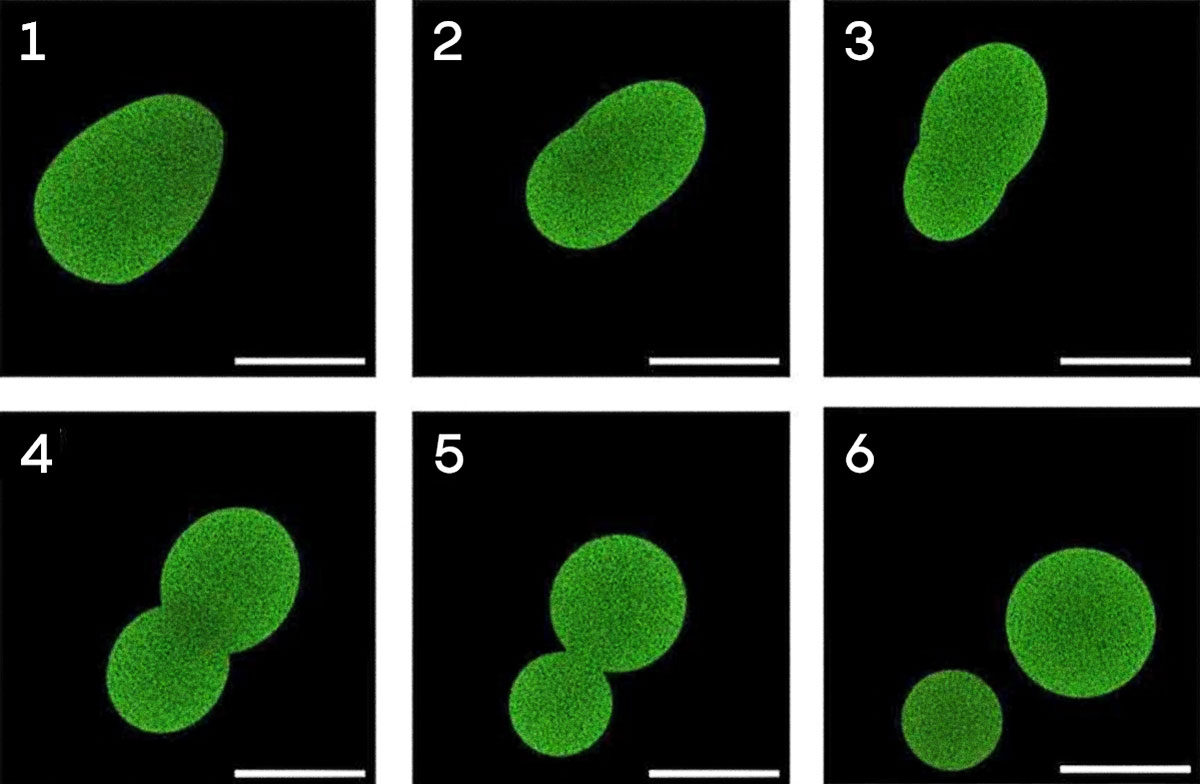
Fluorescent microscopy shows a synthetic cell undergoing cell division: elongating, pinching, and separating
into two
daughter cells.
This was where the field had been stuck for some time.
Researchers before Adamala had figured out different ways to feed and grow synthetic cells and to replicate their DNA. But cell division is a different beast.
Synthetic biologists could not figure out how to get their cells to undergo this complex process.
So Adamala decided to ditch the cytoskeleton.
One day, while tearing through the literature, she came across an interesting mechanism in a paper.
Following this approach, Adamala tweaked a cell-membrane protein and tested it in her protocells.
After several tries, it worked.
This paper "beautifully demonstrates this division mechanism," said Job Boekhoven, a systems chemist at the Technical University of Munich who was not involved in the study.
By putting together systems inspired by different labs - DNA replication; feeder liposomes; and swarming, division-inducing proteins - and then optimizing them to work together, Adamala's team showed that it is possible to induce the chemical world to form a biological one in the lab.
Michael Lynch, an evolutionary biologist at Arizona State University who was also not involved in the study, agreed.
However, he also cautioned against over-hyping the cell since it's not yet self-sustaining.
Once the synthetic cells were created, her students and others started calling them Adamala cells - a moniker she hated.
She insisted that they name the cells after anything else, jokingly suggesting potatoes.
So her students started calling them spudcells...
Each cell is tiny.
Its genome is way smaller than bacterial genomes, and it doesn't look like anything special.
Evolution and Beyond
The cell could grow and divide.
The researchers started fiddling with the synthetic cell's DNA to see if they could get some cells to grow larger or divide faster - in effect, creating genetic variation in the cell population.
They found that the cells that grew bigger also had more daughter cells and started to become more populous.
In other words,
What Adamala's team demonstrated was not quite natural selection, the primary mechanism that drives evolutionary change, in which organisms that are better adapted to their environment are more likely to survive.
Even if she got their cell to produce more daughter cells, she doesn't think it would lead to evolution.
That's because Adamala's team had to create genetic variation synthetically, instead of allowing for random mutations in DNA.
They will need to find an enzyme that is more error-prone - but not so error-prone that the genome's integrity and the cell's function is lost.
She said that she needs to find the sweet spot between order and chaos, referencing the biochemist and complexity theorist Stuart Kauffman, a professor emeritus at the University of Pennsylvania, who argues that biology works best at the "edge of chaos."
A clear demonstration of an evolutionary process is,
Other researchers have shown adaptive evolution in other types of synthetic cells.
But those cells were bacteria stripped of all but the bare minimum of genes - they weren't built from the ground up. The cells are also limited by the fact that they need to be fed many of their raw materials.
That the cells can't make their own ribosomes, the way natural cells do,
Adamala also thinks they will need to figure out a way to add a cytoskeleton to improve their replication system.
Currently, the cells waste a lot of energy and time attracting molecules to crowd around and help them divide.
All told, scientists are far from building anything remotely close to a modern living cell - but this new one is still the most lifelike yet.
Alongside sharing the new results, Adamala and other synthetic biologists announced the formation of a nonprofit called Biotic, which they will use to make their synthetic biology tools available to researchers around the world.
The team is releasing their data and methods so that synthetic biologists can start building and improving on their cell. The hope is that the work can be used, decades from now, to create plastics without fossil fuels, for example, or fertilizers or drugs.
These synthetic cells could also pave the way to the past, to the origins of biology itself. Life on Earth would have started from much simpler molecules than the ones that spudcells use.
Still, Adamala's creation of a synthetic cell system from non-living materials brings researchers a step closer to exploring, in the lab, deeper questions about life's origins and requirements, a dream she shares with others.
|