|

by Julian Ryall
March 17, 2008
from
NationalGeographic Website
A planet roughly the size of Earth could be tracing a vast,
elliptical orbit at the outer edge of our solar system - and
astronomers in Japan think they know where to find it.
The presence of this unnamed body has been suggested before, noted
Tadashi Mukai, a professor at Kobe University's department of
earth and planetary sciences.
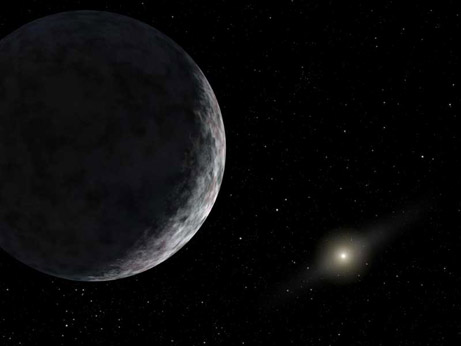
The sun barely
illuminates the dwarf planet Eris in an artist's conception.
The distant body
rocked the astronomical community
when it was discovered in 2005
because it is slightly larger than Pluto,
sparking debate over
what should be classified as a planet.
Now researchers in Japan say an Earth-size or larger object should
be orbiting the sun
in the outer reaches
of the solar system - and they think they know
where to look to find
this potential new planet within the next ten years.
Image courtesy NASA/JPL-Caltech
"We have been able to identify more
than 1,100 objects beyond Neptune since 1992, and a huge number
of objects are showing large orbital eccentricities and
elliptical orbits," Mukai said.
This suggests that a body with sizeable
mass must be influencing the movement of these objects by exerting a
gravitational pull. But the extreme distance and unusual orbit of
the elusive "Planet X" have made it difficult to spot even with the
most advanced telescopes.
In a paper appearing in an upcoming issue of the Astronomical
Journal, Mukai and colleagues propose that other researchers have
simply been looking in the wrong place.
"We have reached our conclusions
from simulations that explain the orbital elements," Mukai said.
"We are now looking in places that we have not looked before,
and I think we will be able to see the planet within the next
five or ten years."
Big, But Light
The eight known planets in our solar system are on very
similar elliptical orbits and are all almost within the ecliptic
plane, the geometric plane that roughly describes Earth's orbit
around the sun.
"Most surveys [looking for Planet X]
are concentrated toward the ecliptic plane, since that is where
most solar system objects concentrate," said Mark Sykes,
director of the Planetary Science Institute in Tucson,
Arizona.
The new models, however, suggest that
Planet X is circling the sun on a 20 to 40 degree angle relative
to the ecliptic plane.
"The discovery of new planets with
higher inclinations, like [the dwarf planet] Eris, encourages
more searches of those regions," Sykes said.
(What
is a dwarf planet?)
In addition to its odd orbit, Planet X
should have a diameter between 6,200 and 9,900 miles (10,000 and
16,000 kilometers), according to Mukai's team.
By contrast, Earth's
diameter is about 7,900 miles (12,800 kilometers). Despite its size,
the planet will probably have a far lower density than Earth, the
researchers think.
Earth has iron at its core, but if Planet X formed in the outer
reaches of the solar system, it will have stone at its center and a
mantle of ice.
The surface of the planet will probably be similar to that of
Pluto - covered with ice made of water, ammonia, or methane with a
surface temperature between -423.7° and -405.7° Fahrenheit
(-253.1° and -243.1° Celsius).
Alternatively, if it is a
"rogue" planet that took shape in the inner reaches of the solar
system, the body could be mostly rock with a metallic core and its
primordial atmosphere frozen on its surface.
Planet X's strange, oblong orbit means that it would take the
object about a thousand years to orbit the sun, the researchers say,
which could be one reason no one has spotted it yet.
What's more,
the body's closest approach would bring it only within 80
astronomical units (AUs) of the sun, while its furthest distance
would be about 200 AUs. (One AU equals the distance between
Earth and the sun, about 93 million miles or 150 million
kilometers.)
The most distant known planet, Neptune, is about 30 AUs during its
closest approach.
Not a Planet?
The idea of looking at higher angles than the known planets' orbits
raises the likelihood that more distant bodies will be found, said
Sykes, of the Planetary Science Institute.
"If this object is discovered, it
would help us understand how many others there might be out
there," Sykes said. "It would be a fascinating object to visit."
"Its discovery would also cause a
major stir in the astronomical world", he said.
Like Pluto, the new body would
not dominate its orbit and so would not be classified as a planet
under the recently changed definition of the International
Astronomical Union (read "Pluto
Not a Planet - Astronomers Rule" - August 24, 2006.)
But before that controversy can erupt anew, researchers have to
actually find Planet X.
Mukai and colleagues are hopeful that
the Pan-STARRS mission slated to start in 2009 will do the job. This
multi-facility collaboration being led by the University of Hawaii
will pool data from four telescopes based in Hawaii that will
constantly scan the skies for asteroids, Mukai said.
When the telescopes are operational, there is a good possibility
that they will make unprecedented discoveries about the most distant
parts of our solar system.
"I agree that there is the
possibility of other large planetoids out there" in addition to
Planet X, he said. "We certainly cannot discount that
possibility."
Video
from
YouTube Website
-
Is Planet X, NIBIRU ready to
show it self this March 2016?
-
And if so, What will it bring
with it?
-
Are NEMESIS and NIBIRU hiding behind the sun?
-
With so many people wondering
about other world affairs and not looking to the sky, could
Planet X already being showing itself?
Biblically backed and thoroughly
researched, another excellent video interview with Gill Broussard
regarding Planet 7X and how it explains the,
...as well as events in the coming
tribulation.
In our opinion, this is a must-watch for EVERYONE!
Most important, he discusses why it is
critical to know these things BEFORE they begin, where you might
want to be, and why a year's worth of food and water are critical.
Nibiru Planet X - The Best Evidence to Date
The Coming Events 2016!
|

