WORLDS IN COLLISION
Commentary By Robertino Solàrion 2001
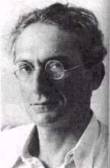 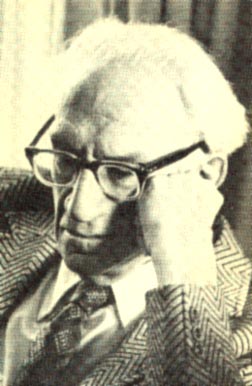 The righthand picture was probably taken in the early 1970s.
Oftentimes, after a long and complex research project such as this work on Hyperborea, The Cosmic Tree, it is beneficial to return to the original source material that engendered the endeavor. It has been exactly 28 years since I first read Dr. Velikovsky's WORLDS IN COLLISION and began this investigation, without knowing particularly where it would eventually lead me. Although WORLDS IN COLLISION captivated me more than Dr. Velikovsky's other books, soon thereafter my attention was riveted on his Historical Reconstruction presented in the AGES IN CHAOS series. By the late 1970s I had written a 70-page treatise titled "June 15, 762 BCE : A Mathematical Analysis Of Ancient History" in which I think I proved that Dr. Velikovsky's purely historical postulations could be mathematically verified and thoroughly cross-referenced. That treatise was not published, however, until August 1994 in an edition of THE VELIKOVSKIAN Journal. This historical research sequence of the past three decades is discussed elsewhere in these essays, such as in HYPERBOREA, THE NIGHT SUN. Note above that WORLDS IN COLLISION was first published in 1950, half a century after Miss E. Valentia Straiton published THE CELESTIAL SHIP OF THE NORTH and half a century prior to the completion of my own research. And also during that second half-century there also were published such relevant works as HAMLET'S MILL by Giorgio de Santillana and Hertha von Dechend, THE EARTH CHRONICLES by Zecharia Sitchin, and FLYING SERPENTS AND DRAGONS by R.A. Boulay, amongst others. Since all of this prior and seemingly disparate writing spanned the entire century, it would have been -- and was -- impossible for me to finalize all the conclusions which are presented here under the umbrella-title of THE COSMIC TREE. Transcribed below are several excerpts from WORLDS IN COLLISION. Chapters One and Two of Part Two (Exodus/Santorini) are transcribed in their entirety; subsequent excerpts contain only parts of various succeeding chapters. It is quite impossible for me to transcribe the entire volume. If you are interested in reading it in its totality, you are advised to locate a complete copy by way of your public library, favorite bookstore or even the Internet. Regardless of Dr. Velikovsky's personal interpretation of the ultimate cause of these events, when we read it in light of all other material, we are forced to view this "invading comet" as the cyclical Planet Nibiru. These excerpts below thus describe the magnetic, meteorologic, geologic and other phenomena that accompanied the last arrival-sequence of Planet Nibiru in 1587 BCE and ensuing years. Thus, we may safely conclude that, as horrible as these events might seem, humanity did indeed survive; and we can regard the words of Dr. Velikovsky as an ominous preview of what will probably transpire when Planet Nibiru returns again, in the coming years that surround 2012. To be forewarned is to be forearmed. In Dr. Velikovsky's material, all footnotes are omitted, unless they contain information significantly peripheral to the text itself, and then they will be bracketed and included following the paragraph to which they refer. If any reader wishes to explore Dr. Velikovsky's source material in greater detail, then I recommend that you visit your public library and check out the book itself. This book was translated into numerous foreign languages and has sold millions of copies worldwide, so it might be possible for readers in non-English-speaking countries, particularly in Europe, to locate a local translated copy. Also, in lieu of italics and bold type, capital letters will be used in this transcription. Regarding the opening information about the Sun's standing still, you are also referred to my own accompanying essay THE NIGHT THE STARS STOOD STILL. You will note in Chapter Two the "52-Year Period" from the events of the Exodus until the Battle of Gibeon. The exact chronology of this period has been debated for centuries and is dealt with in other essays in this collection. Assuming that it has a certain validity, then the Exodus and the Santorini Cataclysm/Explosion occurred in my scenario in the year 1587 BCE; and the Sun stood still over Gibeon 52 years later in 1535 BCE. Significantly, Dr. Velikovsky also linked this period of 52 years to the Mayan traditions; it more than coincidental that the Mayan astronomical system is partially constructed around the framework of a cycle of 52 years, or 4 times 13. In his discussion of the relevance of the number 13, however, Dr. Velikovsky was undoubtedly not aware that the END-TIME DATE for the current Mayan Baktun, i.e., the end date of 13.0.0.0.0, falls on 21 December 2012, precisely 3,600 years after the cosmic cataclysm of Exodus/Santorini; and 3,600 years is the length of one Nibiruan Orbit, that cycle of time after which new "world ages" begin, birthed by fearsome cosmic storms of fire, water and wind. Robertino Solàrion, Dallas, Texas, 4 January 2001
WORLDS IN COLLISION PART TWO Chapter 1 THE MOST INCREDIBLE STORY The most incredible story of miracles is told about Joshua ben Nun who, when pursuing the Canaanite kings at Beth-horon, implored the sun and the moon to stand still. "And he said to the sight of Israel, Sun, stand thou still upon Gibeon; and thou, Moon, in the valley of Ajalon. And the sun stood still, and the moon stayed, until the people had avenged themselves upon their enemies. Is not this written in the book of Jasher? So the sun stood still in the midst of heaven, and hasted not to go down about a whole day" (Joshua 10:12-13). This story is beyond the belief of even the most imaginative or the most pious person. Waves of stormy sea may have drowned one host and been merciful to another. The earth could crack asunder and swallow up human beings. The Jordan could be blocked by a slice of its bank falling into the bed of the river. Jericho's walls -- not by the blast of trumpets, but by an incidental earthquake -- could have been breached. But that the sun and the moon should halt in their movement across the firmament -- this could be only the product of fancy, a poetic image, a metaphor; a hideous implausibility when imposed as a subject for belief; a matter for scorn -- it manifests even a want of reverence for the Supreme Being. According to the knowledge of our age -- not of the age when the Book of Joshua or of Jasher was written -- this could have happened if the earth had ceased for a time to roll along its prescribed path. Is such a disturbance conceivable? No record of the slightest confusion is registered in the present annals of the earth. Each year consists of 365 days, 5 hours, and 49 minutes. A departure of the earth from its regular rotation is thinkable, but only in a very improbable event that our planet should meet another heavenly body of sufficient mass to disrupt the eternal path of our world. It is true that aerolites or meteorites reach our earth continually, sometimes by the thousands and tens of thousands. But no dislocation of our precise turning round and round has ever been perceived. This does not mean that a larger body, or a larger number of bodies, could not strike the terrestrial sphere. The large number of asteroids between the orbits of the planets Mars and Jupiter suggests that at some unknown time another planet revolved there; now only these meteorites follow approximately the path along which the destroyed planet circled the sun. Possibly a comet ran into it and shattered it. That a comet may strike our planet is not very probable, but the idea is not absurd. The heavenly mechanism works with almost absolute precision; but unstable, their way lost, comets by the thousands, by the millions, revolve in the sky, and their interference may disturb the harmony. Some of these comets belong to our system. Periodically they return, but not at very exact intervals, owing to the perturbations caused by gravitation toward the larger planets when they fly too close to them. But innumerable other comets, often seen only through the telescope, come flying in from immeasurable spaces of the universe at very great speed, and disappear -- possibly forever. Some comets are visible only for hours, some for days or weeks or even months. Might it happen that our earth, the earth under our feet, would roll toward perilous collision with a huge mass of meteorites, a trail of stones flying at enormous speed around and across our solar system? This probability was analyzed with fervor during the last century. From the time of Aristotle, who asserted that a meteorite, which fell at Aegospotami when a comet was glowing in the sky, had been lifted from the ground by the wind and carried in the air and dropped over that place, until the year 1803 when, on April 26, a shower of meteorites fell at l'Aigle in France and was investigated by Biot and the French Academy of Sciences, the scholarly world -- and in the meantime there lived Copernicus, Galileo Galilei, Kepler, Newton, and Huygens -- did not believe that such a thing as a stone falling from the sky was possible at all. And this despite many occasions when stones fell before the eyes of a crowd, as did the aerolite in the presence of Emperor Maximilian and his court in Ensisheim, Alsace, on November 7, 1492. Only shortly before 1803, the Academy of Sciences of Paris refused to believe that, on another occasion, stones had fallen from the sky. The fall of meteorites on July 24, 1790, in southwest France was pronounced "un phénomène physiquement impossible". Since the year 1803, however, scholars have believed that stones fall from the sky. If a stone can collide with the earth, and occasionally a shower of stones, too, cannot a full-sized comet fly into the face of the earth? It was calculated that such a possibility exists but that it is very unlikely to occur. [D.F. Arago computed on some occasion that there is one chance in 280 million that a comet will hit the earth. Nevertheless, a hole one mile in diameter in Arizona is a sign of an actual headlong collision of the earth with a small comet or asteroid. On June 30, 1908, a calculated forty-thousand-ton mass of iron fell in Siberia at 60°56' north latitude and 101°57' east longitude. In 1946 the small Giacobini-Zinner comet passed within 131,000 miles of the point where the earth was eight days later. [While investigating whether an encounter between the earth and a comet had been the subject of a previous discussion, I found that W. Whiston, Newton's successor at Cambridge and a contemporary of Halley, in his NEW THEORY OF THE EARTH (the first edition of which appeared in 1696) tried to prove that the comet of 1680, to which he (erroneously) ascribed a period of 575.5 years, caused the biblical Deluge on an early encounter. [G. Cuvier, who was unable to offer his own explanation of the causes of great cataclysms, refers to the theory of Whiston in the following terms:
[I. Donnelly, author, reformer, and member of the United States House of Representatives, tried in his book RAGNAROK (1883) to explain the presence of till and gravel on the rock substratum in America and Europe by hypothesizing an encounter with a comet, which rained till on the terrestrial hemisphere facing it at that moment. He placed the event in an indefinite period, but at a time when man already populated the earth. Donnelly did not show any awareness that Whiston was his predecessor. His assumption that there is till only in one half of the earth is arbitrary and wrong.] If the head of a comet should pass very close to our path, so as to effect a distortion in the career of the earth, another phenomenon besides the disturbed movement of the planet would probably occur: a rain of meteorites would strike the earth and would increase to a torrent. Stones scorched by flying through the atmosphere would be hurled on home and head. In the Book of Joshua, two verses before the passage about the sun that was suspended on high for a number of hours without moving to the occident, we find this passage:
The author of the Book of Joshua was surely ignorant of any connection between the two phenomena. He could not be expected to have had any knowledge about the nature of aerolites, about the forces of attraction between celestial bodies, and the like. As these phenomena were recorded to have occurred together, it is improbable that the records were invented. The meteorites fell on the earth in a torrent. They must have fallen in very great numbers for they struck down more warriors than the swords of the adversaries. To have killed persons by the hundreds or thousands in the field, a cataract of stones must have fallen. Such a torrent of great stones would mean that a train of meteorites or a comet had struck our planet. The quotation in the Bible from the Book of Jasher is laconic and may give the impression that the phenomenon of the motionless sun and moon was local, seen only in Palestine between the valley of Ajalon and Gibeon. But the cosmic character of the prodigy is pictured in a thanksgiving prayer ascribed to Joshua:
The wide radius over which the heavenly wrath swept is emphasized in the prayer:
A torrent of large stones coming from the sky, an earthquake, a whirlwind, a disturbance in the movement of the earth -- these four phenomena belong together. It appears that a large comet must have passed very near to our planet and disrupted its movement; a part of the stones dispersed in the neck and tail of the comet smote the surface of our earth a shattering blow. Are we entitled, on the basis of the Book of Joshua, to assume that at some date in the middle of the second millennium before the present era the earth was interrupted in its regular rotation by a comet? Such a statement has no many implications that it should not be made thoughtlessly. To this I say that though the implications are great and many, the present research in its entirety is an interlinked sequence of documents and other evidence, all of which in common carry the weight of this and other statements in this book. The problem before us is one of mechanics. Points on the outer layers of the rotating globe (especially near the equator) move at a higher linear velocity than points on the inner layers, but at the same angular velocity. Consequently, if the earth were suddenly stopped (or slowed down) in its rotation, the inner layers might come to rest (or their rotational velocity might be slowed) while the outer layers would still tend to go on rotating. This would cause friction between the various liquid or semifluid layers, creating heat; on the outermost periphery the solid layers would be torn apart, causing mountains and even continents to fall or rise. As I shall show later, mountains fell and others rose from level ground; the earth with its oceans and continents became heated; the sea boiled in many places, and rock liquefied; volcanoes ignited and forests burned. Would not a sudden stop by the earth, rotating at a little over one thousand miles an hour at its equator, mean a complete destruction of the world? Since the world survived, there must have been a mechanism to cushion the slowing down of terrestrial rotation, if it really occurred, or another escape for the energy of motion besides transformation into heat, or both. Or if rotation persisted undisturbed, the terrestrial axis may have tilted in the presence of a strong magnetic field, so that the sun appeared to lose for hours its diurnal movement. These problems are kept in sight and are faced in the Epilogue of this volume.
ON THE OTHER SIDE OF THE WORLD The Book of Joshua, compiled from the more ancient Book of Jasher, related the order of events. "Joshua ... went up from Gilgal all night." In the early morning he fell upon his enemies unawares at Gibeon, and "chased them along the way that goes up to Beth-horon". As they fled, great stones were cast from the sky. That same day ("in the day when the Lord delivered up the Amorites") the sun stood still over Gibeon and the moon over the valley of Ajalon. It has been noted that this description of the position of the luminaries implies that the sun was in the forenoon position. The Book of Joshua says that the luminaries stood in the midst of the sky. Allowing for the difference in longitude, it must have been early morning or night in the Western Hemisphere. We go to the shelf where stand books with the historical traditions of the aborigines of Central America. The sailors of Columbus and Cortes, arriving in America, found there literate peoples who had books of their own. Most of these books were burned in the sixteenth century by the Dominican monks. Very few of the ancient manuscripts survived, and these are preserved in the libraries of Paris, the Vatican, the Prado, and Dresden; they are called codici, and their texts have been studied and partly read. However, among the Indians of the days of the conquest and also of the following century there were literary men who had access to the knowledge written in pictographic script by their forefathers. [The Mayan tongue is still spoken by about 300,000 people, but of the Mayan hieroglyphics only the characters employed in the calendar are known for certain.] In the Mexican ANNALS OF CUAUHTITLAN -- the history of the empire of Culhuacan and Mexico, written in Nahua-Indian in the sixteenth century -- it is related that during a cosmic catastrophe that occurred in the remote past, the night did not end for a long time. The biblical narrative describes the sun as remaining in the sky for an additional day ("about a whole day"). The Midrashim, the books of ancient traditions not embodied in the Scriptures, relate that the sun and the moon stood still for thirty-six ITIM, or eighteen hours, and thus from sunrise to sunset the day lasted about thirty hours. In the Mexican annals it is stated that the world was deprived of light and the sun did not appear for a fourfold night. In a prolonged day or night, time could not be measured by the usual means at the disposal of the ancients. [With the exception of the water clock.] Sahagun, the Spanish savant who came to America a generation after Columbus and gathered the traditions of the aborigines, wrote that at the time of one cosmic catastrophe the sun rose only a little way over the horizon and remained there without moving; the moon also stood still. I am dealing with the Western Hemisphere first, because the biblical stories were not known to its aborigines when it was discovered. Also, the tradition preserved by Sahagun bears no trace of having been introduced by the missionaries: in his version there is nothing to suggest Joshua ben Nun and his war against the Canaanite kings; and the position of the sun, only a very little above the eastern horizon, differs from the biblical text, though it does not contradict it. We could follow a path around the earth and inquire into the various traditions concerning the prolonged night and prolonged day, with sun and moon absent or tarrying at different points along the zodiac, while the earth underwent a bombardment of stones in a world ablaze. But we must postpone this journey. There was more than one catastrophe when, according to the memory of mankind, the earth refused to play the chronometer by undisturbed rotation on its axis. First, we must differentiate the single occurrences of cosmic catastrophes, some of which took place before the one described here, some after it; some of which were of greater extent, and some of lesser.
Chapter Two FIFTY-TWO YEARS EARLIER The pre-Colombian written traditions of Central America tell us that fifty-two years before the catastrophe that closely resembles that of the time of Joshua, another catastrophe of world dimensions had occurred. It is therefore only natural to go back to the old Israelite traditions, as narrated in the Scriptures, to determine whether they contain evidence of a corresponding catastrophe. The time of the Wandering in the Desert is given by the Scriptures as forty years. Then, for a number of years before the day of the disturbed movement of the earth, the protracted conquest of Palestine went on. It seems reasonable, therefore, to ask whether a date fifty-two years before this event would coincide with the time of the Exodus. [According to rabbinical sources, the war of conquest in Palestine lasted fourteen years.] In the work AGES IN CHAOS, I describe at some length the catastrophe that visited Egypt and Arabia. In that work it is explained that the Exodus took place amid a great natural upheaval that terminated the period of Egyptian history known as the Middle Kingdom. There I endeavor to show that contemporary Egyptian documents describe the same disaster accompanied by the "the plagues of Egypt", and that the traditions of the Arabian Peninsula relate similar occurrences in this land and on the shores of the Red Sea. In that work I refer also to Beke's idea that Mt. Sinai was a smoking volcano. However, I reveal that "the scope of the catastrophe must have exceeded by far the measure of the disturbance which could be caused by one active volcano", and I promise to answer the question: "Of what nature and dimension was this catastrophe, or this series of catastrophes, accompanied by plagues?" and to publish an investigation into the nature of great catastrophes of the past. Both works -- the reconstruction of history and the reconstruction of natural history -- were conceived within the short interval of half a year; the desire to establish a correct historical chronology before fitting the acts of nature into the periods of human history impelled me to complete AGES IN CHAOS first. I shall employ some of the historical material from the first chapters of AGES IN CHAOS. There I use it for the purpose of synchronizing events in the histories of the countries around the eastern Mediterranean; here I shall use it to show that the same events took place all around the world, and to explain the nature of these events.
THE RED WORLD In the middle of the second millennium before the present era, as I intend to show, the earth underwent one of the greatest catastrophes in its history. A celestial body that only shortly before had become a member of the solar system -- a new comet -- came very close to the earth. The account of this catastrophe can be reconstructed from evidence supplied by a large number of documents. The comet was on its way from its perihelion and touched all earth first with its gaseous tail. Later in this book I shall show that it was about this comet that Servius wrote: "Non igneo sed sanguineo rubore fuisse" (It was not of a flaming but of a bloody redness). One of the first visible signs of this encounter was the reddening of the earth's surface by a fine dust of rusty pigment. In sea, lake, and river this pigment gave a bloody coloring to the water. Because of these particles of ferruginous or other soluble pigment, the world turned red. The MANUSCRIPT QUICHÉ of the Mayas tells that in the Western Hemisphere, in the days of a great cataclysm, when the earth quaked and the sun's motion was interrupted, the water in the rivers turned to blood. Ipuwer, the Egyptian eyewitness of the catastrophe, wrote his lament on papyrus: "The river is blood," and this corresponds with the Book of Exodus (7:20): "All the waters that were in the river were turned to blood." The author of the papyrus also wrote: "Plague is throughout the land. Blood is everywhere," and this, too, corresponds with the Book of Exodus (7:21): "There was blood throughout all the land of Egypt." The presence of the hematoid pigment in the rivers caused the death of fish followed by decomposition and smell. "And the river stank" (Exodus 7:21). "And all the Egyptians digged round about the river for water to drink; for they could not drink of the water of the river" (Exodus 7:24). The papyrus relates: "Men shrink from tasting; human beings thirst after water," and "That is our water! That is our happiness! What shall we do in respect thereof? All is ruin." The skin of men and of animals was irritated by the dust, which caused boils, sickness, and the death of cattle -- "a very grievous murrain". Wild animals, frightened by the portents in the sky, came close to the villages and cities. The summit of mountainous Thrace received the name "Haemus", and Apollodorus related the tradition of the Thracians that the summit was so named because of the "stream of blood which gushed out on the mountain" when the heavenly battle was fought between Zeus and Typhon, and Typhon was struck by a thunderbolt. It is said that a city in Egypt received the same name for the same reason. The mythology which personified the forces of the cosmic drama described the world as colored red. In one Egyptian myth the bloody hue of the world is ascribed to the blood of Osiris, the mortally wounded planet god; in another myth it is the blood of Seth or Apopi; in the Babylonian myth the world was colored red by the blood of the slain Tiamat, the heavenly monster. The Finnish epos of KALEVALA describes how, in the days of the cosmic upheaval, the world was sprinkled with red milk. The Altai Tatars tell of a catastrophe when "blood turns the whole world red", and a world conflagration follows. The Orphic hymns refer to the time when the heavenly vault, "mighty Olympus, trembled fearfully ... and the earth around shrieked fearfully, and the sea was stirred [heaped], troubled with its purple waves". An old subject for debate is: Why is the Red Sea so named? If a sea is called Black or White, that may be due to the dark coloring of the water or to the brightness of the ice and snow. The Red Sea has a deep blue color. As no better reason was found, a few coral formations or some red birds on its shores were proposed as explanations of its name. [H.S. Palmer, SINAI (1892). Probably at that time the mountainous land of Seir, upon which the Israelites wandered, received the name Edom (Red), and Erythrea (erythraios -- red in Greek) its name; Erythrean Sea was in antiquity the name of the Arabian Gulf of the Indian Ocean, applied also to the Red Sea.] Like all the water in Egypt, the water on the surface of the Sea of the Passage was of a red tint. It appears that Raphael was not mistaken when, in painting the scene of the passage, he colored the water red. It was, of course, not this mountain or that river or that sea exclusively that was reddened, thus earning the name Red or Bloody, as distinguished from other mountains and seas. But crowds of men, wherever they were, who witnessed the cosmic upheaval and escaped with their lives, ascribed the name Haemus or Red to particular places. The phenomenon of "blood" raining from the sky has also been observed in limited areas and on a small scale in more recent times. One of these occasions, according to Pliny, was during the consulship of Manius Acilius and Gaius Forcius. [Another instance, according to Plutarch, occurred in the reign of Romulus. (It must be mentioned here that Romulus and Remus founded Rome at the time of the Trojan War, that is, around the date of the so-called "Great Eclipse" and "Great Earthquake" of 15 June 762 BCE, a date which marked the beginning of the departure sequence of this "comet" Hyperborea, as is discussed elsewhere in this series of essays. RS)] Babylonians, too, recorded red dust and rain falling from the sky; instances of "bloody rain" have been recorded in divers countries. The red dust, soluble in water, falling from the sky in water drops, does not originate in clouds, but must come from volcanic eruptions or from cosmic spaces. The fall of meteorite dust is a phenomenon generally known to take place mainly after the passage of meteorites; this dust is found on the snow of mountains and in polar regions. [It is estimated that approximately one ton of meteorite dust falls daily on the globe.]
THE HAIL OF STONES Following the red dust, a "small dust", like "ashes of the furnace", fell "in all the land of Egypt" (Exodus 9:8), and then a shower of meteorites flew toward the earth. Our planet entered deeper into the tail of the comet. The dust was a forerunner of the gravel. There fell "a very grievous hail, such as has not been in Egypt since its foundations" (Exodus 9:18). Stones of "barad", here translated "hail", is, as in most places where mentioned in the Scriptures, the term for meteorites. We are also informed by Midrashic and Talmudic sources that the stones which fell on Egypt wee hot; this fits only meteorites, not a hail of ice. [In the Book of Joshua it is said that "great stones" fell from the sky, and then they are referred to as "stones of barad". "The ancient Egyptian word for 'hail', AR, is also applied to a driving shower of sand and stones; in the contest between Horus and Set, Isis is described as sending upon the latter AR N SA, 'a hail of sand'." A. Macalister, "Hail", in Hastings, DICTIONARY OF THE BIBLE (1901-1904).] In the Scriptures it is said that these stones fell "mingled with fire" (Exodus 9:24), the meaning of which I shall discuss in the following section, and that their fall was accompanied by "loud noises" (KOLOT), rendered as "thunderings", a translation which is only figurative, and not literally correct, because the word for "thunder" in RAAM, which is not used here. The fall of meteorites is accompanied by crashes or explosion-like noises, and in this case they were so "mighty", that, according to the Scriptural narrative, the people in the palace were terrified as much by the din of the falling stones as by the destruction they caused (Exodus 9:28). The red dust had frightened the people, and a warning to keep men and cattle under shelter had been issued: "Gather thy cattle and all that thou hast in the field; for upon every man and beast which shall be found in the field, and shall not be brought home, the hailstones shall come down upon them, and they shall die" (Exodus 9:19). "And he that regarded not the word of the Lord left his servants and his cattle in the field" (Exodus 9:21). Similarly, the Egyptian eyewitness: "Cattle are left to stray, and there is none to gather them together. Each man fetches for himself those that are branded with his name." Falling stones and fire made the frightened cattle flee. Ipuwer also wrote: "Trees are destroyed"; "No fruits, no herbs are found"; "Grain has perished on every side"; "That has perished which yesterday was seen. The land is left to its weariness like the cutting of flax." In one day fields were turned to wasteland. In the Book of Exodus (9:25) it is written: "And the hail [stones of barad] smote every herb of the field, and brake every tree of the field." The description of such a catastrophe is found in the VISUDDHI-MAGGA, a Buddhist text on the world cycles. "When a world cycle is destroyed by wind ... there arises in the beginning a cycle-destroying great cloud. ... There arises a wind to destroy the world cycle, and first it raises a fine dust, and then coarse dust, and then fine sand, and then coarse sand, and then grit, stones, up to boulders as large ... as mighty trees on the hill tops." The wind "turns the ground upside down", large areas "crack and are thrown upwards", "all the mansions on earth" are destroyed in a catastrophe when "worlds clash with worlds". ["World Cycles", VISUDDHI-MAGGA, in Warren, BUDDHISM IN TRANSLATIONS, p. 328.] The Mexican ANNALS OF CUAUHTITLAN describe how a cosmic catastrophe was accompanied by a hail of stones; in the oral tradition of the Indians, too, the motif is repeated time and again: In some ancient epoch the sky "rained, not water, but fire and red-hot stones", which is not different from the Hebrew tradition.
NAPHTHA Crude petroleum is composed of two elements, carbon and hydrogen. The main theories of the origin of petroleum are:
The organic theory implies that the process started after life was already abundant, at least at the bottom of the ocean. [Even before Plutarch the problem of the origin of petroleum was much discussed. Speaking of the visit of Alexander to the petroleum sources of Iraq, Plutarch said: "There has been much discussion about the origin of (this naphtha) ." But in the extant text of Plutarch a sentence containing one of two rival views is missing. The remaining text reads: " ... or whether rather the liquid substance that feeds the flame flows out from the soil which is rich and productive of fire." Plutarch, LIVES (transl. B. Perrin, 1919), "The Life of Alexander", xxv.] The tails of comets are composed mainly of carbon and hydrogen gases. Lacking oxygen, they do not burn in flight, but the inflammable gases, passing through an atmosphere containing oxygen, will be set on fire. If carbon and hydrogen gases, or vapor of a composition of these two elements, enter the atmosphere in huge masses, a part of them will burn, binding all the oxygen available at the moment; the rest will escape combustion, but in swift transition will become liquid. Falling on the ground, the substance, if liquid, would sink into the pores of the sand and into clefts between the rocks; falling on water, it would remain floating if the fire in the air is extinguished before new supplies of oxygen arrive from other regions. The descent of a sticky fluid which came earthward and blazed with heavy smoke is recalled in the oral and written traditions of the inhabitants of both hemispheres. POPUL-VUH, the sacred book of the Mayas, narrates:
The entire population of the land was annihilated. The MANUSCRIPT QUICHÉ perpetuated the picture of the population of Mexico perishing in a downpour of bitumen:
A similar account is preserved in the ANNALS OF CUAUHTITLAN. The age which ended in the rain of fire was called QUIAUH-TONATIUH, which means "the sun of fire-rain". And far away, in the other hemisphere, in Siberia, the Voguls carried down through the centuries and millennia this memory:
Half a meridian to the south, in the East Indies, the aboriginal tribes relate that in the remote past SENGLE-DAS or "water of fire" rained from the sky; with very few exceptions, all men died. The eighth plague as described in the Book of Exodus was "BARAD [meteorites] and fire mingled with the BARAD, very grievous, such as there was none like it in all the land of Egypt since it became a nation" (Exodus 9:24). There were "thunder [correct: loud noises] and BARAD, and the fire ran along upon the ground" (Exodus 9:23). The Papyrus Ipuwer describes this consuming fire: "Gates, columns, and walls are consumed by fire. The sky is in confusion." The papyrus says that this fire almost "exterminated mankind". The Midrashim, in a number of texts, state that naphtha, together with hot stones, poured down upon Egypt. "The Egyptians refused to let the Israelites go, and He poured out naphtha over them, burning blains [blisters]." It was "a stream of hot naphtha". Naphtha is petroleum in Aramaic and Hebrew. The population of Egypt was "pursued with strange rains and hails and showers inexorable, and utterly consumed with fire: for what was most marvelous of all, in the water which quencheth all things the fire wrought yet more mightily", which is the nature of burning petroleum; in the register of the plagues in Psalms 105 it is referred to as "flaming fire", and in Daniel (7:10) as "river of fire" or "fiery stream". In the Passover Haggadah it is said that "mighty men of Pul and Lud [Lydia in Asia Minor] were destroyed with consuming conflagration on the Passover". In the valley of the Euphrates the Babylonians often referred to "the rain of fire", vivid in their memory. All the countries whose traditions of fire-rain I have cited actually have deposits of oil: Mexico, the East Indies, Siberia, Iraq, and Egypt. For a span of time after the combustive fluid poured down, it may well have floated upon the surface of the seas, soaked the surface of the ground, and caught fire again and again. "For seven winters and summers the fire has raged ... it has burnt up the earth," narrate the Voguls of Siberia. The story of the wandering in the desert contains a number of references to fire springing out of the earth. The Israelites traveled three days' journey away from the Mountain of the Lawgiving, and it happened that "the fire of the Lord burnt among them, and consumed them that were in the uttermost part of the camp" (Numbers 11:1). The Israelites continued on their way. Then came the revolt of Korah and his confederates.
When they kindled the fire of incense, the vapors which rose out of the cleft in the rock caught the flame and exploded. Unaccustomed to handling this oil, rich in volatile derivatives, the Israelite priests fell victims to the fire. The two elder sons of Aaron, Nadab and Abihu, "died before the Lord, when they offered strange fire before the Lord, in the wilderness of Sinai". The fire was called strange because it had not been known before and because it was of foreign origin. If oil fell on the desert of Arabia and on the land of Egypt and burned there, vestiges of conflagration must be found in some of the tombs built before the end of the Middle Kingdom, into which the oil or some of its derivatives might have seeped. We read in the description of the tomb of Antefoker, vizier of Sesostris I, a pharaoh of the Middle Kingdom:
The rain of fire-water contributed to the earth's supply of petroleum; rock oil in the ground appears to be, partly at least, "star oil" brought down at the close of world ages, notably the age that came to its end in the middle of the second millennium before the present era. The priests of Iran worshiped the fire that came out of the ground. The followers of Zoroastrianism or Mazdaism are also called fire worshipers. The fire of the Caucasus was held in great esteem by all the inhabitants of the adjacent lands. Connected with the Caucasus and originating there is the legend of Prometheus. He was chained to a rock for bringing fire to man. The allegorical character of this legend gains meaning when we consider Augustine's words that Prometheus was a contemporary of Moses. Torrents of petroleum poured down upon the Caucasus and were consumed. The smoke of the Caucasus fire was still in the imaginative sight of Ovid, fifteen centuries later, when he described the burning of the world. The continuing fires in Siberia, the Caucasus, in the Arabian desert, and everywhere else were blazes that followed the great conflagration of the days when the earth was caught in vapors of carbon and hydrogen. In the centuries that followed, petroleum was worshiped, burned in holy places; it was also used for domestic purposes. Then many ages passed when it was out of use. Only in the middle of the last century did man begin to exploit this oil, partly contributed by the comet of the time of the Exodus. He utilized its gifts, and today his highways are crowded with vehicles propelled by oil. Into the heights rose man, and he accomplished the age-old dream of flying like a bird; for this, too, he uses the remnants of the intruding star that poured fire and sticky vapor upon his ancestors.
THE DARKNESS The earth entered deeper into the tail of the onrushing comet and approached its body. This approach, if one is to believe the sources, was followed by a disturbance in the rotation of the earth. Terrific hurricanes swept the earth because of the change or reversal of the angular velocity of rotation and because of the sweeping gases, dust, and cinders of the comet. Numerous rabbinical sources describe the calamity of darkness; the material is collated as follows: An exceedingly strong wind endured seven days. All the time the land was shrouded in darkness.
The darkness was of such kind that "their eyes were blinded by it and their breath choked"; it was "not of ordinary earthly kind". The rabbinical tradition, contradicting the spirit of the Scriptural narrative, states that during the plague of darkness the vast majority of the Israelites perished and that only a small fraction of the original Israelite population of Egypt was spared to leave Egypt. Forty-nine out of every fifty Israelites are said to have perished in this plague. A shrine of black granite found at el-Arish on the border of Egypt and Palestine bears a long inscription in hieroglyphics. It reads:
This record employs the same description of the darkness as Exodus 10:22:
The difference in the number of the days (three and nine) of the darkness is reduced in the rabbinical sources, where the time is given as seven days. The difference between seven and nine days is negligible if one considers the subjectivity of the time estimation under such conditions. Appraisal of the darkness with respect to its impenetrability is also subjective; rabbinical sources say that for part of the time there was a very slight visibility, but for the rest (three days) there was no visibility at all. It should be kept in mind that, as in the case I have already discussed, a day and a night of darkness or light can be described as one day or as two days. That both sources, the Hebrew and the Egyptian, refer to the same event can be established by another means also. Following the prolonged darkness and the hurricane, the pharaoh, according to the hieroglyphic text of the shrine, pursued the "evil-doers" to "the place called Pi-Khiroti". The same place is mentioned in Exodus 14:9:
The inscription on the shrine also narrates the death of the pharaoh during this pursuit under exceptional circumstances: "Now when the Majesty fought with the evil-doers in this pool, the place of the whirlpool, the evil-doers prevailed not over his Majesty. His Majesty leapt into the place of the whirlpool." This is the same apotheosis described in Exodus 15:19:
If "the Egyptian darkness" was caused by the earth's stasis or tilting of its axis, and was aggravated by a thin cinder dust from the comet, then the entire globe must have suffered from the effect of these two concurring phenomena: in either the eastern or the western parts of the world there must have been a very extended, gloomy day. Nations and tribes in many places of the globe, to the south, to the north, and to the west of Egypt, have old traditions about a cosmic catastrophe during which the sun did not shine; but in some parts of the world the traditions maintain that the sun did not set for a period of time equal to a few days. Tribes of the Sudan to the south of Egypt refer in their tales to a time when the night would not come to an end. KALEVALA, the epos of the Finns, tells of a time when hailstones of iron fell from the sky, and the sun and the moon disappeared (were stolen from the sky) and did not appear again; in their stead, after a period of darkness, a new sun and a new moon were placed in the sky. Caius Julius Solinus writes that "following the deluge which is reported to have occurred in the days of Ogyges, a heavy night spread over the globe". In the manuscripts of Avila and Molina, who collected the traditions of the Indians of the New World, it is related that the sun did not appear for five days; a cosmic collision of stars preceded the cataclysm; people and animals tried to escape to mountain caves.
Thus the traditions of the Peruvians describe a time when the sun did not appear for five days. In the upheaval, the earth changed its profile, and the sea fell upon the land. East of Egypt, in Babylonia, the eleventh tablet of the EPIC OF GILGAMESH [Gilgamesh] refers to the same events. From out the horizon rose a dark cloud and it rushed against the earth; the land was shriveled by the heat of the flames.
The Iranian book ANUGITA reveals that a threefold day and threefold night concluded a world age, and the book BUNDAHIS, in a context that I shall quote later and that shows a close relation to the events of the cataclysm I describe here, tells of the world being dark at midday as though it were in deepest night: it was caused, according to the BUNDAHIS, by a war between the stars and the planets. A protracted night, deepened by the onrushing dust sweeping in from interplanetary space, enveloped Europe, Africa, and America, the valleys of the Euphrates and the Indus also. If the earth did not stop rotating but slowed down or was tilted, there must have been a longitude where a prolonged day was followed by a prolonged night. Iran is so situated that, if one is to believe the Iranian tradition, the sun was absent for a threefold day, and then it shone for a threefold day. Farther to the east there must have been a protracted day corresponding to the protracted night in the west. According to "Bahman Yast", at the end of a world age in eastern Iran or in India the sun remained ten days visible in the sky. In China, during the reign of the Emperor Yahou, a great catastrophe brought a world age to a close. For ten days the sun did not set. The events of the time of the Emperor Yahou deserve close examination; I shall return to the subject shortly. [The way the Egyptians estimated the time the sun was not in the sky must have been similar to the Chinese method of estimation. It is very probable that these peoples reckoned the disturbance as lasting five days and five nights (because a ninefold or tenfold period elapsed from one sunrise or sunset to the other).]
EARTHQUAKE The earth, forced out of its regular motion, reacted to the close approach of the body of the comet: a major shock convulsed the lithosphere, and the area of the earthquake was the entire globe. Ipuwer witnessed and survived this earthquake. "The towns are destroyed. Upper Egypt has become waste. ... All is ruin." "The residence is overturned in a minute." Only an earthquake could have overturned the residence in a minute. The Egyptian word for "to overturn" is used in the sense of "to overthrow a wall". This was the tenth plague. "And Pharaoh rose up in the night, he, and all his servants, and all the Egyptians; and there was a great cry in Egypt; for there was not a house where there was not one dead" (Exodus 12:30). Houses fell, smitten by one violent blow.
NOGAF, meaning "smote", is the word used for a very violent blow, as, for instance, goring by the horns of an ox. The Passover Haggadah says:
The reason why the Israelites were more fortunate in this plague than the Egyptians probably lies in the kind of material of which their dwellings were constructed. Occupying a marshy district and working on clay, the captives must have lived in huts made of clay and reeds, which are more resilient than brick or stone.
An example of the selective action of a natural agent upon various kinds of construction is narrated also in Mexican annals. During a catastrophe accompanied by hurricane and earthquake, only the people who lived in small log cabins remained uninjured; the larger buildings were swept away.
In AGES IN CHAOS (my reconstruction of ancient history), I shall show that "first-born" (BKHOR) in the text of the plague is a corruption of "chosen" (BCHOR). All the flower of Egypt succumbed in the catastrophe.
To confirm my interpretations of the tenth plague as an earthquake, which should be obvious from the expression, "to smite the houses", I find a corroborating passage of Artapanus in which he describes the last night before the Exodus, and which is quoted by Eusebius: There was "hail and earthquake by night, so that those who fled from the earthquake were killed by the hail, and those who sought shelter from the hail were destroyed by the earthquake. And at that time all the houses fell in, and most of the temples." Also, Hieronymus (St. Jerome) wrote in an epistle that "in the night in which Exodus took place, all the temples of Egypt were destroyed either by an earthshock or by the thunderbolt". Similarly in the Midrashim:
It is also said that the structures which were erected by the Israelite slaves in Pithom and Ramses collapsed or were swallowed by the earth An inscription which dates from the beginning of the New Kingdom refers to a temple of the Middle Kingdom that was "swallowed by the ground" at the close of the Middle Kingdom. The head of the celestial body approached very close, breaking through the darkness of the gaseous envelope, and according to the Midrashim, the last night in Egypt was as bright as the noon on the day of the summer solstice. The population fled.
The population of a city destroyed by an earthquake usually spends the nights in the fields. The Book of Exodus describes a hurried flight from Egypt on the night of the tenth plague; a "mixed multitude" of non-Israelites left Egypt together with the Israelites, who spent their first night in Sukkoth (huts).
This happened on the night of the fourteenth of the month Aviv (Exodus 12:6; 13:4). This is the night of Passover. It appears that the Israelites originally celebrated Passover on the eve of the fourteenth of Aviv. The month Aviv is called "the first month" (Exodus 12:18). Thout was the name of the first month of the Egyptians. What, for the Israelites, became a feast, became a day of sadness and fasting for the Egyptians.
The Hebrews counted (and still count) the beginning of the day from sunset; the Egyptians reckoned from sunrise. As the catastrophe took place at midnight, for the Israelites it was the fourteenth day of the (first) month; for the Egyptians it was the thirteenth day. An earthquake caused by contact or collision with a comet must be felt simultaneously all around the world. An earthquake is a phenomenon that occurs from time to time; but an earthquake accompanying an impact in the cosmos would stand out and be recalled as a memorable date by survivors. In the calendar of the Western Hemisphere, on the thirteenth day of the month, called OLIN, "motion" or "earthquake", a new sun is said to have initiated another world age. The Aztecs, like the Egyptians, reckoned the day from sunrise. Here we have, en passant, the answer to the open question concerning the origin of the superstition which regards the number 13, and especially the thirteenth day, as unlucky and inauspicious. It is still the belief of many superstitious persons, unchanged through thousands of years and even expressed in the same terms: "The thirteenth day is a very bad day. You shall not do anything on this day." I do not think that any record of this belief can be found dating from before the time of the Exodus. The Israelites did not share this superstition of the evil-working number thirteen (or fourteen).
Chapter Three (Excerpts) [COMMENT: To read Chapter Three in its entirety, CLICK HERE] THE BATTLE IN THE SKY At the same time that the seas were heaped up in immense tides, a pageant went on in the sky which presented itself to the horrified onlookers on earth as a gigantic battle. Because this battle was seen from almost all parts of the world, and because it impressed itself very strongly upon the imagination of the peoples, it can be reconstructed in some detail. When the earth passed through the gases, dust, and meteorites of the tail of the comet, disturbed in rotation, it proceeded on a distorted orbit. Emerging from the darkness, the Eastern Hemisphere faced the head of the comet. This head only shortly before had passed close to the sun and was in a state of candescence. The night the great earthquake shook the globe was, according to rabbinical literature, as bright as the day of the summer solstice. Because of the proximity of the earth, the comet left its own orbit and for a while followed the orbit of the earth. The great ball of the comet retreated, then again approached the earth, shrouded in a dark column of gases which looked like a pillar of smoke during the day and of fire at night, and the earth once more passed through the atmosphere of the comet, this time at its neck. This stage was accompanied by violent and incessant electrical discharges between the atmosphere of the tail and the terrestrial atmosphere. There was an interval of about six days between these two close approaches. Emerging from the gases of the comet, the earth seems to have changed the direction of its rotation, and the pillar of smoke moved to the opposite horizon. The column looked like a gigantic moving serpent. When the tidal waves rose to their highest point, and the seas were torn apart, a tremendous spark flew between the earth and the globe of the comet, which instantly pushed down the miles-high billows. Meanwhile, the tail of the comet and its head, having become entangled with each other by their close contact with the earth, exchanged violent discharges of electricity. It looked like a battle between the brilliant globe and the dark column of smoke. In the exchange of electrical potentials, the tail and head were attracted one to the other and repelled one from the other. From the serpentlike tail extensions grew, and it lost the form of a column. It looked now like a furious animal with legs and with many heads. The discharges tore the column to pieces, a process that was accompanied by a rain of meteorites upon the earth. It appeared as though the monster were defeated by the brilliant globe and buried in the sea, or wherever the meteorites fell. The gases of the tail subsequently enveloped the earth. The globe of the comet, which lost a large portion of its atmosphere as well as much of its electrical potential, withdrew from the earth but did not break away from its attraction. Apparently, after a six-week interval, the distance between the earth and the globe of the comet again diminished. This new approach of the globe could not be readily observed because the earth was shrouded in the clouds of dust left by the comet on its former approach as well as by dust ejected by the volcanoes. After renewed discharges, the comet and the earth parted. This behavior of the comet is of great importance in problems of celestial mechanics. That a comet, encountering a planet, can become entangled and drawn away from its own path, forced into a new course, and finally liberated from the influence of the planet is proved by the case of Lexell's comet, which in 1767 was captured by Jupiter and its moons. Not until 1779 did it free itself from this entanglement. A phenomenon that has not been observed in modern times is an electrical discharge between a planet and a comet and also between the head of a comet and its trailing part. The events in the sky were viewed by the peoples of the world as a fight between an evil monster in the form of a serpent and the light-god who engaged the monster in battle and thus saved the world. The tail of the comet, leaping back and forth under the discharges of the flaming globe, was regarded as a separate body, inimical to the globe of the comet. A full survey of the religious and folklore motifs which mirror this event would require more space than is at my disposal here; it is difficult to find a people or tribe on the earth that does not have the same motif at the very focus of its religious beliefs. [COMMENT: I intend to handle a portion of this material in an essay on The Dragon. (To my knowledge, Dr. Velikovsky never wrote this dragon essay before his death in November 1979. If I can locate it, I shall of course transcribe it at a future date. Let me add something here : to one who has studied the possibility, indeed the reality, of The Cosmic Tree as the "docked" and "tethered" Planet Nibiru at a position of Hyperborea -- Beyond The North -- the above description by Dr. Velikovsky regarding the serpent tail, or tree trunk, battling the fiery globe, or the Planet Nibiru, suggests the early sequence of events that commence this docking process, when the serpentine electromagnetic "tethering beam" is lashing out at the Earth in an effort to connect with the NEW North Pole. RS)] Since the descriptions of the battle between Marduk and Tiamat, the dragon, or Isis and Seth, or Vishnu and the serpent, or Krishna and the serpent, or Ormuzd and Ahriman follow an almost identical pattern and have many details in common with the battle of Zeus and Typhon, I shall give here Apollodorus' description of this battle. Typhon "out-topped all the mountains, and his head often brushed the stars. One of his hands reached out to the west and the other to the east, and from them projected a hundred dragons' heads. From the thighs downward he had huge coils of vipers which ... emitted a long hissing. ... His body was all winged ... and fire flashed from his eyes. Such and so great was Typhon when, hurling kindled rocks, he made for the very heaven with hissing and shouts, spouting a great jet of fire from his mouth." To the sky of Egypt Zeus pursued Typhon "rushing at heaven". "Zeus pelted Typhon at a distance with thunderbolts, and at close quarters struck him down with an adamantine sickle, and as he fled pursued him closely as far as Mount Casius, which overhangs Syria. There, seeing the monster sore wounded, he grappled with him. But Typhon twined about him and gripped him in his coils. ... " "Having recovered his strength Zeus suddenly from heaven riding in a chariot of winged horses, pelted Typhon with thunderbolts. ... So being again pursued he [Typhon] came to Thrace and in fighting at Mount Haemus he heaved whole mountains ... a stream of blood gushed out on the mountain, and they say that from that circumstance the mountain was Haemus [bloody]. And when he started to flee through the Sicilian sea, Zeus cast Mount Etna in Sicily upon him. That is a huge mountain, from which down to this day they say that blasts of fire issue from the thunderbolts that were thrown." The struggle left deep marks on the entire ancient world. Some districts were especially associated with the events of this cosmic fight. The Egyptian shore of the Red Sea was called Typhonia. Strabo narrates also that the Arimi (Aramaeans or Syrians) were terrified witnesses of the battle of Zeus with Typhon. And Typhon, "who, they add, was a dragon, when struck by the bolts of lightning, fled in search of a descent underground", and not only did he cut furrows into the earth and form the beds of the rivers, but descending underground, he made fountains break forth. Similar descriptions come from various places of the ancient world, in which the nations relate the experience of their ancestors who witnessed the great catastrophe of the middle of the second millennium. At that time the Israelites had not yet arrived at a clear monotheistic concept and, like other peoples, they saw in the great struggle a conflict between good and evil. The author of the Book of Exodus, suppressing this conception of the ancient Israelites, presented the portent of fire and smoke moving in a column as an angel or messenger of the Lord. However, many passages in other books of the Scriptures preserved the picture as it impressed itself upon eyewitnesses. RAHAB is the Hebrew name for the contester with the Most High.
Deutero-Isaiah prayed:
From these passages it is clear that the battle of the Lord with Rahab was not a primeval battle before Creation, as some scholars think. Isaiah prophesied for the future: "In that day the Lord with his sore and great and strong sword shall punish leviathan the piercing serpent, even leviathan that crooked serpent; and he shall slay the dragon that is in the sea." [Isaiah 27:1.] The "crooked serpent" is shown in many ancient pictures from China to India, to Persia, to Assyria, to Egypt, to Mexico. With the rise of the monotheistic concept, the Israelites regarded this crooked serpent, the contester with the Most High, as the Lord's own creation.
The sea was cleft, the earth was cut with furrows, great rivers disappeared, others appeared. The earth rumbled for many years, and the peoples thought that the fiery dragon that had been struck down had descended underground and was groaning there.
THE SPARK A phenomenon of great significance took place. The head of the comet did not crash into the earth, but exchanged major electrical discharges with it. A tremendous spark sprang forth at the moment of the nearest approach of the comet, when the waters were heaped at their highest above the surface of the earth and before they fell down, followed by a rain of debris torn from the very body and tail of the comet.
An exceedingly strong wind and lightnings rent the cloud. In the morning the waters rose as a wall and moved away.
The immense tides were caused by the presence of a celestial body close by; they fell when a discharge occurred between the earth and the other body. Artapanus, the author of the no longer extant DE JUDAEIS, apparently knew that the words, "The Lord looked unto the host of the Egyptians through the pillar of fire and of the cloud", refer to a great lightning. Eusebius quotes Artapanus:
The great discharges of interplanetary force are commemorated in the traditions, legends, and mythology of all the peoples of the world. The god -- Zeus of the Greeks, Odin of the Icelanders, Ukko of the Finns, Perun of the Russian pagans, Wotan (Woden) of the Germans, Mazda of the Persians, Marduk of the Babylonians, Shiva of the Hindus -- is pictured with lightning in his hand and described as the god who threw his thunderbolt at the world overwhelmed with water and fire. Similarly, many psalms of the Scriptures commemorate the great discharges.
Nothing is easier than to add to the number of such quotations from other parts of the Scriptures -- Job, the Song of Deborah, the Prophets. With the fall of the double wall of water, the Egyptian host was swept away. The force of the impact threw the pharaoh's army into the air.
The tossing of the Egyptian host into the air by an avalanche of water is referred to also in the Egyptian source I quoted before; on the shrine found in el-Arish the story is told of a hurricane and of a prolonged darkness when nobody could leave the palace, and of the pursuit by the pharaoh Taoui-Thom of the fleeing slaves whom he followed to Pi-khiroti, which is the biblical Pi-ha-khiroth. "His Majesty leapt into the place of the whirlpool." Then it is said that he was "lifted by a great force". Although the larger part of the Israelite fugitives were already out of the reach of the falling tidal waves, a great number of them perished in this disaster, as in the previous ones of fire and hurricane of cinders. That Israelites perished at the Sea of Passage is implied in Psalm 68 where mention is made of "my people" that remained in "the depths of the sea". These tidal waves also overwhelmed entire tribes who inhabited Tehama, the thousand-mile-long coastal region of the Red Sea.
Likewise the tradition related in Kitab Alaghani is familiar with the plague of insects (ants of the smallest variety) that forced the tribe to migrate from Hedjaz to their native land, where they were destroyed by "Toufan" -- a deluge. In my reconstruction of ancient history, I endeavor to establish the synchronism of these events and the Exodus.
THE COLLAPSED SKY The rain of meteorites and fire from the sky, the clouds of dust of exogenous origin that drifted low, and the displacement of the world quarters created the impression that the sky had collapsed. The ancient peoples of Mexico referred to a world age that came to its end when the sky collapsed and darkness enshrouded the world. Strabo relates, in the name of Ptolemaeus, the son of Lagus, a general of Alexander and founder of the Egyptian dynasty called by his name, that the Celti who lived on the shores of the Adriatic were asked by Alexander what it was they most feared, to which they replied that they feared no one, but only that the sky might collapse. The Chinese refer to the collapse of the sky which took place when the mountains fell. Because mountains fell or were leveled at the same time when the sky was displaced, ancient peoples, not only the Chinese, thought that mountains support the sky.
[Psalms 68:8. On periodic collapses of the firmament see also Rashi's commentary on Genesis 11:1, referred to in the Section, "World Ages". (For additional related information, see THE WAYWARD SUN which also appeared in THE VELIKOVSKIAN Journal. After a lengthy discussion on cosmic catastrophes, those writers conclude by asking "But why did the sky fall?" Also, let me add here that this idea of mountains supporting the sky might indeed refer to "The Cosmic Mountain", "The North Mountain", "The Foundation Of The World" -- that is to say, the electromagnetically tethered Planet Nibiru -- The Cosmic Tree. RS)] The tribes of Samoa in their legends refer to a catastrophe when "in days of old the heavens fell down". The heavens or the clouds were so low that the people could not stand erect without touching them. The Finns tell in their KALEVALA that the support of the sky gave way and then a spark of fire kindled a new sun and a new moon. The Lapps make offerings accompanied by the prayer that the sky should not lose its support and fall down. The Eskimos of Greenland are afraid that the support of the sky may fail and the sky fall down and kill all human beings; a darkening of the sun and the moon will precede such a catastrophe. [COMMENT: NOTA BENE that these three cultures are located at the northernmost latitudes of this planet. Those peoples would have had the best overall view of The Cosmic Tree Hyperborea and would have been more concerned about its stability perhaps than other peoples at more southern latitudes. You are referred to THE HYPERBOREA SKY DIAGRAMS for more information. RS] The primitives of Africa, in eastern as well as western provinces of the continent, tell about the collapse of the sky in the past. The Ovaherero tribesmen say that many years ago "the Great of the sky" (Eyuru) let the sky fall on the earth; almost all the people were killed, only a few remained alive. The tribes of Kanga and Loanga also have a tradition of the collapse of the sky which annihilated the human race. The Wanyoro in Unyoro likewise relate that the sky fell on the earth and killed everybody: the god Kagra threw the firmament upon the earth to destroy mankind. The traditions of the Cashinaua, the aborigines of western Brazil, is narrated as follows: "The lightnings flashed and the thunders roared terribly and all were afraid. Then the heaven burst and the fragments fell down and killed everything and everybody. Heaven and earth changed places. Nothing that had life was left upon the earth." In this tradition are included the same elements: the lightnings and thunderings, "the bursting of heaven", the fall of meteorites. About the change of places between heaven and earth there is more to say, and I shall not postpone the subject for long.
Chapter Five EAST AND WEST Our planet rotates from west to east. Has it always done so? In this rotation from west to east, the sun is seen to rise in the east and set in the west. Was the east the primeval and only place of the sunrise? There is testimony from all parts of the world that the side which is now turned toward the evening once faced the morning. In the second book of his history, Herodotus relates his conversations with Egyptian priests on his visit to Egypt some time during the second half of the fifth century before the present era. Concluding the history of their people, the priests told him that the period following their first king covered three hundred and forty-one generations, and Herodotus calculated that, three generations being equal to a century, the whole period was over eleven thousand years. The priests asserted that within historical ages and since Egypt became a kingdom, "four times in this period (so they told me) the run rose contrary to his wont; twice he rose where he now sets, and twice he set where he now rises." This passage has been the subject of exhaustive commentaries, the authors of which tried to invent every possible explanation of the phenomenon, but failed to consider the meaning which was plainly stated by the priests of Egypt, and their efforts through the centuries have remained fruitless. [COMMENT: This mystery can now be solved. Herodotus wrote in the 400s BCE. Add to that eleven thousand years, and you arrive at a date of approximately 11,450 BCE. If the arrival of the Planet Nibiru consistently results in a shift of the Polar Axis, as it did in 1587 BCE (more accurately, as has been shown by the Book of Joshua, in 1535 BCE, or 52 years later), then previous Polar Axis Shifts would have occurred in approximately 5187 BCE, 8787 BCE and 12,387 BCE, the last date of which is less than a thousand years previous to 11,450 BCE. Thus, these priests must have been referring to the four times prior to Herodotus' visit that there had been arrivals of the Planet Nibiru. RS] The famous chronologist of the sixteenth century, Joseph Scaliger, weighed the question whether the Sothis period, or time reckoning by years of 365 days which, when compared with the Julian calendar, accumulated an error of a full year in 1,461 years, was hinted at by this passage in Herodotus, and remarked: "Sed hoc non fuerit occasum et orientem mutare" (No reversal of sunrise and sunset takes place in a Sothis period). [COMMENT: For a complete mathematical analysis of the Egyptian Sothis Period, please see my accompanying essay AN INTRODUCTION TO GALACTIC MATHEMATICS] Did the words of the priests to Herodotus refer to the slow change in the direction of the terrestrial axis during a period of approximately 25,800 years, which is brought about by its spinning or by the slow movement of the equinoctial points of terrestrial orbit (precession of the equinoxes)? So thought Alexander von Humboldt of "the famous passage of the second book of Herodotus which so strained the sagacity of the commentators". But this is also a violation of the meaning of the words of the priests, for during the period of spinning, orient and occident do not exchange places. One may doubt the trustworthiness of the priests' statements, or of Egyptian tradition in general, or attack Herodotus for ignorance of the natural sciences, but there is no way to reconcile the passage with present-day natural science. It remains "a very remarkable passage of Herodotus, that has become the despair of commentators". Pomponius Mela, a Latin author of the first century, wrote:
It should not be deduced that Mela's only source for this statement was Herodotus. Mela refers explicitly to Egyptian written sources. He mentions the reversal in the movement of the stars as well as of the sun; if he had copied Herodotus, he would probably not have mentioned the reversal in the movement of the stars (sidera). At a time when the movement of the sun, planets, and stars was not yet regarded as the result of the movement of the earth, the change in the direction of the sun was not necessarily connected in Mela's mind with a similar change in the movement of all heavenly bodies. If, in Mela's time, there were Egyptian historical records which referred to the rising of the sun in the west, we ought to investigate the old Egyptian literary sources extant today. The Magical Papyrus Harris speaks of a cosmic upheaval of fire and water when "the south becomes north, and the Earth turns over". In the Papyrus Ipuwer it is similarly stated that "the land turns round [over] as does a potter's wheel" and the "Earth turned upside down". This papyrus bewails the terrible devastation wrought by the upheaval of nature. In the Ermitage Papyrus (Leningrad, 1116b recto) also, reference is made to a catastrophe that turned the "land upside down; happens that which never (yet) had happened". It is assumed that at that time -- in the second millennium -- people were not aware of the daily rotation of the earth, and believed that the firmament with its luminaries turned around the earth; therefore, the expression, "the earth turned over", does not refer to the daily rotation of the globe. Nor do these descriptions in the papyri of Leiden and Leningrad leave room for a figurative explanation of the sentence, especially if we consider the text of the Papyrus Harris -- the turning over of the earth is accompanied by the interchange of the south and north poles. Harakhte is the Egyptian name for the western sun. As there is but one sun in the sky, it is supposed that Harakhte means the sun at its setting. But why should the sun at its setting be regarded as a deity different from the morning sun? The identity of the rising and setting sun is seen by everyone. The inscriptions do not leave any room for misunderstanding: "Harakhte, he riseth in the west." The texts found in the pyramids say that the luminary "ceased to live in the occident, and shines, a new one, in the orient". After the reversal of direction, whenever it may have occurred, the words "west" and "sunrise" were no longer synonyms, and it was necessary to clarify references by adding: "the west which is at the sun-setting". It was not mere tautology, as the translator of this text thought. Inasmuch as the hieroglyphics were deciphered in the nineteenth century, it would be only reasonable to expect that since then the commentaries on Herodotus and Mela would have been written after consulting the Egyptian texts. In the tomb of Senmut, the architect of Queen Hatshepsut, a panel on the ceiling shows the celestial sphere with the signs of the zodiac and other constellations in "a reversed orientation" of the southern sky. The end of the Middle Kingdom antedated the time of Queen Hatshepsut by several centuries. The astronomical ceiling presenting a reversed orientation must have been a venerated chart, made obsolete a number of centuries earlier.
The center of this panel is occupied by the Orion-Sirius group, in which Orion appears west of Sirius instead of east.
The real meaning of "the irrational orientation of the southern panel" and the "reversed position of Orion" appears to be this: the southern panel shows the sky of Egypt as it was before the celestial sphere interchanged north and south, east and west. The northern panel shows the sky of Egypt as it was on some night of the year in the time of Senmut. Was there no autochthonous tradition in Greece about the reversals of the revolution of the sun and stars? Plato wrote in his dialogue,
Plato continued his dialogue, using the above passage as the introduction to a fantastic philosophical essay on the reversal of time. This minimizes the value of the quoted passage despite the categorical form of his statement. The reversal of the movement of the sun in the sky was not a peaceful event; it was an act of wrath and destruction. Plato wrote in POLITICUS:
The reversal of the movement of the sun was referred to by many Greek authors before and after Plato. According to a short fragment of a historical drama by Sophocles (ATREUS), the sun rises in the east only since its course was reversed.
Euripides wrote in ELECTRA:
Many authors in later centuries realized that the story of Atreus described some event in nature. But it could not have been an eclipse. Strabo was mistaken when he tried to rationalize the story by saying that Atreus was an early astronomer who "discovered that the sun revolves in a direction opposite to the movement of the heavens". During the night the stars move from east to west two minutes faster than the sun which moves in the same direction during the day. [Every night stars rise four minutes earlier: the earth rotates 366.25 times in a year in relation to the stars, but 365.25 times in relation to the sun.] Even in poetical language such a phenomenon would not have been described as follows: "And the sun-car's winged speed from the ghastly strife turned back, changing his westering track through the heavens unto where blush-burning dawn rose," as Euripides wrote in another work of his. [ORESTES, II. 1001ff.] Seneca knew more than his older contemporary Strabo. In his drama THYESTES, he gave a powerful description of what happened when the sun turned backward in the morning sky, which reveals much profound knowledge of natural phenomena. When the sun reversed its course and blotted out the day in mid-Olympus (noon), and the sinking sun beheld Aurora, the people, smitten with fear, asked:
[COMMENT: The above quote from Seneca contains a hidden meaning. If "mid-Olympus" refers to the noontime position of the Sun directly overhead, then "Olympus" must have meant "the sky" as well as a mythical mountain of the gods. If Mount Olympus is merely a Greek designation for The Cosmic Tree Hyperborea, then "Mount Olympus" would indicate a "sky mountain" of some sort, such as the legendary "Mount Of The North Pole". RS] The early Greek philosophers, and especially Pythagoras, would have known about the reversal of the revolution of the sky, if it actually occurred, but as Pythagoras and his school kept their knowledge secret, we must depend upon the authors who wrote about the Pythagoreans. Aristotle says that the Pythagoreans differed between the right- and left-hand motion of the sky ("the side from which the stars rise" is heaven's right, "and where they set ... its left"), and in Plato we find: "A direction from left to right -- and that will be from west to east." The present sun moves in the opposite direction. In the language of a symbolic and philosophical astronomy, probably of Pythagorean origin, Plato describes in TIMAEUS the effects of a collision of the earth "overtaken by a tempest of winds" with "alien fire from without, or a solid lump of earth", or waters of "the immense flood which foamed in and streamed out": the terrestrial globe engages in all motions, "forwards and backwards, and again to right and to left, and upwards and downwards, wandering every way in all the six directions". [COMMENT: SIX DIRECTIONS! Six North-South Polar Alignment Possibilities, along the Polar Pivotal Belts. See also the accompanying essay on THE POLAR PIVOTAL AXIS] As the result of such a collision, described in a not easily understandable text which represents the earth as possessing a soul, there was a "violent shaking of the revolutions of the Soul", "a total blocking of the course of the same", "shaking of the course of the other", which "produced all manner of twistings, and caused in their circles fractures and disruptures of every possible kind, with the result that, as they [the earth and the 'perpetually flowing stream'?] barely held together one with another, they moved indeed but more irrationally, being at one time reversed, at another oblique, and again upside down". In Plato's terminology, "revolution of the same" is from east to west, and "revolution of the other" is from west to east. In THE STATESMAN, Plato put this symbolic language into very simple terms, speaking of the reversal of the quarters in which the sun rises and sets. [COMMENT: These are the sorts of choice nuggets of information that fire the mind. For those who are familiar with Dario Salas' "Archon Y", that Archon who made the "bad deal" with Moses at the time of the Exodus, and thus -- automatically! -- was a "player" in the events surrounding 1587 BCE, here we find Plato discussing the "Soul" of the Earth; and Dario Salas said that "Archon Y" attacked the "other Archon" who was already in charge of the "Soul" of the Earth, in the very heart of the planet, the "entity" who had outgrown the capabilities of a mere human brain and needed a "planetary brain" and thus reincarnated in our Earth. Archon Y fought this resident Archon to a tie, so to speak, the classic battle of Evil against Good. Now they supposedly jointly inhabit, control, incarnate within our Planet; hence, all the conflicts and wars and injustices that have bedeviled Sapiens for almost four millennia can be explained as a result of this on-going battle for conquest of Earth's Soul. Dr. Velikovsky, who was certainly not familiar with Dario Salas because Dr. Velikovsky died before Dario Salas wrote any books, can be excused for saying that this passage from Plato was "a not easily understandable text which represents the earth as possessing a soul". This idea is not exclusive to either Plato or Dario Salas, however. That Archon Y (who is undoubtedly YAHWEH, the Jewish/Christian God of "Evil", the Nibiruan Crown-Prince Enlil) battled the resident Archon (whose identity is not specified by Dario Salas) is reminiscent of the earlier passage above that "The Lord" of the Jews battled "Rahab", the "invader" or "usurper" at the moment in time when all of the other celestial events and catastrophes were occurring. [ALSO, what exactly would be the "right" and "left" sides of the sky? From the above we are told that west is the left side and east, the right. If one were standing and looking due-north at Polaris/Hyperborea, west would be to one's left and east would be to one's right; but if one's back were to Hyperborea (Heaven), as if one were looking down from "up there", then west would be to the right and east, to the left. And note this sentence above : In Plato's terminology, "revolution of the same" is from east to west, and "revolution of the other" is from west to east. If "same" refers to the regular Sun that we see today, and if OTHER refers to the tethered Planet Nibiru, The Night Sun, The Demon Sun, then it could be inferred that although our planet rotates from west to east (left to right), Nibiru might rotate from east to west (right to left)! The ancient peoples could have simply noted its direction one way or the other by looking at it in the northern sky and watching it turn on its axis, in a motion opposite to the one here at ground-level, regardless of which Polar Axis this planet might be rotating around during any particular "world age". RS] I shall return later to some other Greek references to the sun setting in the east. Caius Julius Solinus, a Latin author of the third century of the present era, wrote of the people living on the southern borders of Egypt:
The traditions of peoples agree in synchronizing the changes in the movement of the sun with great catastrophes which terminated world ages. The changes in the movement of the sun in each successive age make the use by many peoples of the term "sun" for "age" understandable.
In the Syrian city Ugarit (Ras Shamra) was found a poem dedicated to the planet-goddess Anat, who "massacred the population of the Levant" and who "exchanged the two dawns and the position of the stars". The hieroglyphics of the Mexicans describe four movements of the sun, NAHUI OLLIN TONATIUH.
These "four motions" refer "to four prehistoric suns" or "world ages", with shifting cardinal points. [COMMENT: Note the similarity here between the early Mexicans and the ancient Egyptians, as mentioned above, who told Herodotus that "four times" the Sun had changed its motion in their recorded history since the founding of Egypt. RS] The sun that moves toward the east, contrary to the present sun, is called by the Indians Teotl Lixco. The people of Mexico symbolized the changing direction of the sun's movement as a heavenly ball game, accompanied by upheavals and earthquakes on the earth. The reversal of east and west, if combined with the reversal of north and south, would turn the constellations of the north into constellations of the south, and show them in reversed order, as in the chart of the southern sky on the ceiling of Senmut's tomb. The stars of the north would become stars of the south; this is what seems to be described by the Mexicans as the "driving away of the four hundred southern stars". The Eskimos of Greenland told missionaries that in an ancient time the earth turned over and the people who lived then became antipodes. Hebrew sources on the present problem are numerous. In Tractate Sanhedrin of the Talmud it is said: "Seven days before the deluge, the Holy One changed the primeval order and the sun rose in the west and set in the east." [COMMENT: In the event of a Polar Axis Shift along the Polar Pivotal Belts, with each shift to "the six directions", the former frozen Poles would melt as the new Poles were freezing over. If all Polar Ice were to melt, all land up to an altitude of 250 feet (about 80 meters) would be flooded. Thus, after seven days in the heat of a non-polar environment, it is quite conceivable that by that point the former Poles would have melted significantly enough to cause enormous coastal deluges, or periodic "destructions by water". RS] TEVEL is the Hebrew name for the world in which the sun rose in the west. ARABOT is the name of the sky where the rising point was in the west. Hai Gaon, the rabbinical authority who flourished between 939 and 1038, in his RESPONSES refers to the cosmic changes in which the sun rose in the west and set in the east. The Koran speaks of the Lord "of two easts and of two wests", a sentence which presented much difficulty to the exegetes. Averrhoes, the Arab philosopher of the twelfth century, wrote about the eastward and westward movements of the sun. References to the reversal of the movement of the sun that have been gathered here do not refer to one and the same time: the Deluge, the end of the Middle Kingdom, the days of the Argive tyrants, were separated by many centuries. The tradition heard by Herodotus in Egypt speaks of four reversals. Later in this book and again in the book that will deal with earlier catastrophes, I shall return to this subject. At this point, I leave historical and literary evidence on the reversal of earth's cardinal points for the testimony of the natural sciences on the reversal of the magnetic poles of the earth. [COMMENT: Unfortunately, Dr. Velikovsky died before he was able to publish this much anticipated material. Bits and pieces of it filtered out during the late 1970s in the KRONOS Journal. After his death in 1979, many of his unpublished notes eventually appeared in KRONOS, but they were never collected together in any organized format. When Dr. Velikovsky died, he was tormented by the fact that he had not as yet totally completed the AGES IN CHAOS series, which lacked the promised middle volume (of five) on ASSYRIAN CONQUEST. My "Mathematical Analysis Of Ancient History" subsequently published in THE VELIKOVSKIAN Journal was an attempt to "assist" Dr. Velikovsky by demonstrating that his stubborn adherence of a second cosmic cataclysm year of 747 was inaccurate, that it should have been moved backwards to 762. He received a xerox copy of my treatise a couple of months prior to his death. If he read it, and I never heard from him about it, then he must have realized that I, at least, had figured it out -- mathematically. At any rate, one of the ideas left unpublished by Dr. Velikovsky was his postulation of The Night Sun, anchored or tethered above our North Pole. And he was aware of the book HAMLET'S MILL by Giorgio de Santillana and Hertha von Dechend. The fact is that he was simply old, 85 when he died, and did not have the time to complete and publish all of his enormous research. I have tried to take up where he left off. RS]
THE REVERSED POLARITY OF THE EARTH A thunderbolt, on striking a magnet, reverses the poles of the magnet. The terrestrial globe is a huge magnet. A short circuit between it and another celestial body could result in the north and south magnetic poles of the earth exchanging places. It is possible to detect in the geological records of the earth the orientation of the terrestrial magnetic field in past ages. "When lava cools and freezes following a volcanic outburst, it takes up a permanent magnetization dependent upon the orientation of the Earth's magnetic field at the time. This, because of small capacity for magnetization in the Earth's magnetic field after freezing, may remain practically constant. If this assumption be correct, the direction of the originally acquired permanent magnetization can be determined by tests in the laboratory, provided that every detail of the orientation of the mass tested is carefully noted and marked when it is removed." [J.A. Fleming, "The Earth's Magnetism and Magnetic Surveys" in TERRESTRIAL MAGNETISM AND ELECTRICITY, ed. by J.A. Fleming (1939), p. 32.] We would expect to find a full reversal of magnetic direction. Although repeated heating of lava and rocks can change the picture, there must have remained rocks with inverted polarity. Another author writes: "Examination of magnetization of some igneous rocks reveals that they are polarized oppositely from the prevailing present direction of the local magnetic field and many of the older rocks are less strongly magnetized than more recent ones. On the assumption that the magnetization of the rocks occurred when the magma cooled and that the rocks have held their present positions since that time, this would indicate that the polarity of the Earth has been completely reversed within recent geological times." [A. McNish, "On Causes of the Earth's Magnetism and Its Changes" in TERRESTRIAL MAGNETISM AND ELECTRICITY, ed. by Fleming, p. 326.] Because the physical facts seemed entirely inconsistent with every cosmological theory, the author of the above passage was cautious not to draw further conclusions from them. The reversed polarity of lava indicates that in recent geological times the magnetic poles of the globe were reversed; when they had a very different orientation, abundant flows of lava took place. Additional problems, and of a large scope, are: whether the position of the magnetic poles has anything to do with the direction of rotation of the globe, and whether there is an interdependence in the direction of the magnetic poles of the sun and of the planets.
THE QUARTERS OF THE WORLD DISPLACED The traditions gathered in the section before last refer to various epochs; actually, Herodotus and Mela say that according to Egyptian annals, the reversal of the west and east recurred: the sun rose in the west, then in the east, once more in the west, and again in the east. Was the cosmic catastrophe that terminated a world age in the days of the fall of the Middle Kingdom and of the Exodus one of these occasions, and did the earth change the direction of its rotation at that time? If we cannot assert this much, we can at least maintain that the earth did not remain on the same orbit, nor did its poles stay in their places, nor was the direction of the axis the same as before. The position of the globe and its course were not settled when the earth first came into contact with the onrushing comet; in Plato's terms, already partly quoted, the motion of the earth was changed by "blocking of the course" and went through "shaking of the revolutions" with "disruptures of every possible kind", so that the position of the earth became "at one time reversed, at another oblique, and again upside down", and it wandered "every way in all six directions". The Talmud and other ancient rabbinical sources tell of great disturbances in the solar movement at the time of the Exodus and the Passage of the Sea and the Lawgiving. In old Midrashim it is repeatedly narrated that four times the sun was forced out of its course in the few weeks between the day of the Exodus and the day of the Lawgiving. The prolonged darkness (and prolonged day in the Far East) and the earthshock (i.e., the ninth and the tenth plagues) and the world conflagration were the result of one of these disturbances in the motion of the earth. A few days later, if we follow the biblical narration, immediately before the hurricane changed its direction, "the pillar of cloud went from before their faces and stood behind them"; this means that the column of fire and smoke turned about and appeared from the opposite direction. Mountainous tides uncovered the bottom of the sea; a spark sprang between two celestial bodies; and "at the turning of the morning", the tides fell in a cataclysmic avalanche. The Midrashim speak of a disturbance in the solar movement on the day of the Passage: the sun did not proceed on its course. On that day, according to the Psalms (70:8), "the earth feared and was still". It is possible that Amos (8:8-9) is reviving the memory of this event when he mentions the "flood of Egypt", at the time "the earth was cast out of the sea, and dry land was swallowed by the sea", and "the sun was brought down at noon", although, as I show later on, Amos might have referred to a cosmic catastrophe of a more recent date. [COMMENT: This "more recent date", of course, encompasses the events that occurred between the years 762-687 BCE when there was a second series of cosmic catastrophes. This second period of time historically describes the departure sequence of the Hyperborea Planet Nibiru after 900 years during which it was tethered to our North Pole as The North Mountain, The Celestial Ship Of The North, The Cosmic Tree. If you would wish to read about this departure event, you are urged to get a copy of WORLDS IN COLLISION. None of this next section of Dr. Velikovsky's book will be transcribed at present, since I personally am more fascinated at the moment by Nibiru's impending return than its future departure 900 years following 2012. Once the "chaos" of 2012 passes into oblivion, we shall have ample time to contemplate Nibiru's next departure for "Deep Space", to either the Oort Cloud or the Sirius System. RS] Also, the day of the Lawgiving, when the worlds collided again, was, according to numerous rabbinical sources, a day of unusual length: the motion of the sun was disturbed. On this occasion, and generally in the days and months following the Passage, the gloom, the heavy and charged clouds, the lightning, and the hurricanes, aside from the devastation by earthquake and flood, made observation very difficult, if not impossible. "They walk on in darkness: all the foundations of the earth are out of course" (Psalms 82:5) is a metaphor used by the Psalmist. The Papyrus Ipuwer, which says that "the earth turned over like a potter's wheel" and "the earth is upside down", was written by an eyewitness of the plagues and the Exodus. The change is described also in the words of another papyrus (Harris) which I have quoted once before: "The south becomes north, and the earth turns over." Whether there was a complete reversal of the cardinal points as a result of the cosmic catastrophe of the days of the Exodus, or only a substantial shift, is a problem not solved here. The answer was not apparent even to contemporaries, at least for a number of decades. In the gloom that endured for a generation, observations were impossible, and very difficult when the light began to break through. The KALEVALA relates that "dreaded shades" enveloped the earth, and "the sun occasionally steps from his accustomed path". Then Ukko-Jupiter struck fire from the sun to light a new sun and a new moon, and a new world age began. In VÖLUSPA (Poetic Edda) of the Icelanders we read: "No knowledge she [the sun] had where her home should be, the moon knew not what was his. The stars knew not where their stations were." Then the gods set order among the heavenly bodies. The Aztecs related: "There had been no sun in existence for many years. ... [The chiefs] began to peer through the gloom in all directions for the expected light, and to make bets as to what part of heaven he [the sun] should first appear in. Some said 'Here', and some said 'There'; but when the sun rose, they were all proved wrong, for not one of them had fixed upon the east". Similarly, the Mayan legend tells that "it was not known from where the new sun would appear". "They looked in all directions, but they were unable to say where the sun would rise. Some thought it would take place in the north and their glances were turned in that direction. Others thought it would be in the south. Actually, their guesses included all directions because the dawn shone all around. Some, however, fixed their attention on the orient, and maintained that the sun would come from there. It was their opinion that proved to be correct." According to the COMPENDIUM of Wong-shi-Shing (1526-1590), it was in the "age after the chaos, when heaven and earth had just separated, that is, when the great mass of cloud just lifted from the earth", that the heaven showed its face. In the Midrashim it is said that during the wandering in the desert the Israelites did not see the face of the sun because of the clouds. They were also unable to orient themselves on their march. The expression repeatedly used in the Books of Numbers and Joshua, "the east, to the sunrising", is not tautology, but a definition, which, by the way, testifies to the ancient origin of the literary materials that served as sources for these books; it is an expression that has its counterpart in the Egyptian "the west which is at the sun-setting". The cosmological allegory of the Greeks has Zeus, rushing on his way to engage Typhon in combat, steal Europa (Erev, the evening land) and carry her to the west. Arabia (also Erev) kept its name, "the evening land", though it lies to the east of the centers of civilization -- Egypt, Palestine, Greece. Eusebius, one of the Fathers of the Church, assigned the Zeus-Europa episode to the time of Moses and the Deucalion Flood, and Augustine wrote that Europa was carried by the king of Crete to his island in the west, "betwixt the departure of Israel out of Egypt and the death of Joshua". The Greeks, like other peoples, spoke of the reversal of the quarters of the earth and not merely in allegories but in literal terms. The reversal of the earth's rotation, referred to in the written and oral sources of many peoples, suggests the relation of one of these events to the cataclysm of the day of the Exodus. Like the quoted passage from VISUDDHI-MAGGA, the Buddhist text, and the cited tradition of the Cashinaua tribe in western Brazil, the versions of the tribes and peoples of all five continents include the same elements, familiar to us from the Book of Exodus: lightning and "the bursting of heaven", which caused the earth to be turned "upside down", or "heaven and earth to change places". On the Andaman Islands the natives are afraid that a natural catastrophe will cause the world to turn over. In Greenland also the Eskimos fear that the earth will turn over. Curiously enough, the cause of such perturbation is revealed in beliefs like that of the people of Flanders in Belgium. Thus we read: "In Menin (Flanders) the peasants say, on seeing a comet: 'The sky is going to fall; the earth is turning over!'" [COMMENT: Compare the old European "fable", transported by emigrant settlers to America, of Chicken Little who warned that "the sky is falling, the sky is falling!" RS]
CHANGES IN THE TIMES AND THE SEASONS Many agents collaborated to change the climate. Insolation was impaired by heavy clouds of dust, and the radiation of heat from the earth was equally hindered. Heat was generated by the earth's contact with another celestial body; the earth was removed to an orbit farther from the sun; the polar regions were displaced; oceans and seas evaporated and the vapors precipitated as snow on new polar regions and in the higher latitudes in a long Fimbul-winter and formed new ice sheets; the axis on which the earth rotated pointed in a different direction, and the order of the seasons was disturbed. Spring follows winter and fall follows summer because the earth rotates on an axis inclined toward the plane of its revolution around the sun. Should this axis become perpendicular to that plane, there would be no seasons on the earth. Should it change its direction, the seasons would change their intensity and their order. The Egyptian papyrus known as Papyrus Anastasi IV contains a complaint about gloom and the absence of solar light; it says also: "The winter is come as (instead of) summer, the months are reversed the the hours are disordered."
In the historical memoirs of Se-Ma Ta'ien, as in the annals of the Shu King which we have already quoted, it is said that Emperor Yahou sent astronomers to the Valley of Obscurity and to the Sombre Residence to observe the new movements of the sun and of the moon and the syzygies or the orbital points of the conjunctions, also "to investigate and to inform the people of the order of the seasons". It is also said that Yahou introduced a calendar reform: he brought the seasons into accord with the observations; he did the same with the months; and he "corrected the days". Plutarch gives the following description of a derangement of seasons: "The thickened air concealed the heaven from view, and the stars were confused with a disorderly huddle of fire and moisture and violent fluxions of winds. The sun was not fixed to an unwandering and certain course, so as to distinguish orient and occident, nor did he bring back the seasons in order." In another work of his, Plutarch ascribes these changes to Typhon, "the destructive, diseased and disorderly", who caused "abnormal seasons and temperatures". It is characteristic that in the written traditions of the peoples of antiquity the disorder of the seasons is directly connected with the derangement in the motion of the heavenly bodies. The oral traditions of primitive peoples in various parts of the world also retain memories of this change in the movement of the heavenly bodies, the seasons, the flow of time, during a period when darkness enveloped the world. As an example I quote the tradition of the Oraibi in Arizona. They say that the firmament hung low and the world was dark, and no sun, no moon, nor stars were seen.
[COMMENT: The "planet god" Machito and the following Uira-cocha both obviously refer to the newly re-tethered Hyperborea Planet Nibiru. RS] Among the Incas the "guiding power in regulating the seasons and the courses of the heavenly bodies" was Uira-cocha. "The sun, the moon, the day, the night, spring, winter, are not ordained in vain by thee, O Uira-cocha." The American sources, which speak of a world colored red, of a rain of fire, of world conflagration, of new rising mountains, of frightening portents in the sky, of a twenty-five-year gloom, imply also that "the order of the seasons was altered at that epoch".
It did not occur to him that the biblical narrative of the time of the Exodus contains the same elements. With the end of the Middle Kingdom in Egypt, when the Israelites left that country, the old order of seasons came to an end and a new world age began. The Fourth Book of Ezra, which borrows from some earlier sources, refers to the "end of the seasons" in these words:
Because of various simultaneous changes in the movement of the earth and the moon, and because observation of the sky was hindered when it was hidden in smoke and clouds, the calendar could not be correctly computed; the changed lengths of the year, the month, and the day required prolonged, unobstructed observation. The words of the Midrashim, that Moses was unable to understand the new calendar, refer to this situation; "the secrets of the calendar" (sod ha-avour), or more precisely, "the secret of the transition" from one time-reckoning to another, was revealed to Moses, but he had difficulty in comprehending it. Moreover, it is said in rabbinical sources that in the time of Moses the course of the heavenly bodies became confounded. The month of the Exodus, which occurred in the spring, became the first month of the year:
Thus, the strange situation was created in the Jewish calendar that the New Year is observed in the seventh month of the year: the beginning of the calendar year was moved to a point about half a year away from the New Year in the autumn. [COMMENT: The ancient Abyssinian tradition, still practiced today and originally based upon the old Jewish method of time-keeping, still retains this New Year in the early autumn of the year. RS] With the fall of the Middle Kingdom and the Exodus, one of the great world ages came to its end. The four quarters of the world were displaced, and neither the orbit nor the poles nor, probably, the direction of rotation remained the same. The calendar had to be adjusted anew. The astronomical values of the year and the day could not be the same before and after an upheaval in which, as the quoted Papyrus Anastasi IV says, the months were reversed and "the hours disordered". The length of the year during the Middle Kingdom is not known from any contemporaneous document. Because in the Pyramid texts dating from the Old Kingdom there is mention of "five days", it was erroneously concluded that in that period a year of 365 days was already known. But no inscription of the Old or Middle Kingdom has been found in which mention is made of a year of 365 days or even 360 days. Neither is any reference to a year of 365 days or to "five days" found in the very numerous inscriptions of the New Kingdom prior to the dynasties of the seventh century. Thus, the inference that "the five days" of the Pyramid Texts of the Old Kingdom signify the five days over 360 is not well founded. There exists a direct statement found as a gloss on a manuscript of TIMAEUS that a calendar of a solar year of three hundred and sixty days was introduced by the Hyksos after the fall of the Middle Kingdom; the calendar of the Middle Kingdom apparently had fewer days. The fact I hope to be able to establish is that from the fifteenth century to the eighth century before the present era the astronomical year was equal to 360 days; neither before the fifteenth century, nor after the eighth century was the year of this length. In a later chapter of this work extensive material will be presented to demonstrate this point. The number of days in a year during the Middle Kingdom was less than 360; the earth then revolved on an orbit somewhat closer to the present orbit of Venus. An investigation into the length of the astronomical year during the periods of the Old and Middle Kingdoms is reserved for that part of this work which will deal with the cosmic catastrophes that occurred before the beginning of the Middle Kingdom of Egypt. [COMMENT: As I mentioned earlier, Dr. Velikovsky died before being able to complete these portions of his theory that related to earlier cosmic catastrophes. RS] Here I give space to an old Midrashic source which, taking issue with a contradiction in the scriptural texts, referring to the length of time the Israelites sojourned in Egypt, maintains that "God hastened the course of the planets during Israel's stay in Egypt", so that the sun completed 400 revolutions during the space of 210 regular years. These figures must not be taken as correct, since the intention was to reconcile two biblical texts, but the reference to the different motion of the planets in the period of the Israelites' stay in Egypt during the Middle Kingdom is worth mentioning. In Midrash Rabba, it is said on the authority of Rabbi Simon that a new world order came into being with the end of the sixth world age at the revelation on Mount Sinai. "There was a weakening (metash) of the creation. Hitherto world time was counted, but henceforth we count it by a different reckoning." Midrash Rabba refers also to "the greater length of time taken by some planets".
Commentary As can be concluded from the foregoing material, this arrival sequence of the Planet Nibiru Hyperborea does not happen overnight. Although the process seems to have started rather suddenly and caught everybody by surprise, once begun, it continued for a number of decades. Hopefully, these days, this time around, we'll have a bit of advance warning via the Hubble Space Telescope, but that advance warning will not stop the event itself. Kingdoms will fall, as the ancient writer reported. Nevertheless, throughout this entire period of devastation, remnants of humanity continued to survive, indicating that in some regions of the world there were adequate supplies of fresh food and potable water. How much of humanity was destroyed? We can only estimate. Dr. Velikovsky reported that even before the Passage through the Red Sea, 49 out of every 50 Israelites had already perished; and that of those who remained alive, even some of them were buried by tidal waves along with the pursuing Egyptians. This non-survival rate could thus be extended to, perhaps for example, 99 out of every 100 people. Put another way, out of every 1,000 people, only 10 will survive. Out of every 1,000,000 people, only 10,000 will survive. Out of a current worldwide population of almost 6,500,000,000 people, under such circumstances, only 65,000,000 (65 million) would survive. This is probably a pessimistic extrapolation, but certainly it would be entirely possible for a survival population of only 65 million to carry on the human race in all its diversity. The United States of America's current 2000 official census count of 280,000,000 people would be reduced to only 2,800,000 people, the same number of people that live today in the single city of Chicago, Illinois. Considering the polluted condition of our vastly overpopulated Planet, we are reminded of that passage from the Hindu Mahabharata : "The time for the purification of the worlds has now arrived. The period dreadful for the Universe, moving and fixed, has come." Once this event gets underway, only the very youngest amongst us will survive the several decades until the Earth again stabilizes, and life can continue with a return of normalcy. Those of us who are older will be able to witness only the initial years of destruction and madness. As Dr. Velikovsky indicates, this period will last for about 50-52 years. The Israelites celebrated a "50-Year Jubilee" in commemoration of its finality, and the Mayas of Central America fashioned their complex calendar around a cycle of 52 years. Thus, if this arrival sequence were to begin exactly on 21 December 2012, it would not be complete until at least 2064 CE by which time "the dust will have settled" and The Cosmic Tree Hyperborea will gleam like a fiery jewel in the northern heavens, anchored to Earth by its magnificent Rainbow Bridge. The Golden Age will commence, the Age of the Gods, the Saurian Space-Kings from the Planet Nibiru. In the following conclusion of this condensed version of Dr. Velikovsky's WORLDS IN COLLISION, I am going to take the liberty of substituting the word NIBIRU for the word VENUS in the text. Dr. Velikovsky erroneously concluded that the cause of this cosmic catastrophe was a one-time event marking THE BIRTH OF VENUS, when Jupiter ejected a large "comet" that after swinging by the Earth several times, eventually stabilized as the new Planet Venus. This "outrageous" theory that Venus formed at a very recent time, not in connection with the formation of the Solar System as a whole, is what led astronomers and other scientists like the late Carl Sagan of Cornell University to attack Dr. Velikovsky so vociferously in what became known as "The Velikovsky Affair". Ultimately, Carl Sagan and his supporters may have been right about the origin of the Planet Venus, but not a single one of them ever put forth any alternative explanation to account for all of the evidence that Dr. Velikovsky had amassed. To them, all these ancient reports were fictional fables not worthy of scientific consideration. That was Carl Sagan's dismal failure, and that is the dismal failure of the entire scientific establishment. Rob Solàrion
6 January 2001 Chapter Eight (Excerpts) THE BIRTH OF "NIBIRU" A planet turns and revolves on a quite circular orbit around a greater body, the sun; it makes contact with another body, a comet, that travels on a stretched out ellipse. The planet slips from its axis, runs in disorder off its orbit, wanders rather erratically, and in the end is freed from the embrace of the comet. The body on the long ellipse experiences similar disturbances. Drawn off its path, it glides to some new orbit; its long train of gaseous substances and stones is torn away by the sun or by the planet, or runs away and revolves as a smaller comet along its own ellipse; a part of the tail is retained by the parent comet on its new orbit. Ancient Mexican records give the order of the occurrences. The sun was attacked by Quetzal-cohuatl; after the disappearance of this serpent-shaped heavenly body, the sun refused to shine, and during four days the world was deprived of its light; a great many people died at that time. Thereafter, the snakelike body transformed itself into a great star. The star retained the name of Quetzal-cohuatl [Quetzal-coatl]. This great and brilliant star appeared for the first time in the east. Quetzal-cohuatl is the well-known name of the Planet Nibiru. Thus we read that,
The sequence of seasons and the duration of days and nights became disarranged.
Again, the old texts speak "of the change that took place, at the moment of the great catastrophe of the deluge, in the condition of many constellations, principal among them being precisely Tlahuizcalpanteuctli or the Star of Nibiru." The cataclysm, accompanied by a prolonged darkness, appears to have been that of the days of the Exodus, when a tempest of cinders darkened the world disturbed in its rotation. Some of the references may allude to the subsequent catastrophe of the time of the conquest by Joshua, when the sun remained for more than a day in the sky of the old world. Since it was the same comet that on both occasions made contact with the earth, and at each of the contacts the comet changed its own orbit, the relevant question is not, "On which occasion did the comet change its orbit?" but first of all, "Which comet changed to a planet?" or "Which planet was a comet in historical times?" The transformation of the comet into a planet began on contact with the earth in the middle of the second millennium before the present era and was carried a step further one jubilee period later. After the dramatic events of the time of Exodus, the earth was shrouded in dense clouds for decades, and observation of stars was not possible; after the second contact, Nibiru, the new and splendid member or the solar family, was seen moving along its orbit. It was in the days of Joshua, a time designation meaningful to the reader of the sixth book of the Scriptures; but for the ancients it was "the time of Agog". As I explained above, he was the king by whose name the cataclysm (the Deluge of Ogyges) was known, and who, according to Greek tradition, laid the foundations of Thebes in Egypt.
In THE CITY OF GOD by Augustine it is written:
[COMMENT: Not coincidentally, as was reported by Miss E. Valentia Straiton in THE CELESTIAL SHIP OF THE NORTH, one of the names for this stationary northern "cosmic object" was The Garden Of The Hesperides. It is quite unfortunate in retrospect that Dr. Velikovsky apparently was unaware of the momentous significance of The Cosmic Tree, as it would have changed entirely his perspective on these various cosmic catastrophes. RS] The Fathers of the Church considered Ogyges a contemporary of Moses. Agog, mentioned in the blessing of Balaam, was the king Ogyges. The upheaval that took place in the days of Joshua and Agog, the deluge that occurred in the days of Ogyges, the metamorphosis of Nibiru in the days of Ogyges, the star Nibiru which appeared in the sky of Mexico after a protracted night and a great catastrophe -- all these occurrences are related. Augustine went on the make a curious comment on the transformation of Nibiru:
Augustine had no inkling that Castor, as quoted by Varro, and the Book of Jasher, as quoted in the Book of Joshua, refer to the same occurrence. Are Hebrew sources silent on the birth of a new star in the days of Joshua? They are not. It is written in a Samaritan chronicle that during the invasion of Palestine by the Israelites under Joshua, a new star was born in the east: "A star arose out of the east against which all magic is vain." Chinese chronicles record that "a brilliant star appeared in the days of Yahu [Yahou]".
THE BLAZING STAR Plato, citing the Egyptian priest, said that the world conflagration associated with Phaëthon was caused by a shifting of bodies in the sky which move around the earth. As we have reason to assume that it was the comet Nibiru that, after two contacts with the earth, eventually became a planet, we shall do well to inquire: Did Phaëthon turn into the Morning Star? Phaëthon, which means "the blazing star", became the Morning Star. The earliest writer who refers to the transformation of Phaëthon into a planet is Hesiod. This transformation is related by Hyginus in his ASTRONOMY, where he tells how Phaëthon, that caused the conflagration of the world, was struck by a thunderbolt of Jupiter and was placed by the sun among the stars (planets). It was the general belief that Phaëthon changed into the Morning Star. On the island of Crete, Atymnios was the name of the unlucky driver of the sun's chariot; he was worshiped as the Evening Star, which is the same as the Morning Star. The birth of the Morning Star, or the transformation of a legendary person (Ishtar, Phaëthon, Quetzal-cohuatl) into the Morning Star was a widespread motif in the folklore of the oriental and occidental peoples. The Tahitian tradition of the birth of the Morning Star is narrated on the Society Island in the Pacific; the Mangaian legend says that with the birth of a new star, the earth was battered by countless fragments. The Buriats, Kirghiz, and Yakuts of Siberia and the Eskimos of North America also tell of the birth of the planet Nibiru. [COMMENT: "Birth" is not quite the word for this event -- "rebirth" or "re-appearance" would be a more explicit term. One wonders in passing throughout this current discussion whether, in fact, "Morning Star" and "Evening Star" are the proper translations of this stellar concept from these various other languages. It would be interesting to investigate and determine if these words or phrases actually refer to a "Northern Star". Also note in the above paragraph, once again, there are cited legends of peoples who live along the northernmost latitudes of the planet, where they were re-located following the last Polar Axis Shift. RS] A blazing star disrupted the visible movement of the sun, caused a world conflagration, and became the Morning-Evening Star. This may be found not only in the legends and traditions, but also in the astronomical books of the ancient peoples of both hemispheres.
ONE OF THE PLANETS IS A COMET Democritus (circa -460 to circa -370), a contemporary of Plato and one of the great scholars of antiquity, is accused by the moderns of not having understood the planetary character of Nibiru. Plutarch quotes him as speaking of Nibiru as if it were not one of the planets. But apparently the author of the treatises on geometry, optics, and astronomy, no longer extant, knew more about Nibiru than his critics think. From quotations which have survived in other authors, we know that Democritus built a theory of the creation and destruction of worlds which sounds like the modern planetesimal theory without its shortcomings. He wrote:
He knew that "the planets are at unequal distances from us" and that there are more planets than we are able to discover with our eyes. Aristotle quoted the opinion of Democritus: "
Among the early Greek scholars, Pythagoras of the sixth century is generally credited with having had access to some secret science. His pupils, and their pupils, the so-called Pythagoreans, were cautious not to disclose their science to anyone who did not belong to their circle. Aristotle wrote of their interpretation of the nature of comets:
[COMMENT: This remark by Aristotle is specious, because Mercury is certainly visible as a Morning or Evening Star at regular-enough intervals of time so as not to be considered "great" intervals. We must keep in mind that when all of these ancient scientists and philosophers were recording their impressions of natural phenomena, there was no longer a Cosmic Tree; Planet Nibiru had departed several centuries before their time, and they were merely relying on -- from their standpoint -- what would have seemed like their own ancient "fables" and "myths". Thus, it is not surprising that this information about a "long-lost" comet-planet would have become garbled as time passed by. RS] This is a confused presentation of a theory; but it is possible to trace the truth in the Pythagorean teaching, which was not understood by Aristotle. A comet is a planet which returns at long intervals. One of the planets, which rises only a little above the horizon, was still regarded by the Pythagoreans of the fourth century as a comet. With the knowledge obtained from other sources, it is easy to guess that by "one of the planets" is meant Nibiru (that is, Venus); only Mercury and Venus rise a little above the horizon. Aristotle disagreed with the Pythagorean scholars who considered one of the five planets to be a comet.
With these words, Aristotle, who did not learn the secrets of the Pythagoreans directly, tried to refute their teaching by arguing that all five planets are in their places when a comet appears, as if the Pythagoreans thought that all comets were one and the same planet leaving its usual path at certain times. But the Pythagoreans did not think that one planet represents all comets. According to Plutarch, they taught that each of the comets has its own orbit and period of revolution. Hence the Pythagoreans apparently knew that the comet which is "one of the planets" is Nibiru.
THE COMET "NIBIRU" During the centuries when Venus was a comet, it had a tail. [COMMENT: This is a surprisingly odd statement to find here and read again. It has always been my impression that the Velikovskian School agreed that the principal reason that this "comet-planet" was considered to be Venus and that it had been ejected from Jupiter not long before this cosmic catastrophe, was that it had been actually observed to have left Jupiter, that is, that this explosion at Jupiter was part and parcel of the rest of this interpretation of ancient legends and events. Dr. Velikovsky seems to be contradicting himself here by saying that this "birth of Venus" occurred "centuries" before the second millennium BCE. RS] The early traditions of the peoples of Mexico, written down in pre-Colombian days, relate that Nibiru smoked.
Sahagun, the sixteenth century Spanish authority on Mexico, wrote that the Mexicans called a comet "a star that smoked". It may thus be concluded that since the Mexicans called Venus "a star that smoked", they considered it a comet. [COMMENT: All of these writings occurred, of course, centuries after the actual last visit here by the Planet Nibiru. These Mexican legends could only be explained as referring to Venus or whatever else, because the Spaniards, Alexander von Humboldt and others would have had absolutely no frame of reference to interpret them as something like Nibiru that was unknown and not visible in their time. RS] It is also said in the VEDAS that the star Nibiru looks like fire with smoke. Apparently, the star had a tail, dark in the daytime and luminous at night. In very concrete form this luminous tail, which Nibiru had in earlier centuries, is mentioned in the Talmud, in the Tractate Shabbat: "Fire is hanging down from the planet Nibiru." This phenomenon was described by the Chaldeans. The planet Nibiru "was said to have a beard". This same technical expression ("beard") is used in modern astronomy in the description of comets. These parallels in observations made in the valley of the Ganges, on the shores of the Euphrates, and on the coast of the Mexican Gulf prove their objectivity. The question must then be put, not in the form, What was the illusion of the ancient Toltecs and Mayas? but, What was the phenomenon and what was its cause? A train, large enough to be visible from the earth and giving the impression of smoke and fire, hung from the planet Nibiru. Nibiru, with its glowing train, was a very brilliant body; it is therefore not strange that the Chaldeans described it as a "bright torch of heaven", also as a "diamond that illuminates like the sun", and compared its light with the light of the rising sun. At present, the light of Venus is less than one millionth of the light of the sun. "A stupendous prodigy in the sky," the Chaldeans called it. [COMMENT: In other words, when skies are clear and Nibiru, The Cosmic Tree, would be visible in the nighttime sky, it would brighten the world in much the same way that our current dawn and twilight do; thus, there would never be any total darkness, as we know it today at the time of the New Moon. On overcast nights, Nibiru would probably add a warm glow to the clouds, also dispelling some of the darkness. Conversely, such a bright sky, as dim a glow as it would be, would nevertheless obscure our view of the stars, at least in the immediate vicinity of the North Polar region of the sky. The farther south one would travel in the world, the brighter the stars would become, until below the Southern Tropic Latitude, Nibiru's brightness would have no effect at all upon the nighttime view, since Hyperborea -- Land Beyond The North -- would be hidden by the world's southern hemisphere. Even as bright as Venus can get today, and sometimes it is bright enough to be visible during daylight hours, if it were rising as a Morning Star high in the sky, it would never add enough brightness to the horizon to compare it to the dawn sky. Thus, Venus is not this "comet-planet"; Nibiru is. [ALSO, if must be noted that the electromagnetic tether or "tree trunk" connecting Nibiru to Earth is said to be darkish, or smoky, in appearance during the daylight hours but glow like fire at night. In short, for those who live long enough to witness this, it will be a magnificent thing to behold. RS] The Hebrews similarly described the planet: "The brilliant light of Nibiru blazes from one end of the cosmos to the other end." The Chinese astronomical text from Soochow refers to the past when "Nibiru was visible in full daylight and, while moving across the sky, rivaled the sun in brightness". As late as the seventh century, Ashurbanipal wrote about Nibiru (Ishtar) "who is clothed with fire and bears aloft a crown of awful splendor". The Egyptians under Seti thus described Nibiru (Sekhmet): "A circling star which scatters its flame in fire ... a flame of fire in her tempest." [COMMENT: King Ashurbanipal of Assyria ascended the throne in 666 BCE. He was the son of King Esarhaddon, who began to reign in 679 after the death of his father King Sennacherib, who ruled during 695-679. Sennacherib was the King of Assyria in 687 BCE when his army was destroyed at Pelusium, Sinai, on its march to attack Egypt. This army was destroyed by "unknown cosmic forces" which Dr. Velikovsky describes in great detail in WORLDS IN COLLISION. In Egypt, according to the Historical Reconstruction of the AGES IN CHAOS series, the Nineteenth Dynasty began in the year 671 with the accession of Ramses I. Then Seti I ruled from 659; Ramses II, from 636. Thus, the Nineteenth Dynasty in Egypt was contemporaneous with Esarhaddon and Ashurbanipal in Assyria. This point in time occurred just after the Planet Nibiru had completed a 75-year period of undocking, detethering and departing, swinging past the Earth five times in 15-year intervals from 762 through 687. Some of these rulers mentioned above undoubtedly had seen Nibiru complete its departure sequence and recalled its fiery splendor. [ALSO, here is a convenient place to mention something else. As I stated above, no transcription will be made of Dr. Velikovsky's discussion of the catastrophes during 762-687, Part Three of his book; however, I'll add that what he describes is rather the "reverse" of what happened when Nibiru arrived. After 900 years, people had become so accustomed to its presence, that when it began to depart, people felt that the sky was disintegrating, that the very foundation of the world and the universe was being ripped apart; and they feared for the future and for their very own lives. Fortunately for them, the departure sequence was not nearly so cataclysmic as the arrival sequence; there was no Polar Axis Shift, for instance. In the Mediterranean region, however, people did begin to date the beginning of their "modern history" from the time of The Trojan War, which occurred simultaneously with this departure sequence. Then Rome was founded. The Greeks Olympiads began. The new Era of Nabonassar was proclaimed at Babylon. But ... by now once again, the centuries have passed, and Mankind has forgotten his "gods" that lived in their "Hyperborea Paradise Tree". All that remains today are spooky myths and legends, dusty forgotten memories from long ago. But as William Shakespeare wrote : "What is past is prologue." RS] Possessing a tail and moving on a not yet circular orbit, Nibiru was more of a comet than a planet, and was called a "smoking star" or a comet by the Mexicans. They also called it by the name of Tzontemocque, or "the mane". The Arabs called Ishtar (Nibiru) by the name of Zebbaj or "one with hair", as did the Babylonians. [COMMENT: This "Demon Star" has also been compared to the legendary Greek she-monster, The Medusa, whose hair was a tangle of snakes and whom Odysseus encountered on his return voyage from Troy after the war. This legend has also been linked to Constellations like Cassiopeia that encircle our North Polar Star. This "hair" most likely refers to the "72 Branches Of The Cosmic Tree" which are its "host" of planetoids and moons, 72 in all, that, like the Earth, may be tethered, but more closely than Earth, to this Mother Planet, and swarm around it like a "tangle of snakes" on top of "Ishtar's" head. What else? RS] "Sometimes there are hairs attached to the planets," wrote Pliny; an old description of Nibiru must have served as a basis for his assertion. But hair or "coma" is a characteristic of comets, and in fact "comet" is derived from the Greek word for "hair". The Peruvian name "Chaska" (wavy-haired) is still the name for Venus, though at present the Morning Star is definitely a planet and has no tail attached to it. The coma of Nibiru changed its form with the position of the planet. When the planet Venus approaches the earth now, it is only partly illuminated, a portion of the disc being in shadow; it has phases like the moon. At this time, being closer to the earth, it is most brilliant. When Nibiru had a coma, the horns of its crescent must have been extended by the illuminated portions of the coma. It thus had two long appendages and looked like a bull's head. Sanchoniathon says that Astarte (Nibiru) had a bull's head. The planet was even called Ashteroth-Karnaim, or Astarte of the Horns, a name given to a city in Canaan in honor of this deity. The golden calf worshiped by Aaron and the people at the foot of Sinai was the image of the star. Rabbinical authorities say that "the devotion of Israel to this worship of the bull is in part explained by the circumstance that, while passing through the Red Sea, they beheld the celestial Throne, and most distinctly of the four creatures about the Throne, they saw the ox". The likeness of a calf was placed by Jeroboam in Dan, the great temple of the Northern Kingdom. Tishtrya of the ZEND-AVESTA, the star that attacks the planets, "the bright and glorious Tistrya mingles his shape with light moving in the shape of a golden-horned bull". The Egyptians similarly pictured the planet and worshiped it in the effigy of a bull. The cult of a bull sprang up also in Mycenaean Greece. A golden cow head with a star on its brow was found in Mycenae, on the Greek mainland. The people of faraway Samoa, primitive tribes that depend on oral tradition as they have no art of writing, repeat to this day:
Examples and references could be multiplied ad libitum. The astronomical texts of the Babylonians describe the horns of the planet "Venus"/Nibiru. Sometimes one of the two horns became more prominent. Because the astronomical works of antiquity have so much to say about the horns of Venus, modern scholars have asked themselves whether the Babylonians could have seen the phases of Venus, which cannot now be distinguished with the naked eye; Galileo saw them for the first time in modern history when he used his telescope. The long horns of Nibiru could have been seen without the aid of a telescopic lens. The horns were the illuminated portions of the coma of Nibiru, which stretched toward the earth. These horns could also have extended toward the sun as Nibiru approached the solar orb, since comets were repeatedly observed with projections in the direction of the sun, while the tails of the comets are regularly directed away from the sun. When Venus approached close to one of the planets, its horns grew longer: this is the phenomenon the astrologers of Babylon observed and described when Venus neared Mars. [COMMENT: That last sentence, transcribed as it is, is most peculiar. Probably it is a futile attempt by Dr. Velikovsky to link Venus with Mars, as a duo, since the second series of catastrophes during 762-687 he attributed to erratic movements of Mars. Suffice it to say that since Dr. Velikovsky was confused overall about the Planet Nibiru, such a statement is to be expected occasionally. RS]
Chapter Nine (Excerpts) In the Babylonian psalms Ishtar says:
The Wichita, an Indian tribe of Oklahoma, tell the following story of "The Deluge and the Repepoling of the Earth":
The water monsters succumbed. Only four giants remained, but they fell, too, each on his face. "The one in the south as he was falling said that the direction he fell should be called south." The other giant said that "the direction in which he was falling should be called west -- Where-the-sun-goes". The third fell and named the direction of his fall north; the last called his direction "east -- Where-the-sunrises". Only a few men survived. The wind also survived on the face of the earth; everything else was destroyed. A child was born to a woman (from the wind), a Dream-girl. The girl grew rapidly. A boy child was born to her.
This tale sounds like an incoherent story, but let us note its various elements: "something in the north that looked like clouds" which made people and animals huddle together in apprehension of an approaching catastrophe; wild beasts emerging from the forests and coming to human abodes; an engulfing tide that destroyed everything, even the monster animals; the determination of the new four quarters of the horizon; a generation later the birth of the Morning Star. This combination of elements cannot be accidental; all these events, and in the same sequence, were found to have occurred in the middle of the second millennium before the present era. The Indians of the Chewkee tribe on the Gulf Coast tell:
In eastern Africa we can trace the same tradition.
The Kaska tribe in the interior of British Columbia relate: "Once a long time ago the sky was very close to the earth." The sky was pushed up and the weather changed. The sun, after being stopped on its way across the firmament, "became small, and small it has remained since then". Here is a story, told to Shelton by the Snohomish tribe on Puget Sound, about the origin of the exclamation "Yahu", to which I have already referred briefly.
Shelton says that the word "Yahu" is used today when some heavy object like a large canoe is being lifted. [COMMENT: And then there was Chinese Emperor Yahou. And now today, of course, we have http://www.yahoo.com/ If only Dr. Velikovsky could see this! HAHA! RS] It is easy to recognize the origin of this legend. Clouds of dust and gases enveloped the earth for a long time; it seemed that the sky had descended low. The earth groaned repeatedly because of the severe twisting and dislocation it had experienced. Only slowly and gradually did the clouds lift themselves from the ground. The clouds that had enveloped the Israelites in the desert, the trumpet like sounds that they heard at Mount Sinai, and the gradual lifting of the clouds in the years of the Shadow of Death are the same elements that we find in this Indian legend. Because the same elements can be recognized in very different settings, we can affirm that there was no borrowing from one people by another. A common experience created the stories, so dissimilar at first, and so much alike on second thought. The story of the end of the world, as related by the Pawnee Indians has an important content. It was written down from the mouth of an old Indian:
The Pawnee Indians are not versed in astronomy. For one hundred and twenty generations father has transmitted to son and grandfather to grandchild the story of the past and the signs of future destruction. [COMMENT: The "South Star" -- The Demon Star -- arrives from the southern Constellation of Sagittarius, from the "Dark Rift" of the Milky Way, The Black Road. It travels northwards and -- when docked, anchored and tethered -- causes the "North Star" to disappear (occult) behind it. RS]
|