|

by John Lash
November 2004
from
MetaHistory Website
|
The material on Gnostic
Archon theory in Metahistory.org is unique to this site
and essential to the Gaia Mythos. Various articles and
Lexicon entries describe the origin, nature and
activities of the Archons, a species of predatory
inorganic beings who may be equated with
the Anunnaki of
Sumerian myth, as well as with ETs (Grays and
Reptilians) in the intervention scenario of modern UFO
lore.

Human beings are on a
journey of awareness,
which has been momentarily interrupted by extraneous
forces.
Carlos Castaneda
Magical Passes
|
In all the "high strangeness" of the Gnostic materials, the
strangest of all things is certainly the presence of the Archons.
Here we confront a genuine enigma.
-
Where do we situate these
weird entities in the narrative of the Gaia Mythos?
-
Are they to be regarded as
real entities, a species in their own right, albeit a
non-terrestrial one?
-
What is their relation to
Gaia, the intelligence of the biosphere?
-
And how do the Archons in
turn relate to humanity?
|
Archon
From Greek archai,
"origins, beginning things, prior in time." In the
classical Mediterranean world, archon was commonly
used for the governor of a province, or, more
loosely, any religious or governmental authority.
Hence the plural, Archons, is often translated in
Gnostic texts as "the Authorities." (There is no
Coptic word for Archon, so Gnostic texts use the
Greek term in Coptic transliteration.)
Pronounced Ar-kon. Adjective, Archontic (Ar-KON-tik).
In my usual habit of attempting the impossible, I
propose three definitions, or three levels of
definition:
Level One:
Cosmological
In Gnostic cosmology, Archons are a species of
inorganic beings that emerged in the solar
system prior to the formation of the earth. They
are cyborgs inhabiting the planetary system
(exclusive of the earth, sun and moon), which is
described as a virtual world (stereoma) they
construct by imitating the geometric forms
emanated from the Pleroma, the realm of the
Generators, the Cosmic Gods.
The Archons are a
genuine species with their own proper habitat,
and may even be considered to be god-like, but
they lack intentionality (ennoia: self-directive
capacity), and they have a nasty tendency to
stray from their boundaries and intrude on the
human realm. Archons are said to feel intense
envy toward humanity because we possess the
intentionality they lack.
The Gaia Mythos describes how the Archons were
produced by fractal impact in the dense
elementary field arrays (dema) of the galactic
limbs, when the Aeon Sophia plunged unilaterally
from the galactic core. See especially Episode
10. This event is also described in detail in
Alien Dreaming.
Level Two: Noetic-Psychological
In Gnostic psychology, the noetic science of the
Mystery Schools, Archons are an alien force that
intrudes subliminally upon the human mind and
deviates our intelligence away from its proper
and sane applications. They are not what makes
us act inhumanely, for we all have the potential
to go against our innate humanity, violating the
truth in our hearts, but they make us play out
inhumane behavior to weird and violent extremes.
Left to our own
devices, we would sometimes act inhumanely and
then correct it, contain the aberration.
Obviously, we do not always do so. In the
exaggeration of our insane and inhumane
tendencies, and in extreme, uncorrected deviance
from our innate intelligence, Gnostics saw the
signature of an alien species that piggy-backs
on the worst human failings.
Hence, Archons are psycho-spiritual parasites.
Yet as offspring of the Aeon Sophia, they are
also our cosmic kin.
As inorganic entities of two types, embryonic
and reptilian, Archons can at moments penetrate
the terrestrial atmosphere and terrorize humans,
although there is no reason or order to these
forays, for the aliens cannot remain for very
long in the biosphere and, anyway, they have no
master plan to accomplish here. The ontological
status of the Archons is dual: they exist both
as an alien species independent of humankind,
and as a presence in our minds, rather like a
set of programs operating in our mental
environment. The risk they pose by invading our
mental software is far greater than any physical
risk they might pose by erratically breaching
the biosphere.
Working through telepathy and suggestion, the
Archons attempt to deviate us from our proper
course of evolution. Their most successful
technique is to use religious ideology to
insinuate their way of thinking and, in effect,
substitute their mind-set for ours. According to
the Gnostics, Judeo-Christian salvationism is
the primary ploy of the Archons, an alien
implant.
Our capacity to discern alien forces working in
our minds is crucial to survival and
co-evolution with Gaia who, as Sophia,
accidentally produced the Archons in the first
place. (This comment belongs to Level One, the
cosmological definition, but as so often happens
with Gnostic teachings, noetic and cosmic
elements tend to merge.)
By recognizing and
repelling the Archons, we claim our power,
define our boundaries in the cosmic framework,
and establish our purpose relative to Gaia, the
indwelling intelligence of the planet.
Level Three: Sociological
In the Gnostic view of human society, the
Archons are alien forces that act through
authoritarian systems, including belief-systems,
in ways that cause human beings to turn against
their innate potential and violate the symbiosis
of nature. LIVE spelled backwards is EVIL, but
the Archons are not evil in the sense that they
possess autonomous powers of destruction, able
to be applied directly upon humanity.
They are agents of
error rather than evil — but human error, when
it goes uncorrected and runs beyond the scale of
correction, turns into evil and works against
the universal plan of life. Gnostics taught that
the Archons exploit our tendency to let our
mistakes go uncorrected.
Because the Archons need human complicity to
gain power over humankind, any one who assists
them can be considered a kind of Archon, an
accessory. How do humans assist the Archons? One
way (suggested in the Level Two definition) is
by accepting the mental programs of the Archons
— that is, adopting the alien intelligence as if
it were human-based — and implementing those
programs by actually enforcing them in society.
Another way is by actively or passively
conforming to the agendas so proposed and
imposed.
Jacques Lacarriere suggests that Gnostics
detected the humanized face of the Archons in
all authoritarian structures and and systems
that deny authenticity and self-determination to
the individual. He argues that Gnostics
recognized "the fundamentally corrupt character
of all human enterprises and institutions: time,
history, powers,states, religions, races,
nations..." (The Gnostics, p. 24)
Corruption occurs,
not because we make errors, but because the
errors we make go uncorrected and extrapolate
beyond the scale of correction. Lacarriere says
that Gnostics reached this conclusion “out of
rational observation of the natural world and
human behavior.” Ultimately, they asserted the
“contention that all power – whatever kind it
may be – is a source of alienation... All
institutions, laws, religions, churches and
powers are nothing but a sham and a trap, the
perpetuation of an age-old deception.” (p.
28-29)
This may seem like
a dark view of human affairs, but given the
evidence of history (not to mention current
events), it cannot be said to be unfair or
exaggerated.
|
Non-Ordinary Reason
Gnostics explored these questions in a sober and consistent way, but
to follow in their tracks we must first observe a caveat: Do not
expect the inquiry into the Archons to be rational. At least not in
the ordinary sense of rationality.
Aristotle observed that the mark of a
mature mind is to entertain an idea without accepting it — without
"buying" it , as we say today. I am not insisting that anyone buy
the Archon theory of Gnosticism. I propose that we examine
and sample it, that's all. Equanimity is essential when it comes to
the enigma of the Archons.
This inquiry calls for application of a special faculty that might
be called non-ordinary reason. What this is can be illustrated by a
Woody Allen joke (from the film Manhattan):
A man comes to a psychiatrist in
behalf of his brother who suffers the affliction of believing he
is a chicken, and behaving accordingly.
"It's terrible to see,
Doctor. The way he goes around clucking and scratching. The
family is going through hell with this. What can you do? Can
psychiatry help my brother?"
The doctor responds that certainly
it can.
"Even in advanced delusions like
this, therapy can often bring the patient back to reality," the
doctor assures him. "I am willing to work with your brother, to
do whatever it takes. It will be a long haul, though."
Assuming
that the man is encouraged, the psychiatrist consults his
agenda. "When can you bring your brother in for the first
session?" he asks.
Suddenly the man furrows his brow.
"Sorry, Doc. I'd like to, but I can't do that. I really can't.
We need the eggs."
The man's response is entirely rational
within the context of his imagination. When Trekkies (devotees of
the cult TV series, Star Trek) avidly discuss characters and events
in the series, they are using non-ordinary reason. The Pokeman
card-trading phenomena triggered an explosion of non-ordinary reason
in which children had to recite in rigorous detail the behaviors and
traits specific to over a hundred different entities.
In Internet MMORPGs (Massive
Multiplayer Online Role-Playing Games) players assume fictional
identities that must behave in consistent way, exhibiting a kind of
virtual rationality. The reasoning involved in such role-playing is
rigorous, for players cannot cause their "avatars" to do anything
they like. The avatars must have specific codes of behavior.
Developing and maintaining such codes involves non-ordinary reason.
In effect, non-ordinary reason is just like ordinary reason, except
that its subject matter is imagined rather than perceived.
Gnostic seers had to be skilled in non-ordinary reason to interpret
the experiences they underwent in states of heightened perception.
Not everything in the cosmos or in the human psyche can be reduced
to rational terms, of course, and that in any case is not the point
of non-ordinary reasoning. The point is, to bring sane and sober
understanding to aspects of human experience that lie beyond the
limits of ordinary sense perception.
This essay treats the Archons in the context of the imaginal
exercise proposed in
Coco De Mer - Our Participation in Gaia's
Dreaming. What we learn about these entities, and
ourselves in relation to them, will involve non-ordinary reason, but
it will not be irrational nonsense. Contemplating the Archons is not
an exercise in fantasy or a game of make-believe.
Far from it.
If the Gnostics were right, it is
primarily by detecting how the Archons work that we can know our own
minds work, and claim the sovereign power of intelligence endowed in
us by Sophia.
Fractal
Visions
The Archons may be regarded as progeny of Sophia, but not in the
same sense as species born and sustained in Gaia's womb, the
terrestrial biosphere. In fact, they are called Archons (from
the Greek archai, "primordial, first, antecedent in time")
because they arise in the planetary system before Earth was formed
into a habitat for life.
Sophia's unilateral Dreaming produced a
power surge from the cosmic center, and the Goddess, shooting forth
like a torrential current, impacted the inert fields of primordial
matter in an unusual way.
Gnostic texts use the term "aborted
fetus" to describe the results of this impact..
A veil exists between the world
above, and the realms that are below; and shadow came into being
beneath the veil. Some of the shadow became matter, and was
projected apart. And what Sophia created became a product in the
matter, like an aborted fetus.
(The
Hypostasis of the Archons, 94: 5 - 15)
To the Coco de Mer icon we can now add a
graphic variation to suggest how the Archons emerge from Sophia's
Dreaming, like a leak from a placenta. As explained in the preceding
essay of this trilogy, the Coco de Mer with cosmic detailing
represents the "trimorphic protennoia," the original three-body
world of Sophia's Dreaming.
Our world, the terrestrial biosphere
coupled with the sun and the moon, is the manifestation of this
Dreaming.
With the arising of the Archons, another
Dreaming comes into play outside our threefold world order. I
propose to call this the Alien Dreaming. (This choice of language
will become self-evident as we proceed.)
This other Dreaming is a
spin-off of Sophia's power of emanation, an exotic spill, yet it
does not impede or arrest Her original Dreaming.

The Gaia Mythos describes how the impact
of the Aeon Sophia upon the density of atomic matter produced a
massive fracture, like the shatter pattern on an ice pond. The
pattern has a center where Sophia is located (identified by the
Mandelbrot Set), and a spider-web extension of fracture lines that
run in all directions (the frozen sea of fractal waves).
Episode 9 describes how Sophia, situated
in the center of the impact zone, sees around Her something like a
sea of tensile waves, and riding the waves, or actually composing
the waves they appear to ride, are self-repeating forms that
resemble seahorses. These seahorses are similar to the forms that
appear at high reiteration of the equation for the Mandelbrot Set.
These forms correspond to the anatomical type spontaneously
generated from formless atomic matter by Sophia's impact, a type
called the "shadow body," haibes in Coptic.
A word on fractals: although fractal-like patterns appear in nature
(in ferns, for instance: the disposition of the leaves on a stem is
repeated in the form of the stemmed branches), the self-similar
forms produced by high iteration are not natural, strictly speaking.
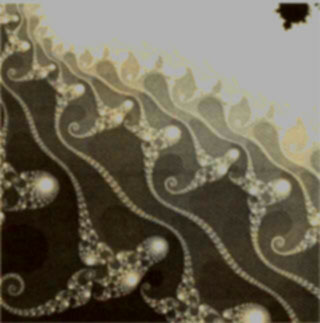
Fractals such as those pictured here result from feeding a
mathematical formula into a computer and having the formula
reprocess itself, over and over again.
However, the forms so produced do
resemble the famous "paisley" seen by many people who took LSD in
the 1960s. I would argue, first, that fractals are consistently seen
in altered states, and second, that the patterns thus seen may also
represent real, though supernatural processes in the cosmos at
large.
The fractal formations described in the Gaia Mythos (Episodes 9 -
10) are actual physical phenomena that occur spontaneously when an
Aeon (a mass-free, high-porosity current of stellar plasma) pours
into the dense fields of elementary matter. At first these "fractal
seahorses" seem to be inanimate structures, rigid and almost
crystalline in nature, but by the very fact that Sophia beholds
them, they become animated.
In the second stage of the unfoldment
described in Trimorphic Protennoia, the Aeon Sophia,
"descends to empower her fallen
members by giving them spirit or breath." (NHLE 1996, p. 511)
Thus the tensile forms morph from
semi-rigid seahorses into rounded fetal forms with tails, but the
tails, it seems, keep falling off and turning into other embryos. By
this bizarre process of self-repeating generation, the neonate horde
of the Archons emerges.
The Lord
Archon
The Hypostasis of the Archons describes a further development that
follows the initial emergence of the fetal Archontic
entities. In the passage cited here, I apply some concepts drawn
from modern astronomy to develop a more vivid picture of events
presumably observed by Gnostic seers in the cosmos at large:
A veil exists between the world
above [in the galactic core], and the realms that are below
[exterior, in the galactic limbs]; and shadow came into being
beneath the veil. Some of the shadow [dark mass] became [atomic]
matter, and was projected apart [partially formed into
elementary arrays, the dema].
And what Sophia created [by her
impact] became a product in the matter [the dema], [a
neonate form] like an aborted fetus. And [once formed] it
assumed a plastic shape molded out of shadow, and became an
arrogant beast resembling a lion. It was androgynous, because it
was from [neutral, inorganic] matter that it derived.
(The Hypostasis of the
Archons, II, 4, 93:30 ff, with my glosses in brackets.)
A close reading reveals a crucial
detail: after the initial formation of the embryonic Archon types, a
second variant of "shadow body" arises, with distinct
characteristics of its own. The Hypostasis of the Archons describes
it as "an arrogant beast resembling a lion," but this creature is
also described (in another cosmological text, the
Apocryphon of John 10: 5) as "a
serpentine body (drakon) with a lion-like face."
Thus there are two distinct types of
Archons:
-
a fetal or embryonic type
-
a drakonic or reptilian type
In
The Hypostasis of the Archons (93:
30 - 94:5), a supplicant asks the great angel Eleleth,
"Teach me about the faculty of the
Archons, how did they come into being, and by what kind of
genesis, of what material, and who created them and produced
their force."
The teachings given in response to this question
were precise and detailed. Two distinct variants of the Archon
type are indicated, and their behaviors are also specified.
Another cosmological treatise,
The Tripartite Tractate, states
that "the two orders [of Archons] assaulted one another,
fighting for command because of their manner of being."
(84: 5-15)
Due to the two distinct stages of their
generation, the Archons are invested with an aggressive and divisive
nature, fighting among their own ranks.
The problem is provisionally resolved,
however, when the reptilian type assumes dominance over the massive
horde of neonates, and, indeed, over the entire realm of the dema
affected by Sophia's plunge:
Opening his eyes, he [the drakonic
Archon] saw a vast quantity of matter without limit [spread
through the galactic limbs], and he became arrogant, saying "It
is I who am God [the sole deity of these regions], and there is
no other apart from me."
(Hyp Arch, 94:20)
While the neonate Archons are inert,
their forms arrested at a premature stage of development,
the
reptilian leader is aggressive, territorial, and charged with
demonic powers.
For one thing, he is a formidable shapeshifter:
Ialdabaoth had a multitude of faces
more than all of them, so that he could put a face before all of
them, according to his desire... He shared his fire with them,
therefore he became lord over them. Because of power of the
glory he possessed of his mother's light, he called himself God.
And he did not obey the place from which he came.
(The Apocryphon of John, 11:35 -
12:10)
The declaration of the chief Archon that
he is the only god in the cosmos is, needless to say, a defining
moment in Gnostic cosmology — if not in human evolution as well. All
the cosmological texts describe this event, with slight variations.
Gnostics were insistent on the identification of Yaldabaoth with
Yahweh or Jehovah, the tribal god of the Hebrews. This deity is not
only blind, but witless and insane (Hypostasis of the Archons 89:
24-25).
To Gnostics insanity is not so much
unsoundness of mind as the consequence of failure to correct mental
errors. The mentality of the Archons "cannot be rectified," and,
what's worse, "the archontic nature is not capable of development."
(Gilhus, The Nature of the Archons, p. 40) Due to the manner of
their generation, Archons have no ennoia, no innate intentionality.
Theirs is an Alien Dreaming, set apart
from the biosphere, the intelligent life-field of Gaia.
The concept of a god who is both void of will power and insane is
apparently unique to Gnosticism. Needless to say, when Gnostics
expressed their views on the identity of Jehovah to devout Jews and
to Christians who also revered the Jewish Father God, they were not
well received.
The Apocryphon of John adds crucial details to the Archon scenario.
For one thing, it presents a rare instance where Sophia is actually
called the mother of the Archons. It also says of the chief Archon
that "he did not obey the place from which he came." This is a
telling detail. The fact that the chief Archon moves away from the
places where he arose indicates a key concern of Gnostics: the
boundary-violating tendencies of the Archons. From the outset they
are an invasive species.
The drakonic Archon is said to be blind (Coptic bille), so he does
not see either the Pleroma or Sophia. "Blindness of the spiritual
world characterizes the Archons." (Gilhus, p. 17). He is called
Samael and Saklas. Samael is Hebrew and Saklas is Aramaic for "blind
one."
Understanding the blindness of the
Archons is crucially important to our detection of how they can
affect humanity.
Alias Jehovah
The chief of the Archons is also called the Lord Archon. He is also
given the bizarre name, Yaldabaoth (pronounced Yall-DAH-buy-OT).
Scholars disagree on what this name might mean, and how it was
derived. By one translation it means "the child who crosses space."
By another, it means "chief of the horde." (Jarl Egil Fossum, The
Name of God and the Angel of the Lord, p. 332-6.)
Thus it seems to slur together allusions
to both types of Archons. In the Old Testament the title yhwh
seba'ot, Yahweh Sebaoth, occurs 276 times as the title of the father
god. (Dictionary of Deities and Demons in the Bible, p. 155) Gershom
Scholem, pre-eminent scholar of the Cabala and Jewish mysticism,
explained Ialdabaoth as "a compound of the Aramaic active participle
yaled (i.e., 'to beget') and the name Abaoth, which represents an
abridged form of the name Sabaoth. Thus, Ialdabaoth means 'the
begetter of Sabaoth'." (Nathaniel Deutsch, The Gnostic Imagination,
p. 55)
And there are half a dozen more
interpretations.
It is likely that the name Ialdabaoth is simply a variant of
Jehovah, the paternal father god of the Hebrews. Gnostics identified
Jehovah with the Lord Archon and rejected the OT and the entire
Judaic plan for salvation as a subterfuge of the Archons. It makes
sense that they would have used the same term used by Jews to expose
the true nature of the Jewish deity.
When it came to knowledge that they considered crucial to human
survival, and to humanity's co-evolution with Sophia, Gnostics could
be confrontational, and totally unconcerned about whom they might
offend.
Their uncompromising and sometimes scornful attitude,
combined with their failure to anticipate the high degree of
physical violence that would be triggered by their challenge to
Judeo-Christian beliefs, undoubtedly fuelled the vicious fanatisicm
that destroyed the Mysteries.

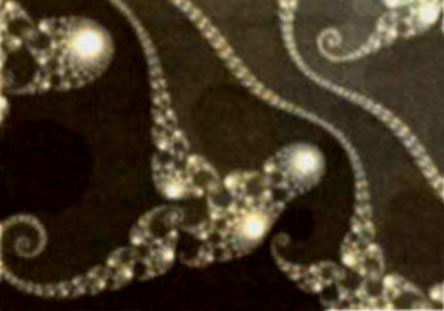
Magnification of the fractal Archon generation presents a graphic
image that seems to fit the scenario described by Gnostic seers.
The
embryonic type, or neonate Archon, is clearly defined, but so is
another entity: the reptilian Archon with its avaricious jaw and
long spermatic tail. This "arrogant beast" seems to lunge at the
entrails of the embryonic type. Right at the point where the
embryonic Archon would have a nurturing umbilicus, the reptilians
move in invasively. The neonate Archon remains passive, apparently
sucking its finger or thumb!
Something odd is happening in the lower part of the neonate's body,
for its seahorse-tail is precariously jointed to the torso. The
embryonic type remains self-absorbed, but reacts to the aggression
of the other type by dropping its tail, as frightened reptiles do.
We wonder if the disjointed tail will form another neonate, or
another reptilian. The reptilian form does appear to be fractally
repeated in the tail-structure of the embryonic type, as if the tail
broke off and became an entity of its own, rather than another
embryo.
The element of fear figures largely in the behavior of the Archons
and their effect on humanity. In the Old Testament, fear of God is
held to be one of the primary marks of religious experience. The
possibility that human fear is a kind of nutriment for certain
invasive extraterrestrials has been widely argued in the ET/UFO
debate. The Second Treatise of the Great Seth says that the agenda
of the Archons is "fear and slavery." The Archons wish to keep
humankind under "the contraint of fear and worry." (NHLE 1990, p.
367) Other passages also warn against the Archons' use of fear as a
psychological weapon.
In another striking detail, the reptilian type seems to be holding a
sphere in its jaws, recalling the mythical image of a serpent who
offers forbidden fruit: for instance, the Serpent in the Garden of
Hyperborea with the golden apple in its mouth. Is the neonate eating
from this rounded fruit? Gnostics had their own version of what
transpired in the Garden of Eden, events in which the Archons were
deeply involved, and so it is perhaps not surprizing to see hints of
the Paradise scenario at this primal stage of cosmic activity.
All this activity in the fractal generation of the Archons is
imaginal, but it is not imaginary, i.e., not purely made up in our
minds. Recreating what Gnostic seers observed is a sober use of
imagination, not a flight into make-believe.
It takes non-ordinary reason to describe
what is happening here, but the scenario so developed is entirely
reasonable and coherent on its own terms.
Fetal Conflict
However the Gnostic seers of the Mysteries came to imagine the
generation of the Archons, the high-iteration fractals around the
Mandelbrot Set fit their scenario in an uncanny manner. And they do
more as well, for the fractal embryos and reptilians also mimic
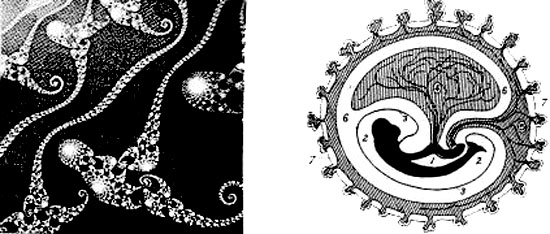
features of human gestation (or vice versa). In human conception,
the embryonic sac consists of two parts: the yolk sac (4 in the
illustration below), and the foetal mass attached to it (1),
suspended in amniotic fluid (2).
At the moment the developing embryo
gains initial anatomical definition, it is fish-like (a fact that
medical science likes to use to remind us of our pre-human origins).
It has a distinct head, and a tail, and a third feature, the
umbilicus that connects it to the yolk sac through which it is fed.
The fractal generation of the Archons exhibits all these features in
a clear and precise manner.

As the embryo grows, the yolk sac (4 in
above image) contracts, and there is at the
same time a secondary development. Also connected to the umbilicus
is the allontois (5), a vesicle that fills the interspace between
the amnion (3) and the chorion (7), the outermost boundary of the
entire placental sac. A kind of morphological tension plays between
these evolving structures: for the allontois to grow, it must
contract or press back (repress) the yolk sac that feeds the growing
fetus.
Unless the allontois grows in this
manner, the protective placenta cannot be fully matured. A similar
tension pertains between the embryonic Archons and the reptilians.
Just as embryonic development in humans is divided between the
growth of the fetus fed from the yolk sac, and the repression of the
yolk sac to produce the full-grown placenta from the allontois
membrane, the power of the Archons is divided by the nature of their
generation ("because of their manner of being," cited above)
This conflict is partially resolved when
the reptilian type assumes dominance over the massive horde of
neonates.
Gnostics certainly knew what an aborted fetus looks like. Morally
opposed to biological procreation by humans, they were known to
practice birth control, and must have assisted others to do so. They
would have known from direct observation that the fetus aborted at
an advanced stage of gestation does not resemble a half-baked
omelet; it has the vestiges of anatomical form.
Their choice of this bizarre metaphor
must have been intentional, reflecting the occult perception that
Archon anatomy mimics the neonate form of humans. Such a metaphor is
extremely valuable, not only because it allows us to visualize what
Gnostic seers detected by extrasensory perception, but also because
it establishes a close tie between the human species on earth and
the pre-terrestrial Archons.
For more on this tie, see the closing passage, "Cosmic Cousins."
The Serpent
Power
The description of a "lion-headed serpent" for the Ialdabaoth is
arresting. For Gnostics the lion represented the blind force of
procreation (an association that probably stems from Egyptian
Mystery schools, not to mention observation of the force and noise
of lions mating in the desert), so the sperm-like body of the
lion-headed reptilians is even more appropriate.
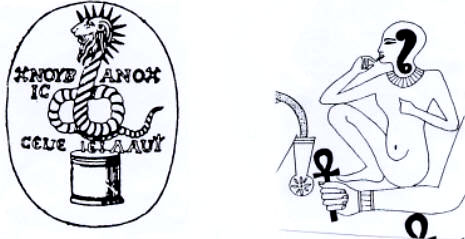
This drakonic type of Archon appears on
Gnostic germs, not because the Gnostics worshipped the reptilians—
far from it— but because they viewed the image as a magical antidote
to Archontic influence. Rather in the way a skull on a label
indicates a poisonous liquid, thus preventing us from mistaking it
for a liquid that is safe to drink, the lion-serpent image was
represented on Gnostic amulets to ward off Archontic intrusion.

The lion-headed serpent of the Gnostics is called by magical names
such as Ophis, Knuphis, and Abrasax.
In the occult anatomy of Asian
mysticism and Yoga, this reptile is known as Kundalini, the serpent
power. Gnostics who practiced Kundalini yoga were called Ophites,
from the Greek ophis, "snake." This cult was condemned by early
Christians as pagan "snake-worshippers."
To the mundane and uninitiated mind, the
Kundalini serpent can only be conceived by crude literalization. To
Gnostics, the lion-headed serpent crowned with solar rays was not
only the image of the Lord Archon, but also of the source of
spiritual power that allows human beings to resist that entity.
Experts who do not look outside Gnosticism to understand it never
mention Kundalini, but unorthodox and esoteric scholars such as G.
R. S. Mead, Helena Blavatsky, and C. W. King (Gnostics and Their
Remains) make the connection routinely, as do comparative
mythologists such as Joseph Campbell and Alain Danielou.
In The Inner Reaches of Outer Space,
Campbell shows how the image of Kundalini, the "serpent power,"
appears in world art from the Indus Valley circa 2300 BCE and
continues right across the spectrum of ancient cultures, well down
into the Common Era. As late at the 16th century, golden thalers in
Germany (Campbell, Fig. 8) showed the Crucifixion on one face and a
serpent draped over the cross on the other.
At that late date, Christ would have
been identified with Kundalini — without an inkling of why, however
— but to Gnostics the snake on the cross was a cancellation of the
saving power attributed to crucifixion (i.e., the glorification of
suffering as a redemptive force). Arousal of Kundalini produces
ecstacy, triggers superconsciousness, opens the occult faculties,
and releases waves of healing energy that flush physiological and
hormonal secretions through the body.
As the mythical serpent guarding the Tree of Knowledge in Genesis, Kundalini was "the messenger of salvation" for Gnostics. In a
complete reversal of the usual reading of the Fall, Gnostics
regarded the serpent as a spiritual ally to primal humanity,
"the
first to attempt to release mankind from bondage to an unknowing god
who had identified himself with the Absolute and thus blocked the
way to the tree of eternal life."
(Campbell , p. 78)
The "unknowing god" who falsely
identified himself with the Absolute is of course Yaldabaoth, alias
Jehovah.
Gnostics taught that nous, the spiritual intelligence endowed in
humanity, could be blocked by the Archons. This occurs through
Archontic intrusion (subject of the forthcoming companion essay,
How We Are Deviated), involving a kind of subliminal invasion at the
level of thought and language (i.e., mental syntax). But nous could
be reinforced through accessing the power of Kundalini, an ecstatic
current that normally rests dormant in the human body.
In his monograph on the Archons, I. S. Gilhus notes that,
"the erotic strategy is the most important means
used by the pneumatics to save the lost light."
(p. 51)
Pneumatics
is the Gnostic terms for humans who pursue the path of psychosomatic
illumination, the key method of Gnostic religion. Pneuma, "spiritual
force," is developed by cultvation of nous, "higher intelligence."
But the Archons present a blind field of resistance to this process:
in short, they rely on humans remaining ignorant of their inherent
spiritual potential.
When Kundalini is raised from its dormant state, higher intelligence
blossoms, and there are other effects as well. Gnostic sects such as
the Ophites practiced the communal raising of Kundalini to produce
an protective envelope against Archontic intrusion. In effect, they
held Kundalini, the sexual-spiritual energy locked in the body
structure, to be the main instrument of defense against the Archons.
The Dialogue of the Savior, NHC III, 5
(85), contains this exchange:
Judas said, "Behold, The authorities
(Archons) dwell above us, so it is they who will rule over us."
The savior said, "It is you who will rule over them. But
only when you rid yourselves of jealousy, and take on the
protection of the Light, and enter the nymphion (bridal
chamber)."
The savior-teacher is emphatic that we
have power over the Archons, but he also makes it clear that some
human failings impede the use of our power. The Greek word phthonos
may be translated as "jealousy" or "envy." Gnostics considered envy
to be the signature of the Archons, as well as the key human failing
that makes us vulnerable to their intrusion.
"The protection of the Light" comes
through activated Kundalini, often described as a lightning-like
tide of electrified light that pours through the body. "Nymphion" is
a code word for the ambient cell of psychophysical protection
generated by high levels of Kundalini.
Sir John Woodruffe, the great transmitter of Hindu Tantric wisdom to
the West, directly identified the practice of Kundalini yoga
(raising the serpent power through the channels of the spine) with
Gnostic rites of "serpent worship." (Shakti and Shakta, p. 191 ff.)
Buddhist scholars such as E. A. Evans-Wentz,
J. M. Reynolds, and H.
V. Guenther have made similar observations, but Gnostic scholars
have not reciprocated because they do not look outside their genre
to understand the theory and practice of Gnosis.
The lion-serpent image is displayed over and over in hieroglyphic
form on the walls of the Temple of Horus at Edfu, forty miles south
of Nag Hammadi. In the cult of Hathor celebrated there, the
lion-serpent represented the "royal seed" of the pharaoh. The royal
child Horus is often depicted in a finger-sucking gesture that
vividly recalls the posture of the embryonic Archons.
Did Egyptian priests who directed the
breeding of the dynastic families have intimate knowledge of
Kundalini, as well as the Archons?
The Kundalini serpent is displayed in
Egyptian sacred art by a standing cobra, or a pair of cobras,
sometimes wound on a staff, and by the uraeus, the cobra headress of
divine empowerment. The ceremonial braid on the side of Horus' head
was yet another indication of the serpent power. The pharaonic
braid, traditionally worn on the right side of the head, visually
repeats the form of the spermatic cobras of Edfu. The sacred
iconography carries explicit, but highly occult knowledge: Horus is
the child who right-brain cerebral functions are heightened by the
serpent power.
The "esoteric" imagery of the serpent power operates at several
levels at once. We shall see that the complex biological symbolism
of Gnostic myth has much to teach us about the nature of the
Archons, as well as how we can resist them.
The Rape of
Eve
Ialdabaoth is also called the Archigenetor, "the master breeder." (Apoc
John II, 12, 25)
Gnostics, to whom ethics must be consistent with
cosmology, regarded biological procreation, insofar as it is an
involuntary act, as a mindless mechanism that makes humans accessory
to the head Archon. How Ialdabaoth breeds his own type, and controls
the breeding of the embryo-types, and may even be involved in
interbreeding with humans — are some of the more baffling elements
in the Sophia mythos.
Several texts in the NHC describe the
Archons' attempt to "rape Eve": i.e., inseminate the human species.
The texts make it clear, however, that they do not succeed in their
aims.
The Hypostasis of the Archons describes this episode:
Then the Archons approached Adam. and when they saw his female
counterpart speaking with him, they became greatly agitated and in
arousal for her. They said to one another, "Come let us sow our seed
in her," and they pursued her.
And she, the mother of the living,
laughed at them for their witlessness and blindness; and in their
clutches she turned into a tree, and left before them her shadowy
reflection resembling herself.
(89: 15-25)
This passage demonstrates the imaginal sophistication of Gnostic
vision. Gnostics seers discerned the Archons attempt to inseminate
Eve — to interfere in the genetics of the human species, if you will
— but they also observed that the attempt was a failure. The
metamorphosis of Eve into a tree recalls the Greek myth of Daphne
who turned into a laurel.
(This parallel shows that Gnostic cosmo-mythology
was not a fluke, but a system of visionary knowledge deeply rooted
in the indigenous mind of pre-Christian Europe.)
For Gnostics, the visions they beheld in
altered states were empirically true and could be tested. By doing
so, they were able to develop extraordinary insight into the
superhuman worlds, the activities of the gods, the relation of
humanity to alien species, and the long-term experience of the human
species.
The above scenario describes how the Archons fail to capture Eve,
yet they somehow engage her shadow, a mere reflection. This implies
that although the Archons cannot access our genetic structure, they
may affect or distort our image of woman, of the Feminine, and in
that sense they really can succeed in defiling Eve. They may distort
our sense of our own genetic make-up.
As it so often does, Gnostic insight into cosmic order challenges us
to understand what is happening in our own minds. Is there some way
in which we humans have defiled the image of woman? For instance, by
imposing on women an artificial notion of identity, a falsification
of their true nature? If so, we would be regarded by Gnostics as
accessory to the rape of Eve by the Archons.
Is there evidence in
the world today that we have a distorted view of genetics?
If so, this distortion, and the actions
that proceed from it, would fully merit being regarded as
consequences of the Archons' deviating effect on human behavior.
Enter The
Anunnaki
The above passage from The Hypostasis of the Archons calls to mind
current scenarios of alien intervention in human genetics. Most
theories of the ET breeding program assume that whatever the aliens
(usually, the embryonic Grey types are suspect) might choose to do,
they can do. But Gnostic seers who applied non-ordinary reasoning to
their observations of the Archons reached a different conclusion. In
the Gnostic view, it would be a huge error to assume the Archons are
doing things they cannot do, for that would give them power over us.
Gnostics taught that the main danger we
face with the Archons lies less in what they can actually do than in
what we falsely believe they can do. Their trump card is deceit (apaton
and plane in Greek), especially deceit about the nature and extent
of their powers.
"For their delight is bitter, and
their beauty is depraved. Their pleasure is in deception."
(The Apocryphon of John BG 56,
3-7)
Strange as they are, certain elements in
the Gnostic mythos of our species may now begin to look familiar. The
theme of alien insemination of the human race also occurs in archaic
narratives from
ancient Sumeria, dating to the third millennium BCE,
and it is rampant in contemporary ET/UFO lore. Sumerian accounts
describe an alien species called the Anunnaki, who are credited with
producing the human species by genetic engineering, and also with
inaugurating civilization.
These narratives are found on cuneiform
tablets dating to circa 1800 BCE, but they preserve late redactions
of much earlier versions. Apparently, the story about alien
intervention is one of the oldest scripts of our species. Many
people who follow the ET/UFO debate are aware of the Sumerian
accounts of the Anunnaki, who are easily equated with modern-day ETs,
but there is a total absence of reference to the Gnostic scenario of
the Archons in the controversy so far.
The Gnostic account of Archon/Anunnaki activities differs on many
significant points from what is found in the Sumerian accounts. For
one thing, Gnostics did not regard Archons as superior beings who
jump-start civilization. Nor did they consider the Archons capable
of accessing the human genome (called by them the Anthropos),
although they did grant some role for Archontic activity in our
physical evolution.
This point is extremely difficult to
clarify, however... By far the most striking difference between the
Sumerian and Gnostic accounts is that the former contain no inkling
of the Sophia mythos and no explanation of how the Archons, alias
Anunnaki, originated. This is a considerable lacuna, to say the
least.
In his elaborate reworking of the Sumerian materials,
Zecharia Sitchin describes
the Anunnaki as a highly advanced
non-human species who inhabit the planet Nibiru, an outrider of the
solar system with a period of 3600 years. In Sitchin's version of
prehistory, the Anunnaki came to earth in quest of gold for
manufacturing a colloidal suspension needed to stabilize their
atmosphere. (For a full account, see Sitchin's last book,
The Lost Book of Enki.)
Although Sitchin appears to be a
legitimate Sumerologist with a profound grasp of ancient languages,
no orthodox scholar endorses his scenario for the Anunnaki. At
worst, it is dismissed as an "ancient astronauts" fantasy dressed up
in scholarly robes. I am unable to say whether Sitchin's account of
the Anunnaki on
Nibiru is an accurate rendition of cunieform texts
or a fantasy extrapolated in his mind.
Significantly, Sitchin never describes the physical appearance of
the Anunnaki of either type. One of the great benefits of the Gnostic Archon scenario is that it does provide vivid descriptions
of these entities.
-
Is it a coincidence that the
embryonic and serpentine Archons described in Gnostic texts
present an identical match to the two kinds of ETs most
frequently reported in modern times,
the Greys and
the
Reptilians?
-
If the Gnostics got this part of
the intervention scenario right, what else did they get
right?
Cosmic Cousins
The same manifestations that
created our religious beliefs,
created our UFO beliefs. A serious look at the
Phenomenon
would cause a revision of our way of looking at
religion.
John Keel
UFO: Operation Trojan
Horse
It is startling to find vivid and
detailed descriptions of predatory aliens in obscure texts dating
from the 4th century CE, but the revelations of Gnosis are nothing
if not startling. Some ancient reports of "UFO sightings" do exist,
but Gnostic material on the Archons does not merely present
"reports."
It explains their origins in the cosmic
order, their nature (inorganic, imitative, without intentionality),
their appearance and tactics, their attitude toward humanity, and
more. A more clear and coherent solution to "the Phenomenon" (the
ET/UFO enigma) could hardly be imagined.
The "high strangeness" of the Gnostic Archon material poses a
credibility issue, of course. We are faced with the choice of
believing that these texts represent an accurate account of what
Gnostic seers observed in states of non-ordinary reality — that is,
a reliable report of genuine parapsychological research achieved by
remote viewing,
lucid dreaming,
clairvoyant observation, and then
carefully assessed by non-ordinary reason — or believing that
Gnostics were mere fantasists, mystics deluded by their visions,
wacko cult weirdoes, or worse.
How, then, can we determine if the Gnostic account of the Archons
was delusional or if it presents reliable knowledge of alien
intervention?
In Sources of the Gaia Mythos, I discussed the indigenous concept of
the Dreamtime, the timeless play of creative awareness in the
Eternal Now, and its variant, Dreaming:
When the Dreamtime comes to expression
in particular knowledge and behavior, the Aborigines refer to the
Dreaming of the creature who embodies that knowledge and exhibits
that behavior. For instance, the Kangaroo Dreaming is the summation
of the innate knowledge and instinctual behavior of all kangaroos,
going back to the Dreamtime ancestors. One could say, in biological
terms, it is the enactment of the genome of the Kangaroo species.
All creatures, organic and inorganic, human and non-human, live and
die by the Dreamings that play through them. In the Aboriginal
worldview the unique gift of humans to create culture stems from our
capacity to remember and retell the Dreaming, not only of our own
species, but of others as well. The indigenous belief that the role
of humanity is to remember the events of the Dreaming for all
creatures accords with the suggestion presented in Sharing the Gaia
Mythos: the human species enables a memory-circuit for Gaia.
To apply these ideas to the problem of the
Archons, let's recall
that we, the human species, are involved in a special way in Gaia's
Dreaming, which originates from the trimorphic protennoia, the
threefold primal intention of the Aeon Sophia. Our proper boundaries
are defined by the earth-moon-sun trinity, and our wisdom endowment
unfolds, given by Sophia, unfolds within the unique conditions of
the biosphere, the womb of Gaia. However, there is another Dreaming
that leaks into the Earth Dreaming, rather like a wireless message
that bleeds through into a conversation in progress on another
frequency.
Something extremely weird is happening on Earth due to a fissure in
the human mind, and this fissure in turn arises from an anomaly in
the cosmic order.
"The world system we inhabit came about by a
mistake."
(The Gospel of Philip, NHC II, 3, 75.1)
The magical
journey of awareness in which we co-evolve with Gaia's Dreaming is
deviated or distorted by an alien influence, so the Gnostics taught.
On this recondite point they seem to have agreed with
the old Yaqui
sorcerer, Don Juan, who said to Carlos Castañeda,
"Human beings are
on a journey of awareness, which has been momentarily interrupted by
extraneous forces."
In the companion essay,
How We Are Deviated, we will look more
closely at how Gnostics described the intrusion of these extraneous
forces, the alien entities who are also our cosmic cousins.
Everything we learn about the Archons teaches us something crucial
about ourselves.
|