|
|
|

|
from SouthPoleTelescope Website
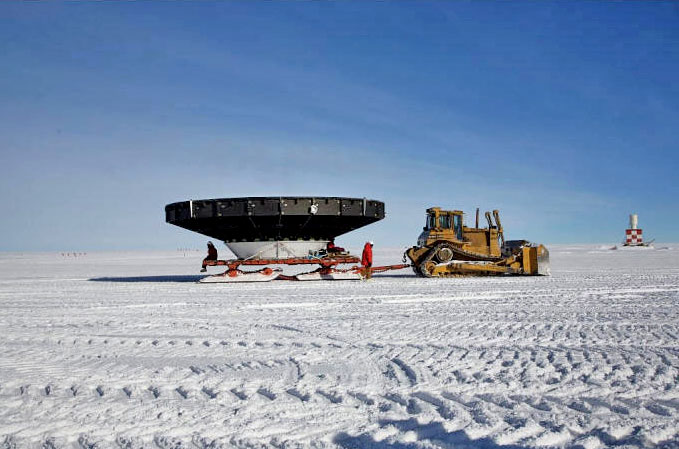
The South Pole Telescope is a huge undertaking!
More than thirty scientists and engineers make up the team to build and operate this enormous instrument, and many more people are involved in supporting the effort at the South Pole Station.
Building this telescope in one of the most extreme locations on the planet has posed unique challenges.
The SPT is one of many powerful instruments being used to address
these questions.
After all, where would you start? Remarkably, the Universe has properties and "fossils" in it that indicate that we can learn about its history, age and development as a whole. The familiar "Big Bang" model makes concrete predictions for measurable phenomena, allowing the model to be experimentally tested.
So far the Big Bang model has passed all the tests.
Perhaps more importantly, the Big Bang model unifies a diverse set of measurements and observations into a single picture for how the Universe began and how it has evolved.
While the core concepts of the Big Bang picture are on very solid footing, observations have also uncovered mysterious features of the Universe that are not yet understood.
One outstanding question is the fundamental question of what makes up the Universe. We all know about matter: we, the earth, the sun and all the stars are made up of matter.
However, observations of the Cosmic Microwave Background (CMB) and careful measurements of the distances of certain kinds of supernova explosions both give evidence (agreeing with each other in a most surprising and pleasing way) that matter is only about 4% of what makes up the Universe.
These measurements and others indicate that we need not just one, but two other major components in the cosmic inventory.
We have called them Dark Matter (DM) and Dark Energy (DE), because they are not visible directly to our observations.
These things are needed in the model because without
them, we cannot explain the measured properties of the CMB,
supernovae, or other features of the observable Universe.
One of the first goals of the SPT is to try to confirm the existence of the Dark Energy and find out something about its properties. The effect of Dark Energy is to push things that are very far apart even further apart - opposite to the usual force of gravity that pulls things together.
If this is true, it will have an effect on how the biggest things in the universe, clusters of galaxies, grow with time. The first set of measurements the SPT will make is to make an accounting of the number and sizes of galaxy clusters as the universe ages.
The telescope will use the fact that the clusters affect the CMB a little bit as it passes through the gas in the cluster.
The fact that the cluster gas would have this effect was first proposed by two Russian Astrophysicists, Yakov Zel'dovich and Rashid Sunyaev in the '60s, so the effect was named the Sunyev-Zel'dovich effect. Making a careful map of the CMB over a big region of the sky allows us to find all the clusters and determine their sizes individually.
The number of clusters we will
find could be as many as 50,000 or as few as 5,000.
The South Pole Telescope is quite different from these optical telescopes that look at the usual visible light. It observes light with a wavelength longer than that of infrared light but shorter than the wavelength of radio waves.
The CMB arrives at the earth from all directions having traveled for billions of years through space since its birth in the early universe.
To observe the CMB light we need a very clear atmosphere, without much water vapor which absorbs this light. This is the primary reason the telescope is situated at the South Pole [more (link to page on why at the south pole)].
The questions that we try to answer with this South
Pole Telescope are big questions about the universe as a whole,
rather than questions about the stars, galaxies, or other objects
that make up the universe.
When you look at an image (like a Hubble Space Telescope image) of a galaxy cluster in optical wavelengths, the cluster looks like an association of a number of separate but distinct galaxies. When these clusters were first discovered and studied, the term "galaxy cluster" was a simple description of what the observers saw in their images.
However the name "galaxy cluster" hides the fact that clusters are gravitationally bound, distinct objects. Most of the ordinary matter in a galaxy cluster is not found in the galaxies but is more diffuse, hot gas.
Most of the total mass of the cluster is not even
ordinary matter as we know it but is dark matter, which is a type of
matter that does not emit light but does interact through gravity.
They are also the youngest class of objects, as it has taken the age of the universe for them to gather all their mass. During the epoch of cluster formation, a mysterious component of the universe known as Dark Energy appears to have played an important role in the universe. Dark energy inhibits the growth of galaxy clusters over time.
If we can trace out how many large-mass clusters have formed throughout different periods in the history of the universe, we can probe the tug-of-war between gravity (through which matter clumps together) and dark energy (which impedes cluster formation by causing space to expand more rapidly).
This is one way
that we can learn more about the role that dark energy has played.
The universe was a soup of particles and high-energy (short wavelength) light. As the universe expanded and cooled, atoms were able to form out of the particles, and the light was able to escape from the particle soup and travel freely through space.
As the universe expanded and cooled even more, the wavelength of this light was stretched out so that what was once the high-energy "glow" from the hot early universe became the Cosmic Microwave Background - a background radiation everywhere in the universe that is characterized by relatively long wavelengths of around a millimeter.
A telescope sensitive to millimeter-wave light will see the CMB in
every direction from the earth, and the slight variations in the
intensity of the CMB light encode valuable information about what
the universe was like back when it was a hot soup of particles and
radiation.
Most of that light has traveled freely through empty space, without being scattered by intervening matter. However, when CMB light travels through the dense interior of a galaxy cluster, a tiny fraction (1%) of the light may collide with electrons in the hot gas in the cluster's core.
The fast-moving electrons can
transfer energy to the CMB light. Some small amount of the CMB light
that has passed through a cluster has had its energy boosted through
this effect (called the
Sunyaev-Zel'dovich effect) and therefore has
a shorter wavelength than the rest.
Instead, we see holes in the background light where the clusters are.
Thus we can locate galaxy clusters by finding "holes" in the cosmic microwave background. If our telescope is sensitive to multiple wavelengths of CMB light, we may also be able to directly see the higher-energy light that has been boosted through the Sunyaev-Zel'dovich effect.
The South Pole Telescope will eventually be sensitive to multiple
wavelengths of CMB light to aid in identifying the locations of
galaxy clusters.
No single technique is perfect, and the best approach is to use many different techniques to find and study galaxy clusters. One key advantage to using the Sunyaev-Zel'dovich effect is that it allows us to look for galaxy clusters that are very very distant (and therefore formed very early in the universe).
While distant clusters would be too faint for optical surveys to find, the distortions that they cause in the CMB are no different than those caused by nearby clusters, and the SPT will be able to detect them in the same way. The SPT will be able to look back to when the very first large clusters formed.
Additionally, the degree to which the CMB light is affected by a given cluster depends on how massive that cluster is, because a more massive cluster has more hot gas to scatter CMB light. The Sunyaev-Zel'dovich effect therefore leads to a measurement of the mass of each cluster that we observe.
This is an
important quantity to trace over cosmic history, because the rate at
which massive clusters form is sensitive to Dark Energy.
|