|
by Nikhil Mahant
Close Encounters of the Third Kind (1977) by Steven Spielberg.
Photo by Getty
Images might communicate prepares us for first contact and illuminates the nature of our own languages...
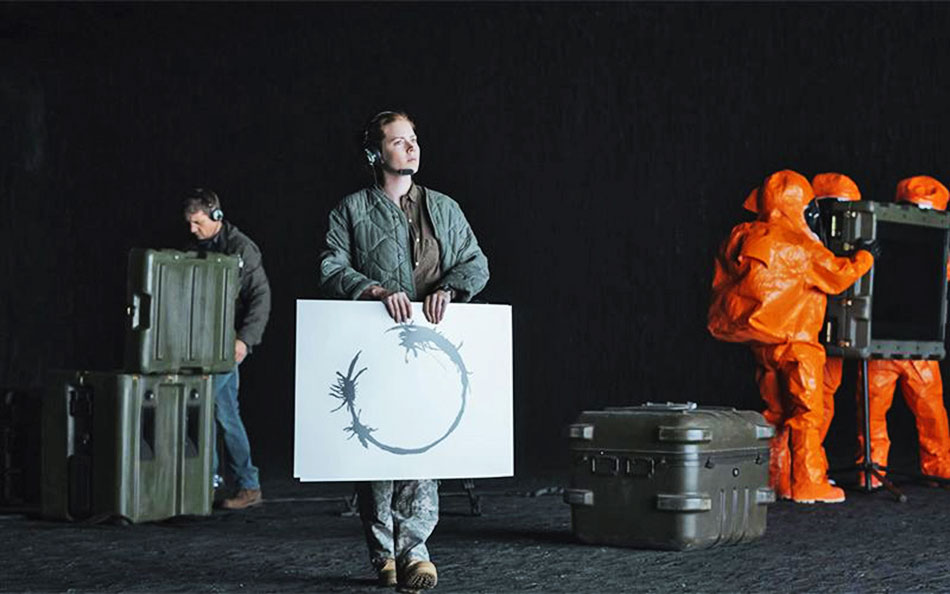
The aliens - dubbed Heptapods - are obliging enough to provide room in their spaceship for linguistic exchanges, but the team charged with translation is baffled.
The creatures write in sentences that look like
circular smoky inkblots, unlike anything on our planet.
Apart from the sci-fi twist that learning it imparts special abilities, the Heptapod language is not very different from ordinary human languages.
The symbols are strange and circular, sure, but they still stand for words belonging to familiar grammatical categories like nouns and verbs, and can be translated into English.
© Paramount
In fact, a major plot element in the movie is the mistranslation of a Heptapod noun meaning 'tool' as 'weapon'. The situation is similar with several other nonhuman languages in fiction.
Consider Klingon from Star Trek, now spoken by several Earthlings.
Klingon's claim to alienness is that it contains a peculiar set of sounds and an unusual sentence structure.
The same is true of other fictional languages like,
Even outside fiction, imaginations are rather impoverished.
The development of constructed languages (referred to as 'conlangs') for fictional and other purposes draws primarily from linguistics.
But, as a science, linguistics generally focuses on discovering the general rules governing actual, observable human languages - their sounds, symbols or gestures, their grammar, the elements and structure of their sentences, the meanings of their expressions, etc.
And while conlangs may have unique
vocabularies or flout one or more rules of human languages, the
formula for creating one essentially involves adapting familiar
elements from how Earthlings communicate.
The space of possible languages is vast, and full of exotic languages that are much weirder and stranger than any we have yet imagined. We should explore what those might be - and for more than intellectual curiosity alone.
If we one day encounter aliens through first contact or a signal sent across the galaxy, their language might be nothing like ours. After all, humans have evolved with certain cognitive abilities and limitations.
Expecting intelligent beings with alternative
origins to use languages like ours betrays an anthropocentric view
of the cosmos. If we want to move beyond exchanging prime number
sequences to figuring out what the extraterrestrials are actually
saying, we need to be prepared.
A language can be thought to contain four levels, corresponding to four features of human languages:
While an alien language might not share all these features, it's helpful to know what they are before we venture into extraterrestrial strangeness.
Perhaps the easiest is to make changes at the first level:
One could cook up an alien language by adopting an arbitrary set of phonemes that no spoken human language has.
For
a written language, one could choose an entirely new set of symbols.
In principle, any familiar Earth language can be used as a 'base' to construct such a language.
The resulting alien language will seem very
different from the base language, even when the alien language is
identical to the familiar language at the level of structure,
semantics and pragmatics.
of an alien language
be the
same as human languages?
Word and sentence structure differs across human languages:
The word order in a sentence can vary across languages too.
A majority of languages have sentences beginning
with a subject - a referring expression like a name or a noun phrase
like 'the tiger' - but a tiny minority have them beginning with a
verb.
An alien language may lack words of some grammatical type:
Such a language may 'nominalise' verbs, adjectives or other parts of speech in a way analogous to the gerunds of English.
For example,
For instance,
These claims are still
controversial, but they give us all
the more reason to drop the simplistic assumption that the words of
an alien language should belong to the same grammatical types that
words of human languages do.
Philosophers have been toying with such languages for some time.
In his Tractatus Logico-Philosophicus (1921), Ludwig Wittgenstein proposed a 'logically perfect' language whose elementary sentences contain only simple signs, analogous to names like Xi Jinping, Colosseum or Bogota that refer to individuals, objects and places.
Wittgenstein thought that the sentences of the
language are true when the configuration of names that they contain
correctly 'picture' or represent the world.
may be less like English, Swahili or Cantonese,
but more
like maps...
The objects have properties, relate to each other in different ways, and are themselves arranged in complex patterns in space and time.
For example,
How can a mere configuration of names represent such facts, which include patterns, properties or relations?
Wittgenstein himself thought that the world - including properties and relations - was itself an enormous collection of objects arranged in different configurations.
But even if we reject Wittgenstein's quixotic view about what the world is like, we can imagine that the logical language can represent facts using, again, sequences of names.
Alternatively, the logical language could represent them using different distances between names, or different spatial arrangements of names in a sentence.
However one decides, such 'Wittgenstein languages' are plausible candidate languages whose words belong to a single grammatical type:
An alien language could behave similarly...
For instance, it may not have words and
sentences, and, if it does, they may belong to grammatical types not
found in any human language.
It is difficult to identify words or sentences on a map. One may think that the icon for a church is a sign that corresponds to a noun phrase, such as 'the church'.
However, there are so many differences between the properties of map elements and linguistic elements that they cannot be considered the same.
For example, map elements 'update automatically':
But there is no corresponding phenomenon in natural language.
Languages that differ at the level of sign or structure will appear quite alien.
But they may still be translatable into a human language like English. Such alien languages may have elements that refer to the same objects, or convey the same meanings that some English words and sentences d
The sentence Aristotle Plato Socrates in a Wittgenstein language may have the same meaning as the English sentence 'Plato is the teacher of Aristotle, and Socrates of Plato' (if, say, the space between names represents the relation 'is the teacher of').
An icon of a church in the middle of a green
patch on a map may translate into English as 'The church is located
in a park.' It may be possible to match elements of two languages
that differ only at the first and second level as translations of
one another.
To some extent even different human languages exhibit untranslatability of this kind.
A human language may have a noun or verb with a meaning that no noun or verb of another human language does.
We can also imagine alien languages that raise this sort of problem.
Some elements of an alien language may be untranslatable into human languages because they refer to an alien sentiment or some astronomical object that the aliens have discovered but we have not.
However, this problem is, in principle, solvable.
The object or phenomena described by a noun or verb from one language can be described using a collection of words (if not a single word) from another language.
And if we have not yet discovered the object or phenomena described by some elements of an alien language, we may make further discoveries and expand our knowledge of the world, and coin new words or phrases that describe them.
These new words in our language will then serve
as translations of the alien elements.
As humans with a certain set of evolved cognitive abilities, we perceive the world as structured in a certain way. For instance, we perceive it as containing objects, actions, properties and processes.
The kind of meanings that the elements of our languages have reflects our way of structuring the world.
For
instance, proper nouns have objects as their meaning, verbs refer to
actions, and whole sentences represent facts.
the aliens
may need concepts like 'truth' and 'falsity'
The language of this species would reflect its own way of classifying the world with categories that we do not have the cognitive capacities to grasp.
Unless we know what element of the world a fragment of an alien language corresponds to, coining a new word in our language would not help. The elements of such an alien language are radically untranslatable, not because we cannot know what they mean, but because we would not even know what kind of meaning they have.
In his book Alien Structure (2024), the
philosopher Matti Eklund argues that it is indeed possible
for such radically untranslatable languages to exist, and does so
even without appealing to differences in cognitive apparatus.
For example,
Even if their language is very
different from ours, the aliens may need concepts like 'truth',
'falsity', 'description', 'question', etc.
If we identify a set of elements in an alien language that serve as descriptions or commands, we can match them up with our indicative or imperative sentences.
And if we can figure out when the aliens take a
description to be 'true' or 'false', we may even be able to narrow
it down to a set of sentences that correspond to the alien
description (even when we do not know the exact meaning of the words
in the description).
He argued that Albert Einstein changed the concept of 'mass' so much from Newtonian mass that the two are incommensurable and untranslatable (the amount of Newtonian mass in the Universe is constant, but Einsteinian mass is convertible with energy).
However, the fact that we can understand both
Einsteinian and Newtonian physics should give us hope of being able
to understand the concepts expressed by an alien language,
especially if the differences are not too radical and too pervasive.
Recall that Klingon employs different signs and a somewhat different structure, but mirrors human languages at the other levels. But, in practice, we should expect real alien language to differ at multiple levels.
Aliens who perceive the world to be structured
differently would also have a language with grammatical and
syntactic elements different from familiar languages. So, it is
quite unlikely that aliens have a language that is different only at
the fourth, pragmatic level, while being just like English at the
other levels.
These creatures can 'eat a horse' if they are happy, and one is 'a chicken' if they are prone to run in a zigzag manner.
Further, human languages have implicatures, which communicate things that go beyond what is literally expressed (like the sentence we saw earlier: I'm here with my partner, which serves as a polite refusal of a dance invitation).
The norms governing alien communication may be
different, resulting in implicatures of a different kind. Unless we
know the relevant conventions, we will not understand fragments of
this language.
If so, alien pragmatics can be much different,
and weirder.
In the episode 'Darmok' (1994), Captain Picard's Enterprise makes contact with a Tamarian spaceship, but the crew struggle to communicate. Starfleet's 'universal translator' can provide only literal translations of Tamarian expressions.
One of the aliens keeps repeating the sentence Darmok, on the ocean, but Picard cannot understand its meaning.
It turns out the Tamarians do not consider the literal meanings of their words important - in fact they do not even attend to them. Instead, they attend to allegorical associations between expressions and concepts rooted in the myths and history of their culture.
Thus, the expression Darmok, on the ocean communicates something in the vicinity of loneliness on a quest, by reminding them of a story with a certain Darmok and their ordeals at sea.
Someone unfamiliar with the story, or the fact
that the story has this meaning - instead of, say, drowning - would
not be able to communicate with the Tamarians.
who can communicate telepathically
will not
have the first level of signs...
The Tamarians do use the literal meanings of
Darmok and ocean to figure out which story is referenced. So, it
would seem terribly wasteful not to use the literal meanings to
communicate.
The language of an alien species who can communicate telepathically, for example, will not have the first level of signs.
Aliens who have the cognitive capacity to remember an infinite number of signs (eg, a name) - each standing for a distinct meaning - would have no use for the second level of structure.
Human languages, by contrast, have a structure
because, despite our limited memory and cognitive abilities, it
helps us create infinitely many sentences using finite elements.
Its words do not refer to objects nor are its sentences true or false descriptions of the world.
Creatures that use such a language would be causal mechanisms that hook up with the world by way of environmental inputs - eg, smell, temperature or radiation - to produce resultant outputs.
'Communication' between such creatures may be a series of causal transactions:
This should remind us of the interaction between machines, which is also causal in nature:
It is difficult to give a simple answer to this...
But these are the sort of questions that we should expect to encounter when meditating on alien modes of communication. We expect an encounter with aliens to challenge our conception of what it is to have a body, what it is to be conscious, what it is to be a living creature, and what it means to behave intelligently.
So, in thinking about alien modes of communication,
Alien modes of communication may also have additional levels, ones that we cannot yet foresee.
Perhaps there is an affective level that can encode how exactly one feels - say, the nature and intensity of one's pain. Or a phenomenal level that can encode qualitative experiences, such as an apple's redness.
Growing out of our anthropocentric bubble to explore how aliens might communicate will equip us better for a potential first contact scenario.
But it will also make us more reflective about, and potentially improve, one of the greatest assets that our species possesses:
|