|
by Dr. Kai-Alexander Schlevogt May 02, 2026 from RT Website
Israel has avowed it will kill leaders yet unknown - a revolutionary, open-ended warrant for lawless execution...
German schoolmasters of an earlier dispensation indulged the cruel sport of asking pupils in final examinations which disease had carried off Julius Caesar.
The trap was designed to expose as a fool the candidate who could not answer, proof enough that Caesar's assassination remained common knowledge long after antiquity itself had vanished.
In the postmodern age of unbounded electronic warfare, extrajudicial killing has assumed a more sinister, revolutionary form:
Ex ante Execution - The Grammar of a Novel Transgression
There are pivotal moments in geopolitics when language itself begins to signal a deeper rupture.
Along a fatal arc of escalation, the Jewish State has crossed from killing subordinate commanders to eliminating the very apex of its adversaries' leadership - first in Lebanon, then in Gaza, and ultimately in Iran, where sovereignty was reduced to a target and the supreme leader to a mark.
More ominous still are the announcements:
A declaration that a state will kill not merely its enemies, but its enemies-to-be, that is, future officeholders not yet chosen, not yet acting, not yet accountable, inaugurates a moment of disjunction in the form of a stark conceptual shift:
At its core, Israel's posture can be characterized as a doctrine of pre-emptive or anticipatory assassination:
This stance falls within what security analysts more broadly subsume under the rubric of leadership decapitation strategy, the deliberate elimination of command figures to provoke internal succession struggles, disrupt decision-making, and send an unmistakable deterrent signal to adversaries.
Yet the novelty of what may be termed "expectant extrajudicial elite execution" (EEEE) lies not in the removal of senior decision-makers as such, but in the extension of that logic forward in time, rendering the future occupant of the supreme office a present target.
In the case of such proleptic condemnation, violence is no longer justified by what a concrete individual has done, but by what future helmsmen are presumed to become.
It is an institutionalized policy of unconstrained assassination and collective punishment transposed to leadership in the abstract, because the threat attaches not to a specific actor, but to the office itself.
From a legal standpoint, especially under human-rights law, such a posture can be categorized as,
Supporters, however, invoke a different vocabulary, reducing such depersonalized, role-based assassination to mere deterrence signaling or psychological warfare:
On this account, the strategic logic of elite deterrence seeks to magnify the hazards of political ascendancy to the point where succession itself becomes unstable.
If holding an office carries an implicit death sentence, potential successors may simply refuse to assume power, and, ultimately, governance may wither.
Even those intrepid enough to accept the targeted office are thought to be diminished: forced into concealment, deprived of personal contact, and unable to project the charismatic presence on which power and influence often depends.
Leadership then becomes spectral - formally present, yet politically half-absent - until followers may begin to wonder whether a leader exists at all.
Yet alongside these intended effects lie significant risks, especially if organizations replenish leadership faster and more adeptly than expected:
What appears in theory as a sequence of clean decapitations may, in practice, yield a hydra-like reality:
Classical Tyrannicide - The Person, not the Placeholder
Athens could dedicate an altar to the "unknown god"; it did not designate unknown tyrants for death.
Even before the advent of Christian moral thought, Greek and Roman debates on tyrannicide remained tethered to the person of the ruler, whose conduct, however contentiously judged, furnished the grounds for punitive action.
What is at issue now is the radicalization of that logic:
Such a paradigmatic leap, from striking down a tyrant to pre-emptively threatening any successor, would have strained even the comparatively permissive moral horizons of pagan antiquity.
The doctrine of tyrannicide has its roots in classical antiquity, where it was construed, however controversially, as a defense of the political community against unlawful rule.
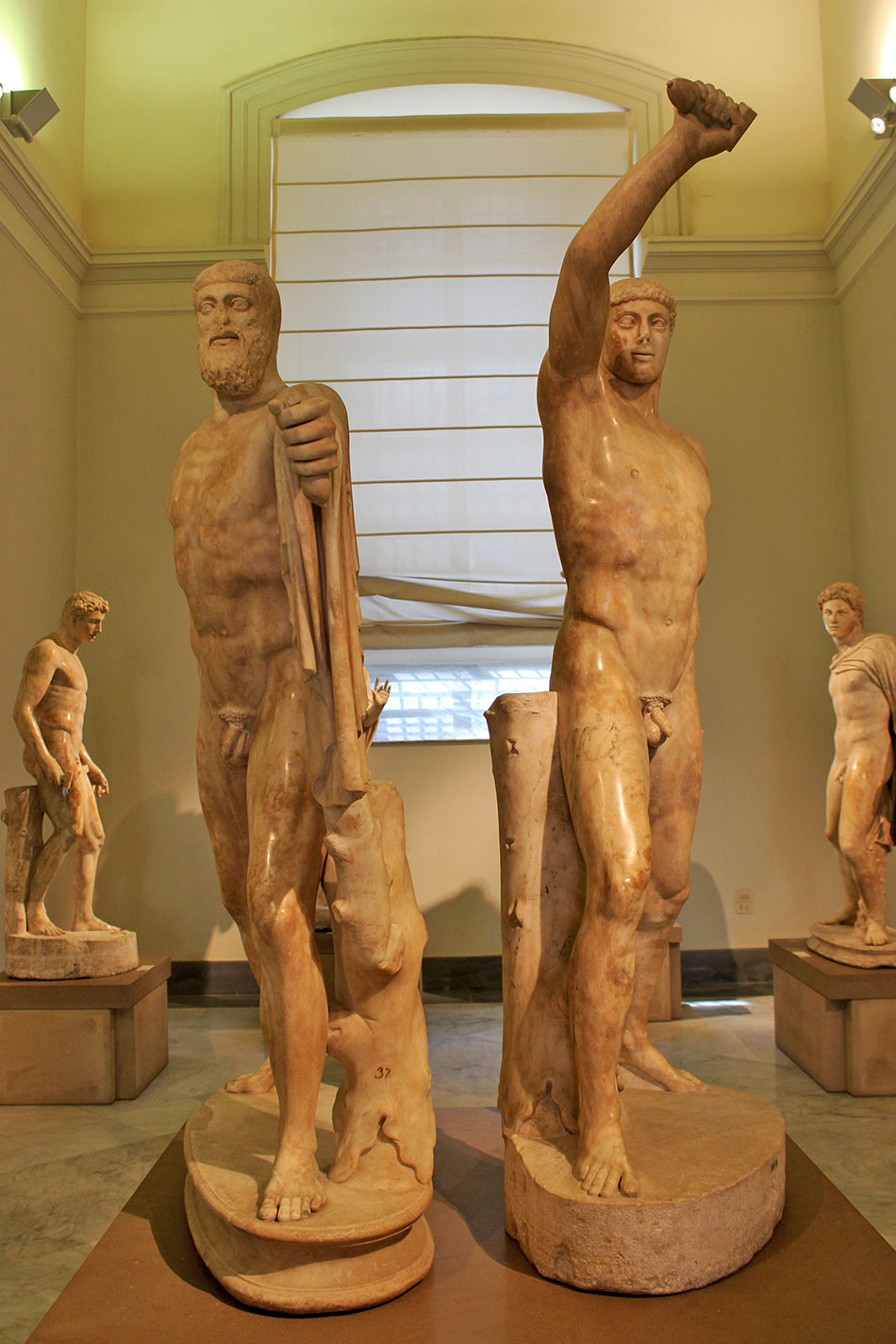
In the Greek world, the killing of Hipparchus by Harmodius and Aristogeiton in 514 BC in Athens during the Panathenaea - the city's sacred festival of Athena - was canonically enshrined as the founding myth of tyrannicide.
Statue of Harmodius and Aristogeiton, Naples. Roman copy of the Athenian version by Kritios and Nesiotes. Wikipedia
The conspirators' violent deed came to be hallowed as an act of civic virtue, even as philosophers continued to dispute its moral warrant.
In truth, the deed that immortalized Harmodius and Aristogeiton belonged less to the assembly-ground of politics than to the theatre of passion.
As Thucydides stresses in the History of the Peloponnesian War (6.53-59), the joint deed sprang from private grievance rather than public principle:
Only later was this act of personal vengeance transfigured into a noble but deceptive legend.
The narrative recast an impulsive killing as the iconic archetype of conscientious tyrant-slaying, thereby sanctifying an ignoble deed that sprung from private affront rather than public cause.
As an early illustration of extrajudicial killing's perverse effects, this pseudo-tyrannicide neither ended the tyranny nor liberated Athens; it merely hardened the regime:
Murder and Memory - From the Peisistratids to the Ides of March
Taken together, the very genealogy of tyrannicide, corrupt before it became canonical, is tainted at the source:
Within the economy of the posthumous discourse, the exculpatory and legitimating myth functions as a stark foil, supplying the positive pole of a Manichaean opposition.
This interpretive emplotment is ideologically useful precisely because it suppresses ambiguity, turning a muddled act of private violence into a metanarrative morality play of liberty against tyranny.
For latter-day liberals in decadent Western circles, the erotic bond between Harmodius and Aristogeiton only deepens the aura of civic sanctity woven around the celebrated Tyrannicides.
With so tainted a pedigree - a private vendetta later ennobled as public virtue - it is small wonder that the progeny of this lineage should bear the marks of their vitiated origin: from further extrajudicial killings in antiquity,
Against this morally entangled backdrop, Thucydides' nuanced judgment is all the more striking:
Posterity schooled in the Whig myth of liberty smiled more readily on the Alcmaeonids, the rival aristocratic house, because democracy claimed them as ancestors.
Yet the record is less moral than memorial, for the Peisistratids were tyrants with achievements, while the Alcmaeonids were retrospectively anointed liberators with a stain:
From Athens, the historical arc bent next to Rome, where political killing widened from the personal tyrant-slayer's blow to the bureaucratic terror of proscription and, ultimately, to the most famous assassination of antiquity:
The death of the dictator perpetuo remains so deeply lodged in cultural memory that German schoolmasters of a bygone age, formed in the venerable humanist tradition, forged ignorance of it into a badge of intellectual disgrace, taking for granted that every pupil - save the irredeemably obtuse - knew Caesar had not died of disease...
|