|
Article also
HERE "YOLO" (you only live once). Source: Brendan Smialowksi / Getty.
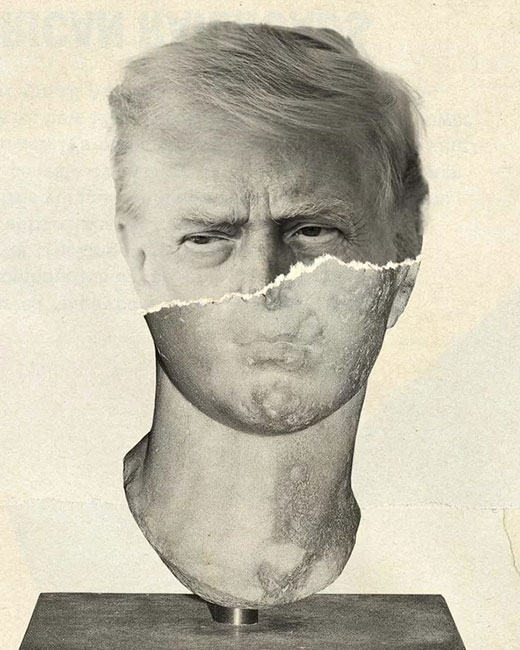
Hegel's theory of "world-historical individuals," men who redirected the course of humanity, focused on three figures:
Hegel described them as unlikely "heroes of an Epoch" for upending established orders that had previously seemed fixed.
They were "practical, political men" who were each condemned in their age for smashing norms and for other conduct "obnoxious to moral reprehension" - as Trump has been accused of, centuries later.
The tendency to self-aggrandize is as fundamental a feature of Trump as his sculpted hair and overlong red ties.
But it has become even more important in setting his priorities and steering his actions as he hurtles through his final term in office.
He no longer has to worry about the judgment of voters and can instead focus on what he's decided really matters:
The result, at least so far, has cost many lives and billions of dollars, damaged the world economy, strained already fragile alliances, and cratered the president's standing with the public.
But those around him cast his new focus as a liberation.
What the American people think - and what near-term consequences they may face - has mattered less to Trump than his own designs to remake the world by,
Earlier this month, Trump described the conflagration with Iran in existential terms, writing on social media,
Even when he later agreed to a two-week cease-fire - which has since been extended - Trump portrayed his Middle East adventurism as,
At home, he has focused his time and attention on unending tributes to his reign - building projects that recall ancient Rome, decorative gilding that evokes imperial France, banners with his visage draped across government buildings, and a gold coin set to be minted with his image for the nation's 250th birthday.
When we asked several White House officials whether Trump had discovered and embraced Hegel's writings, they dismissed the hypothesis almost laughingly.
He did recently learn about the powerful triumvirate in a brief passage that someone handed him, the senior official told us, although that person couldn't recall if it was a poem or an essay or something else.
The second senior official suggested that Trump might be recalling a speech he heard at a golf-club event last year, where a speaker placed Trump in the frame of historical figures such as Alexander the Great and Genghis Khan.
White House officials and allies have debated other reasons for the president's turn toward history, and some have dismissed it as typical Trumpian braggadocio - the greatest, the biggest, the best.
They all spoke with us on the condition of anonymity to candidly detail their private conversations with the president.
Then, on Saturday night, following an assassination attempt at the annual White House Correspondents' Association Dinner, Trump turned briefly introspective, offering yet another glimpse of how he views his place in the scope of history.
Speaking to reporters shortly after the alleged gunman had been apprehended, Trump said that he had "studied assassinations," mentioned Lincoln, and argued that,
Trump's heightened tendency to view himself as a world-historical figure - capable of brash, misunderstood greatness - has transformed his second term, and not necessarily in a good way.
But for Trump, the costs have been outweighed by what he views as the opportunity before him, a chance to transform the world in a manner that few historical figures have ever even approached.
A second Trump confidant summarized bluntly:
Ever since moving back into the Oval Office, Trump has been adding accents to the room, cluttering the space with golden urns, military flags, rows of presidential portraits, and a 19th-century copy of the Declaration of Independence.
The crowns of the doors have been gilded, as have the seal and stars on the ceiling. Like clip art in blank spots on the wall, he has affixed ornamental molding, coated in gold leaf.
When we entered the Oval Office for an interview last April, one of the first questions he asked us was of decor:
(Ultimately, he opted against it because the logistics were not ideal; one option included hanging it directly through the bald eagle's beak on the presidential seal.)
The doors, however, remained glaringly unadorned until Trump had an idea:
In the weeks that followed, Trump made his way through the West Wing, seeking out new places to affix his coins (golden and featuring the presidential seal).
One by one, the president decorated the office doors of each of his deputies. His aides are convinced that he will eventually cover all of the doors.
Trump, a developer by trade, has always loved these sorts of details - to a point of distraction.
And now, as president, Trump feels that he's deploying those skills for the common good.
The president's friends and advisers have told us story upon story of his obsession with the smallest minutiae, of his dedication to his monuments of self - the time he got down on all fours to help explain exactly how he wanted new tiling at Mar-a-Lago arranged:
His passion for his personal projects has begun bleeding into daily work as president.
One month into the Iran war, for instance - as gas prices averaged near $4, mortgage rates were climbing, and inflation fears were eroding stock values - Trump came to the press cabin in the back of Air Force One to argue that the bombing campaign was working.
Or, at least, that's what the reporters covering his trip home from Mar-a-Lago thought he was there to do.
Then he suddenly switched from talking about the war to boasting about his plans for "hand-carved" Corinthian columns as part of his $400 million White House ballroom.
The president presented six mounted, photo-realistic renderings of the project that he explained at length, like this was a miles-high slide show.
He went on about the drone-resistant roof, the bulletproof windows, the multiple porches, and the basement military facility, before pausing near the end to explain his priorities.
A foreign leader visiting Washington today would find a city under reconstruction, with tower cranes over the White House, a spectacle that recalls Roman Emperor Augustus's claim that,
There's,
(That destruction prompted the largest outcry, perhaps because the symbolism was visual, physical, visceral - a wrecking ball laying waste to a cherished pillar of democracy.)
The proposed "Arc de Trump," a 250-foot structure modeled after Paris's Arc de Triomphe, would be taller than any similar structure in world history, and more than twice the height of the Lincoln Memorial, across the river from where it would stand.
Even the yearlong celebration of the nation's semiquincentennial has become as much about feting Trump as observing the nation's 250th birthday.
Trump will mark his 80th birthday in June with a demonstration by modern-day gladiators - a UFC Freedom 250 fight on the White House South Lawn.
The fighters will weigh in at the Lincoln Memorial. Later, they will emerge from the Oval Office to battle before a waiting Trump, the event complete with fireworks and a light show - a grandiose and very Trumpian tribute to himself.
As Trump searched for a running mate in 2024, the second Trump confidant recounted that they had tried to implore him to pick someone who could help continue his political movement.
Trump retorted:
But there is no dispute that something has changed in his second term - a freeing of his ambition, and a newfound sense of power.
His top advisers now talk about him as the person with,
That has left everyone around him attempting to proceed as if this is a normal presidency - or, at least, a normal Trump presidency - but the president is different now, firmly in his second term with personal electoral victory no longer a driving force.
The guardrails from the first term are gone, and Trump has all but abandoned the pretense of much caring about the Republican Party that he holds in an emperor-like grip.
Top White House officials, political advisers, and Cabinet members gathered in mid-February at the Capitol Hill Club to lay out a midterm-election strategy that would focus on delivering a consistent message that's focused on the economy and cost of living, regardless of what Trump says or does.
The group met again a month later, at Washington's Waldorf Astoria, which was previously the Trump International Hotel.
The February plan had run headlong into the expensive war, so the message became blunter:
Sarah Longwell, a former Republican and an anti-MAGA political strategist who regularly conducts focus groups with Biden-Trump swing voters, told us that Trump keeps acting in politically irrational ways.
One Trump ally told us that the president is not particularly worried whether he loses the House, and that he cares only slightly about holding the Senate.
The reason:
But Trump has survived two impeachments, and he arguably returned more powerful.
His focus now is on doing something more enduring with his influence. Trump worries about being perceived as a lame-duck president, several people told us, including this ally.
Jimmy Carter died in late 2024, during the presidential transition, and when he lay in state in the Capitol Rotunda, Trump watched the proceedings for hours from Mar-a-Lago, transfixed by the coverage, a person close to the White House told us.
One day, Trump mused, he would be inside a flag-draped coffin like that. (In a story about Trump's health, New York magazine also reported a version of these comments.)
The same ally told us that Trump now cares more about his successor, believing that a Republican president loyal to him will help ensure that his actions are not immediately reversed.
After losing in 2020, he had four years out of power to watch President Biden try to return the nation to a pre-Trump status quo ante, and he now understands what lasting change requires.
But even that is complicated.
(Trump has publicly mused about running again in 2028 - a clear joke to troll his opponents, advisers insist - though other people in Trump's orbit, such as the MAGA influencer and former adviser Steve Bannon, are more seriously pushing the idea.)
In short,
Still, Trump's team remains cautiously optimistic that it can refocus him on the coming midterms, which could act, perhaps, as the last guardrail to curb his influences in a term that, so far, has mainly been dictated by such whims.
But after those elections, this person mused,
Hegel - whether or not Trump has actually read a word of his dense tracts - may offer some hints.
As Hegel concluded:
The German philosopher could just as well have been writing about Trump, some 200 years before the American president dubbed himself a great man of history and began trampling so many modern-day flowers.
|