|

by David E. Sanger
March 21, 2026
from
NYTimes Website
Article also
HERE
|
David E. Sanger
has covered five
American presidents.
He writes often on
the intersection of technology and national security,
and the revival of superpower conflict
the subject of his
latest book. |
The repercussions of
President
Trump's "excursion" into Iran
may
outlast his interest in it.
Credit:
Al Drago for The New York Times
President Trump says
he is
considering "winding down"
operations
in Iran.
But many
of his original war goals
remain
unaccomplished...
Ever since President
Trump began what he now delicately calls his
"excursion" into Iran, Washington has been consumed by the question
of when he would call it a day - even if many of his war goals
remain unaccomplished.
On Friday evening, as he headed to Florida, Mr. Trump seemed to be
designing that much-discussed exit. But he clearly has not yet
decided whether to take it.
And there is mounting evidence - average gas price approaching $4 a
gallon, infrastructure in ruins across the Persian Gulf, a decimated
Iranian theocracy digging in and American allies at first rebuffing
and now struggling with demands to patrol hostile waters - that the
repercussions of Mr. Trump's excursion may outlast his interest in
it.
As always, Mr. Trump's messaging is inconsistent, which his critics
cite as evidence that he entered this conflict with no strategy and
his followers cheer as strategic ambiguity. With thousands of
additional marines headed to the region and the pace of American and
Israeli attacks quickening, Mr. Trump told reporters on Friday he
had no interest in a cease-fire because the United States was
"obliterating" Iran's missile stocks, navy, air force and defense
industrial base.
Hours later, perhaps sensitive to a Republican base understandably
nervous about the political effects, he posted on his social media
site that,
"we are getting very close to meeting our
objectives as we consider winding down our great Military
efforts in the Middle East."
But his latest list of those objectives left out
a few of his previous goals and watered down others.
He made no mention of defeating the Islamic
Revolutionary Guards Corps, which appears to remain in power, along
with
Mojtaba Khamenei, who has succeeded his father as
supreme leader, though he has yet to be seen or heard in public.
Mr. Trump also omitted any message to the Iranian
people, whom he told only three weeks ago:
"When we are finished, take over your
government. It will be yours to take."
And after insisting in the failed negotiations
that led up to the war that Iran had to ship all of its nuclear
material out of the country - starting with the 970 pounds of
enriched uranium that are closest to bomb-grade - he suggested a new
goal.
"Never allowing Iran to get even close to
Nuclear Capability," he wrote, "and always being in a position
where the U.S.A. can quickly and powerfully react to such a
situation."
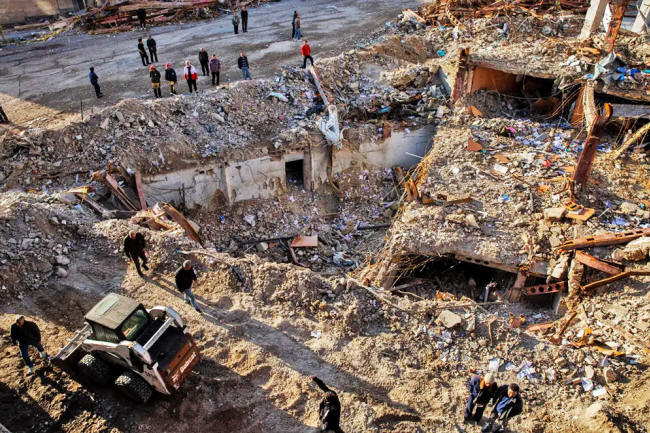
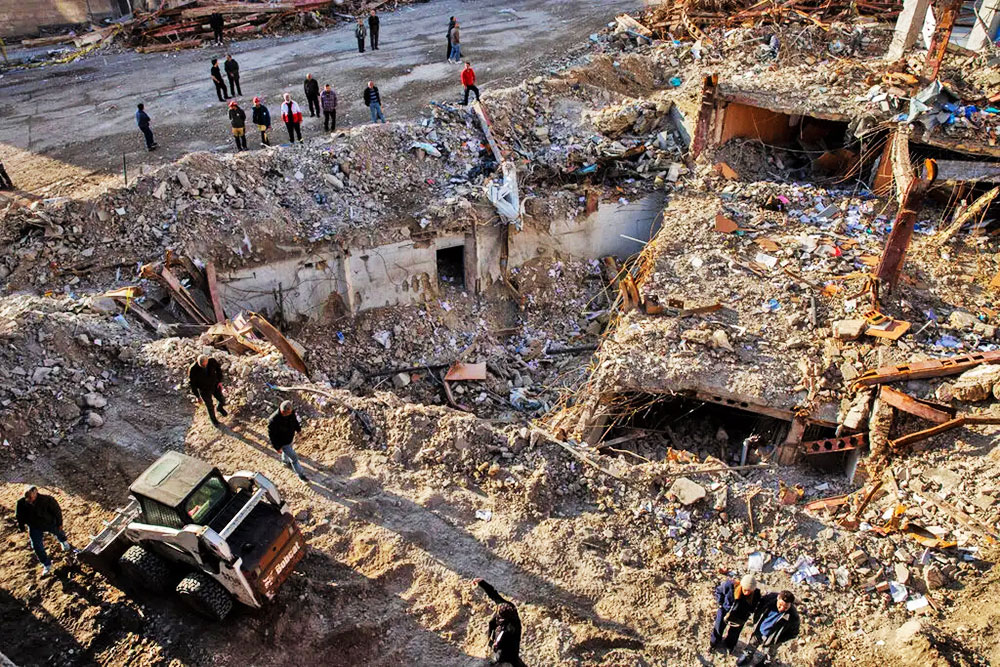
The site of a U.S.-Israeli
airstrike
in Tehran on
Saturday.
Credit: Arash
Khamooshi
for The New
York Times
That is, essentially, where the United States was after it buried
Iran's nuclear program in rubble last June. The sites have remained
under the watchful eye of U.S. spy satellites.
Mr. Trump ended the posting with a new demand for American allies,
whom he had frozen out of his deliberations before starting the war,
and gave no warning to prepare for its consequences.
"The Hormuz Strait will have to be guarded
and policed, as necessary, by other Nations who use it - the
United States does not!"
American forces would help, he said.
"Think of it as the new Trump Doctrine for
the Middle East,"
Richard N. Haass, the former president
of the Council on Foreign Relations, who served on the National
Security Council and at the State Department during the Persian
Gulf War and the Iraq war, wrote on social media.
"We broke it, but you own it."
Mr. Trump's shifting goals continued into
Saturday evening.
Just a few days ago, he was calling on Israel to
avoid targeting Iranian energy sites, for fear it would lead to an
escalating round of retaliatory counter-strikes across the Gulf.
But on Saturday,
he threatened to hit Iran's power plants if
it did not "FULLY OPEN, WITHOUT THREAT, the Strait of Hormuz"
within 48 hours.
He said that U.S. strikes on Iranian plants would start "WITH
THE BIGGEST ONE FIRST." Iran's biggest plant appears to be its
only operating nuclear power plant, at Bushehr.
For decades, nuclear power plants have been
considered completely off limits for strikes because of the obvious
risk of environmental calamity.
This is not where Mr. Trump expected to be after three weeks of war.
Foreign leaders, diplomats and U.S. officials who have spoken with
the president said that in the first week he voiced expectations
that Iran would capitulate. That was clear in Mr. Trump's demand on
March 6 for Iran's "unconditional
surrender."
The demand was mystifying, said one European diplomat with long
experience dealing with Iran, given the country's competing power
centers, its national pride and a Persian state that has existed
within the rough boundaries of modern-day Iran, enduring many rises
and falls, since the days of Cyrus the Great around 550 B.C.
(That demand was also missing from his latest set of objectives. The
White House has since said that the president does not expect a
surrender announcement from Iran, but that Mr. Trump will determine
when Iran has "effectively surrendered.")
Iran's refusal to "cry uncle,'' as Mr. Trump
termed it to reporters on Air Force One, has been only one of the
surprises to the president in recent weeks.
The first was the crisis in the energy markets, which the
International Energy Agency
has called,
"the largest supply disruption in the history
of the global oil market."
It has sent Mr. Trump and his aides scrambling.
They have promised releases from the
Strategic Petroleum Reserve, which was only 60 percent full,
reflecting a lack of planning.
Over the past week the Treasury Department
has issued licenses for the delivery of Russian and Iranian oil
already at sea.
In other words,
to calm the markets, the president has
approved enriching an adversary that is at war with Ukraine, an
American ally, and another that is at war with the United
States.
So far, the effects are minimal...
Brent crude closed at around $112 a barrel on
Friday after the Treasury announcements, and Goldman Sachs warned on
Thursday that if ships were reluctant to make their way through the
Strait of Hormuz, prices could remain high into 2027.
The Iranians clearly understand that market chaos is their one
remaining superweapon. On Saturday, Tehran warned it could set fire
to other facilities in the Middle East.
The United States believes the country entered
the war with 3,000 or so sea mines - some of which are believed to
have been destroyed - and the United States has focused on
destroying small boats in the Iranian fleet that are targeting
tankers associated with American allies.
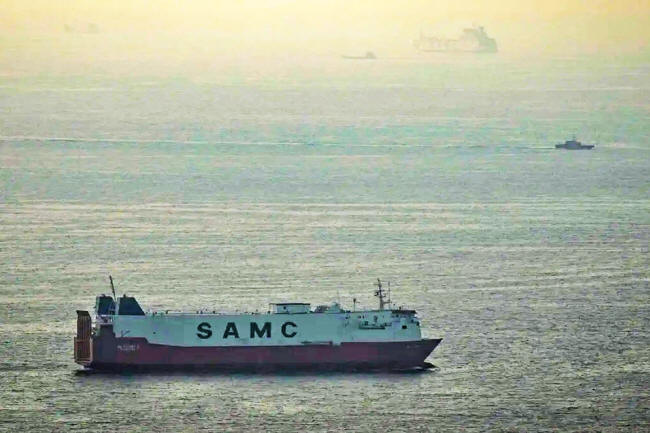
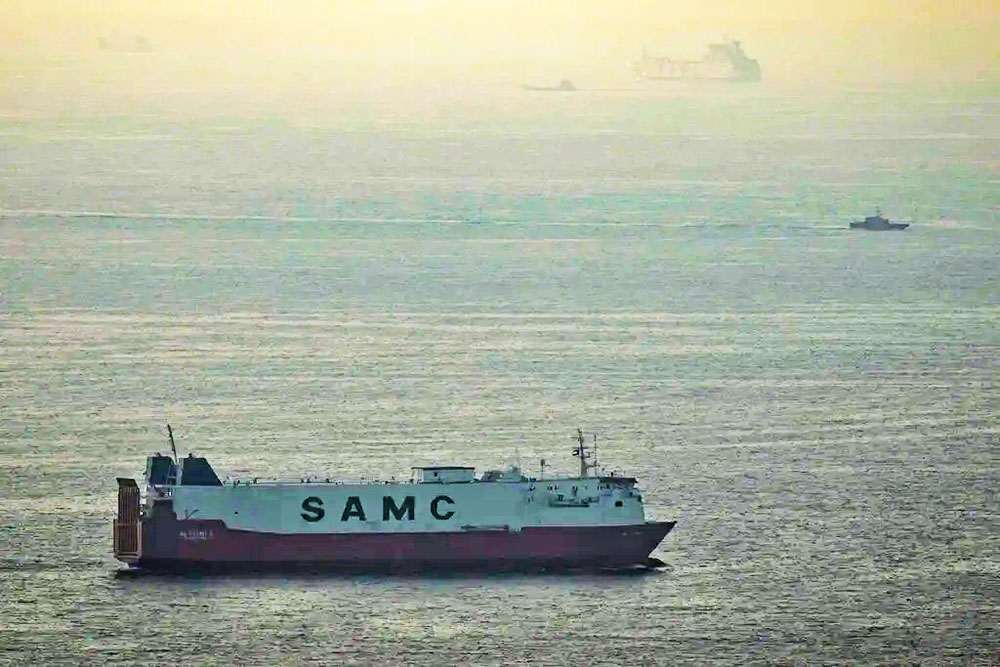
Cargo ships
in the Persian
Gulf on Thursday,
heading toward
the Strait of Hormuz.
Credit:
Associated Press
"All it takes is for one of those things to
get through to shut down traffic," said John F. Kirby,
who served as both Pentagon and State Department spokesman after
retiring as a naval officer.
"The fear alone can be paralyzing to the
shipping industry, as we have already seen."
Mr. Trump's second surprise was his sudden need
for allies.
He didn't imagine it at the beginning of the
conflict, the defense minister of one Gulf nation said recently,
because he thought the war would be short.
But patrolling the strait, and other
checkpoints, appears to be a task that could last months or
years...
His third surprise was the absence of any
uprising among either the Revolutionary Guards or ordinary Iranians.
Treasury Secretary
Scott Bessent said in
the Oval Office earlier this week,
"we are seeing defections at all levels as
they're starting to sense what's going on with the regime."
But American and European intelligence officials
say they have no evidence of such defections - even after Israel
targeted, and eliminated, Iran's supreme leader, its top security
and intelligence chiefs and many top military officials.
All that could yet come. Wars are not won or lost in three weeks.
But Mr. Trump entered the Iran war after enjoying
the fruits of quick victories. A bombing run over Iran's
three major nuclear sites in June was a one-evening expedition,
essentially burying the country's nuclear stockpiles and wiping out
thousands of its centrifuges, which are used to enrich uranium.
The commando raid to
seize Nicolás Maduro of Venezuela from
his bed in Caracas was similarly swift. And so far, the government Mr. Trump left in
place - essentially Mr. Maduro's government - has been compliant.
That operation has helped Mr. Trump
destabilize Cuba, which has lost
the Venezuelan fuel supplies that it has long depended on.
The other day the electric grid in Cuba
collapsed, and administration officials have been openly
suggesting that the government will, too.
Perhaps those quick results encouraged Mr. Trump
to believe the U.S. military was all-powerful [sic], and that the mullahs
and generals and militias that run Iran, a country of 92 million
people, would crumble.
Perhaps he rushed...
Military historians will be dissecting this
conflict for a long time.
But for now it is clear that Iran is a
different kind of challenge.
Mr. Trump started using the word
"excursion" to suggest this is just a short trip, a brief
diversion.
But there is no real end in sight...
|