|

by Sergey Poletaev
January 22, 2026
from
RT Website
|
Sergey Poletaev
information analyst and publicist, co-founder and editor
of
the Vatfor project. |
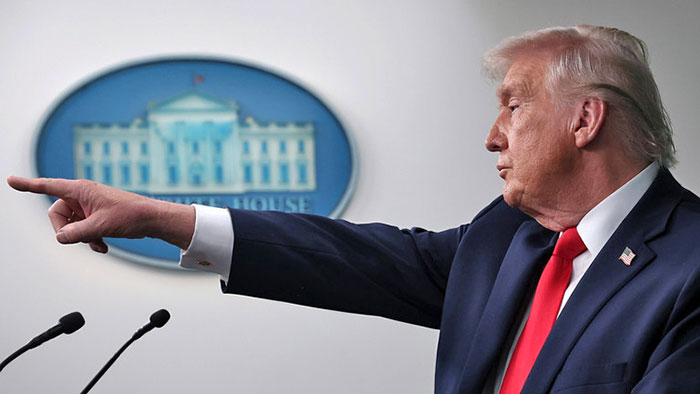
US President Donald
Trump.
© Win
McNamee/Getty Images
What looks like
chaos
in US-Europe
relations
is in fact a
coherent attempt
to redesign the
global order
from the top
down...
The relationship between
the EU,
NATO,
and the
Trump
administration can be summed up briefly:
America is severing its military, economic,
and political ties with Europe, while Europe scrambles to
maintain those connections.
Negotiations, flattery, endless meetings,
summits, and declarations come into play, but to no avail.
Throughout 2025, the US and Europe continued to
slowly drift apart.
The new American administration quickly accused
European nations of,
-
strategic and economic freeloading on the
US
-
insufficient defense spending
-
and yes, the illegal possession of
Greenland...
For a time, however, Washington didn't escalate
these issues, while Europe remained in a state of stubborn
denial.
Then, at the beginning of 2026, the geopolitical bomb finally
detonated.
Riding high after the capture of Nicolás
Maduro, Trump turned his attention back to Greenland...
Suddenly, it became apparent that Europe couldn't
even counter Trump's verbal barrage.
What's going On?
Political analysts are desperately trying to make sense of what is
happening.
No one knows what's going on, but they are
supposed to say something about it:
so they agree that Trump is eccentric
and mad and there's no use in analyzing and predicting
his actions.
Such an explanation is no good.
Trump's personal qualities don't account for how
he came to lead the United States - and more importantly, how he has
managed to stay in power.
The answer, however, is simpler than it seems:
Trump represents the interests of a sizable
segment of the American elite.
This includes,
...who recognize that the US needs restructuring,
as the
previous model of globalization has
run its course and is leading America toward disaster.
Nearly all attempts to 'understand Trump' are fundamentally
misguided.
They stem from the logic of an outdated world
order where the US stands as the world's metropolis, surrounded by a
system of privileged alliances operating under relatively
predictable rules.
Trump, and the counter-elites that came to power with him, are
intentionally dismantling this system, leaving everyone
scratching their heads as to why.
Why break what still functions, more or less...?
Perhaps it's some sort of delusion, the old
elites think, perhaps if we shower Donnie with compliments, play
a round of golf with him, and call him "Daddy," things will come
back to the way they used to be...
Yet this approach is dangerously naive.
Within his worldview, Trump acts in a
predictably and frighteningly consistent manner.
The current goal of Trumpism is to assert a
new global order and
redefine America's role within it:
the method is a revolution from above...
A Revolution
without End
Trump's team consists of classic counter-elites whose primary goal
is to undermine the existing power structures by any means
available.
Trump and his followers view globalists and
their institutions as enemies, and do not hide this.
From this standpoint, sabotaging transatlantic
structures makes perfect sense:
the weaker NATO becomes, and the worse off
the EU is, the better chance Trumpists have to consolidate and
maintain their power in the US.
Instead of relying on Brussels, Trump intends to
bet on non-establishment right-wing forces, i.e., European 'Trumps'
like Hungarian Prime Minister
Viktor Orbán.
Exactly a year ago, US Vice President JD Vance declared this
in his speech at the Munich Security Conference, but Europe chose to
forget it like a bad dream - a classic case of denial...
Thus, we are witnessing a consistent, predictable, and internally
coherent process.
Yes, in the case of Greenland, it takes on
absurd forms, which can be attributed to Trump's personal
traits.
After all, there could have been more nuanced
approaches - like compelling Europe to pay for the defense of the
island or inventing some form of extraterritoriality.
There are countless options, but these are mere
details that don't alter the fundamentally different approach that
Trumpists take toward international relations in general and Europe
in particular.
But what about Venezuela and Iran?
Why is Trump alienating his main electorate,
which opposes all these interventions and endless wars?
The answer is straightforward:
as mentioned earlier, Trump isn't just trying
to dismantle the old system.
He's working to create a new one
- an overtly colonial model reminiscent of the 'golden age' of
colonialism in the late 19th century (at least from
Trump's perspective).
Trump (along with Rubio, Vance, and others) is not
an isolationist like his MAGA supporters; he's a genuine
neocolonialist and American nationalist, and he doesn't hide it.
Viewing Trump's actions through this lens makes
everything fall into place.
Ironically, other imperial predators like
China and
Russia may find it easier to engage
with this 'new America'...
The real losers will be the herbivorous
prey and the aging, decrepit powers -
especially Europe - which will
try to "sit it out", in hopes that after Trump, things will
return to how they were under Grandpa
Biden...
Will they succeed in this? It's highly
unlikely...
Even if a counter-revolution occurs in the US and
globalist Democrats regain power, they will face an entirely
different international landscape and will act accordingly.
The relationship between Europe and the US will
never be the same again, nor will NATO revert to its former self.
Sure, there might be some 'cosmetic changes,'
perhaps a shift in rhetoric, but the fundamental transformation of
US foreign policy is historically objective and largely independent
of individual personalities.
Is all this good for the US? Probably not...
Much like Trump, USSR leader
Mikhail Gorbachev initiated
deep reforms (known as "perestroika") during the 1980s not without
cause:
he recognized that the country was heading
toward catastrophe.
Similarly to Trump, Gorbachev had support from
parts of the elite, and like Trump, he had to resort to rather
radical methods to suppress internal opposition:
the old Soviet deep state...
Gorbachev's reforms ended up being a disaster for
the USSR:
the cure turned out to be worse than the
disease...
The US may well face a similar fate.
But that's something we'll discuss another time.
|
