|
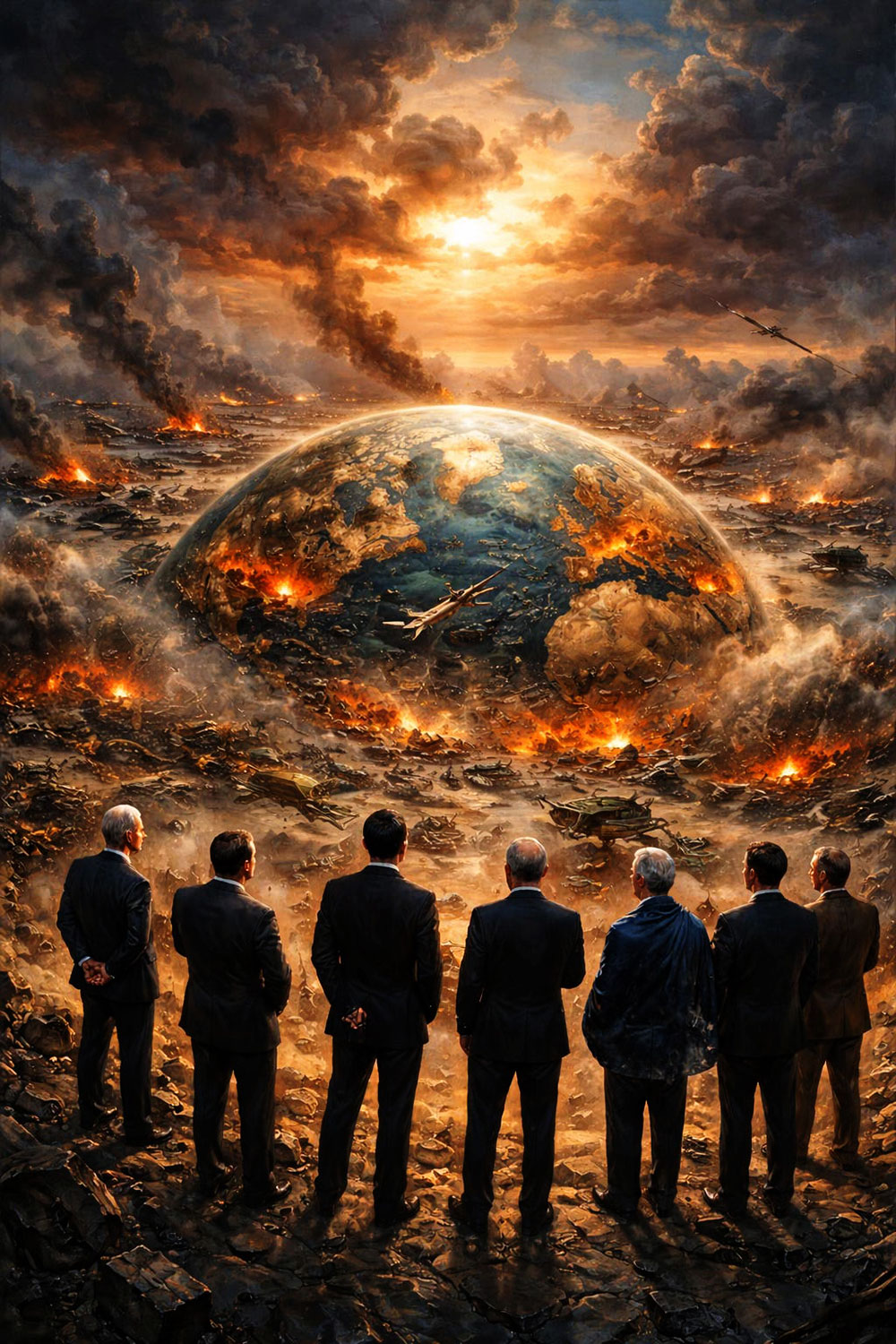
"Harsh Birth of the Multipolar Order".
and the new order had not yet been institutionalized.
As the power transition unfolds on a conflictual and uncertain terrain, the world stands on a historical threshold...
Instead of managing this transition, the United States has attempted to prevent it - thereby generating deeper and more frequent crises.
The new order has not yet been institutionalized; however, it is evident that the old order has entirely lost its legitimacy.
2025 stands as the harshest year of this interim period. It has gone down in history as the year in which Western dominance - and its latest incarnation, Pax Americana - declined de facto, not rhetorically, collapsing across multiple domains.
Pax Americana can no longer make credible promises about the future. Historically, a power that has lost its capacity to establish order, manage crises, and maintain legitimacy cannot be associated with the concept of "peace."
From this point onward, the world no longer speaks of an American-centered peace order.
Instead, it confronts a polycentric, harsh, uncertain, and transitional era of power struggle. In this age, seas, trade routes, energy corridors, and legal frameworks are being redefined. New balances are emerging amid the wreckage of the old order.
This is why 2025 represents not only the end of American Peace, but also the year in which,
Today, rather than accepting its diminishing position and seeking a framework for shared influence with emerging power centers, the United States remains trapped in the reflex of preserving the status quo through force.
This approach has not slowed multipolarity; on the contrary, it has rendered the transition more brittle, volatile, and uncontrolled.
NATO enlargement, the containment of Russia, and the reliance on proxy warfare represent the essence of Washington's response to multipolarity.
Contrary to expectations, however, the war has not demonstrated absolute Western superiority. Instead, it has revealed the limits of sanctions, disparities in military-industrial capacity, and the fragmentation of global support.
The Ukrainian front has laid bare the boundaries
of hegemonic deterrence.
This maneuver, which triggered a revolutionary shift across the continent, pushed Europe - still loyal to the paradigm of endless wars driven by global finance capital - toward astronomically increased defense expenditures and the intensification of its long-standing hostility toward Russia.
The leaders of this bloc, particularly in
France, the United Kingdom, and Germany, have
demonstrated a troubling willingness to encourage confrontation with
Russia despite widespread public opposition.
While this perpetuates military tension, it also turns the Western Pacific - the heart of global maritime trade - into a permanent risk zone for the world economy.
Vulnerabilities in maritime trade routes constitute one of the most concrete and dangerous reflections of the multipolar transition.
Strategic chokepoints such as,
...are no longer the secure backbone of the global system.
They have become zones of geopolitical pressure and military challenge.
In this context, the year-round operationalization of the Northern Sea Route (NSR) under Russian control in the Arctic has revealed, for the first time in 500 years,
During this period, the seas have begun to play a separating rather than unifying role.
Meanwhile, the legitimacy of the old order has fully collapsed.
The discourse of a "rules-based international order" has lost meaning due to the growing gap between rhetoric and practice; rules are invoked only when they serve the interests of the powerful.
Thus, 2025 can be defined as an "intermediate period" - but not an ordinary one.
It has been the harshest, riskiest, and most instructive year of transition.
Historically, such periods are those in which the gravest mistakes are made - and the most enduring outcomes are produced.
Rather, it emerged from a layered and irreversible process of disintegration, as long-standing structural weaknesses became visible simultaneously.
The erosion of moral legitimacy, declining naval deterrence, the unsustainability of a debt-driven financial order, and deepening distrust among allies constitute the core pillars of this breakdown.
Israeli geopolitics and Anglo-Zionist strategic dynamics played a significant role in accelerating this collapse.
These instruments do not generate order; they deepen crises, intensify conflicts, and accelerate the formation of counter-blocs.
This is not hegemony, but post-hegemonic drift.
Events in Iran, Venezuela, Gaza, and Lebanon have marked a historical rupture in which the United States effectively invalidated its long-standing discourse on a,
Israel's attack on Iran during ongoing U.S.-Iran negotiations in Oman, and the collapse of indirect talks involving Hamas under Western protection, severely damaged American credibility.
Similarly, the U.S. Navy's sinking of Venezuelan and Colombian vessels in the Caribbean - outside the frameworks of international maritime law and the law of armed conflict - and the application of wartime-style blockades under the pretext of counterterrorism further eroded legitimacy.
Throughout 2025, Washington's disregard for international law, civilian protection, and proportionality revealed to the global majority that U.S. legal discourse functions as a selective, instrumental tool rather than a universal norm.
At this point, even the concept of "double
standards" proves insufficient; what has occurred is direct norm
destruction.
This represents not merely an image problem, but the complete breakdown of the hegemonic consent-production mechanism.
From a geopolitical perspective, the dissolution of the Soviet Union created, in Washington, the illusion of the "end of history."
This illusion rested on the assumption that hegemonic borders were no longer necessary, that military power alone could establish order, and that no actor remained capable of meaningful resistance.
At that point, the United States abandoned the strategic patience and restraint required of a hegemon and began to act with imperial reflexes. Hegemony functions through persuasion, attraction, and indirect influence. Empire, by contrast, relies on direct force, coercion, and military imposition.
After the Cold War, the United States ignored this distinction and - particularly in the period after September 11, 2001 - entered an era of endless wars through a neocon-Zionist strategic partnership.
These choices generated short-term gains; in the
long run, however, they produced naval-power erosion, budget
deficits, and domestic political fragmentation.
Across these fronts, the recurring pattern is clear:
This approach may have yielded substantial gains for the defense industry, private security firms, and financial networks in the short term.
Yet from the standpoint of statecraft, all of these wars amount to strategic losses.
A permanent condition of war has pushed the U.S. budget into chronic deficits; borrowing, monetary expansion, and financial manipulation have become routine instruments of state policy.
It must be remembered that,
The United States chose the latter path - and has
begun paying its price through internal political fragmentation,
class tension, and institutional decay.
Today, the United States remains militarily strong, yet appears politically divided, economically fragile, and strategically directionless.
At the same time, migrations, pandemics, inflation, energy crises, and wars over the past decade are often presented as random shocks.
Read together, however, these developments point to a form of controlled liquidation of 20th-century industrial capitalism based on a productive middle class.
The aim is to move away from a production-centered economic order toward a new model of sovereignty based on digital ownership and platform dominance, centered on,
In this emerging order, a permanent state of emergency, digital control, and tools of social discipline become normalized, while human labor, the social state, and life itself are gradually redefined as cost items.
This process profoundly destabilizes social contracts in the United States and Europe, as well as across much of the world, creating conditions conducive to social explosions.
U.S. public debt - exceeding $33 trillion - is no longer an abstract balance-sheet figure.
With billions of dollars in interest payments every day, it has become a tangible burden that erodes military capacity, diplomatic maneuver, and strategic flexibility.
This dynamic is central to understanding the historical fate of empires and constitutes a direct confirmation of historian Paul Kennedy's "imperial overstretch" thesis.
As Kennedy argued,
The United States has crossed precisely this
threshold...!
Here, the fundamental weakness of financial capitalism is exposed. Financial dominance that is not anchored in production, industry, shipyard capacity, and maritime trade cannot be sustained.
Historically, global powers have maintained confidence in their currencies to the extent that they dominated the seas.
Today, the United States has, to a large degree, transferred its industrial infrastructure and shipbuilding capacity to China. America's share across the spectrum - from global container transport and shipbuilding tonnage to port management and logistics chains - has declined sharply.
This also signifies a structural weakening of
dollar hegemony.
The U.S. Navy remains strong; however, it no longer possesses the attributes of a maritime empire capable of guaranteeing the global circulation and reliability of the dollar on its own. The historical link between naval power and financial power has reached a breaking point.
As a natural consequence,
Yet these instruments no longer deter as they once did, on the contrary, they generate a repulsive effect.
Rather than aligning target countries, sanctions encourage the creation of alternative payment systems, local-currency trade, and regional financial networks.
The financial weapons of the United States are
dismantling the global system rather than controlling it.
This marks the classic final phase of empires:
The result is greater pressure, diminished
legitimacy, and accelerated dissolution.
Naval Power
Decline
The U.S. Navy's decline from roughly 600 ships in the 1990s to around 290 in 2025; the Royal Navy's inability even to adequately protect its aircraft carriers; and persistent shipyard and manpower crises all represent irreversible signs of lost maritime hegemony.
From this perspective, the structural and parallel decline of U.S. and UK naval power is not accidental weakness:
By contrast, China has built a maritime-industry-logistics integration by expanding its navy, shipbuilding industry and merchant fleet simultaneously.
Meanwhile, American maritime dominance - once justified by the claim of securing global maritime trade routes - is no longer absolute or undisputed. U.S. naval presence along the arc stretching from the Red Sea to the Eastern Mediterranean, from the Black Sea to the Indo-Pacific increasingly functions as a source of risk rather than security.
The seas, as during the Pax Americana, no
longer unify; they become fault lines where fragmented spheres of
influence collide.
The seas have ceased to be "open and safe" spaces as in the Pax Americana period:
This development is not merely military; it produces geopolitical consequences.
When maritime superiority weakens, trade security erodes, energy flows become fragile, and the capacity to generate global norms collapses. The U.S. problem today is not the total weakening of its navy; it is that naval power can no longer perform a global order-building function.
This distinction marks the line between hegemony
and mere great-power status.
Today, this integrity is dissolving in the Anglo-Saxon world, while being rebuilt within a new maritime ecosystem centered in Asia.
In the United States and the United Kingdom, warship construction timelines are lengthening, costs are multiplying, and skilled labor is steadily declining. Naval power cannot be sustained if it is not continuously fed by industry.
Anglo-Saxon navies increasingly survive by
consuming their own inherited legacy, while their capacity to
produce renewed maritime dominance steadily shrinks.
This systemic integration constitutes a basic condition for the historical success of classical maritime empires. China is not merely deploying warships; it is producing a domain of influence.
In conclusion, developments in naval power reveal clearly why 2025 is a threshold year.
Anglo-Saxon maritime hegemony is not ending through a dramatic collapse; it is being exhausted through a silent, gradual, and irreversible wear. The seas are no longer the center of a single power; they are the arena of competition among multiple powers.
Those who read this transformation correctly will build the future.
During the final four days of the twelve-day war - which was initially intended to end in victory - Israel suffered serious damage and was forced to request a U.S.-led ceasefire.
What has unfolded in Gaza since October 7, 2023 - marking the beginning of a period of unrestrained aggression and genocidal practices driven by Israeli geopolitics in West Asia - is not merely a regional tragedy; it represents the moral suicide of U.S. hegemony.
This is not a tactical alliance choice; it is a condition of structural dependency in which strategic judgment has been rendered inoperative.
Washington is no longer a center that defines its
own interests in the Middle East; it has become an approval
authority acting in line with Israel's threat perceptions,
priorities, and security reflexes.
For decades, Washington produced global legitimacy through the discourses of "human rights," "international law," "protection of civilians," and "proportionate use of force."
In Gaza, all of these discourses were negated in real time, under global broadcast.
From this point onward, the United States' claim to norm production has collapsed, leaving only brute force. Israel's unlimited military violence, combined with unconditional American support, has irreversibly damaged the global image of the United States.
This damage is not confined to the so-called Global South...
A profound legitimacy crisis has emerged against Washington within European public opinion, universities, civil society, and even among state elites. For the first time, at this scale and with this speed, the United States has lost its moral defensibility in the eyes of its allies' public opinion.
This represents the most dangerous rupture for
hegemonic orders.
Every military and diplomatic move undertaken on
Israel's behalf narrows Washington's room for maneuver in the
Asia-Pacific, Africa, and Latin America. In effect, the United
States is exhausting its claim to leadership in the global system in
order to protect Tel Aviv.
The expansion of BRICS, the acceleration of de-dollarization trends, and the intensification of the search for a multipolar order are directly linked to this loss of legitimacy. The financial and political pressure instruments of the United States are no longer perceived as "protectors of order," but increasingly as "destroyers of order."
This shift in perception fuels alternative blocs and new cooperation architectures. From the perspective of the Global South in particular, Gaza has become a symbol.
It symbolizes the bankruptcy of the West's claim to universality, the selective application of law, and the naked reality of power relations. By placing itself at the center of this symbol, the United States has historically locked itself into a fundamentally flawed position.
This is not a temporary diplomatic error; it is a
long-term strategic cost.
Multipolarity
and Türkiye
Despite all these adverse developments, as the global order dissolves in 2025, Türkiye - having achieved a significant level of self-sufficiency, particularly in the defense industry through the synthesis of "blood and iron" - is not a secondary actor that can be blindly attached to a collapsing Western hegemony.
The path ahead for Türkiye is not a matter of
choosing a direction; it is a matter of restoring balance, expanding
strategic space, and re-strengthening the mind of the state.
Whether aligned with the West through NATO and the EU or drawn into blocs with Asian powers, rigid bloc politics would confine Türkiye to a single axis, reduce its maneuverability, and transform it into a reactive actor within frameworks designed by others.
Türkiye does not need new blocs; it requires a multi-layered, sensitive, rational, and sea-centered balance policy. Its geography offers extraordinary opportunities not to "choose sides," but to establish equilibrium.
For this reason, interpreting Türkiye's relations with China, Iran, Russia, or other actors as the construction of a "new bloc" is a fundamental misreading.
Balance politics, a geopolitical perspective
grounded in maritime power, strategic autonomy, and the Kemalist
state tradition emerge here not as ideological preferences, but as
necessities imposed by Türkiye's geography, history, and
geopolitical imperatives.
Historically, Türkiye weakened whenever it was tossed between great-power blocs; it gained strength during periods when it successfully maintained balance, placed the sea at the center of strategy, and kept state institutions insulated from politics. The Kemalist vision centered on the Blue Homeland - that is, maritime geopolitics - should not be reduced to a military defense doctrine.
On the contrary, it must be conceived as a
comprehensive state project capable of transforming Türkiye into a
geoeconomic and geopolitical founding actor across a vast geography
stretching from the Black Sea to the Eastern Mediterranean, from the
Aegean to the Red Sea and Libya.
For Türkiye, the sea is not a boundary; it is a realm of potential opportunity. Yet the greatest obstacle to realizing this potential lies not outside the country, but within.
Mandate mentality, strategic blindness, and religious-ethnic polarization consume Türkiye's most valuable geopolitical capital.
The illusion that security can be achieved by
attaching oneself to global power centers has been disproven
repeatedly by history. Likewise, fragmenting the state's strategic
mind through identity and religious politics leaves Türkiye exposed
in the fiercely competitive environment of the multipolar world.
Türkiye must return to where Mustafa Kemal Atatürk stood:
This is not a matter of political preference; it
is the minimum condition for survival in an era in which the world
is hardening once again, law is increasingly suspended, and the
balance of power speaks in its rawest form.
The message that Türkiye - pressed from both north and south - must convey is clear:
This is precisely the scenario the siege paradigm seeks to avoid.
The architecture of containment rests on the assumption that Türkiye can be isolated, rendered indecisive, and eventually compelled to retreat.
This assumption collapses the moment Türkiye demonstrates its capacity to develop alternative partnerships and broaden its crisis geography through the opportunities provided by its history and geography.
In this context, Ankara's statement that "Iran's security is our security," delivered after Netanyahu's presumptuous remarks following December 22, 2025 - made alongside Greek leaders - should not be read as conciliatory language.
It represents a declaration of strategic will that shatters the assumptions underpinning the containment. It rejects Israel's belief that the Iranian front can be managed in a "controllable" manner while Türkiye is simultaneously squeezed in the Eastern Mediterranean.
Türkiye does not rely on threats; it targets the
logic of the siege by demonstrating its capacity to expand the
geography of crisis and distribute costs.
Türkiye's task is to frustrate the siege from both north and south with strategic composure.
This can only be achieved through military capability and strategic resolve. Rather than acting as an overzealous NATO member in the north, Türkiye can draw lessons from Hungary's posture.
The process can be managed by signaling,
In parallel, restoring unity, solidarity, and
trust in the state - across law, economy, anti-corruption efforts,
and the struggle against lawlessness - must be pursued while
consciously avoiding neo-Ottoman rhetoric in all domains.
Türkiye must demonstrate that it is neither tired
nor capable of becoming tired.
It depends on maintaining balance, cultivating a geopolitical mindset centered on maritime power, and placing the strategic rationality of the state above ideology. Türkiye's course, as drawn by Mustafa Kemal Atatürk, remains full independence, balance politics, and sea-centered strategic autonomy.
If this course is sustained, Türkiye can shape
the game; if abandoned, Türkiye risks becoming an extra in the games
of others.
|