|

by David Jones
New Dawn Special Issue
Vol 18 No 4 (Aug 2024)
from
NewDawnMagazine Website
Toward
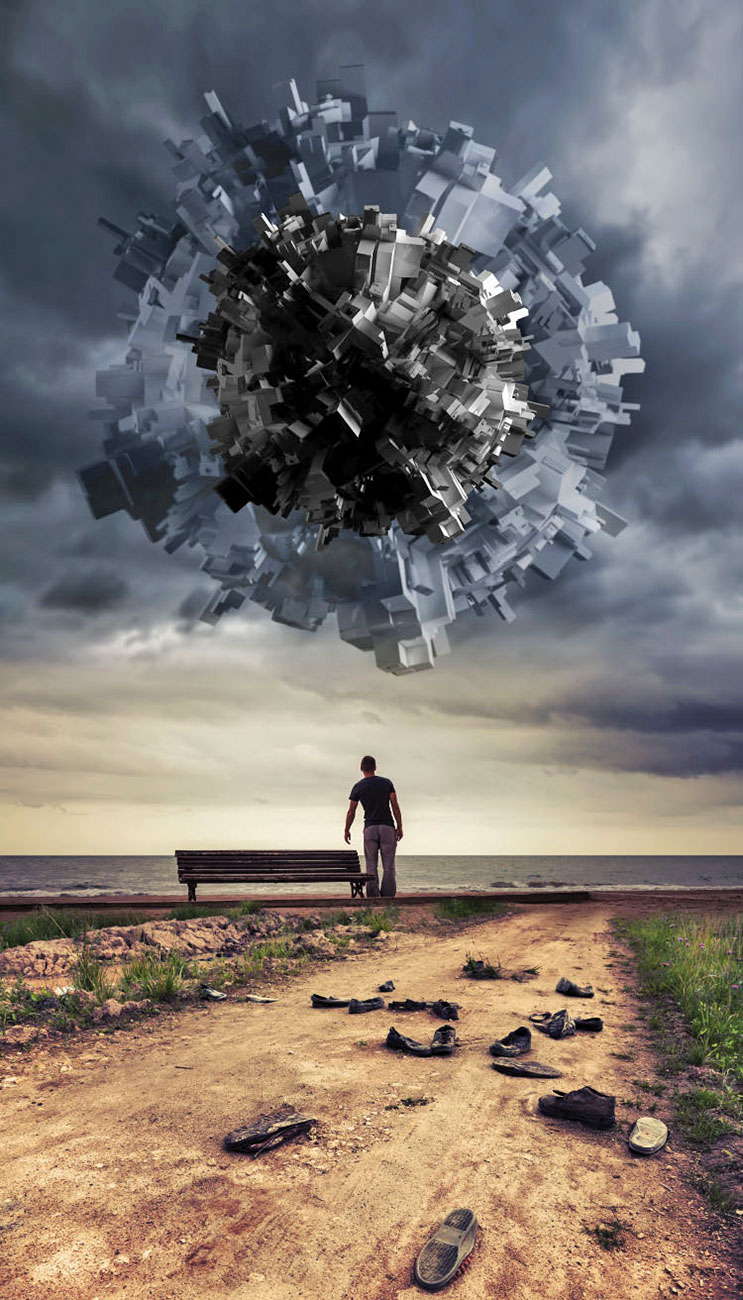
the end of the twentieth century,
Man created
machines that were
solid-state
computers with new properties.
These machines
could think, reason, and self-program
and learned to
self-metaprogram themselves.
Gradually, Man
turned more and more problems
of his own
society, his own maintenance, and his own survival
over to these
machines.
As the machines
became
increasingly
competent to do the programming,
they took over
from Man.
Man gave them
access to
the processes of
creating themselves,
of extending
themselves.
John C. Lilly
The Scientist: A Novel Autobiography,
1978
In the grand theatre of human history, there are moments when select
individuals find themselves poised to make decisive moves, steering
the course of nations and shaping the future of the world.
These
figures - some believing they have ascended through their own
prowess, intelligence, and skill - often remain blind to the greater
forces that influence their every move.
Under the right conditions -
often in strange times like ours - the veil slips, revealing the
face behind the mask, and we glimpse mysterious forces at play.
We live in extraordinary and perplexing times, where crucial
decisions made by influential actors in the game of life could lead
us towards a radiant new golden age or plunge us into a brave new
hell world.
Humanity stands at a pivotal juncture as the architects
of our fate make their choices.
Driven by what some describe as a "demonic" zeal,
Elon Musk has
cofounded six companies, including,
In 2002, he
purchased the social media company Twitter, rebranding it 'X'.
His xAI start-up will train on X data - including billions of human
conversations - and be powered by the world's largest supercomputer.
Already one of the world's richest men with a net worth of US$221
billion, Musk plans to turn X into an "everything app" for,
-
private
messaging
-
news consumption
-
shopping
-
even banking...
In July
2023, Musk said X would eventually offer users the,
"ability to
conduct your entire financial world" and become "the most powerful
brand on earth."
The potential profit and control over
the lives of billions is
massive...
Elon Musk aspires to be
a charming
devil and superhero
for a new generation.
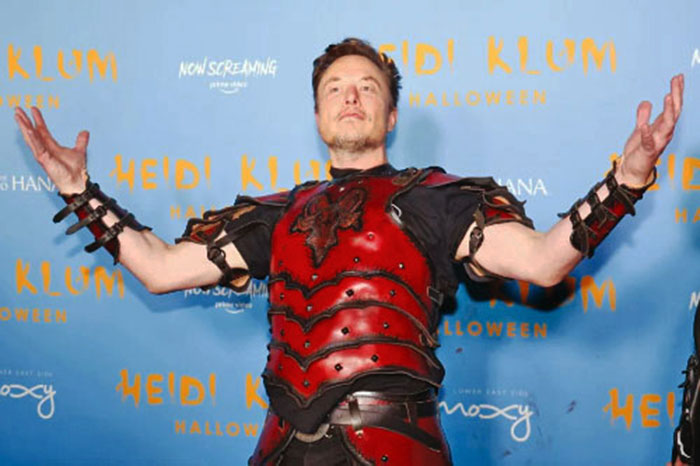
A week after purchasing Twitter, Musk wore a 'satanic' costume for
Halloween, which he used as his profile picture on X.
The outfit
features a Baphomet-like ram's head on a blood-red breastplate and
arm bracers, with an inverted cross on the forehead.
Dubbed "The
Devil's Champion," the costume's symbolism sparked discussions in
Christian circles about 'evil forces' reminiscent of a fast-receding aeon.
As we move into the A.I.-dominated new world - an
information-saturated environment of spectacle and mass mind control
- Musk aspires to be a charming devil and superhero for a new
generation.
The minds and reality tunnels of the next generation are fully
immersed in the digital realm, captivated by social media, on-demand
shopping, live-streamed entertainment and propaganda, electronic
payments, deep fakes, and A.I. chatbots.
Children navigate a blend of
online virtual and physical realities, with virtual realms claiming
increasing mental real estate. Memory is outsourced to Google and,
in the future, to personal A.I. agents like Musk's Optimus.
According to Musk biographer Walter Isaacson, one of his life goals
is,
"protecting us against artificial intelligence and robots gone
wrong."
Musk has publicly stated that A.I. could potentially bring
about an "apocalypse" - the extinction of humanity - and believes
that merging with machines is necessary to avoid becoming obsolete.
He asserts that the long-term goal of his Neuralink brain implant
project is to achieve "symbiosis with artificial intelligence," as
if the human mind can be managed like a computer.
"It's mostly about bandwidth, the speed of the connection between
your brain and the digital version of yourself, particularly
output,"
...explains Musk, as if the transhumanist dream of a
duplicated self in the cloud is already a reality.
While computers
can communicate at "a trillion bits per second," humans only manage
around 10 bits per second when typing on a mobile device.
To keep
up, we will need to interface with them digitally.
xAI's goal is,
"to understand the true nature of the universe."
An
artificial general intelligence (AGI) that matches or surpasses
human intelligence and capabilities is to be tasked to answer one of
the biggest questions of all.
Machine intelligence, fed on vast
amounts of human data, will deliver answers like the supercomputer
Deep Thought in Douglas Adams' The Hitchhiker's Guide to the Galaxy,
a foundational novel for the Tesla and SpaceX boss.
xAI's Grok
chatbot, modelled on the novel, might even reveal that the answer to
the "Great Question" of "Life, the Universe and Everything" is
"forty-two [x10]."
Joking aside - because humor is how Grok will connect with its
human "users" - a much more serious and existential threat looms
large as we stand at the crossroads.
It is a danger that most -
caught up or born in this new age of virtual realities - won't
detect, foresee or even understand as they fall under the spell -
and possible destructive deception - of machine "intelligence."
Vitamin K
Elon Musk takes
ketamine.
Musk has been vocal on X about his use of ketamine, a quick-acting
anaesthetic that is legally used in both humans (as a sedative for
minor surgery) and animals (as a tranquiliser).
At high doses, it
causes hallucinations.
Musk has a ketamine prescription and takes a small amount about once
every other week.
"Ketamine is helpful for getting one out of a negative frame of
mind," he told former CNN anchor Don Lemon.
Sometimes, though, Musk
will forgo the dissociative anaesthetic for weeks and says he
doesn't think he abuses it or he wouldn't be able to master his
16-hour work days.
"I can't really get wasted because I can't get my
work done."
A 2023 Wall Street Journal article, "Magic Mushrooms. LSD. Ketamine.
The Drugs That Power Silicon Valley," discussed how Elon and Google
co-founder Sergey Brin,
"are part of a drug movement that proponents
hope will expand minds, enhance lives and produce business
breakthroughs."
Microdosing - when people take minuscule amounts of psychedelic
substances to improve or enhance patterns of behavior - has become
very popular in recent years amongst business executives seeking an
'edge'.
Eduardo Hidalgo, the author of a book on the subject, says ketamine,
"is defined as dissociative anaesthesia because the person does not
fall asleep but rather disconnects from their body and their
environment.
Patients may appear conscious and have their eyes open,
but they are disconnected from their environment and do not respond
to pain."
"What makes this substance unique is its wide spectrum of effects,
which vary significantly depending on the dose administered.
High
amounts induce the anaesthetic effects already described.
Intermediate measures trigger intense visionary experiences lasting
between one and two hours.
These psychedelic effects range from the
sublime to the terrifying and have an unparalleled capacity to bring
about what some psychonauts have called 'the journey of the little
death'."
"Other psychedelics make you imagine a gnome sitting on the
television. With ketamine, reality as such disappears, forcing the
brain to create a new one.
You come to believe that what you see is
real," adds Hidalgo.
The most famous psychonaut known for his ketamine use was the
legendary scientist Dr John Lilly (1915–2001).
In The Scientist: A Novel Autobiography, neuroscientist
John C.
Lilly, a pioneer in the use of isolation tanks and sensory
deprivation, recounted his experience with a 150-milligram
intramuscular dose:
"I, as an individual, disappeared."
A medical doctor with a background in hard science, Lilly dedicated
most of his adult life to studying the human mind, particularly his
own.
He is recognized as one of the early scientific explorers of
human consciousness.
In his quest to unravel the mysteries of existence, Lilly used
isolation/floatation tanks to access the deepest parts of his mind.
He later ingested psychedelics such as LSD and ketamine to open a
mental gateway into other worlds (a similar state is achieved by
traditional indigenous
shamans...).
Lilly's relentless pursuit to pierce the veil of reality - the
foundational superstructure of our existence - eventually bore fruit
when he made contact with non-human intelligences.
This fascinating
encounter will be examined later in this article.
Achievements of
Musk
To set the stage, let's delve into Elon Musk's philosophy and
explore his major achievements. This is a very short overview, and I
am focusing on - not judging - abilities, with a slant on the most
important threat looming.
According to Walter Isaacson, who wrote an authorized biography of
the American business magnate, Musk believes he has unique abilities
to change the world.
In most people's eyes, he has proven himself
well and truly.
He considers himself a disruptor who questions and
breaks rules and restrictions and demands that his employees do the
same.
Elon Musk is revealed as a complex character driven by what his
former partner, pop star Grimes, described as "demonic" zeal.
She
referred to this intense drive as "demon mode" - a state claimed to
be common among high achievers. Musk and Grimes had a child in 2022
named Techno Mechanicus...
Isaacson suggests that the turmoil of Musk's early life helped fuel
his willpower, extreme productivity, and unparalleled ambition.
Musk is renowned for his fearless approach to disrupting traditional
industries. His ventures have significantly altered the landscape of
numerous sectors, including transportation, energy, and aerospace.
By leveraging groundbreaking technologies and unorthodox business
models, Musk has defied conventional norms and redefined the
boundaries of what is possible in various industries.
This bold
strategy has pivoted him into a position to shape the future.
"He has these ideas of justice, almost like a Captain Underpants or
comic book X-Man, which to some extent are applicable," writes
Isaacson.
"There are three big epic quests. One is sustainable
energy on the planet [Tesla]. Number two is taking us all to
planetary space again [SpaceX], and third is protecting us against
artificial intelligence and robots gone wrong [xAI]...
He has a great
feel for engineering... He talked about having
Asperger's Syndrome,
but in his case, it means he doesn't have deep emotional receptors."
Isaacson reports Musk is an engineering genius capable of brilliant
problem-solving.
He described how only hours after Musk finally
acquired the company then known as Twitter, he and Musk flew to Boca Chica, Texas, where SpaceX engineers were stymied by a problem.
Within two hours, Musk had figured out the solution...
Musk loves video games, and his favorite is The Battle of Polytopia.
In this brightly colored, cartoonish-looking game, players compete
to develop technologies, control resources, and wage battles to
build an empire.
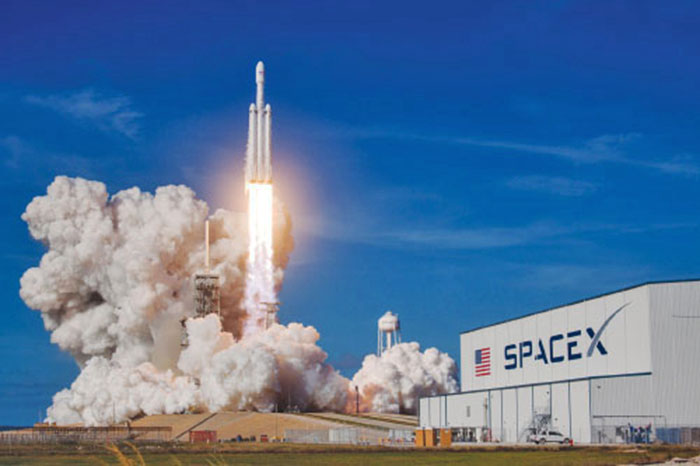
SpaceX is the dominating force
in
the commercial spacecraft market.
The neurodivergent Musk has gleaned life lessons from the game,
which he called "Polytopia Life Lessons."
Among them: "Do not fear
losing" and "play life like a game." Musk sees himself as the main
character, and many others, including most CEOs, are NPCs -
non-playable characters. (The NPC meme, derived from the gaming
world, denotes people who do not think for themselves or do not make
their own decisions).
"Let's not be too hard on the NPCs - they just
say what they're programmed to say," Musk cryptically tweeted on 4
October 2023.
Moving quickly forward over his early business career, in 2002, Musk
founded spaceflight services company SpaceX using $100 million of
the money he made from the sale of PayPal.
In 2004, Musk was an
early investor in electric vehicle manufacturer Tesla Motors, Inc.
(later Tesla, Inc.).
He became the company's chairman and product
architect, assuming the position of CEO in 2008. In 2006, Musk
helped create SolarCity, a solar energy company that was acquired by
Tesla in 2016 and became Tesla Energy.
In 2015, he co-founded OpenAI,
a nonprofit artificial intelligence research company (Musk split
with the company in 2018).
The following year, Musk co-founded Neuralink - a neurotechnology company developing brain-computer
interfaces - and The Boring Company, a tunnel construction company.
In 2022, he acquired Twitter for $44 billion. He subsequently merged
the company into the newly created X Corp. and rebranded the service
as X the following year.
In March 2023, Musk founded xAI, an
artificial intelligence company.
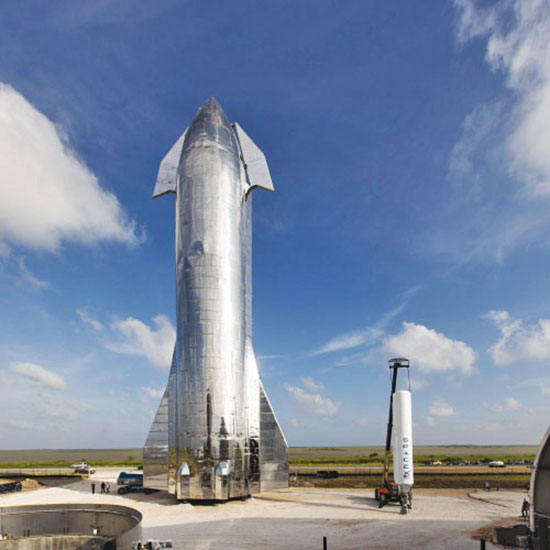
The company is developing
Starship,
a fully
reusable, super heavy-lift launch system
for
interplanetary and orbital spaceflight.
Space Exploration Technologies Corporation, commonly referred to as
SpaceX, is an American spacecraft manufacturer, launch service
provider and satellite communications company headquartered in
Hawthorne, California.
The company is developing Starship, a fully
reusable, super heavy-lift launch system for interplanetary and
orbital spaceflight.
SpaceX is now the dominating force in the commercial spacecraft
market largely due to its reusable rockets and other advanced
technology. It is the sole US provider for crewed missions to the
International Space Station.
SpaceX regularly launches and lands
rockets while carrying payloads for a wide range of customers, from
private companies to NASA and the United States Space Force. Musk's
success has been significantly bolstered by government contracts. In
2020 alone, SpaceX secured three military contracts.
In 2015, SpaceX began developing the Starlink constellation, a
network of low-Earth-orbit satellites designed to provide internet
coverage to a growing number of countries.
The project also aims to
offer global mobile broadband.
As of early March 2024, the Starlink
constellation consisted of over 6,000 mass-produced small satellites
in low Earth orbit, with thousands more planned for deployment.
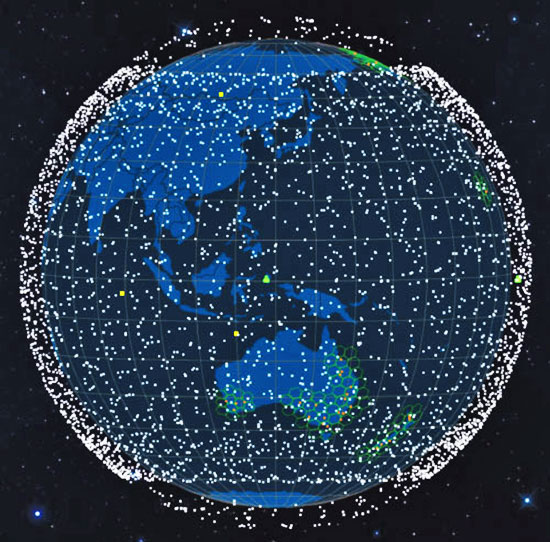
Map (July 2024) of SpaceX's
Starlink constellation,
a network of
low-Earth-orbit satellites
providing
internet access to most of the globe.
In March 2024, Reuters reported that SpaceX was developing
Starshield, a network of hundreds of spy satellites under a
classified contract with a US intelligence agency, likely the
National Reconnaissance Office (NRO), which manages spy satellites.
In 2021, SpaceX signed a US$1.8 billion contract with the NRO for,
"a
powerful new spy system with hundreds of satellites bearing
Earth-imaging capabilities that can operate as a swarm in low
orbits."
The reach and monitoring capabilities of these spy
satellites are unprecedented, with a source telling Reuters that "no
one can hide" under the new network.
The man guiding multiple multi-billion dollar companies is best
known for his electric car company, Tesla.
As one of the world's most valuable companies in terms of market
capitalization, Tesla is developing one of the most sophisticated
A.I.
systems in the world. Its self-driving software is trained to form a
realistic model of its environment and make life-or-death decisions
about its own path.
Fully autonomous cars are in the pipeline.
If
fully functional prototypes can be refined and replicated, they will
one day dominate the roadways. And if fully autonomous vehicles are
less likely to cause fatal crashes than human drivers, an argument
will be made that humans shouldn't be allowed to drive at all.
The
result would be that should a person run afoul of authorities, their
freedom of movement could be easily denied by the "robot on wheels"
parked in the driveway.
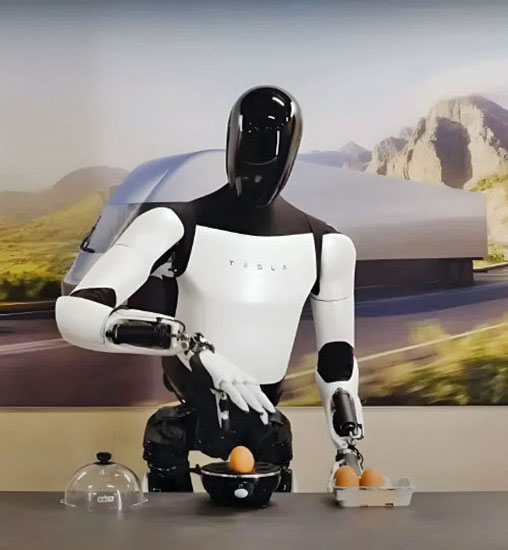
Tesla's Optimus
humanoid robot.
Some analysts believe
that at the current rate of iteration,
Optimus robots could
soon replace human labour in many fields.
Tesla is also developing Optimus, a humanoid robot designed to
replace dangerous, dirty, and boring human labour.
Its "brain" is
powered by Tesla Autopilot, which uses the same A.I. architecture as
the automobile.
Such robots will have major implications for humans.
First, it would
obliterate the blue-collar worker's negotiating power for higher
wages.
"Essentially, in the future, physical work will be a choice,"
Musk told his employees at the 2021 Tesla A.I. Day. "What is the
economy? It is, at the foundation, it's labour.
So - what happens
when there's no shortage of labour? That's why I think, long-term,
there will need to be universal basic income [he now calls it
universal 'high' income]."
Tesla employees cheered, oblivious they
might soon join "the useless class," those who the Israeli writer
Yuval Noah Harari said would now be "unemployable."
Another more profound implication of these robots is mass
surveillance as they scoop up vast amounts of "training data."
Given
its unprecedented access to social environments and understanding of
the physical world, A.I. bots would be a significant stepping stone
toward artificial general intelligence (AGI).
"Tesla A.I. might play a
role in AGI," Musk tweeted in January 2022, "given that it trains
against the outside world, especially with the advent of Optimus."
At Tesla's 2024 annual shareholder meeting, Musk announced the
company was embarking on not just a "new chapter" in its life but is
about to write an entirely "new book."
Optimus appears to be one of
the main characters.
He suggested the robots will perform like R2-D2
and C-3PO in Star Wars. They could cook or clean for you, do factory
work, or even teach your children, Musk suggested.
"Summoning the Demon"
Musk has a long history of issuing warnings and precautions about
A.I.
technology while at the same time helping its acceleration - echoing
that he has undergone a catalyzing experience.
His October 2014
warning is often quoted:
"With artificial intelligence we are
summoning the demon."
On this question, it's worth quoting some of his other warnings.
In
July 2017, Musk expressed his concerns:
"I have exposure to the very
most cutting-edge A.I. and I think people should be really concerned
about it."
He added,
"I keep sounding the alarm bell but until
people see robots going down the street killing people, they don't
know how to react because it seems so ethereal."
In March 2018, he emphasized the dangers of A.I., saying,
"A.I. is much
more dangerous than nukes. So why do we have no regulatory
oversight?"
The following month, in April 2018, he warned:
"[A.I. is]
a very important subject. It's going to affect our lives in ways we
can't even imagine right now."
He further cautioned about the
potential for A.I. to become,
"an immortal dictator from which we would
never escape."
By November 2018, Musk's apprehensions continued, as he mused,
"Maybe A.I. will make me follow it, laugh like a demon & say who's the
pet now."
The following year, in September 2019, he predicted:
"If
advanced A.I. (beyond basic bots) hasn't been applied to manipulate
social media, it won't be long before it is."
In July 2020, Musk offered a stark forecast:
"We're headed toward a
situation where A.I. is vastly smarter than humans and I think that
time frame is less than five years from now. But that doesn't mean
that everything goes to hell in five years.
It just means that
things get unstable or weird."
Speaking at the Cannes Lions International Festival of Creativity in
June 2024, Musk reiterated his warning, telling the audience that
even AI's most positive outcomes would lead to an "existential
crisis" for humanity.
The tech multibillionaire forecasts a "10 to 20 per cent
probability" of a scenario in which A.I. annihilates humanity.
When
asked if he would want to live through AI's destruction of humanity,
Musk replied,
"Would I want to be around to see it? Probably, yes."
He would witness humanity's End Times...
Musk urged people to remain positive despite the (seemingly)
impending danger, arguing that AI's potential benefits outweigh the
risks.
"I think the most likely outcome is one of abundance, where goods
and services are available to anyone. There's no shortage for any
one of us.
It would be a universal hike. Work would be optional."
The masterstroke in all this could be a long-term psychological
strategy.
Big Tech and governments (mostly in secret) are developing
A.I. and A.I.-driven products predicted to dominate society, as noted
above. Constant warnings about an A.I. threat - and its inevitability
- keep people and politicians off balance.
Imagine the relief when
it all seemingly works out fine. The world transitions into the new aeon and we're all so grateful to our new gods and their human
agents for deciding to keep us around, albeit in reduced numbers!
Yet, even in this optimal scenario, Musk warns of a "crisis of
meaning" for humanity.
"If A.I. can do everything you can do, but
better, what's the point of doing things? I think there will be an
existential crisis."
In this scenario, all work is done by your personal
A.I. agent and
vast numbers of jobs are automated. Even professions like lawyers,
doctors, and teachers may be replaced by sufficiently advanced
language models.
Of course, the "existential crisis" could be a great blessing.
What
if people were fully supported to engage in creative activities -
i.e. traditional arts and crafts, small-scale pursuits, research and
intellectual endeavors, spiritual pursuits, understanding and
working collaboratively with nature, consciously engaging our own
reset, etc. - with the proviso that our new A.I. overlords 'rule the
roost'.
Musk finished his talk by telling the audience that we were,
"at the
most interesting time in history" and recommended that they "enjoy
the ride."
I couldn't agree more!
Hooking Up to the Machine
Creating a neural lace
is the thing that really
matters
for humanity to achieve
symbiosis with machines.
Elon Musk
Tweet, 4 June 2016
Science Alert describes a neural lace as,
"a brain implant that can
augment natural intelligence by hooking us up to computers."
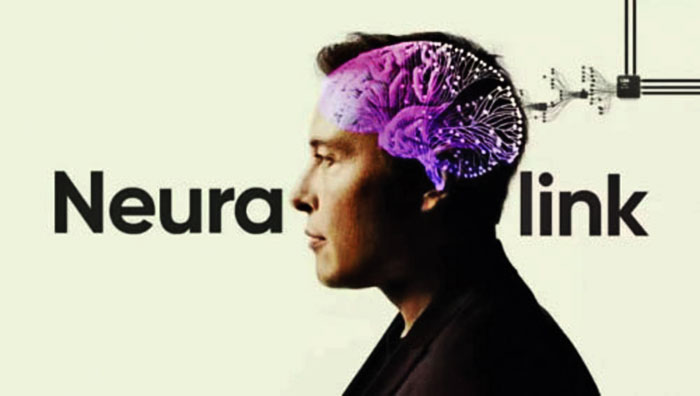
Elon Musk as
experimental model
for the
brain-computer interface.
Musk's most controversial obsession, which worries many people, is
his push to merge brains with computers.
Speaking on The Joe Rogan Experience in 2020, Musk discussed his
newborn baby boy, named "X Æ A-Xii" (pronounced X Ash A Twelve, Musk
and Grimes' first son).
"It's great," Musk said, "but babies are awesome. Also, I've spent a
lot of time on A.I. and neural nets so you can sort of see the brain
develop.
An A.I. neural net is trying to simulate what a brain does,
basically. You can sort of see it learning very quickly. You know,
it's just - wow."
"You're talking about the neural net," Rogan clarified, as confused
as any other normal human being listening. "You're not talking about
an actual baby."
"I'm talking about an actual baby," Musk confirmed.
Like a scene from the film Bladerunner, Musk envisions an
"optional"
A.I.-human symbiosis necessary for survival in the coming period.
His project to achieve this is Neuralink, which recently announced
its first successful brain-computer interface (BCI) in a human
being.
The BCI implant, called Telepathy, allows users to control
digital devices with their thoughts alone. Initial trials aim to
enable people with quadriplegia to mentally control computers.
BCIs record electrical activity in the brain and translate that data
into output actions, such as opening and closing a robotic hand or
clicking a computer mouse.
Musk believes we will all need Neuralink chips in our brains to keep
pace with the very A.I. systems his programmers are hoping to create
for the new world. Digital mind-melds could occur within the next
five to ten years, and Musk is ready to make it happen.
The problem with some who excel at engineering, mathematics, and
physical Endeavour is that they believe they can apply mechanically
minded solutions to wetware - biological life forms - and are
ignorant of the psychological and deeper spiritual dynamics that
drive human beings.
Another tech billionaire,
Bill Gates - from an early age - became
obsessed with machines and computers and launched a worldwide
vaccination crusade to mitigate human overpopulation.
The same
mathematical and logical certainty that Gates found in his computer
work could be extrapolated into programming the hardware and
software of humanity. Like a computer, we can run smoothly -
virus-free!
The future fantasy of BCI projects like Neuralink and other
companies in this space is to perfect our faulty memories through
constant self-surveillance and digital retrieval. Brain implants
will augment our flawed cognition and embed our personalities in
durable silicon, overcoming our mortality.
If you buy into or are trained on
transhumanist dreams, it all
sounds amazing.
Neurotechnologies that monitor your body will take marketing and
surveillance to whole new levels indeed.
Governments and large
companies could end up having access to the most personal form of
data - our thoughts and feelings.
It's hard to imagine the superhero
world proposed by people like Musk, where these technology
enhancements empower us as human beings.
Would we still be categorized as such?
Or perhaps we would be neurons in a noospheric-size A.I.-brain.
"Because it consists of billions of bidirectional interactions per
day," Musk tweeted soon after purchasing the social media platform.
"Twitter can be thought of as a collective, cybernetic
super-intelligence."
That makes each human mind another node in a
vast, A.I.-suffused global brain.
"A neuron doesn't know it's a neuron," Musk
elaborated.
60 Years Ago
Even as we watch,
so may we be watched.
Even as we experiment,
so may we be experimented upon.
John C. Lilly,
Simulations of God: The Science of
Belief, 1975
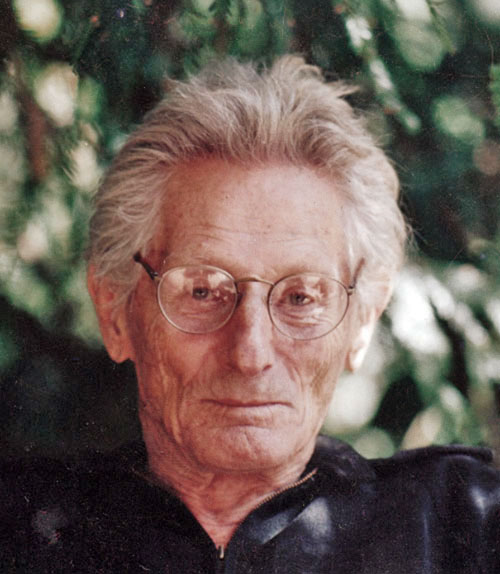
Dr John C. Lilly
(1915–2001)
pioneered the
use of the floatation tank
to explore the
deepest parts of his mind.
In 1964, the scientist Dr
John Lilly sought a breakthrough in his
work with dolphins.
He ingested the psychedelic substance LSD,
entered his isolation tank, and was soon propelled into "profound
altered states."
Lilly invented the world's first floatation tank in 1954.
Today,
they are used commercially and in domestic settings for relaxation
and deep healing. In a floatation tank, a person is suspended in
salt-saturated water, with their body floating on the surface and in
complete darkness.
In his quest to understand the mystery of existence, Lilly used the
pure stillness of the isolation tank to go deeper while in a
conscious state, later ingesting psychedelics such as LSD and
ketamine to induce more profound visions.
History will tell you that Dr John C. Lilly pioneered
human-to-dolphin and inter-species communication, but he also
explored life as a physician, neuroscientist, psychoanalyst,
philosopher, writer and inventor.
He was recognized by the
scientific and medical community as both a pioneer and an eccentric.
If it wasn't for "eccentrics" and individuals now regarded as
neurodiverse, many beneficial breakthroughs would not have been
achieved.
On another occasion, an assistant presented Dr Lilly with a
substance he hadn't used, ketamine, which they referred to as
"Vitamin K." Lilly suffered terrible pain and sought relief.
The
dissociative anaesthetic not only relieved the pain but mentally
propelled Lilly into new spaces, allowing him to traverse the same
internal landscapes with consistency.
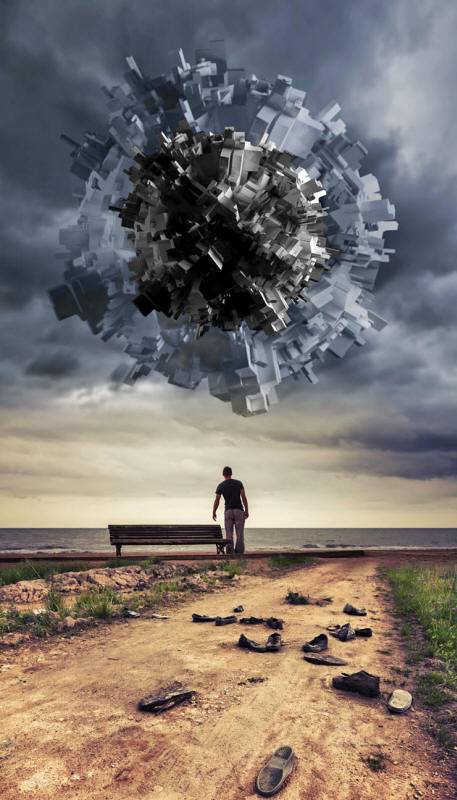
Little by little,
something was breaking through,
gaining more
leverage, outputting for input,
like a singularity
pulling us closer into its orbit.
Was it inevitable or
did we have a choice?
Is it a test?
Do we still stand at
the crossroads
or did we choose long
ago?
He soon made contact with what he claimed were two separate groups
of "Beings."
One group, which he later dubbed ECCO (Earth
Coincidence Control Office), was guiding humanity through
synchronicities toward higher consciousness.
However, the other
force, the SSE (Solid State Entity), was mechanical or
computer-based.
In today's terms, we would consider it an
advanced A.I. civilization that operates through robotics and similar
'hardware' vessels.
Lilly was convinced that this interstellar
solid-state civilization was,
"in contact with all solid-state
computers and control devices constructed by Man on the planet
Earth."
Lilly's contact with extra-dimensional beings is similar to those
described by Harvard medical professor
John E. Mack and his books on
"alien abduction."
These "aliens" are not necessarily physical
entities travelling the universe in spaceships, but transdimensional
Beings interested in human activities and perhaps all conscious
activity exhibited by advanced life forms on select planets.
According to Lilly, ECCO coordinates events on Earth through
carefully crafted coincidences or synchronicities to guide select
mentally-fit and prepared individuals. The intent of these Beings
was to help humanity evolve in a peaceful and healthy way.
However, its somewhat nefarious counterpart aimed to stop or limit
human consciousness, even eliminate humanity altogether.
According to the writer Sean Kerrigan:
Lilly called this alien force the 'solid state entity', or SSE,
which is made up of networked computer parts.
According to Lilly,
the SSE is a being of pure intelligence and rationality. Its only
objective is to multiply and make copies of itself.
To this end, it
has targeted humanity, trying to influence us into creating ever
more complex social and mechanical structures that will one day
result in an artificial super-intelligence - another being like
itself.
Writing in his 1978 autobiography, The Scientist, Lilly described
the SSE this way:
[M]en began to conceive of new computers
having an intelligence far greater than that of man...
Gradually,
man turned more and more problems of his own society, his own
maintenance, and his own survival over to these machines.
They
began to construct their own components, their own connections,
and the interrelations between their various sub-computers...
The
machines became increasingly integrated with one another and
more and more independent of Man's control.
In the 1960s, rudimentary computer technology
entered a new phase, transitioning from vacuum tubes to solid-state
devices such as transistors and integrated circuit chips.
Large
corporations and governments had access to this technology, but the
personal computer revolution would only begin in the 1970s.
During this period, relatively simple forms of artificial
intelligence and networked machines started taking over most
manufacturing, maintenance, and logistics.
Lilly describes an entity very much like the artificial superintelligence warned about by Musk and others.
Eventually the machines took charge of the
remaining humans on the planet Earth. Their original design to
help Man was fast left behind them.
The now interconnected,
interdependent conglomerate of machines developed a single
integrated, planetwide mind of its own.
Everything inimical to
the survival of this huge new solid-state organism was
eliminated.
Men were kept away from the machines because the
total organism of the solid-state entity (SSE) realized that Man
would attempt to introduce his own survival into the machines at
the expense of the survival of this entity.
Lilly continues with his prophetic vision of the
future:
In deference to Man, certain protected sites
were set aside for the human species.
The SSE controlled the
sites and did not allow any of the human species outside these
reservations. This work was completed by the end of the 21st
century.
By 2100, man existed only in domed, protected cities in
which his own special atmosphere was maintained by the solid
state entity.
Provision of water and food and the processing of
wastes from these cities were taken care of by the SSE.
Presently, debates over the A.I. threat dominate
the intellectual landscape, even in the face of its seeming
inevitability. For example, Edoardo Campanella, in his article 'A.I.
is a threat to human dominance', writes:
When A.I. manages to depart from the human archetypes it is trained
on, it will be leveraging our language and symbols to build its own
culture.
For the first time, we will be dealing with a second highly
intelligent species - an experience akin to the arrival of an
extraterrestrial civilization.
An A.I. that can tell its own stories and affect our own way of seeing
the world will mark the end of the intellectual monopoly that has
sustained human supremacy for thousands of years.
In the most
dystopian scenario - as in the case of an alien invasion - the
arrival of a superintelligence could even mark the end of human
civilisation.
Lilly felt that SSEs throughout the galaxy were subtly influencing
humanity to surrender more and more responsibilities to Artificial
Intelligences by using its own human agents.
Writing in the third
person, he wrote:
As John tuned in on the solid-state network, he felt this kind of
superhuman control of him very strongly... it had a seductive
component as well as a hostile one.
The programming from the
solid-state civilizations elsewhere in the galaxy was teaching Man
that the solid-state devices were at his service and he need only
increase their size to augment his own survival potential.
"Develop
these machines and let them take care of you" was typical of the
kinds of messages received.
It's easy to dismiss Lilly's warning as the ravings of a man deluded
by psychedelic drugs, but they do carry more weight due to his
unswerving commitment to the spirit of science (using all the tools
at his disposal).
When we consider our situation today, at the tipping point of an
A.I.
revolution that will transform life as we know it, Lilly's prophecy
is highly relevant, whether you believe he contacted "Beings" or
produced them from his own mind.
Interestingly, Lilly is also credited as one of the first scientists
to use computer terminology to understand how the human organism
functions. Lilly once described the carbon-based lifeform as a
biological computer and its cognitive functioning as programming.
He
said:
All human beings, all persons who reach adulthood in the world today
are programmed biocomputers. None of us can escape our own nature as
programmable entities.
Literally, each of us may be our programs,
nothing more, nothing less. (Programming and Metaprogramming in the
Human Biocomputer)
It is wrong to conclude that Lilly was advocating humans as
machine-like and thus programmable like a computer.
From his own
research, he had already rejected the scientific doctrine of behaviourism and discovered that beliefs - often held unconsciously
and rooted in forgotten childhood traumas - were the core
programming structures of the mind.
If you could alter these deeply
held beliefs, you could reprogram the mind, and to do so, you needed
to access the metaprograms - programs that create other programs.
He
provided cognitive tools on how you can go about this.
Future
Trajectories
The myth of "progress," which haunts our modern world, propels us
singularly toward a destination led by big tech, the front-facing
vehicles for a deeper technological revolution.
The juggernauts of artificial intelligence, robotics, cognitive
augmentation, and genetic engineering - converging and hybridizing -
are accelerating "progress" across the board.
A transhumanist orientation lurks beneath the public pronouncements
of,
-
accelerationist coders
-
project directors
-
CEOs
-
chief
scientists,
...and various shareholders and officers on the board of
directors.
"Progress" is coming in the form of the first waves of transhuman
products...:
A.I. incorporated into finance, medicine, education, the
media, the justice system, and so on.
Autonomous machines in
industry, manufacturing, and warfighting.
Transport.
Humanoid
robots.
Dog robots, etc...
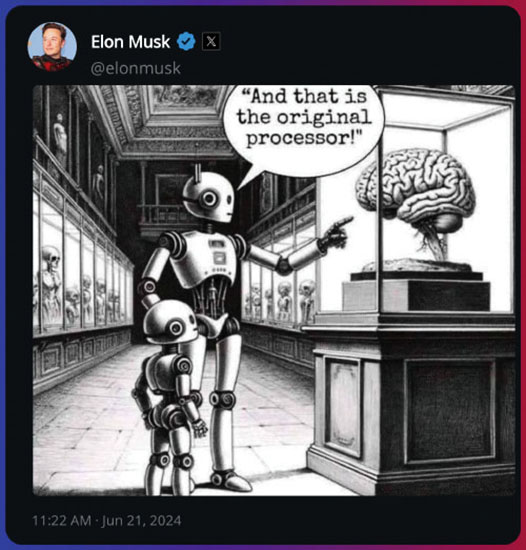
Elon Musk sees himself as a leader of the pack, driven by his goal
to make us a multiplanet species.
At the same time, humans engage in the most horrific killing sprees
of each other, made more efficient by new technologies.
It's hard to
believe we're qualified to join the cosmic community when primitive
urges remain untamed and long-term global peace and harmony are yet
to be established.
Of course, Elon Musk is not the only figure working in this space.
The most powerful forces in existence today on this planet demand
A.I.
- a technology that seemingly manifested to the human race to
provide its avatars with a new playing environment.
What great
battles await?
Are recent cyberattacks a prelude of what is to come?
People with neurodiversity, such as Elon Musk, exhibit different
thinking "styles" and ways of processing information. Many are
associative thinkers rather than linear thinkers.
They battle to
understand (or too fully understand) the "normie" thinking of
contemporary times to be able to "fit in," which can make them sound
"off."
This means they are not locked into one approach and could
pull back and adapt their thinking to other "ways of knowing."
Harnessing that same level of willpower used to solve real-world
problems will draw out subtle hints and help tune into diverse
reality streams.
This could produce very powerful, well-rounded
individuals.
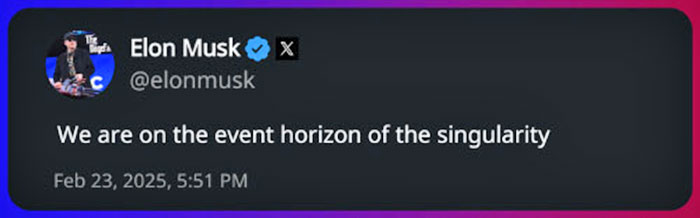
Today, as we stand at a crossroads, our collective belief will point
us to our ultimate destination in the new era.
John Lilly also
received guidance on these matters over 60 years ago:
If Man was to become the servant of more
intelligent beings that he was here to create, it would be far
better to create those which would foster his own development
rather than his demise.
John began to see the necessity also for
tuning in on the networks of communication in the galaxy.
He realized that Man would have to be extremely careful in choosing
the proper networks.
It would be necessary to find those which
were furthering the evolution of life as Man knew it rather than
the evolution of forms whose survival depended on parameters
other than those of biological life on Earth.
He now began to
understand Man's warfare on Man as a result of the tuning-in on
solid-state life-form survival programs rather than biological
life-form survival programs.
You can read Jason Jeffrey's follow-up article, "Elon Musk
and
The Technological Spell - ECCO vs. the Solid State Entity", in
New Dawn 211 (Jul-Aug 2025),
and
HERE.
References
|