|
by Murad Sadygzade March 29, 2026 from RT Website
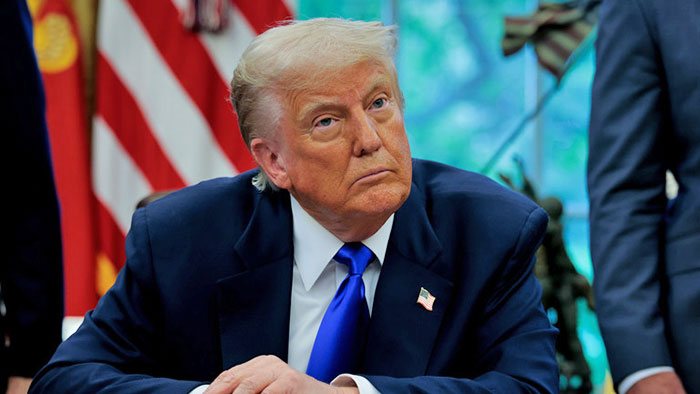
US President Donald Trump © Anna Moneymaker
Getty Images
saw as a quick campaign, Iran sees as a fight for survival. Costs are rising and the end is nowhere in sight...
After one month of war against Iran, one conclusion stands out more clearly than anything declared in all the press briefings:
The campaign was conceived as a short and brutal episode, a shock operation designed to break Iran's will, force Tehran back to the table on humiliating terms, or in the most ambitious fantasies circulating around Donald Trump's political circle, trigger internal collapse and perhaps even regime change.
Israel's aim was somewhat different, though complementary.
It wanted to inflict the maximum possible damage on Iran's military and strategic infrastructure, weaken it for years, and reshape the regional balance through force.
Yet in the first month of fighting, the central assumption behind both approaches began to collapse. Instead of folding and getting coerced into submission, Iran resisted like a state fighting for survival.
The logic was familiar and, from their point of view, elegant.
Some in the Trump camp seem to have believed that Iran's political system was brittle enough to crack under pressure.
That assumption now looks less like strategy and
more like projection. Washington entered the war expecting quick
leverage rather than a drawn out contest of endurance.
The strategic instinct in West Jerusalem was not primarily to negotiate with Tehran from a position of strength, but to use the cover of an American-backed offensive to hit as much as possible and to push Iran backward in military, technological, and geopolitical terms. In that sense, Israel's goals were harsher and more concrete.
But even here the first month exposed a contradiction.
A campaign that hurts but does not decisively
cripple can still end by strengthening Tehran politically, morally,
and strategically if the attacked state manages to survive,
retaliate, and turn endurance into legitimacy.
In Washington, the war seems to have been imagined as a tactical episode.
In Tehran, it was understood as a strategic struggle, even an existential one. Iran's leadership acted not as if it were participating in another bargaining cycle, but as if it had entered a defining confrontation over sovereignty, deterrence, and state survival.
That difference in strategic depth has shaped the first month more than any individual missile strike. A side fighting to improve negotiating conditions usually stops when the price becomes uncomfortable.
A side fighting because it believes defeat would
endanger its future absorbs pain differently, calculates
differently, and escalates with a different kind of discipline.
Whatever grievances, divisions, and frustrations existed inside Iranian society before the war, the assault by the US and Israel gave Tehran a chance to consolidate the population around the state, the flag, and the idea of national survival.
In moments like these, even a government facing criticism can reposition itself as the defender of the nation against foreign violence.
This does not erase internal tensions, nor does it magically solve Iran's domestic problems. But it does give the leadership room to invoke patriotism, sacrifice, and resistance in a way that would have been much harder under normal circumstances.
For the Iranian state, this may prove to be one
of the most important political effects of the war.
It is also measured,
In the first month of this war, the US damaged all four.
It entered with rhetoric of strength and has already found itself talking about pauses, mediation channels, indirect messages, and deadlines extended under pressure. That does not look like a superpower dictating terms.
It looks like a superpower discovering that coercion is easier to launch than to conclude.
A war of this kind does not remain confined to military maps.
What may have been sold in Washington as a limited geopolitical shock has instead begun to resemble an accelerant poured onto an already unstable world economy.
This is how multipolarity grows in practice:
Pressure
exposes NATO fault-lines
America's traditional allies did not rally in the way Washington expected. European governments showed skepticism, irritation, and in some cases outright distance.
Alliance fatigue is showing under pressure.
Credibility in alliance systems is cumulative.
It is built over decades and can be weakened shock by shock. Every episode in which Washington acts first and consults later, every outburst that treats partners as instruments rather than political actors, every demand for obedience without strategic explanation erodes trust a little further.
A military alliance can survive such erosion for a while, especially when members still fear common adversaries. But the political soul of an alliance is harder to repair than its budget lines.
The first month of war with Iran has widened the emotional and strategic distance between the US and parts of Europe, and it has done so at a time when Western institutions were already carrying the weight of internal contradictions.
The collective West is now far less collective than it claims to be, and this conflict has only made that clearer.
Their security conceptions were built for decades around managed dependence on the American umbrella combined with ambitious social and economic transformation at home. That model now looks less stable. The Gulf monarchies face a harsh reality.
They remain exposed to Iranian retaliation, exposed to disruption in shipping lanes, exposed to energy shocks, and exposed to the possibility that Washington may act decisively but not predictably.
In any case, the old assumption that American power automatically equals regional order has been weakened.
For Gulf elites, this means security doctrine and development strategy can no longer be treated as separate spheres. They are becoming one and the same question.
The region is entering a new era in which old
formulas of protection, growth, and political balance will have
to be revised...
If Tehran were eventually forced into humiliating concessions, the present gains in image and positioning could evaporate.
But at this stage, Iran has undeniably improved its international positioning in one crucial sense. It has shown that it can answer Washington and endure under immense pressure.
Across much of the non-Western world, and in large segments of global public opinion that are deeply suspicious of American interventionism, Iran is increasingly seen less as the caricature of official Western messaging and more as a state defending itself against aggression by the US and Israel.
Survival under assault can be politically
transformative...!
Iran did not have to win conventionally in order to alter the meaning of the conflict.
It only had to deny the rapid political result
that the aggressors were hoping for. And by doing so, it shifted the
psychological terrain of the war.
The only
Victories are Political
The immediate beneficiaries appear to be the Israeli far-right currently in power. For them, war expands room for ideological hardening, securitized politics, and the argument that maximal force is the only language the region understands.
A prolonged confrontation with Iran also helps keep domestic political dynamics inside an emergency frame, where dissent can be marginalized and radical agendas can travel further than they otherwise might.
But this is not the same as a strategic Israeli victory.
A region pushed deeper into permanent war is not a region that guarantees long-term safety, even for the side that presently feels ascendant.
The country with the greatest military weight may also be the one that has lost the most strategically.
This is why the first month of the war should not be read only through maps of strikes, casualty counts, and tactical moves.
Its deeper meaning lies elsewhere. It has revealed the bankruptcy of a familiar illusion in American foreign policy, the illusion that one can use violence as a short demonstration, compel strategic capitulation, and walk away before the political consequences mature.
That script worked badly even in a simpler world.
By the end of the first month, cautious attempts at negotiations had begun to emerge, and it is the Americans who appear most interested in testing that track.
This alone says a great deal about how the campaign has unfolded.
Yet the parties remain far from peace.
Their positions are still separated by distrust, anger, incompatible war aims, and the accumulated logic of escalation. The final outcome of the conflict remains deeply uncertain, perhaps more uncertain now than at its start.
The fog has not lifted. It has thickened.
The fear now,
That fear may still sound extreme to some, but
the fact that it is now being spoken aloud at all tells us how
dangerous this conflict has become.
|