|
Article also
HERE during an anti-Israel protest last September in San'a, Yemen.
yahya arhab/epa/shutterstock has ramped up threats
after bottling up
shipping for years... Iran has successfully strangled the Persian Gulf, the most critical maritime route for energy supplies in the world. It hasn't yet prevented its foes from using a workaround that runs through the Red Sea.
That could change if the Houthis get involved.
The U.S. and its partners in the Middle East are keeping a close eye on the Yemeni militant group which - armed and funded by Iran - crippled shipping through the Red Sea for much of two years.
The Houthis have recently stepped up threatening rhetoric that has caught officials' attention.
While they haven't started shooting yet, the militants are an important lever for Iran, if it decides to further squeeze the global economy or expand its targets to Saudi Arabia and nearby U.S. assets, such as a base in Djibouti.
Iran has long cultivated militia allies across the Middle East as a way to project power and as a deterrent against attack.
Hezbollah, in Lebanon, and Iran-aligned militias in Iraq have jumped into the war to attack Israel and U.S. bases.
The Houthis are a notable holdout but have signaled they could jump in at any moment.
Long dismissed as sandal-wearing mountain fighters, the Houthis are formidable combatants.
The group seized control of Yemen's capital and many of its population centers more than a decade ago in a long-running civil war, fending off an Arab coalition led by Saudi Arabia and the United Arab Emirates.
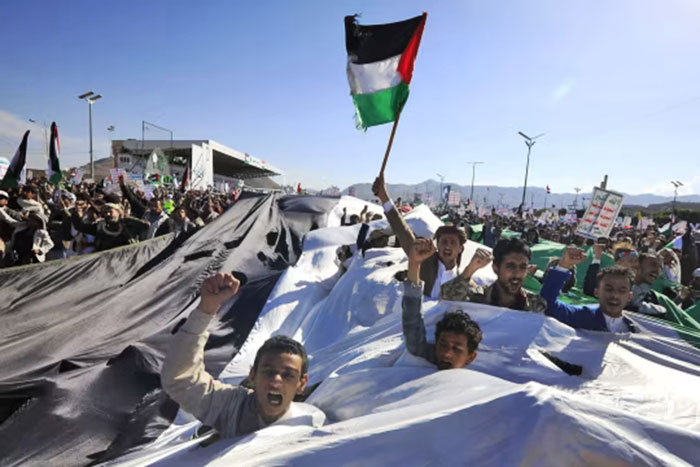
Protesters waved Palestinian flags as they marched in 2024 through San'a, the Houthi-controlled capital of Yemen. YAHYA ARHAB/EPA/Shutterstock
Houthi drone and missile attacks during the war in Gaza all but halted traffic through the Red Sea and Suez Canal, forcing shippers to take the longer journey around South Africa's Cape of Good Hope.
The group also hit Israel, more than 1,000 miles away.
President Trump launched a campaign against the Houthis a year ago that was a preview of the current war with Iran.
The fight exposed U.S. sailors and pilots to a barrage of drones and missiles and ended after nearly two months in a simple cease-fire that left the Houthis battered but not broken.
While the two sides stopped shooting at each other, the Houthis continued to attack Israel and ships in the Red Sea.
The group halted its attacks after the Trump administration brokered a Gaza cease-fire deal last fall, but shippers remain nervous about using the route.
The Red Sea is again in focus, with Iran bottling up oil supplies in the Persian Gulf by controlling the narrow Strait of Hormuz that leads to the Indian Ocean.
Saudi Arabia has pipelines that allow it to partly circumvent the blockage by routing crude across the peninsula to the Red Sea port of Yanbu.
That exit path takes ships past hundreds of miles of Houthi-controlled coastline leading to another chokepoint at Bab al-Mandeb, the strait that links the Red Sea to the Gulf of Aden.
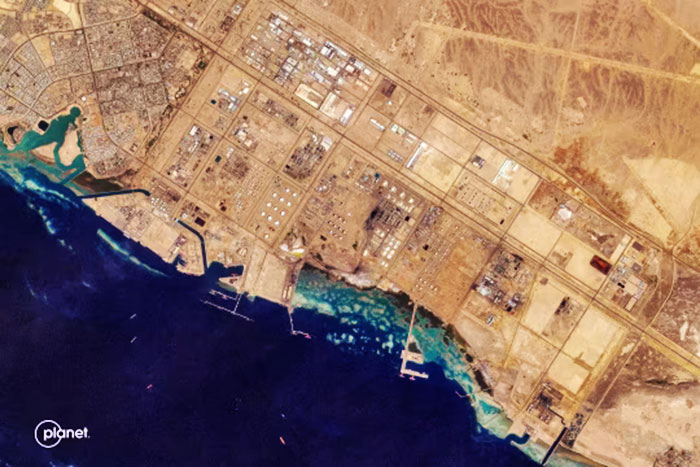
A satellite image from March 4 shows the oil infrastructure at Saudi Arabia‘s Red Sea port of Yanbu. Planet Labs PBC/AFP/Getty Images
Saudi officials said the kingdom has an agreement with the Houthis reached in 2022 not to attack its territory or ships.
The kingdom intervened against the militant group a decade ago during Yemen's civil war but later withdrew and reached a detente that lowered the risk of attacks.
Saudi officials are working to maintain diplomacy with the Houthis to keep them out of the fight, a U.S. official said.
The U.S. and Israel, meanwhile,
While funded and armed by Iran in recent years, the Houthis have their own domestic constituency to tend to.
While fighting in the name of Gaza won the group popularity at home and across the Arab world, siding with Iran while it is shooting at Arab countries could backfire.
The stakes are high for the group, which doesn't want to be perceived as fighting Iran's battles and getting more Yemenis killed in the process.
Hezbollah's decision to join the war in support of Iran brought heavy Israeli airstrikes and an expanded ground invasion that has driven Lebanese civilians from more territory.
Iraq has also become a battle zone again, with the U.S. pounding Iraqi militias and projectiles hitting the U.S. Embassy, the airport in Baghdad and a U.S. base at the Erbil airport.
U.S. attacks on the Houthis last year destroyed military infrastructure and killed a number of militant leaders.
But if feeling existentially threatened, Tehran could pressure the group to join the fray.
The group's secretive leader, Abdul-Malik al-Houthi, said earlier in March that his fighters stand with Iran and are ready to escalate when required.
|