I have a rational fear, and I say rational to distinguish myself
from the war mongers and fanatical Islamophobes who see enemies and
Muslims under their beds and in their closets, that the US is
vulnerable not only to defeat in overseas warfare but is exposed to
attack from its adversaries here at home.
Regarding defeat in war against foreign states, I've spoken before
about the US military's failure and underperformance in the last few
years:
The US Navy had to retreat from the Red
Sea not once but twice against Yemen's Houthis.
Both Biden
and Trump administration officials, civilian and military,
seemed to delight at the prospects of the naval campaign,
invoking WWII-style battles and promising Houthi
capitulation.
In 2024 and again in 2025, the campaigns ended
in face-saving "truces", but the results were clear: Houthi
control of the Red Sea.
US industry can't produce munitions to
keep up with wars in
the Middle East and
Europe, a weakness going back to the US air campaign
against the Islamic State in Iraq and Syria
a decade ago, and one of the chief reasons for Donald
Trump's intervention in last year's 12 day war between
Israel and Iran (both the Israelis and Americans were
running out of missiles to intercept Iranian missiles
and drones).
The inability of the US weapons industry, along
with European weapons companies, to meet the needs of
Ukraine is made all the more alarming as the
Russians, despite the largest sanctions regime in
history, not only are satisfying their armament needs, in
the largest conventional war since WWII, but exporting
weapons for considerable profit.
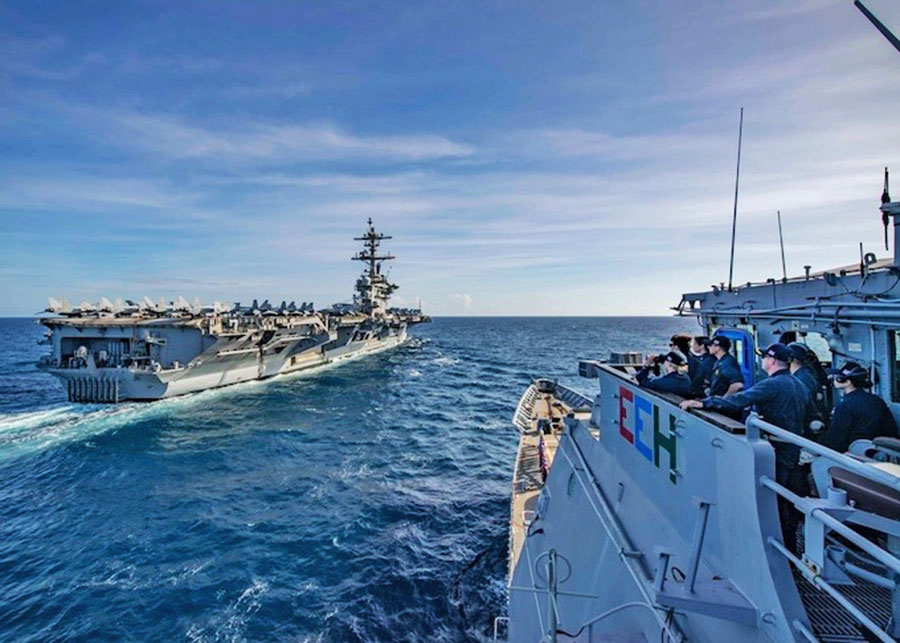
The US Navy is unable to keep enough of
its 11 aircraft carrier battle groups at sea to allow
President Trump to threaten both Venezuela and Iran at the
same time; note the belated entry into to the Persian Gulf
theater of the Abraham Lincoln battle group.
The Navy-Marine
Corps amphibious ready group (ARG) that would normally be in
the Mediterranean, and able to transit to the Arabian Sea to
support operations against Iran, is in the Caribbean.
An ARG
is necessary, for many things such as providing search and
rescue for downed pilots, the seizure of vessels or oil
platforms, serving as a floating base for commando missions,
like the kidnapping of Nicolas Maduro, reinforcing ground
units, or evacuating American citizens from the region.
Traditionally, there is an ARG on station in the vicinity of
the Persian Gulf/Arabian Sea, but that ARG seems to have
only left the US west coast recently.
With 175,000 Marines,
nearly 300 ships and a trillion-dollar budget, you'd think
the American war machine would be able to have 3 ships with
2,000 Marines and some helicopters anywhere in the world it
wants, let alone the Middle East, but it can't.
It's very possible that the US-Israeli
regime change operation that blended into and then hijacked
organic and legitimate Iranian protests last month was
unable to be realized due to the lack of American naval
forces in the area.
IDF Chief of Staff
Eyal Zamir stated last week, after meeting with US
generals in Washington, DC, that the US would carry out
military strikes against Iran in 2 weeks to 2 months.
That
time frame may coincide with weather conditions in the
region (recall both Iraq War I and II began late
winter/early spring, and despite technological advancements
from 35 and 23 years ago, weather does still matter) and the
desire of the Trump administration to go through with at
least a few rounds of negotiations with the Iranians, but it
is likely the timeframe primarily has to do with getting US
forces in position in the region.
Just as Donald Trump, a year ago
at his first press conference with Prime Minister Netanyahu,
asserted the US would
take over the Gaza Strip... and will own it, which is
being realized through Trump's Board of Peace, Trump also
made a
firm commitment regarding Iran.
At that meeting last
February, I believe Trump and Netanyahu agreed to carry out
regime change in Iran.
A year's worth of planning,
preparations and operations went into aligning regional
conditions and Iranian domestic unrest.
This included:
Last June's 12-day war against Iran,
itself a regime change attempt
further weakening and fracturing
Lebanon with over 1,000 Israeli airstrikes, IDF
occupation of parts of Southern Lebanon – essentially
cleansing parts of Southern Lebanon of its population,
and American political pressure meant to increase
division within Lebanon
supporting Syria's reformist al-Qaeda
government in its consolidation of power, not the least,
by the US abandoning its Kurdish allies once again (at
the same time that Damascus consolidates power, Israel
carries out continual bombings, occupation of parts of
southern Syria and incites sectarian violence to bolster
Israel's regional dominance)
getting the Europeans to re-introduce
the draconian snap-back sanctions on Iran last fall,
which were critical to ensure the economic conditions
needed to get Iranians on the streets in protest; and
resolving the Gaza genocide with a victory for zionism,
billionaire real estate developers and genocidal
settlers.
It's quite possible that as everything
aligned for an attempt at regime change last month, the
Trump-Netanyahu plan for Iran was not fully realized because
the US naval forces, including
those needed to defend Israel from Iranian missiles and
drones, were
7,000 miles away in the Caribbean.
The Air Force has its own manpower and
maintenance problems, and its ability to surge additional
squadrons to the Middle East is further constrained by
commitments worldwide.
In 2024 (latest data available),
2 out of 5 Air Force planes were unavailable due to
maintenance.
That's almost 2,000 aircraft, which I guess is
ok because the Air Force is also about
2,000 pilots short. We should note before going further
that the US Air Force hasn't faced an opponent capable of
inflicting significant losses or contesting control of the
sky since the Vietnam War.
This
century, only one Air Force plane has been shot down by
enemy forces, an A-10 in Iraq in 2003 (a second plane, an
F-15E that crashed in Iraq in 2003, was not
confirmed to have been shot down).
The above 2 out of 5 number
reflects what are called Mission Capable rates, meaning the
plane can do at least one of the tasks it is assigned to do.
For example, if the lights on your car don't work, it would
still be considered mission capable because you could drive
it during the day, just not at night.
So, a fighter plane
that can't fire its weapons would still be considered
mission capable. The full mission capable (FMC) rate is more
important, as it tells us how many planes can actually do
the job taxpayers paid for them to do.
The Air Force's
F-35A, which costs well more than $100 million each, has an
FMC of 36%.
That means barely 1 out of 3 Air Force F-35s
are available to carry out any assigned mission. Somehow,
though, an FMC of 36% is better than most of the rest of the
Air Force's other fighters and bombers.
Support aircraft,
limited in number and incredibly vital to any operation, are
just as unreliable.
As this 2024
Air Force report notes, 61% of KC-46 aerial refueling
tankers deemed mission capable include those with broken
booms that cannot refuel other aircraft.
When those tankers
that can't refuel other airplanes are removed, the mission
capable rate falls to 37%.
A refueling tanker literally has
one mission: refuel other planes.
Yet, when a tanker can't
do that, the Air Force still says it is mission capable.
Going back to the analogy of your car, according to the Air
Force, your car is still mission capable even if it is
missing all four wheels because you can still listen to the
radio.
I am going at length here with regards to Air Force
maintenance rates to not simply demonstrate why taxpayers
should be outraged, but to ask:
Do you think an Air Force
that understands itself through such mendacity is going to
perform well in a war against an actual opponent?
As detailed last year in
The New York Times, Russian generals defeated
American generals operationally in the Ukraine war.
While
the last two years of the Ukraine-Russia war have been more
or less an attritional slug fest dominated by drones and
small units along the frontlines, the first two years saw
attempts by both sides at some form of more traditional
combined arms, large unit warfare, including the
catastrophic 2003 summer offensive by the Ukrainians.
The
men commanding the big arrow movements of the Ukrainian
forces were American generals in Germany.
This may not have
been a surprise to those of us who understood this war as a
US proxy war, but the disturbing thing is not the continued
refusal by many Western military commentators and analysts
to accept this definition of the war as a proxy war, but to
acknowledge this operational defeat of US generals by
Russian generals.
Have no doubt, the result would have been
the same if the men dying under American generals were from
Colorado Springs, El Paso or San Diego rather than Kharkiv,
Kryvyi Rih or Lviv.
Even the successful campaign against the
Islamic State in Iraq and Syria, this century's greatest
example of blowback, did not come under the command of
American generals but was the result of coalition efforts in
both Syria and Iraq, with Russian and Iranian generals
commanding the bulk of the ground forces and overall
campaigns.
The Americans certainly played a critical role in
both Syria and Iraq, especially with air support and
logistics, but you can say the same for the Russians in
Syria.
The Iranian leadership role, especially in Iraq, was
paramount.
So, the one successful American military campaign
of this century that realized its objectives, which is all
that ever matters in the end, was a victory in which
American generals had, in Syria, a shared role with Russian,
Iranian, Syrian and Kurdish commanders, while in Iraq,
American generals were effectively subordinate to Iranian
generals.
The examples above, again, are only from the last
few years.
We can go back farther and examine the failures of the
Afghan, Iraq, Libyan and Yemeni wars, review the multitude of
counterproductive and ruinous outcomes of past regime change
operations, or weigh the decades-long systemic and structural
weaknesses of the US military (enlistment, retention, size,
procurement, etc), but I think the point is made.
The American
military is overextended, limited in its resources, unable to be
reliably resupplied by US industry, and commanded by incompetent
generals and admirals.
It is a military in grave danger of defeat
over the course of a campaign and of failing to achieve US
objectives. War with Iran would not just be another illegal and
immoral war, but another unwinnable and stupid one as well.
All that I have said above regarding the US
military needs to be juxtaposed against the strategic success of the
US and Israel in separating their adversaries in the Middle East
from one another in order to deter, diminish or destroy them.
Conditions in the Middle East are different than a year ago and
dramatically different from two years ago.
This political and strategic success in the
region to advance Israeli dominance doesn't contradict my critique
of the US military and my belief that it will lose a war in the
future.
The means utilized to defeat enemies, while
solidifying support among regional allies (essentially the entire
region except for the Axis of Resistance), was not US warfare in a
traditional sense, but primarily the use of proxies and regional
partners (Syria), sanctions and threats of more sanctions (Iraq),
and the Israeli Dahiya doctrine of mass war crimes committed as a
blitz (Lebanon).
Where US military forces were employed, the
results were defeat in the Red Sea and a hasty truce with Iran,
engineered by a theatrical B-2 display, as US munitions stocks were
quickly expiring.
We may not see a regime change attempt against
Iran that resembles what we conventionally imagine.
Last month's
kidnapping of Maduro, which provided the policy effects of regime
change while leaving the Venezuelan government intact, is very
instructive, and so there might be alternative efforts to achieve US
and Israeli ambitions in Iran without war.
Based on the regime change efforts in Iran last
June and last month, sabotage, assassinations, cyber attacks and
other destabilizing attacks would be likely, as well as using
sectarian pressures.
Last month, it seems much weight was put by the
US and Israel on utilizing Kurdish separatists as belligerents to,
if not achieve regime change, cause a Syria or Libya-esque civil
war.
Classic US:
abandon an ally in one place and give them
guns and pledge them our support in another.
I am sure the Syrian Kurds have some advice for
their cousins in Iran.
it's
dangerous to be America's enemy, deadly to be its ally...
Enter Bismarck
and Orwell
Long gone is the world of Otto von Bismarck, who
stated: The Americans are a very lucky people. They're bordered
to the north and south by weak neighbors, and to the east and west
by fish.
Those Americans in favor of these wars see
themselves as immune to the consequences.
So a defeat in the Persian Gulf (or the South
China Sea to gaze a little farther into the future) is not reckoned
to harm those who want these wars most.
Previous wars haven't touched them; if anything,
those wars improved their bank accounts and gave them a bloody flag
to wave on TV and social media.
Yet war is changing and evolving, as warfare
does, and those who celebrate and promote war should be paying
attention to that, as the US, within its boundaries, is becoming
increasingly more vulnerable.
How is the
average American going to be harmed if the Straits of Hormuz are
closed because Donald Trump has attacked Tehran?
My response (transcript edited for clarity and
correction):
Well, our gasoline prices, Judge, will go up
to five or six dollars.
That'll be the immediate consequences.
But there'll be the continuing devaluation of the American
dollar, the continual flight from American treasuries, a
continuing pursuit of alternatives to the American monetary and
financial and economic world order that will have great effects
on the American people in the coming decades in terms of just a
very decreased quality of life; which is really tough to say as
more than 60% of Americans are living paycheck to paycheck now.
What's it going to be like when we don't have
the world's reserve currency? What's it going to be like where
nations aren't lining up around the block to buy our treasuries
to fund our debt?
I mean, so what's going to happen then when
our country, that doesn't really manufacture much, except for
weapons, essentially, is [unable to provide for its
citizens]... and we are a massive importer.
What's going to happen
to American families when inflation is a constant seven, eight,
nine percent because the dollar has crashed?
We can't
manufacture what people need and it costs a fortune to import
[due to a devalued dollar].
So there's these long range things,
not just this immediate pending war with Iran, but the overall
trajectory of American foreign policy.
But there's also something else I want to
bring up, Judge, and my friend Rich, who's a retired Marine
Corps lieutenant colonel, he makes a very compelling argument
about this, about just how vulnerable the United States within
our borders is to attack.
Whether it's things that have been
brushed aside, not spoken of during the war on terror, they
occur, and then they disappear.
I'm talking specifically about
things like the attempted Times Square bombing, the Pulse
nightclub massacre, just a year ago when the guy with the
Islamic State flag on his truck ran over and killed, what, a
dozen, 14 people in New Orleans on New Year's Eve.
None of those attacks, and there are others,
are carried out by men who are saying convert or die. What
they're saying is that you're now getting a part of this war.
What they're saying is stop attacking my country. Stop attacking
my faith. Stop attacking my people.
And the inability of the
American people to understand that... I think most Americans still
probably don't realize that the 9/11 attackers had three
motivations for their attack:
American support for Israel, the
American sanctions and bombing of Iraq, and the American troop
presence in Saudi Arabia.
All pretty much solid motivations. You
don't have to agree with them, but they're reasonable. And none
of [those attackers] are saying convert or die.
And so my friend Rich's point is that we live
in a country that has a lot of soft targets and, particularly in
this day and age where you don't need the sleeper cells anymore
that have been part of the neocon fever dreams of the last 40
years, that there's Iranian or Hezbollah sleeper cells all over
the United States.
You just need a handful of like-minded folks,
people who are inspired by what they see on television, people
who are inspired by Iranians being massacred by American and
Israeli bombs, to pick up a rifle and start doing some damage.
And Rich's point is specifically about our
electrical infrastructure. A couple of years ago, we had a
couple of guys
shoot up a power station in North Carolina.
They never
caught these guys. And it caused great trouble for that part of
North Carolina for a pretty long time several days.
And
so imagine what if just a handful of people around the
countryside grab rifles and go out and start shooting up our
electrical substations?
How could that cripple the United States
for days, for weeks, cause long-term problems, and cause real
problems for Americans here at home?
I mean, just one example of
how we're vulnerable.
And I'm reminded, Judge, that George Orwell,
writing about the Spanish Civil War, and the Spanish Civil War,
for folks who aren't too familiar with it, that was the first
real concentrated use of aircraft to attack civilians, to attack
targets behind the front lines.
And Orwell wrote, after being on
the front line himself: I'm comforted by the evolution, by the
introduction of airplanes into warfare, because it brings the
war behind the front lines.
And I think his comment was, it'd be
great to see some jingoists with bullet holes in them.
This idea of those who support the wars the
most, they're usually the furthest from the front lines and
they're usually facing no threat whatsoever.
I think that's
something to keep in mind as we go forward here [with this
potential war with Iran], that whether it's a [Senator]
Blumenthal or Graham, or McConnell or Fetterman, these are men
and women in Washington, D.C. who, by and large, are immune from
the harm that they're causing with their policies overseas.
The airplanes Orwell referenced that could put
bullet-holes into jingos have evolved into drones.
Drones, one part of this latest generation of
war, have irreversibly changed warfare, just as the airplane itself
did. The prospects are dystopic.
This scene from 2019's Angel Has Fallen
is no longer speculative:
Five years ago, I critiqued a
Chris Pratt action film set 30 years in the future as failing to
incorporate drones adequately.
If that film were set in the present
day, it would be just as inaccurate.
It is not just that drones have
turned the frontlines of the Ukraine-Russia war into no man's lands
where units larger than 3 or 4 men can't operate, but their presence
far beyond the frontlines that is this century's revolution in
military affairs.
The Ukrainians last year launched drones from the
back of a truck far from the frontlines in Russia.
We have trucks
and drones here. The same AI programs that enable Israeli drones and
warplanes to kill Palestinian resistance fighters when they are
present with their children can be duplicated or designed.
What
would keep that, or anything else adversaries can imagine, from
happening here? Adversaries being either foreign or domestic.
Immediate (and long-term) economic shock, men
with rifles shooting up power stations or nightclubs, and drones
assassinating politicians and media figures are just a few
possibilities of war with Iran that I don't believe the American
people understand.
As much as the thought of some modern-day
American jingos ending up with bullet-holes in them pleases me, I
don't think the risk to innocent Americans is worth that form of
justice.
Certainly, the great harm that will come to the Iranian
people, and people throughout the region, isn't worth any of this.
So far, whether it be luck or Providence, and
Bismarck offers both, the United States, except veterans and their
families, has largely avoided the harsh and cruel reality of the
wars it wages overseas.
Those twin guardians of the United States,
luck and Providence, are diminishing.
Luck, because its nature is to
run out, and Providence, because we do not deserve such a blessing.
History applies to us all, we are no exception, and in this age, the
once-great fortress walls of the Atlantic and Pacific can no longer
defend us.
However, more than the technologies that enable
an adversary to disregard thousands of miles of ocean, it will be
our government's actions that are to blame for future wars brought
to the American people on their own soil. Iran has not come across
the world to fight us; we are the aggressor.
If war with Iran comes,
what comes of it is of our making, whether it be defeat abroad or
loss at home.
Shall we expect some transatlantic military
giant, to step the Ocean, and crush us at a blow? Never!
All the armies of Europe, Asia and Africa
combined, with all the treasure of the earth (our own excepted)
in their military chest; with a
Buonaparte
for a commander, could not by force, take a drink from the
Ohio,
or make a track on the
Blue Ridge, in a trial of a thousand years.
At what point then is the approach of danger
to be expected?
I answer.
If it ever reach us it must spring up
amongst us. It cannot come from abroad. If destruction be
our lot, we must ourselves be its author and finisher.
My interview this week with Judge Napolitano.
As the entire episode concerned Iran, I will post
the transcript in a future post.