|

by Constant Méheut and Kim Barker
Reporting from Kyiv
December 05, 2025
from
TheNYT Website
Article also HERE
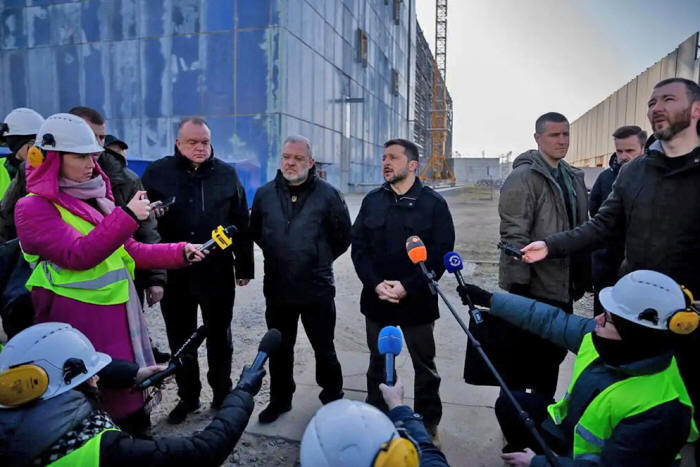
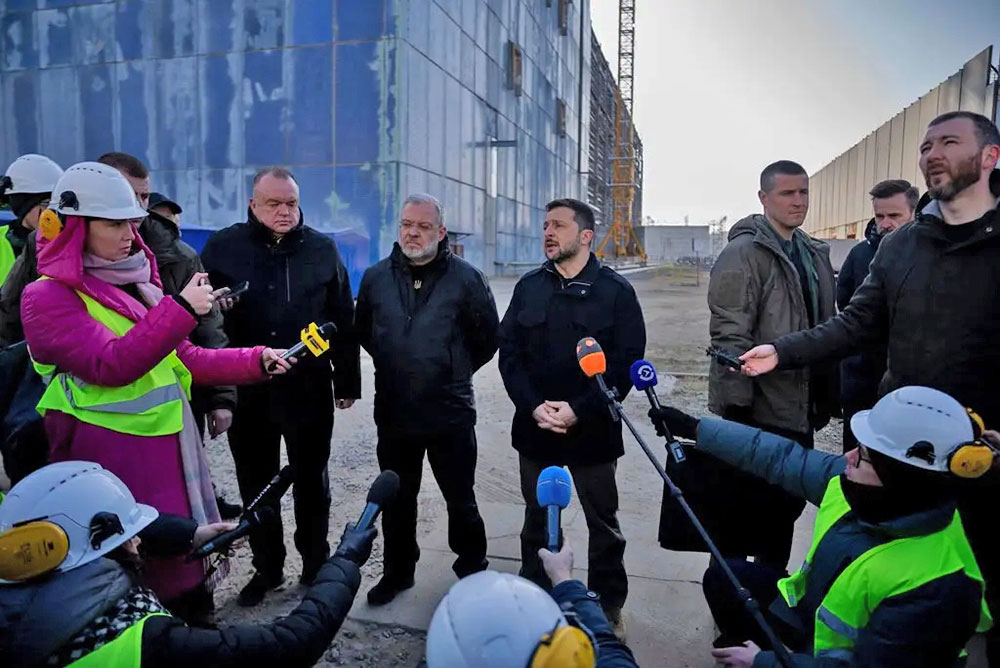
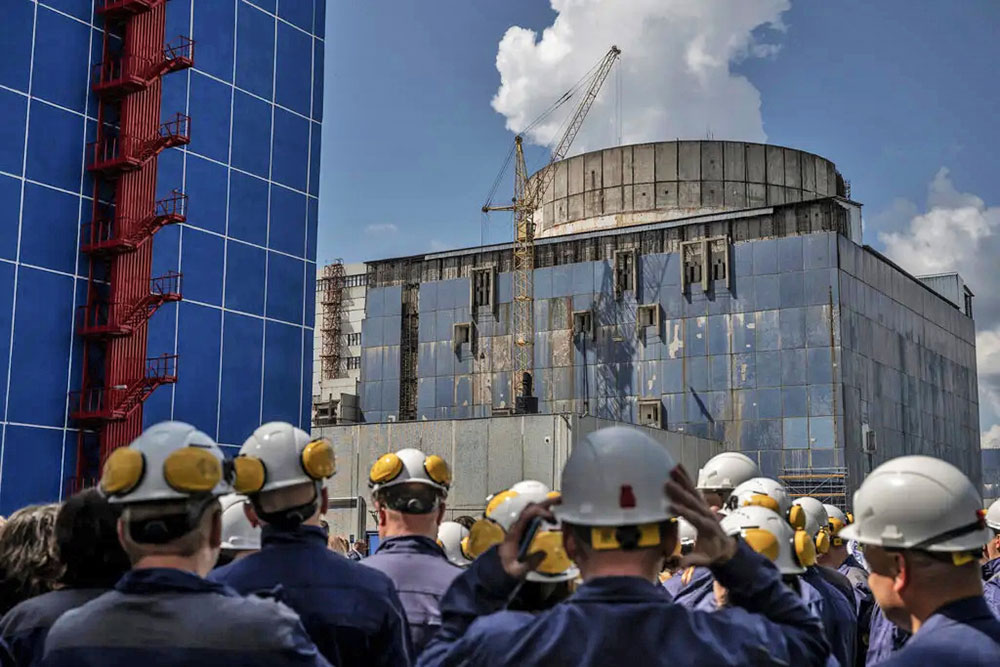
President Volodymyr Zelensky,
center right,
at the nuclear power plant in the
Khmelnytskyi region
of western Ukraine in February.
Credit: Alex Babenko/Associated
Press
Ukrainian
leaders
blame
independent advisers
for
failing to prevent graft.
A Times
investigation found that
President
Volodymyr Zelensky's
own
administration removed guardrails.
When Russian troops invaded Ukraine, Kyiv's Western allies faced a
dilemma: how to spend billions supporting a government fighting
Russia without watching the money vanish into the pockets of corrupt
managers and government officials.
The stakes were high because Ukraine's vital wartime industries'
power distribution, weapons purchases and nuclear energy - were
controlled by state-owned companies that have long served as piggy
banks for the country's elite.
To protect their money, the United States and European nations
insisted on oversight.
They required Ukraine to allow groups of outside experts, known as
supervisory boards, to monitor spending, appoint executives and
prevent corruption.
Over the past four years, a New York Times investigation
found, the Ukrainian government systematically sabotaged that
oversight, allowing graft to flourish.
President Volodymyr Zelensky's administration has stacked
boards with loyalists, left seats empty or stalled them from being
set up at all.
Leaders in Kyiv even rewrote company charters to limit oversight,
keeping the government in control and allowing hundreds of millions
of dollars to be spent without outsiders poking around.
Supervisory boards serve an essential oversight function, allowing
independent experts, typically from other countries, to scrutinize
major decisions inside Ukrainian state-owned companies.
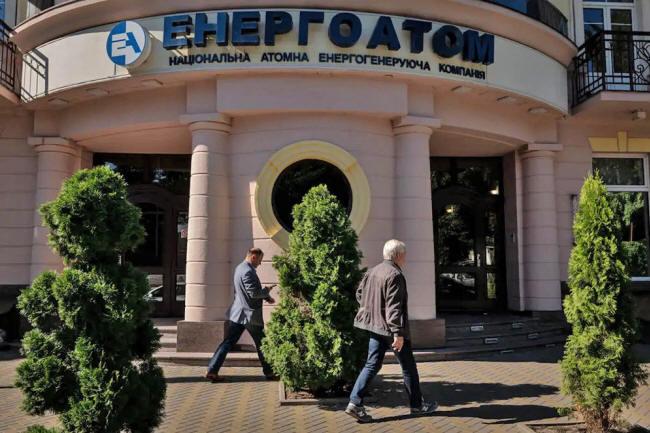
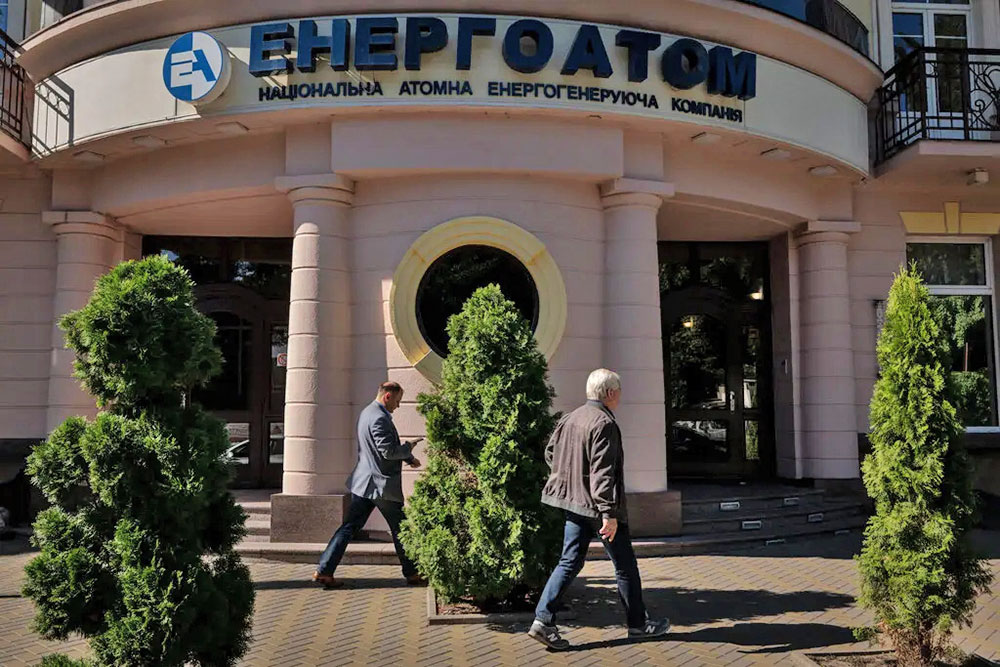
Headquarters of Energoatom in
Kyiv.
The state-owned company is at the
heart of a corruption scandal.
Credit: Nicole Tung for The New
York Times
They are also central to
the corruption scandal swirling
around Mr. Zelensky's government.
Anti-corruption authorities have accused members of his inner circle
of siphoning off and laundering $100 million from the state-owned
nuclear power company,
Energoatom.
Mr. Zelensky's administration has blamed Energoatom's supervisory
board for failing to stop the corruption. But it was Mr. Zelensky's
government itself that neutered Energoatom's supervisory board, The
Times found.
In documents and interviews with about 20 Western and Ukrainian
officials who have worked closely with company boards or served on
them, The Times found political interference not only at
Energoatom but also at the state-owned electricity company
Ukrenergo
as well as at Ukraine's Defense Procurement Agency.
Some people spoke on condition of anonymity to discuss confidential
deliberations.
An adviser for Mr. Zelensky declined to comment, saying that the
supervisory boards were not the president's responsibility.
European leaders have privately criticized but reluctantly tolerated
Ukrainian corruption for years, reasoning that supporting the fight
against Russia's invasion was paramount.
So, even as Ukraine undermined outside oversight, European money
kept flowing.
"We do care about good governance, but we have to accept that
risk," said Christian Syse, the special envoy to Ukraine from
Norway, one of Kyiv's top donors.
He added:
"Because it's war. Because it's in our own interest to help
Ukraine financially. Because Ukraine is defending Europe from
Russian attacks."
The political meddling with Energoatom's supervisory board is a case
study in how Ukraine's leaders have blocked efforts to prevent
corruption.
The Zelensky administration delayed the formation of Energoatom's
board and, when it finally came together, the government left a seat
empty - impeding the board's ability to act.
Had the board worked normally, it might have curtailed what the
authorities now say was rampant corruption. Contractors on
Energoatom projects had to pay kickbacks of up to 15 percent,
according to investigators.
Mr. Zelensky was elected in 2019 on a promise to eliminate graft.
But after Russia's 2022 invasion, he relaxed anti-corruption rules
in the name of speeding up weapons procurement and protecting
military secrets.
Mr. Zelensky also worked with political and business figures whom he
had once
declared to be criminals.
The Energoatom scandal has
hamstrung Mr. Zelensky politically
and weakened his case for Ukraine to join the European Union and
NATO, two institutions wary of adding a member that is dogged by
corruption. Mr. Zelensky sees those memberships as key to his
country's future.
If it does not clean up corruption, Kyiv also might not receive the
hundreds of billions needed to rebuild the country after the war.
"There will be more hesitation to dedicate big funding",
...said Arvid Tuerkner, managing director for Ukraine at the
European Bank for Reconstruction and Development, one of
Kyiv's largest financial backers.
How to Hijack a Board
The Zelensky administration began meddling in Ukrenergo, the
country's power grid operator, a few months before the war,
Volodymyr Kudrytskyi, the company's former chief executive,
recalled in interviews.
In late 2021, he said, he began receiving calls from Herman
Halushchenko, who had recently been appointed Mr. Zelensky's
energy minister.
Mr. Halushchenko wanted Mr. Kudrytskyi to hire people to management
roles who had limited experience in the energy business.
"He started insisting," Mr. Kudrytskyi said. "He started
aggressively trying to make me appoint them."
Mr. Halushchenko did not respond to repeated requests for comment.
The budgets of state-owned companies like Ukrenergo have
historically been major targets for corrupt politicians, so Mr.
Kudrytskyi was suspicious.
He said he successfully resisted the pressure because he had the
backing of his supervisory board.
Ukrenergo's board is made up of seven people who oversee major
projects and executive appointments. The government picks the
supervisory board members, but four are foreigners chosen from a
shortlist made by the European Union and Western banks.
The other three seats go to Ukrainian government representatives.
The principle is that independent expertise will always outvote
government interests.
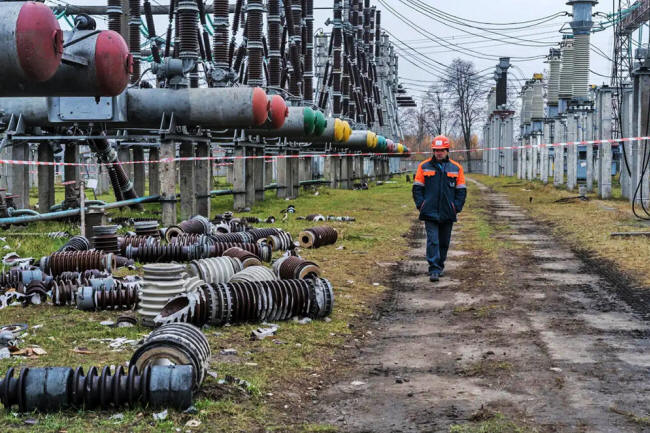
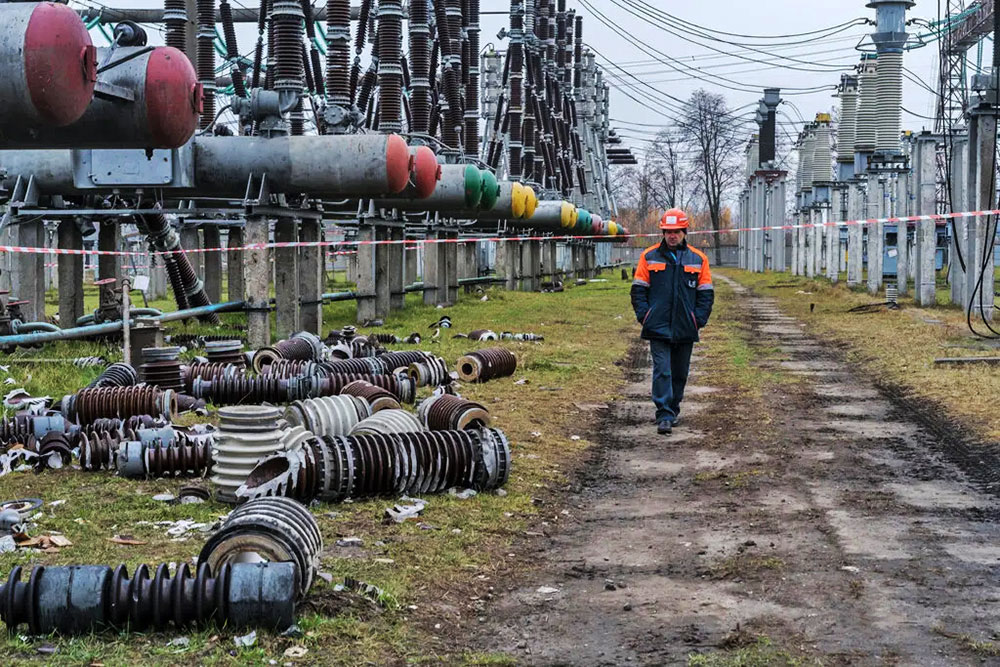
A high-voltage electrical
substation
damaged by a Russian missile
attack in 2022.
Credit: Brendan Hoffman for The
New York Times
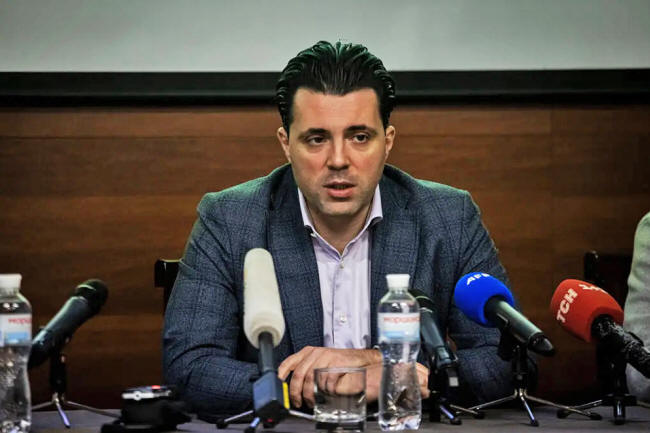
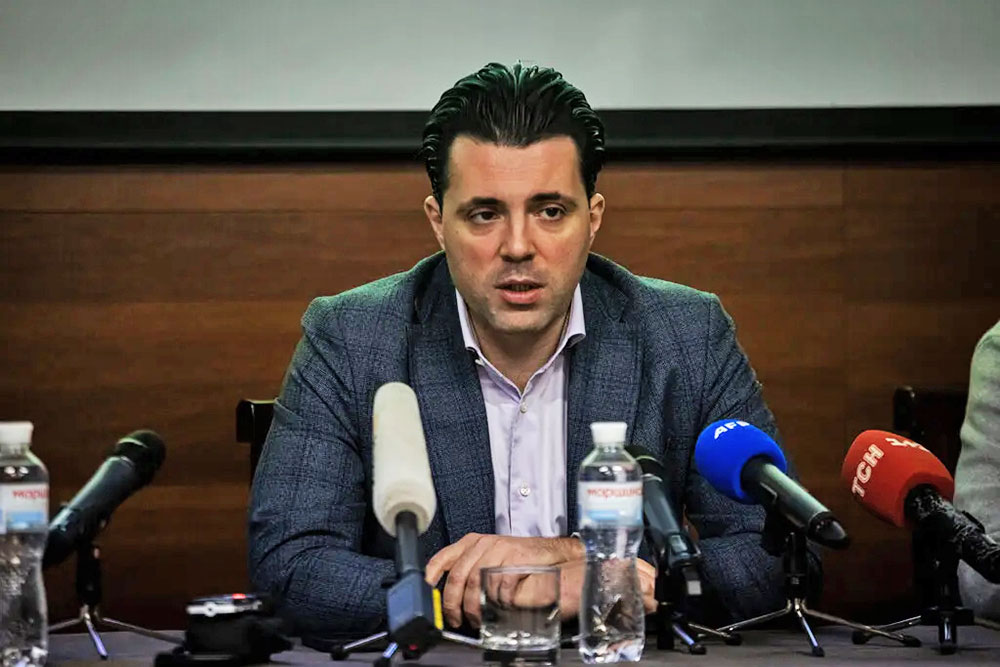
Volodymyr Kudrytskyi,
Ukrenergo's former chief
executive, in 2022.
The Zelensky administration began
meddling
in the company a few months before
the war, he said.
Credit: Ed Ram/Getty Images
By late 2021, Ukrenergo's board was expiring.
European and Ukrainian officials began meeting to consider new
members. They did not realize it at the time, European officials
say, but they now think that the Ukrainian government hijacked that
board and, in doing so, established a playbook to use with other
companies.
The first sign that something was amiss came after the European
Union, the World Bank and the European Bank for
Reconstruction and Development submitted their shortlist.
Rather than pick exclusively from that list, the Ukrainian Energy
Ministry, under Mr. Halushchenko, insisted that one of the seats go
to Roman Pionkowski, a Polish energy expert who had worked on
consulting projects in Ukraine, two officials said.
They said that Mr. Pionkowski had interviewed for the job but was
rated too low to make the shortlist.
Western officials were surprised but accepted Mr. Pionkowski's
nomination as one of the four foreign experts. The new board was
seated in December 2021.
Then the Russians invaded... Ukrenergo soon faced sustained
attacks on energy infrastructure.
Under Mr. Kudrytskyi's leadership, Ukrenergo made repairs around the
clock, allowing it to
maintain the country's power supply.
The company also became a trusted partner for Western donors, who
gave it $1.7 billion in loans and grants in the first years of the
war.
Political pressure continued, Mr. Kudrytskyi said. Government
officials accused him of failing to protect energy infrastructure.
Though he had the support of European countries, he
clashed with Mr. Halushchenko, who
wanted him fired.
This time, Mr. Kudrytskyi did not have the board's protection.
One foreign member had resigned for personal reasons and the
government never filled the seat, leaving an even split between
foreign experts and state representatives.
That tie should have been enough to save Mr. Kudrytskyi's job. But
Mr. Pionkowski, the Polish expert, sided with the Ukrainians and
voted to fire him.
Mr. Pionkowski defended his independence. He said he did not take
orders from Kyiv. He voted for dismissal, he said, because Mr.
Kudrytskyi had repeatedly misled the board. He did not provide
details.
The two other foreign board members resigned in protest,
issuing a statement calling the
dismissal "politically motivated."
But European donors - the banks, central governments and
international institutions that are helping to bankroll Ukraine -
did little.
The reconstruction bank froze new payments to Ukrenergo but honored
ongoing commitments. In European capitals, nobody wanted to pull
financial support and appear as if they were turning their backs on
Ukraine, according to four European officials.
Mr. Kudrytskyi said that none of this was about energy policy. He
said that the Energy Ministry had wanted to make it easier for
corruption to go unchecked.
For example, Mr. Kudrytskyi said, one of the men he had refused to
hire is now under investigation in the Energoatom case and has
reportedly left Ukraine.
And Mr. Halushchenko recently resigned amid the investigation into
his role in that scandal.
Behind the Scenes of a Scandal
As Mr. Halushchenko tried to seize control at Ukrenergo, he
also pushed a major spending plan at Energoatom.
He wanted to buy
two old Russian-designed nuclear reactors from
Bulgaria. Mr. Halushchenko wanted to move them to a
nuclear plant in western Ukraine, bring them back to life and
connect them to the energy grid.
Energoatom counted on Western partners to help finance the
$600 million project.
Western donors and anti-corruption watchdogs immediately criticized
the idea. The project, they said, had all the hallmarks of a
boondoggle at one of Ukraine's most notoriously corrupt state-run
firms.
The reactor project came together just as the Ukrainian government
was approving Energoatom's first supervisory board.
An incoming board member, Tim Stone, a British businessman
with a background in finance and nuclear energy, said that he had
planned to order a review of what he called the "Franken-reactors."
But the Ukrainian authorities stalled the board contracts.
Kyiv blamed disputes over pay and insurance.
European officials and some Ukrainian lawmakers said they saw
another reason.
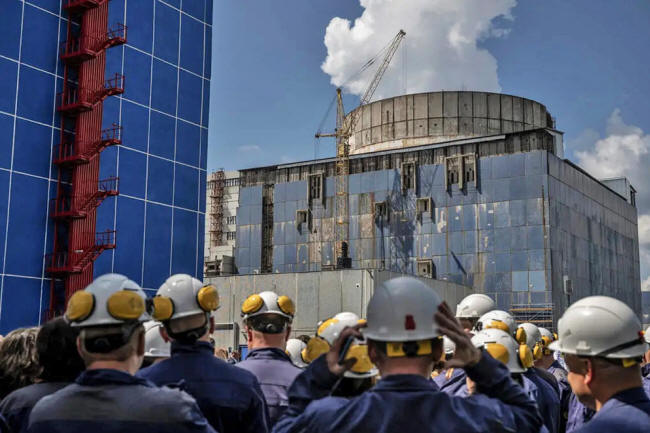
As energy minister, Herman
Halushchenko wanted to buy
two old Russian-designed nuclear
reactors from Bulgaria
and install them at the site.
Credit: Viacheslav Ratynskyi/Reuters
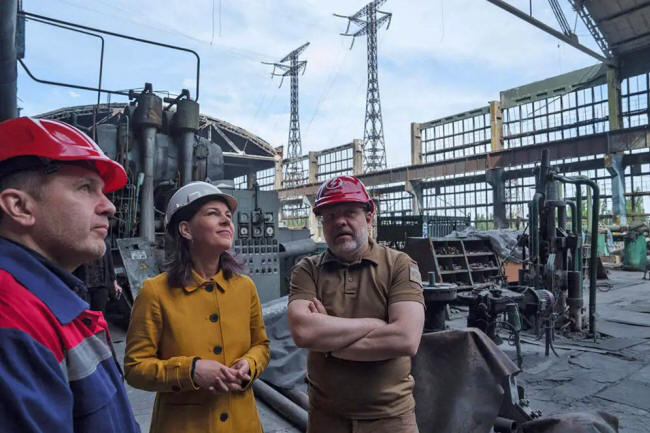
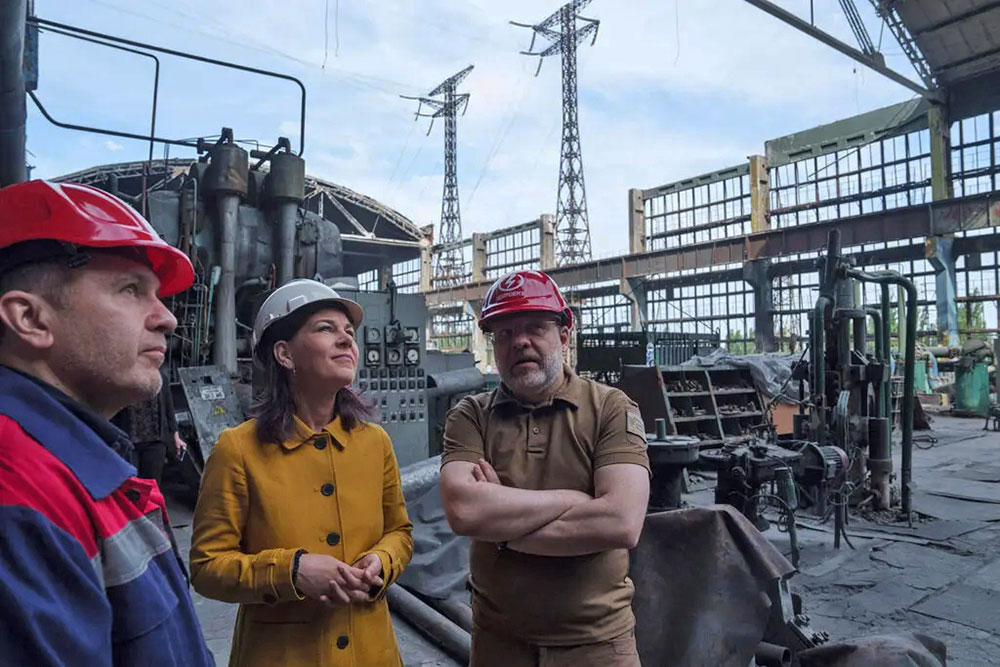
Mr. Halushchenko, right, visiting
a thermal power plant
destroyed by a Russian rocket
attack in Ukraine in 2024.
Credit: Evgeniy Maloletka/Associated
Press
"They understood that as soon as they start the activities of
the supervisory board they can lose control," said Oleksii
Movchan, a lawmaker from Mr. Zelensky's party who has pushed
for independent boards.
"They didn't want to lose control."
While Energoatom's board remained inactive, anti-corruption
investigators say, Ukrainian officials were orchestrating a $100
million kickback scheme at the company.
On Dec. 12, 2024, about a year after the board was supposed to have
started work, ambassadors from Ukraine's top allies, including the
United States and Britain, pressed the government to form the board.
"This is especially important when Energoatom is considering new
large long-term financial investments and liabilities," they
said in a letter obtained by The Times.
With the board still unsettled, Dr. Stone walked away.
"The whole thing was just a complete rat's nest," he said.
When Ukraine finalized the board in January, it kept Dr. Stone's
seat empty, leaving the board with an even split - two foreign
experts and two Ukrainian representatives.
The reactor deal is on hold and is not part of the graft
investigation.
But the resulting split in the board left Energoatom largely
powerless to prevent corruption. It could not change the company's
top managers, one of whom was suspended amid the kickback
investigation.
Eight people, including Mr. Zelensky's former business partner, are
accused in that case of charges including embezzlement, money
laundering and illicit enrichment.
Mr.
Zelensky's right-hand man quit
after his home was raided, but he has not been charged.
A former deputy prime minister was accused of pocketing more than
$1.3 million.
Rewriting the Rules on Defense
Procurement
More than a year into the war, after a scandal erupted over
inflated defense contracts, donors
pushed Kyiv to create an independent agency to clean up weapon
purchases.
Yet, since its start in January 2024, the agency has spent at least
$1 billion in European money either with an incomplete supervisory
board or without one at all.
Maryna Bezrukova, the agency's first head, said that the
absence of a board during her first year in the job left her
vulnerable to pressure from the Zelensky administration.
She said,
the Defense Ministry had pushed her to approve dubious
contracts, including one with a state-owned weapons factory that
could not effectively produce mortar shells.
Under pressure, she signed off.
Many shells failed to fire, prompting
a public outcry in the fall of
2024.
The
ministry turned on Ms. Bezrukova,
accused her of failing to deliver weapons quickly to the front.
But the question of whether to fire her was one for the supervisory
board, which was finally coming together last December.
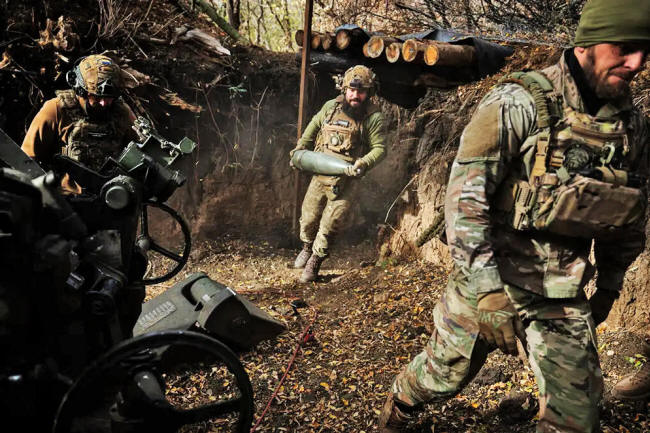
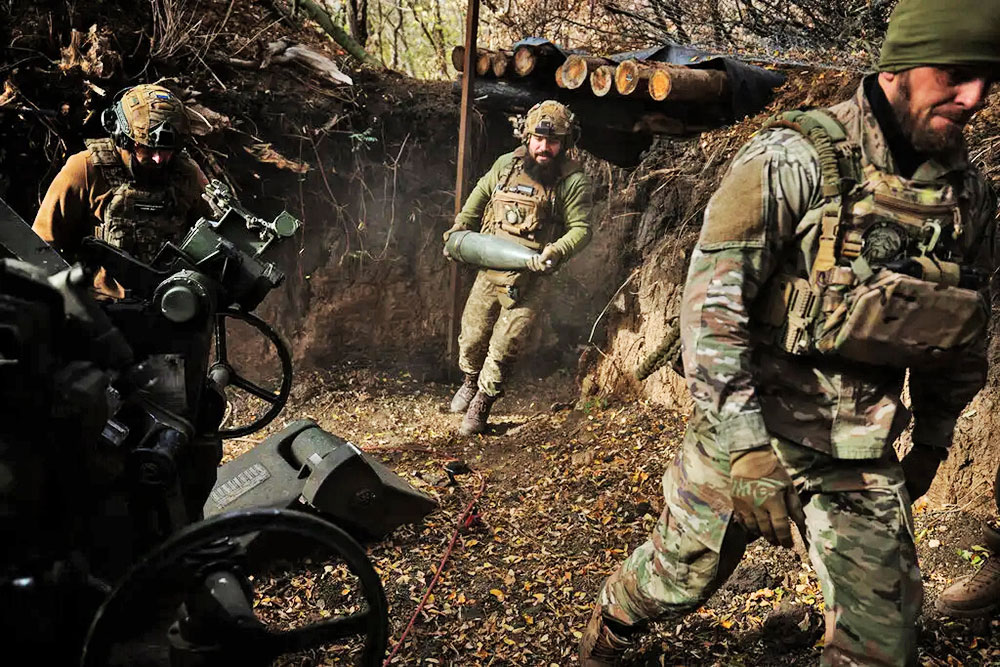
An artillery unit in the
Zaporizhzhia region of Ukraine in October.
Credit: Tyler Hicks/The New York
Times
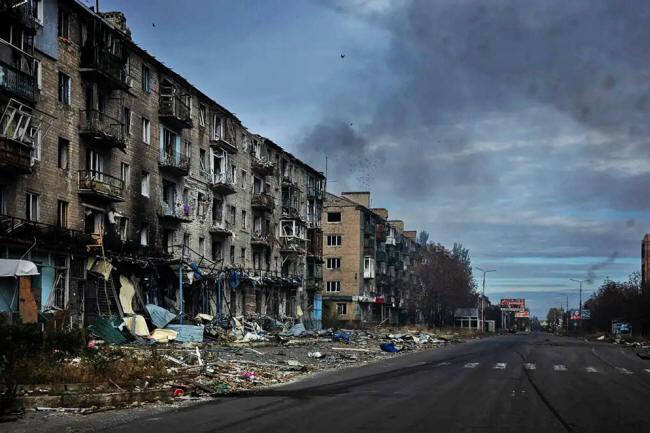
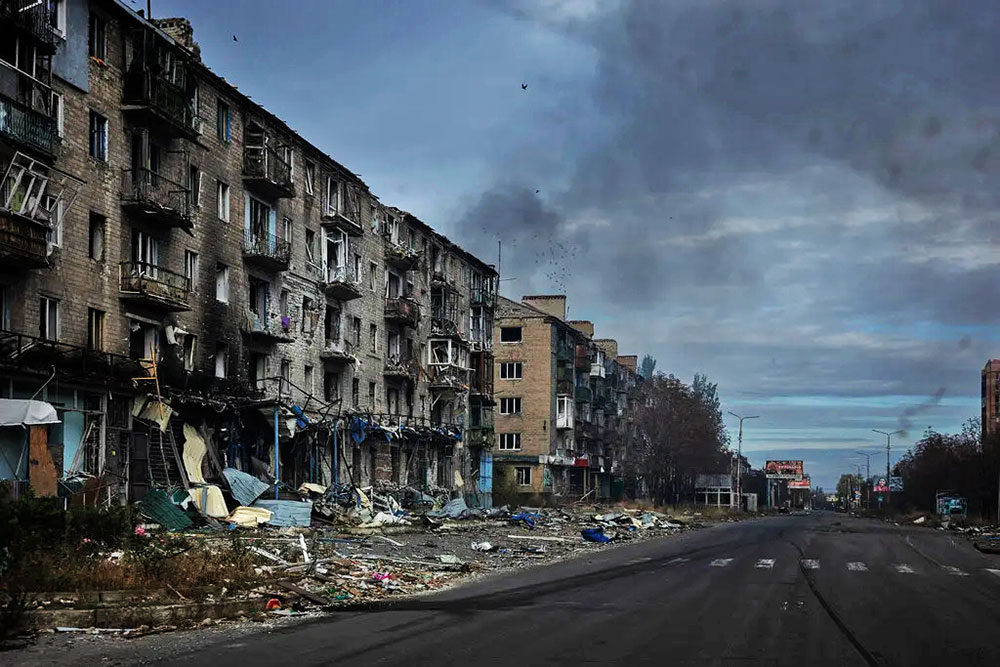
Western officials warn that
without strong safeguards against corruption
Kyiv might not get the billions of
dollars needed to rebuild after the war.
Credit: Tyler Hicks/The New York
Times
On the eve of the first board meeting, the Defense Ministry rewrote
the procurement body's charter, granting itself authority over
hiring and firing the agency's head.
The board protested the meddling and renewed Ms. Bezrukova's
contract for another year.
The Zelensky administration was undeterred. When a foreign expert
resigned, leaving two foreigners and two government representatives
on the board, the administration had an opening.
It fired the two government members, leaving the board without a
quorum.
Powers were transferred to the Defense Ministry.
Ms. Bezrukova was fired early this year.
"Supervisory boards are just window dressing," she said in an
interview.
"They're not real."
The Defense Ministry did not reply to requests for comment. It
has said it acted legally and in
the interest of improving weapon procurement.
The government's move against the procurement agency coincided with
Mr. Trump's return to power and Washington's gradual
disengagement from the war.
That shift, European officials said, emboldened the Ukrainian
authorities to remove anti-corruption guardrails.
The Zelensky administration quietly asserted control by rewriting
the charters of state companies, including Ukrenergo, to give itself
new powers or to change the voting process.
The government also tried, unsuccessfully, to
defang the anti-corruption agencies
while they were investigating Energoatom.
With the United States retreating, Europe is left to confront Kyiv's
handling of corruption.
But so far,
"the Europeans are creating a permissive environment for this
kind of backsliding," said Tyson Barker, a former State
Department official overseeing Ukraine's economic recovery.
The European Commission, the administrative arm of the European
Union, quietly commissioned a report this year into corruption risks
in Ukraine's energy industry.
A copy of the report, obtained by The Times, warned of,
"persistent political interference."
The report, by the Ukrainian Facility Platform, a nonprofit
research group, singled out Kyiv's undermining of supervisory boards
as a critical problem.
A spokeswoman for the European Union said officials have pressed
Ukraine to reform its state-owned businesses. There's no evidence
that European Union money was misused, she said.
She did not address what the investigation reveals about corruption
in Ukraine.
Mr. Zelensky has tried to distance himself from the growing
scandal. In response to the controversy, his prime minister denied
any government interference with Energoatom's supervisory board.
She blamed the board for not stopping corruption.
And she fired all its members...
|