|

by Joel Bowman
May 10, 2026
from
JoelBowman Website
"El porteño nace
donde quiere."
("A porteño is
born wherever he wants.")
Common Argentine quip
about people from Buenos Aires
Note From the
End of the World - Buenos Aires, Argentina…
How goes the Greatest Political Experiment of
Our Age...?
We could give you the stats from the past couple of years, since a
chainsaw wielding libertarian came to power with whacky ideas of
free markets, balanced budgets and …
-
Country Risk: down from 2,700 to 510
-
Poverty: down from 57% to 28%
-
Annual Inflation: down from 211% to 30%
-
Debt: down $30 billion USD
-
Public Spending: down 30%
-
Public Employment: down 65k positions
-
Budget Surplus since 2024
-
Reserves: up $28 billion USD
Etc., etc., etc. …
But there's always more to the story than numbers, which after all
capture only part of the tale.
That's a story that belongs to the Argentine
people and the land they call home...
Once known as "el granero del mundo" (the granary
of the world),
Argentina rose to wealth and
prominence in the late 19th century, largely due to its
fertile pampas, the rich farmland surrounding the capital.
The estancieros (who owned them) and the
gauchos (who worked them) raised and sold cattle, wool,
leather, and grain, which were exported by the ton to the Old World.
To handle the explosion in exports, the engineer
Eduardo Madero was commissioned
to build an enormous port, which today bears his name.
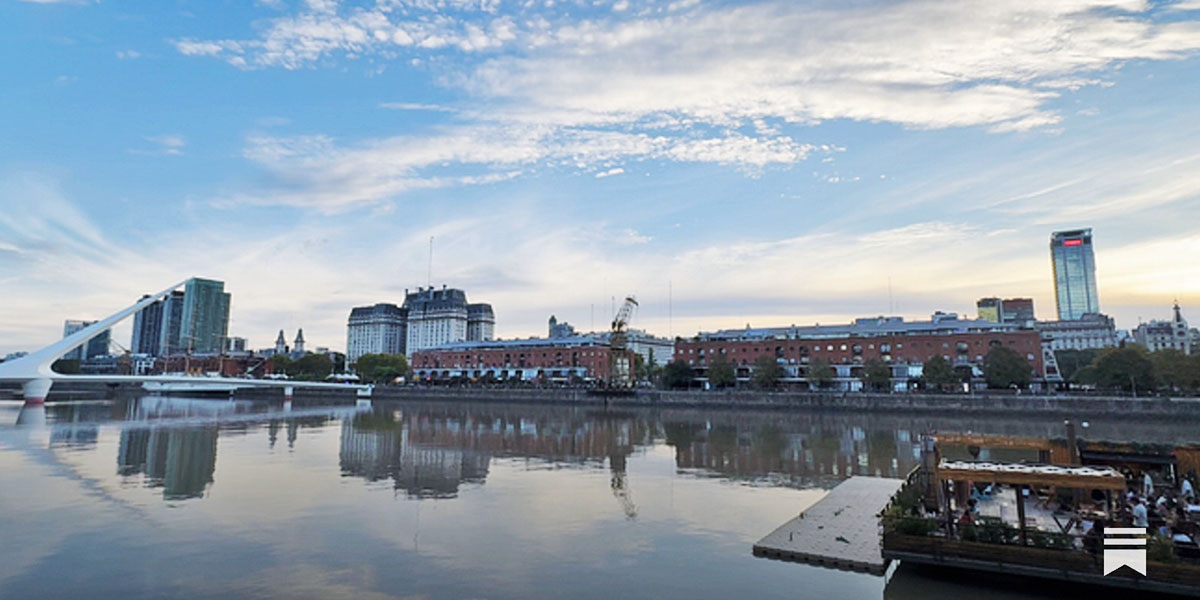
Puerto Madero (captured in the
image, above) is a series of brick warehouses, docks, canals, and
rail connections, purpose built to move Argentina's exports
efficiently onto ships crossing the Atlantic.
Fortuitously for the far-flung nation, the port construction
coincided with the advent of refrigerated shipping, which changed
the game entirely.
Before refrigeration, Argentina could export
hides and salted meat, but not its prized fresh beef.
By the 1880s and 1890s, refrigerated vessels
allowed the highly sought after Argentine meat to reach plates in
European restaurants, hotels and homes.
That transformed the country into an
agricultural-export superpower...
Britain, in particular, invested heavily in the
country's railroads, which stretched out across the pampas,
its frigoríficos (meat-packing plants), as well as in its
banks and shipping infrastructure, and of course the port itself.
Within a couple of decades, Argentina ranked among the world's most
prosperous nations and its capital Buenos Aires, home to los
porteños (people of the port), became known as the "Paris of
South America."
And while its goods left the port, bound for the
continent, it was the continent's people, mostly Italians
and Spaniards, who arrived at the same docks, looking
for opportunity, adventure and a life down here at the End of the
World.
But what one hand gives the other takes
away... and wherever there is Creation, her wily
sister, Destruction, is surely lurking nearby.
As demand for Argentina's agricultural goods
grew, so too did the size of the ships that would transport them.
Barely had the last brick been laid on Puerto
Madero's docks when they were already too narrow for the newer
generation of larger steamships.
Within a couple of decades, trade had mostly
shifted north to the larger Puerto Nuevo (new port)
facilities.
Today, the area is mostly home to trendy cafes and swanky
restaurants, at which you can expect to pay gringo prices for
Argentina's famous beef (there are better parrillas
elsewhere... with far better prices.)
And just across the docks, from high in their sparkling towers of
glass and steal, the nation's "elite" political caste gazes
out across the city and the pampas beyond,
figuring out new ways to turn creation into
destruction once again...
|