|
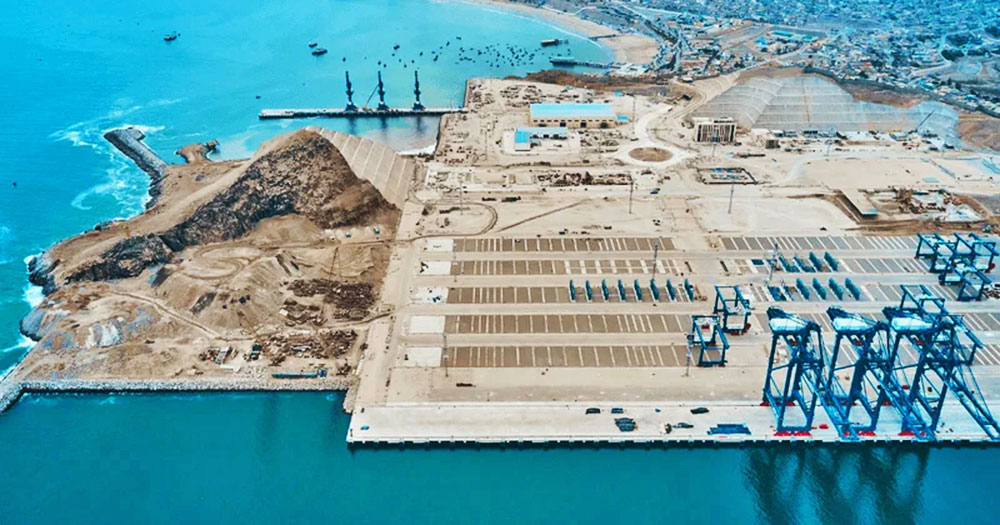
while under construction. Photo by rjankovsky via Adobe Stock, used under the Standard license.
China's commercial infrastructure investment in Latin America threatens the Trump Corollary
to the Monroe
Doctrine...
The port facility, located 80 kilometers from Lima, the Peruvian capital, was constructed by China's COSCO Shipping at a cost of around $1.3 billion.
Chancay Port is considered China's flagship project in Latin America and it has a 60% stake in the port and exclusive operating rights.
Xi Jinping traveled to Peru in November, 2024 to inaugurate the port during the Asia-Pacific Economic Cooperation (APEC) Leaders' Informal Meeting.
The Trump administration is said to view the "megaport with growing alarm."
The state-of-the-art deep-water Chancay Port is able to accommodate large cargo ships and this will impact international trade and shipping industries of the US, Mexico, and Central American countries, according to an analysis by Think China.
Zhu Feng, dean of the School of International Studies at Nanjing University, explained that,
China imports corn, copper, soy, beef, and lithium from Latin America, making it a primary trade partner and,
China's trade with Peru, estimated at $16.3 billion, overshadows trade with the United States, according to UN Comtrade data.
China surpassed the US in trade with Peru during the first Trump administration and continued its dominance during the Biden years.
In order to address this disparity, in mid-December Trump proposed designating Peru as a major non-NATO ally as part of his take on the Monroe Doctrine...
The administration sent a presidential message to the Senate Committee on Foreign Relations informing Congress of his intention.
According to the message, the US and Peru have,
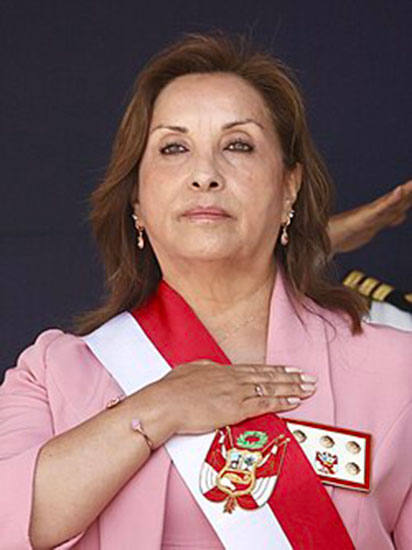
President Dina Boluarte - Subservient to the Neoliberal Order
Boluarte in 2024 (CC BY 2.0)
In October, protests rocked Peru in response to President José Jerí assuming power following the impeachment and removal of Dina Boluarte.
Jerí was accused of sexual assault, alleged illicit enrichment, and bribery.
The Public Prosecutor's Office dismissed the sexual assault case in August. Jerí is described as a conservative in favor of neoliberalism, deregulation, and private investment.
Boluarte traveled to the World Economic Forum (WEF) in Davos in January,
President Boluarte was accused of colluding with the CIA.
The agency has a long and sordid history in Peru, including interference in the 1962 Peruvian general elections, facilitating a gun-running operation, and assisting the Peruvian Air Force in the "war on drugs."
Investigative journalist Wayne Madsen writes that the CIA,
The financial oligarchy has actively worked to prevent the establishment of social reforms in Peru.
Despite this, in 2021, Pedro Castillo Terrones, a rural schoolteacher with no prior political experience, emerged victorious in the second round of the presidential election against the oligarchy's candidate, Keiko Fujimori, the daughter of Peruvian dictator Alberto Fujimori.
Castillo secured just over 50.13% of the vote.
In response, Castillo was attacked.
During the following year and a half, the oligarchy instigated,
In response to concerted attacks by the financial elite and business interests, Castillo attempted to make concessions, thus alienating his political base.
On December 7, 2022, the former rural school teacher moved to shut down the legislature and rule by decree. He was overthrown, imprisoned on corruption charges, and replaced by his vice president, Boularte.
Then Mexican President Andrés Manuel López Obrador characterized Boularte as a,
Obrador said,
According to the Orinoco Tribune,
During the Biden administration, Jose W. Fernandez, Under Secretary for Economic Growth, Energy, and the Environment, met with President Boluarte.
Fernandez was accompanied by a delegation of US corporations hosted by the Business Council for International Understanding and the US Embassy to Peru.
Secretary Fernandez,
APEP envisions economic integration with,
The "high-level goals of the initiative" seek to boost,
APEP is billed as "not a standard free trade agreement" and claims to,
Confronting China, Securing Critical Minerals
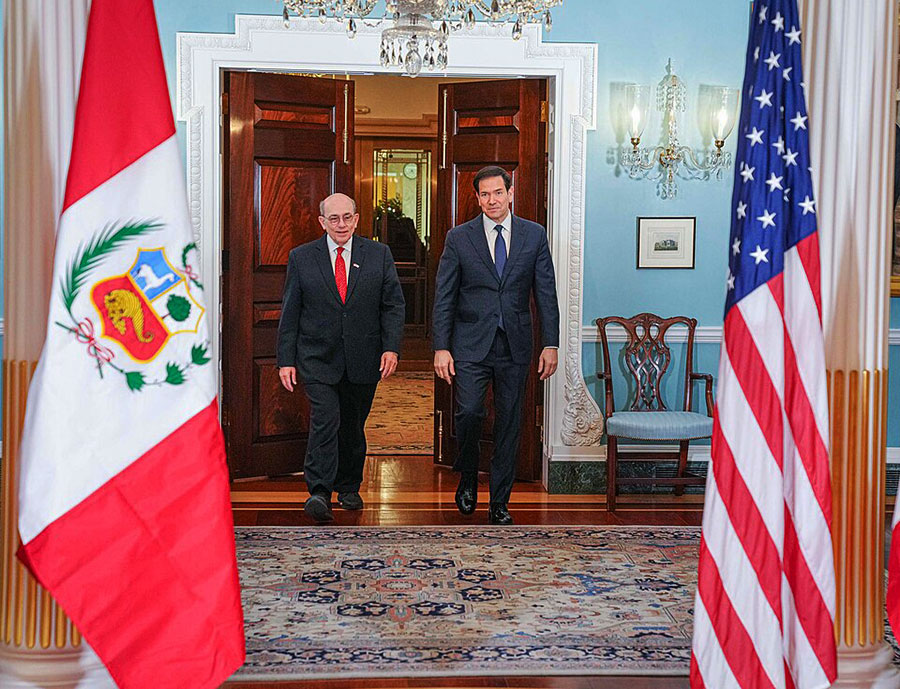
In early December, Secretary of State Marco Rubio met with Peruvian Foreign Minister Hugo de Zela,
Secretary Marco Rubio meets with Peruvian Foreign Minister Hugo de Zela at the Department of State in Washington, D.C., December 5, 2025. (Official State Department photo by Freddie Everett)
Peru is rich in minerals, most notably silver, and has the world's fourth largest mercury mine at Huancavelica.
US Geological Survey data shows that the country holds,
It also produces molybdenum (used in steel alloys), boron, iron ore, phosphate rock, and coal.
Early in Trump's second term, Miami Benworth Capital private-equity millionaire Bernie Navarro was selected to serve as US ambassador to Peru.
Trump said Navarro is,
The private-equity entrepreneur is "best friends" with Marco Rubio and served as a top fundraiser for his campaigns, the Miami Herald reported.
In addition to loaning Rubio $850,000 in 2021, Navarro advised the future secretary of state on real estate transactions.
In May, Trump's Secretary of War, Pete Hegseth, held a meeting with Peruvian Minister of Defense Walter Astudillo and Minister of Foreign Affairs Elmer Schialer.
Hegseth told the ministers in no uncertain terms China poses a significant threat to peace and security in Latin America, and added:
According to the Peru Support Group, a UK organization dedicated to the awareness of human rights violations,
In return for Peru's collaboration, the United States agreed to supply both advanced equipment and training to the Peruvian armed forces.
Not long after the election, a former national security official from the Trump team advocated imposing a 60% tariff on goods entering the US at the Chancay megaport.
However, all goods leaving Chancay Port are shipped to Asia and China, not the US.
If the Trump administration forced China out of Latin America, the US would be on the hook to finance infrastructure projects, in addition to establishing markets for goods, an expensive option for a nation with a debt crisis estimated at more than $34 trillion.
China's continued financial support for Latin American infrastructure projects is evident in the Latin America Outlook 2025 report, which highlights that two-thirds of Latin American countries are participating in the Belt and Road Initiative.
The Port of Chancay is expected to drive infrastructure expansion in neighboring countries.
Increased Chinese investment faces opposition under the Trump administration's tougher stance on Chinese involvement in Latin America and the objective of eliminating China's extensive Belt and Road Initiative.
The United States and it allies have kicked started counter-initiatives to challenge China's BRI, including a Sinocentric international trade network: These initiatives, however, are not of the same magnitude as BRI and are not likely to effectively counter China's growing influence.
Moreover, Trump's confrontational approach towards China, particularly through trade policies and tariffs, is unlikely to impede the growing adoption of a multipolar world.
Trump's desperation was obvious in October when he announced a 100% tariff on all Chinese imports - amounting to 130% when a previous tariff is added - in retaliation to new export controls Beijing planned for valuable rare earth minerals.
The president subsequently agreed to lower the tariff in exchange for a crackdown on fentanyl...
|