|
by Robin George Andrews
NASA needs a lot of power...
Last year, less than a month after being named acting administrator of NASA, U.S. Secretary of Transportation Sean Duffy made an eyebrow-raising announcement to the world:
As part of strengthening U.S. national security in space, he said, this reactor would be designed, built, flown and delivered to the lunar surface by 2030. To many observers, this declaration sounded wild.
Why would you want to put a nuclear reactor on the moon?
The thing is, if America (or any spacefaring nation) wants to establish a permanent presence on the moon - an inhabited station that can operate during the frigid and lengthy lunar night - solar power won't cut it.
Through its Artemis program, which just sent four astronauts on a trip around the moon, NASA wants to transform our planet's argent companion into a scientific outpost, a mining site and a rocket launchpad pointed at Mars.
To do that, nuclear power is the sole option.
It's no wonder, then, that China and Russia are teaming up to put their own nuclear reactor on the moon by 2035 to electrify what they call the International Lunar Research Station - their planned base on the lunar south pole.
Sooner or later, from one nation or another,
Nuclear power plants are safer than many suspect.
But putting reactors in space is a concept with a checkered history. One notorious reactor caused an international incident in 1978 after it came apart in Earth's atmosphere.
And nobody has ever designed a reactor for the moon, a hostile volcanic desert subject to extreme temperature swings, frequent asteroid strikes and protracted quakes.
Experts questioned both the timing and the scale of the nuclear power plant Duffy is proposing.
Placing a reactor capable of powering 80 American households on the lunar south pole - an environment no human has yet set foot in - by 2030 sounds rushed, if not impossible.
And the last thing anyone wants is for the U.S. to barrel through the conception, construction, launch and landing of a lunar nuclear reactor.
If the U.S. does succeed, its nuclear-powered moon base could become a solar system–exploring foothold among the stars.
But mistakes can happen.
And whether you've accidentally spray-painted an ancient reserve of water ice with radioactive waste or fatally stranded your astronauts in the lunar darkness without any power, a nuclear disaster on the moon would be, in Middleburgh's words,
Katy Huff wants to clear something up:
Huff, a nuclear engineer at the University of Illinois at Urbana-Champaign, was the assistant secretary for nuclear energy in the Biden administration.
Nuclear power is her jam.
But it's important to know that unused nuclear fuel is "radiologically very boring," she said during a recent video call.
She gestured to an object on her desk.
The fact that you can hold uranium in your hand without consequence may come as a surprise to many.
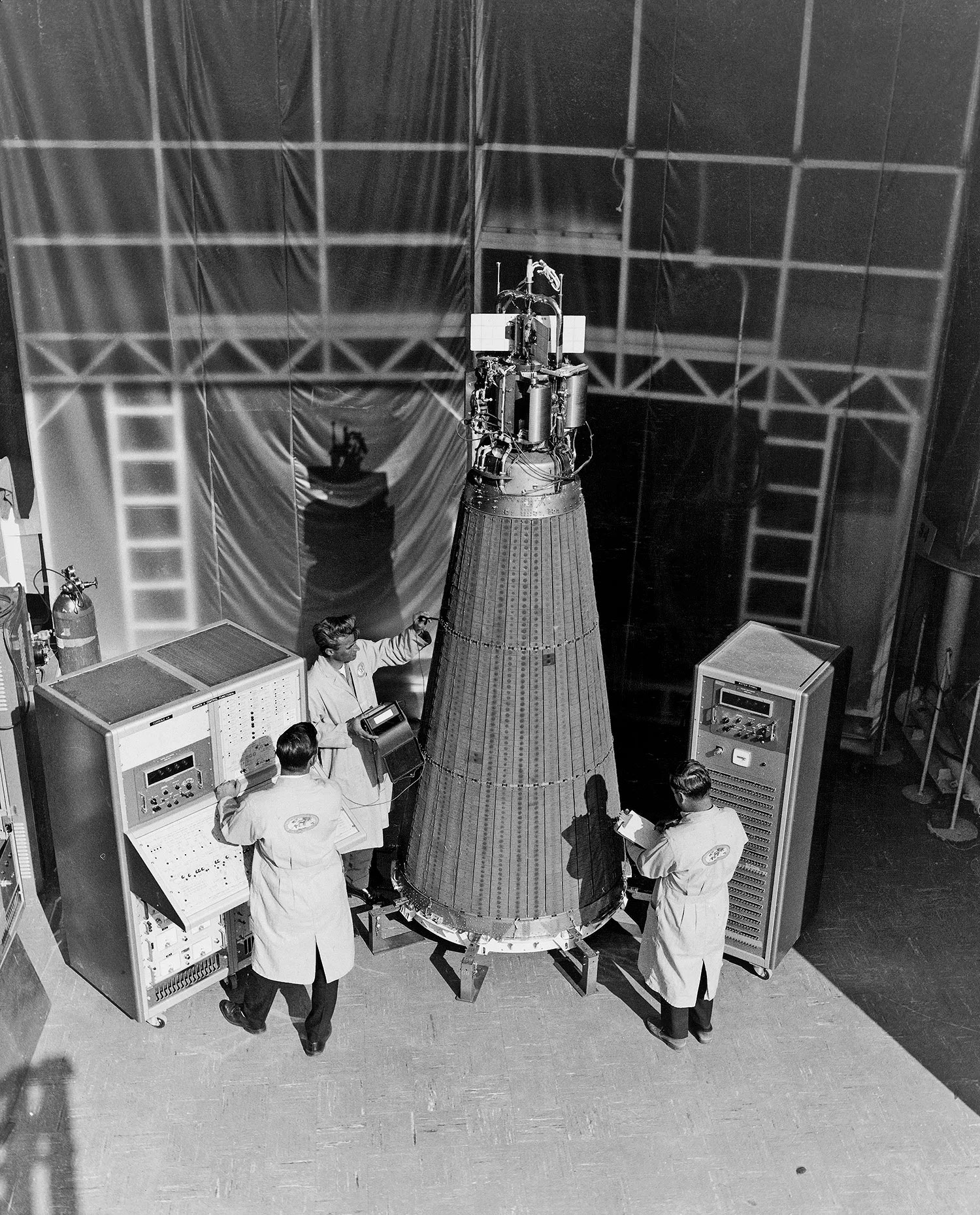
The System for Nuclear Auxiliary Power (SNAP) 10A, which launched in 1965, was the first nuclear reactor sent to space. Heat from the reactor (top) was converted
to electricity by the
cone structure.
Uranium becomes dangerous - and helpful - when you chuck it into a nuclear reactor and fire neutrons at it.
The impact causes the uranium's unstable atomic nuclei to snap apart and emit more neutrons, which cause more nuclei to rupture - and voilà, you have a heat-emitting nuclear fission reaction.
As long as the
reaction doesn't spiral out of control, you can use the heat to turn
a fluid (often water) into steam. That steam rotates a turbine,
which makes electricity.
But because that nuclear cascade can continue for a very
long time, it's a fabulous power source - particularly in space,
where it won't need refueling for years, maybe decades.
Starting in the 1960s, both the U.S. and the Soviet Union sent plenty of radioisotope thermoelectric generators, or RTGs, into space to power all kinds of things, from Earth-orbiting satellites and the Apollo-era scientific experiments on the moon to Mars rovers and deep-space probes.
RTGs, though, are not nuclear reactors.
They are more like nuclear batteries:
But an RTG would be insufficient to power a moon base.
Astronauts need more than just energy to keep the lights on. They need a constant source of heat in the night and a way to vent that heat when the mercury soars during lunar daytime.
If they want machines that can extract precious water from the lunar soil - water for hydrating both astronauts and crops and, crucially, to be electrically split into hydrogen and oxygen gas to make rocket fuel - then they'll need oodles of electricity to power them.
It makes sense, then, that for the past several years, across both the first Trump administration and the Biden administration, NASA and its industry partners had been working on designs for a 40-kilowatt lunar reactor.
This size would be enough to power an office building, which is about right for a prototypical moon base, experts say.
Under Duffy's brief tenure as NASA's leader, that number jumped to 100 kilowatts.
Why?
Compared with a standard U.S. nuclear reactor on terra firma, 100 kilowatts is tiny - it's about 10,000 times less powerful, and it would be only the size of a large car.
But this capacity is "huge for space," Huff says, noting that 100 kilowatts is a full order of magnitude greater than the output of any other nuclear reactor launched off-world.
Technically, putting a bespoke 100-kilowatt reactor on the moon in just four years is possible.
In January, NASA's current administrator, Jared Isaacman, reaffirmed the plan to put nuclear fission power on the moon.
And in March he announced that NASA would launch the first interplanetary spacecraft powered by nuclear electric propulsion - the Space Reactor-1 Freedom - to Mars by the end of 2028.
This mission will help test out nuclear fission technology in deep space before the U.S. establishes a nuclear power plant on the lunar surface.
Yet,
To put a nuclear reactor on the moon, you must first put it on a rocket.
...an expert in space nuclear technology and vice
president of advanced projects at Analytical Mechanics Associates,
an aerospace company based in Virginia. The U.S. launched the first nuclear reactor to space, the experimental Systems for Nuclear Auxiliary Power 10A reactor, back in 1965. This wastebasket-size 600-watt box generated power for just 43 days before a voltage regulator broke.
It's still orbiting the planet today and remains America's sole attempt at operating a nuclear reactor off-planet.
The Soviet Union, in contrast, propelled more than two dozen nuclear reactors beyond Earth's atmosphere. Most of these reactors, which were often used to power radar spy satellites, went up without incident.
One, however,
Technically, putting a bespoke 100-kilowatt reactor on the moon in four years is possible.
The spacecraft carrying that reactor, the Kosmos 954, started moving off target about three months after its September 1977 launch. Both the Soviet Union's operators and the U.S. officials noticed it wobbling around, but the Soviets initially kept quiet.
Their engineers tried to eject the satellite's active nuclear reactor into space before the vehicle crashed back to Earth, but to no avail.
Eventually the Soviets fessed up to their American counterparts - but they claimed Kosmos 954 would incinerate without consequence during its by then unstoppable atmospheric reentry.
U.S. authorities openly wondered what to do about a hot nuclear reactor plunging back to Earth.
Gus Weiss, then a special assistant to the secretary of defense, said at the time that,
Ultimately, in January 1978, Kosmos 954 showered its deadly detritus over a 15,000-square-mile patch of Canada's relatively sparsely inhabited Northern Territories.
During a joint Canadian-American operation called Morning Light, hazmat-suited agents scoured the frozen realm for the shattered corpse of Kosmos 954.
Some parts of the satellite weren't highly radioactive, but other fragments made the agents' personal radiation dosimeters sound off like "a field of crickets," according to a member of the team.
Miraculously this trial by radioactive fire didn't kill a single soul - and the Soviet Union paid Canada $3 million CAD in apology.
One clear lesson emerged from the Kosmos 954 kerfuffle:
Ideally a lunar reactor should launch over the ocean because a splashdown would be a far better outcome than splattering a populous area with a smashed-apart nuclear reactor.
The episode also revealed that the choice of reactor fuel is important, and you would want a fuel type that isn't prone to dispersing over a wide area.
Tristructural isotropic particle fuel, better known as TRISO fuel, could work wonders here.
It consists of pellets that are "basically gobstoppers of fuel," Middleburgh says. Each pellet is essentially a uranium, carbon and oxygen blob imprisoned within an ultraresilient carbon and ceramic shell.
Not only can they survive high-velocity impacts fully intact, but you could pour lava over them to no effect.
Middleburgh, like many of his colleagues, is enchanted by nuclear power.
Unprompted, he waxes lyrical about the first time he saw Cherenkov radiation - an eerie blue glow - in a reactor pool:
But he's under no illusion that trying to put a working nuclear reactor on the moon, though entirely plausible, will be simple.
Let's start with the bad news:
The moon, quite frankly, is an awful place.
It's a low-gravity world with essentially no atmosphere, which means its surface temperatures regularly swing from 250 degrees Fahrenheit during the day to -208 degrees F at night.
It also has moonquakes, which resemble Earth's tectonic tremors but are weirder, and frequent small asteroid impacts create hefty craters on the surface at random times and locations.
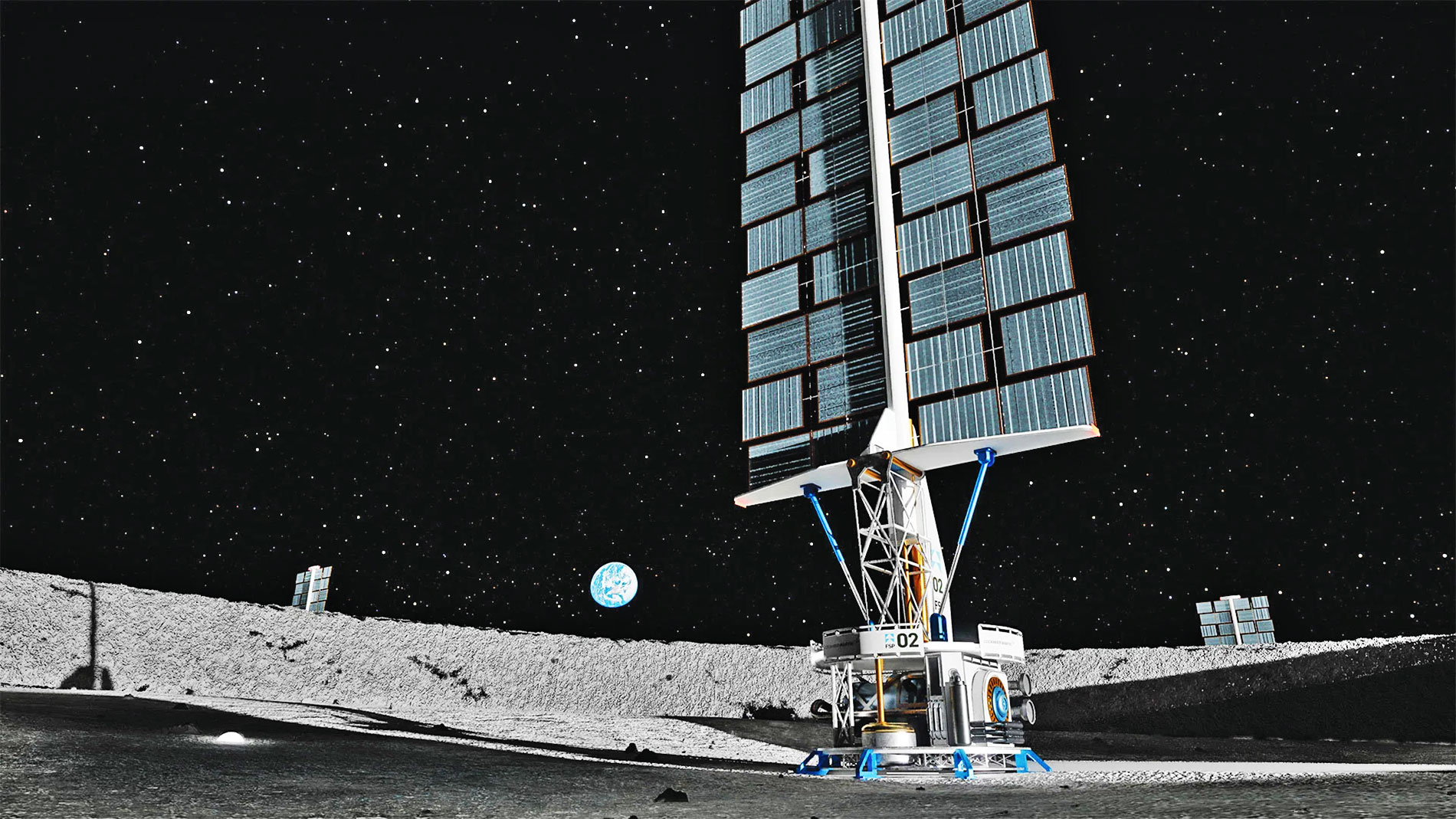
Lockheed Martin illustration shows a potential future
lunar fission power
plant.
But meltdowns are not explosions. Modern reactors are designed so that if nuclear fuel liquefies, they contain it within the plant.
Nuclear power plants are not particularly fragile, either.
But along with the virtually countless nuclear power plants around the world that have been operating normally for decades,
Nuclear submarines are also plentiful; they exist in a fairly extreme environment, get knocked around all the time and are designed to withstand combat scenarios.
There's no reason they can't withstand the moon, too.
A nuclear disaster on the moon is possible, though. Let's say a nuclear reactor does overheat and creates the first-ever nuclear meltdown on the moon. That would be a truly ignoble achievement, but at least most of the melted fuel would be contained at the site.
It would, however, mean that,
Nobody could approach it, perhaps for generations.
And if it oozed into a precious reserve of water ice nearby, that game-changing resource - the entire reason astronauts would be based there - would be permanently contaminated.
But at least the astronauts would be fine, right?
Well, not really...
Radiation from the reactor - even what might be unleashed during a meltdown - wouldn't be a huge worry (in fact, the solar and cosmic radiation on the moon is much more of a concern for astronaut health).
The failure of the plant would be the bigger problem. Say the lunar base relying on it loses electricity during the two weeks when any given spot on the moon is cloaked in darkness. In such cold conditions, battery systems may hold only a modicum of juice before they run dry.
Then the astronauts are in deep trouble,
But experts don't anticipate that we'll see a lunar Chernobyl in our lifetime.
And a spokesperson at NASA says,
That's a relief...
A more realistic worst-case scenario for a 100-kilowatt nuclear reactor is that the moon simply breaks it, and it stops working when the astronauts need it most.
So the real question is,
A lunar reactor will have to function differently than those on Earth.
It probably won't be able to use water either as a coolant or as the heat-absorbing, steam-making substance that turns a turbine to make electricity.
It doesn't flow properly under low gravity, and the maddening temperature swings on the moon could cause the steam to violently expand or the water to freeze, breaking pipes in the process.
Instead the reactor would probably use air brought from
Earth to take on the heat and move it to the turbine. That's more
difficult to design for, but it's possible.
This "waste heat" will need to escape into the environment, but without any atmosphere there won't be any airlike sink to easily soak it up.
Stopping the nuclear reactor from overheating is,
She and Middleburgh suggest the same solution:
Sounds good.
But don't forget about those pesky micrometeorites - pebble-size rocks that move like hypersonic bullets.
...and there's no atmospheric shield to stop them.
If several of these meteorites puncture the radiator fins, the plant will be unable to cool down properly.
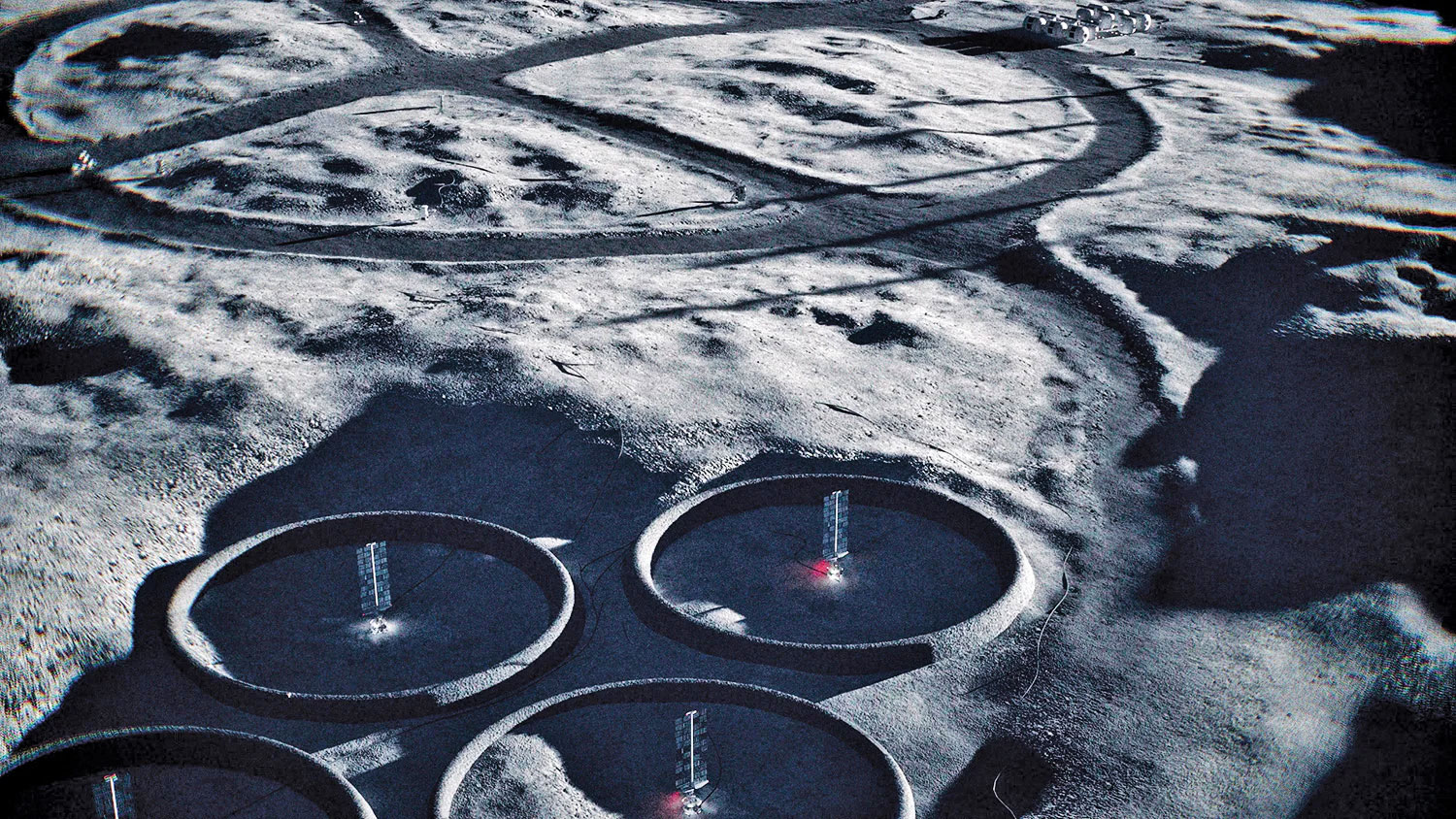
Lockheed Martin illustration shows a potential future
nuclear-powered
Artemis moon base.
Astronauts cannot defend their base against any of these rarer, larger asteroid strikes.
But they can mitigate the threat of the more frequent but diminutive space bullets by burying their power plant underground. They wouldn't even need to dig - they could simply use one of the moon's multitude of hollowed-out lava tubes.
Moonquakes are another challenge.
They are nowhere near as powerful as Earth's tectonic convulsions:
Still, a nuclear power plant shouldn't
go right next to a potentially active fault, because even a modest
tremor could knock over taller structures and break things.
If the reactor isn't properly fortified against the moon's seismic dangers, three things could happen:
NASA's experienced industry partners, its own deep expertise and its cutting-edge testing facilities will certainly help to make any reactor disaster-resistant.
But it's impossible to perfectly re-create the lunar environment on Earth.
Reproducing lunar gravity in a laboratory would require an act of witchcraft, and although vacuum chambers can simulate the moon's extreme temperatures and lack of atmosphere,
Despite the hurdles that must be overcome, many experts are pretty jazzed about the possibility of a lunar nuclear reactor.
But the only way to know for sure that one will work, and work safely, is to go to the moon and switch it on.
Lal at RAND is also excited about the prospect of the U.S. operating the first nuclear reactor on the moon. But she spends a lot of time thinking about "all the things NASA could do wrong" in the process.
Those pitfalls include its interactions with
China, a spacefaring nation also keen to establish a nuclear-powered
foothold on the lunar south pole.
They coordinate certain operations and share a bevy of scientific discoveries, all while keeping a respectful distance from each other.
But it's not the most realistic.
China and the U.S. are geopolitical rivals and competitors in the new race to claim the moon.
The United Nations Outer Space Treaty, which was signed in 1967, states that,
Nobody can legally own territory on the moon (yet).
But in his August 2025 declaration, Duffy noted that nuclear power plants could be used to define a "keep-out zone" to other parties:
Establishing a base would also grant a nation de facto control over a given patch of the moon.
But nuclear power
plants can be put anywhere for any purpose, far from any astronauts,
so both China and the U.S. could place them like radioactive flags.
Nations could quickly stake not quite legal claims on any land they
deemed valuable - including any swaths rich in water.
Preferably, these norms would include the nonaggressive placement of safely designed nuclear reactors.
The deployment of each reactor should also be clearly communicated ahead of time to our neighbors on the lunar surface.
But in the current political climate, clandestine behaviors could win out.
Suspicion is a breeding ground for unforced errors.
And if things get confrontational, nuclear power plants may not be the only territorial markers spacefaring nations put down.
Putting nukes in space is illegal under the Outer Space Treaty.
Nevertheless, Russia is thought to be developing one for this very purpose. And the treaty isn't legally enforceable; it's more like a guideline.
For a moment, though, let's envision a future in which someone sets up a lunar base that's safely powered by the first-ever nuclear reactor on the moon.
Forget a cramped shoebox; they can now create
and sustain a small village for their moonwalkers. In time, this
base becomes an engineering hub and a fuel depot - a springboard for
astronauts to reach the ocher-hued planet farther afield.
Let's hope that in their scramble to win, they unfurl their nuclear ambitions carefully.
No matter how exciting the prospect is and what it may enable, one question should be on everyone's mind throughout:
|