|
by
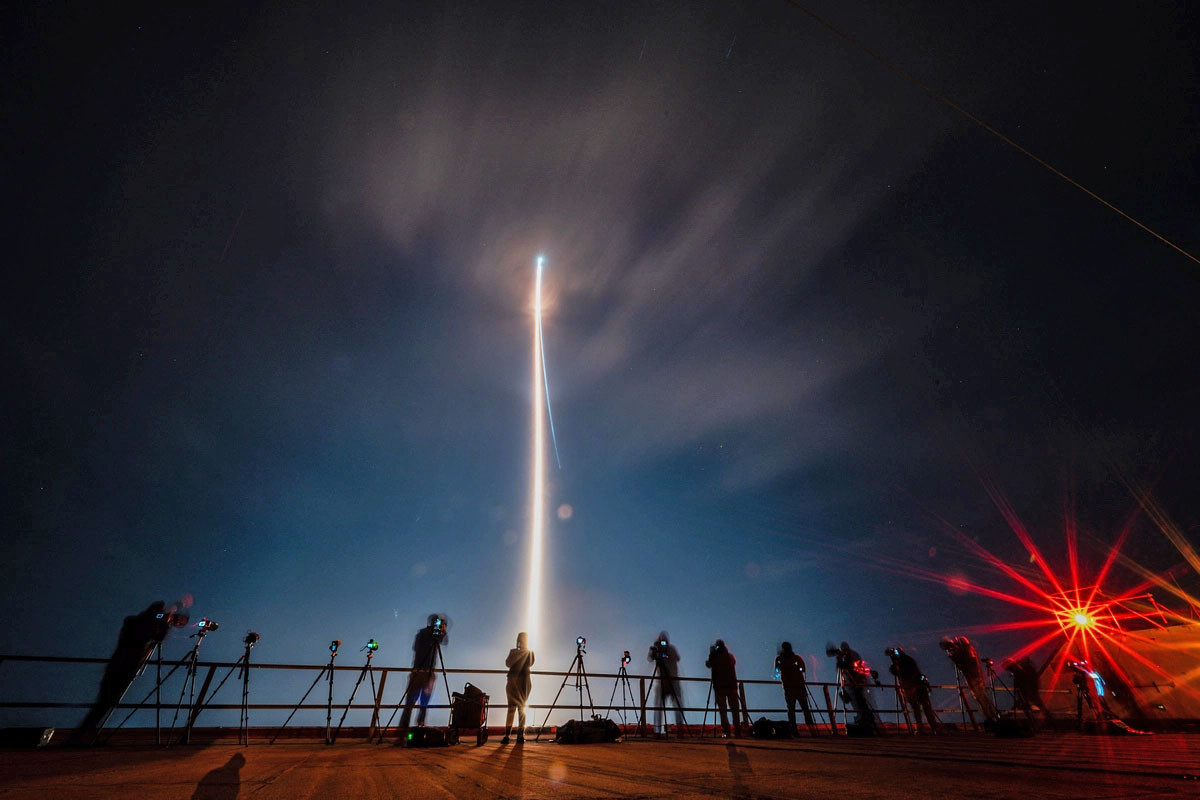
Salena Zito lifts off from Space Launch Complex 41d at Cape Canaveral Space Force Station in Cape Canaveral, Fla., on Jan. 8, 2024, for its maiden voyage, carrying Astrobotic's Peregrine Lunar Lander. Chandan Khanna/AFP via Getty Images
The photographs hang near the front of the building, and John Thornton walks visitors past them the way some fathers show off old Little League pictures.
Then comes the photograph he is proudest of:
That spacecraft, the Peregrine lander, launched in January 2024 and suffered a propellant leak hours after liftoff that ended any chance of a landing.
Behind him, technicians were working on the next one.
Griffin, a lander bound for the moon's south pole, passed acceptance testing at NASA's Jet Propulsion Laboratory in October and came home to the North Side for final work before heading to Cape Canaveral, Florida.
It will carry 10 payloads from six countries.
The company that built it no longer goes by the name in the old photographs.
Colorado-based Voyager Technologies announced in June that it would buy Astrobotic Technology and closed the deal in July, paying a reported $300 million.
The deal did not swallow Pittsburgh. If anything, it went the other way.
According to Keystone Space Collaborative founder Justine Kasznica, he turned down an internship at Boeing in Seattle to stay in Pittsburgh and join Astrobotic.
Carnegie Mellon robotics pioneer
Red Whittaker founded the
company in 2007 to compete for the Google Lunar X Prize.
What he describes next is less a story about space than about Pittsburgh.
Voyager's federal contracts totaled more than $600 million before the acquisition, including work for both NASA and the Pentagon, according to the company.
After Voyager bought Astrobotic,
NASA awarded the company another roughly $298 million to send a
second Peregrine lander to the Moon in 2028.
Thornton said 99 percent of the machined parts on
the shop floor were made in the Pittsburgh region.
The plan was Washington, New York City, or back to Boston.
She stayed, built a practice in robotics, autonomous vehicles, artificial intelligence, and space, and served as Astrobotic's outside general counsel for 15 years.
She is now a partner at the Babst Calland law firm downtown.
The region still has,
...but that's something they can work on, she
said.
His answer is LunaGrid, a commercial power service for the lunar poles built on tall vertical solar arrays.
Thornton said they would stand on south-pole peaks that stay sunlit almost year-round, with batteries to bridge short nights, and the power would be sold to other customers on the surface.
Bringing that capability to space, she argued, is,
Thornton offered one amendment:
About 225 people work at the North Side site, most of them engineers representing nearly every engineering discipline, Thornton said.
The company is hiring roughly 20 additional workers per month at that location alone.
Many are what he calls Pittsburgh boomerangers, people who left to work in space and can now come home.
Others come from Carnegie Mellon, the University of Pittsburgh, and Pennsylvania State University.
Not every job requires a four-year degree...
Some of the technicians building spacecraft used to be car or aircraft mechanics.
In a lab off the main floor, thermal engineer Simeon Frank was testing low-temperature lithium-ion batteries in a thermal vacuum chamber that strips out the air and swings the temperature between hot and cold to mimic space.
Frank, who grew up in southwest Missouri, worked on communications satellites in the San Francisco Bay Area before moving here three years ago.
In his South Side Flats neighborhood, he can get
around on foot or by bike, and families with young children gather
at local parks.
Recruits, she said, often worried about moving to a city with only one space company.
An early volunteer mapping effort with Carnegie Mellon turned up more than 100 NASA prime contractors in the region within two months.
Keystone now counts 1,124 space industry firms in
the tri-state region that together landed more than $9.5 billion in
federal work between 2022 and 2026.
Sen. Shelley Moore Capito (R-W.Va.) introduced him.
Pennsylvania has no NASA center, but neighboring Ohio and West Virginia do:
Kasznica sees both as resources for the region's growing space industry.
Capito has been with them "from day one," she said, and Voyager regularly recruits from West Virginia University:
The building also houses the Moonshot Museum, run by the Astrobotic Foundation, where visitors can watch lunar spacecraft being built.
A few steps away is mission control:
When launch time comes, this is where Pittsburgh
will steer a spacecraft to the Moon...
|