|
by
Philip Ball
for Quanta
Magazine - that life devises its own goals and behaves accordingly - complicates our understanding of what it means to be alive. But does it serve a scientific purpose?
Not much of a deduction, you might think - except that the researchers confined their evidence to observations made by the Galileo spacecraft, which had flown past our planet three years earlier on a looping journey to Jupiter.
So great is the transformative power of life that its presence can be detected just from the light and radio waves our planet emits or reflects into space.
Today we scan the cosmos for some of these
telltale signatures light-years away.
It's not enough to say that life is a non-equilibrium organized state through which there's a constant flux of matter and energy.
That description applies to hurricanes, too. But hurricanes just are.
Only living entities have goals:
One way to express this idea is to say that living organisms have "agency."
It's a hotly contested term. Some biologists reject it outright, at least for any organisms except humans, because we decide on our actions with conscious deliberation. (Whether we're truly the 'only' species to do so is another issue.)
Others think that agency is a fundamental attribute of all life...
Since there's no agreed-upon definition of the term, to some extent it can mean whatever you want it to mean.
But the debate about biological agency touches on fundamental issues in our understanding of what it means to be alive, because agency evokes a notion that biologists and philosophers have always wrestled with: teleology, the apparent purposiveness of life.
If we admit agency into biology,
I suspect that aversion to agency betrays a queasiness about confronting life as something more than some kind of genetic program.
But there's danger in the idea, too:
I'm not looking to either bury or praise agency, but to explore whether it
can be a scientifically productive idea.
Whether it's a bird building a nest or a white
blood cell chasing a bacterium, we can't watch life at work without
supposing that these entities are 'trying to accomplish something'...
Organisms are automata directed by their genes,
and natural selection favors gene variants that make the organisms
behave one way and not another. In this mechanistic, gene-centered
view of life, apparent agency is merely the performance of automated
routines refined over many generations.
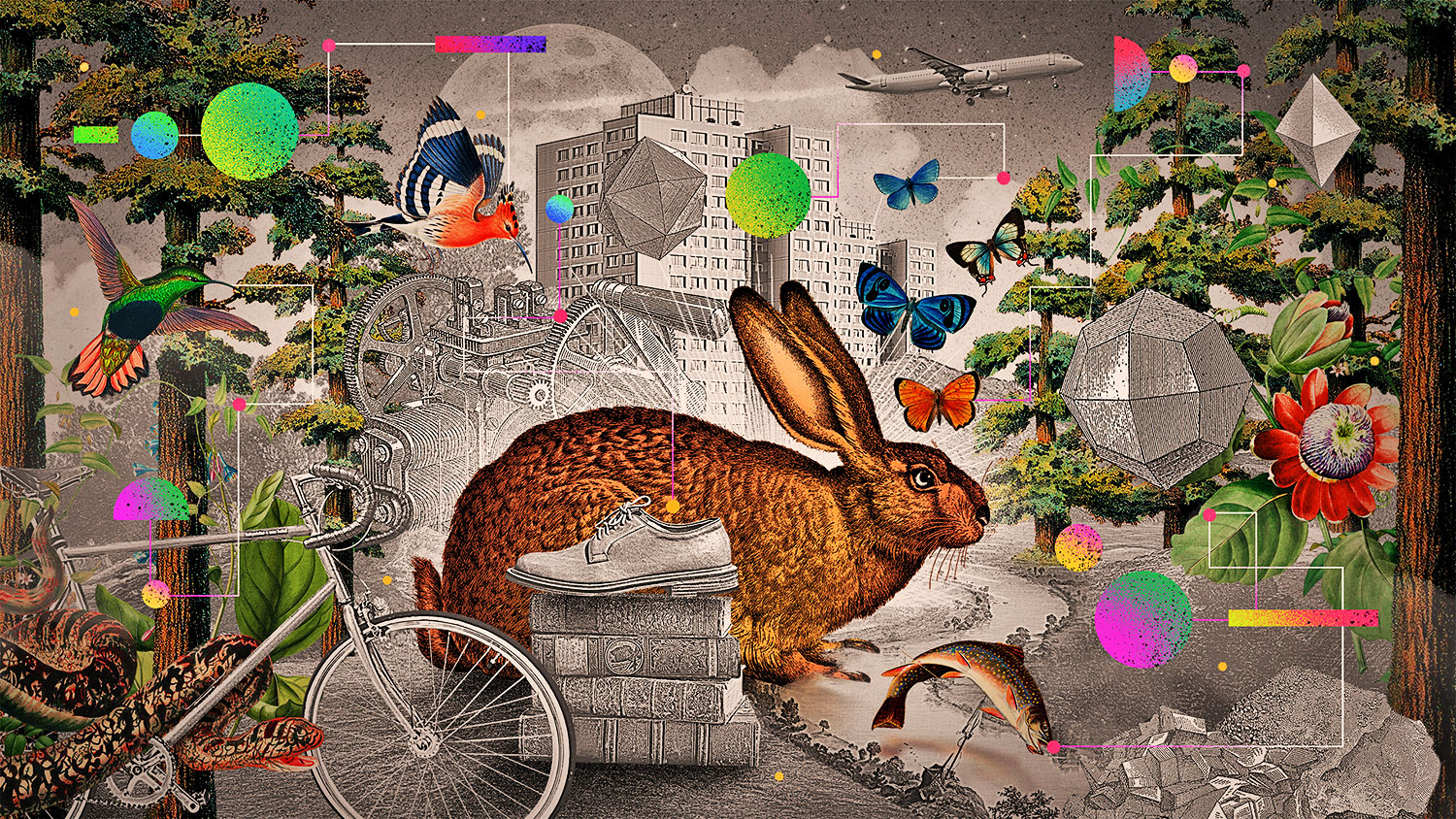
Think of a hare fleeing from a fox.
Sure, its genes are involved in the formation of networks of neurons that enable behaviors that contribute to a state of not being eaten.
Genetics might impose behavioral biases (say, making a hare generally risk-averse), but organisms make decisions by integrating a wealth of contextual and contingent information on the fly, including learned experience.
In one view, agency is neither more nor less than this ability to set proximal goals:
...and then act upon oneself and one's environment to attain them.
We wouldn't say it was your atoms that caused your coffee to get made this morning, nor was it really your genes. It was you, a decision-making agent, who made that happen.
Mitchell is wary of rigid definitions, however.
Samir Okasha, a philosopher of biology at the University of Bristol, is hesitant to invoke this sort of agency.
He said that it's important to distinguish between two ideas:
Even the most gene-centric evolutionary biologist recognizes that many organisms can adapt their behavior to present circumstances and can often be considered to make choices.
But without an ability to self-consciously reflect on the options and the likely outcomes of actions,
James DiFrisco, a philosopher and theoretical biologist at the Francis Crick Institute in London, thinks not.
Agency, he said, is a psychological concept traditionally used to talk about human behavior. Importing it into biology as a whole risks imputing a kind of cryptic self-awareness to all life.
It's not clear how to transfer that word to situations where those concepts simply don't apply.
But what about the goal-directedness of organisms?
This, DiFrisco said, is,
In other words,
But to say that they themselves devise their goals, he said, is untestable and nonexplanatory,
In 2025, DiFrisco and his colleague Richard Gawne published a critique (Biological agency - A concept without a research program) in the Journal of Evolutionary Biology arguing that biological agency is therefore,
Either it's invoking something already familiar in biological science, or it's conjuring up some almost mystical force that makes organisms do things.
This force, they said, is resistant to explanation in terms of causal mechanisms: a vague kind of "holistic power" that doesn't really explain anything, much as the 18th-century notion of a "vital force" animating living things was really just an empty explanation.
Some people, DiFrisco suggested,
The biologist Sonia Sultan of Wesleyan University, whose collaborative work on agency is among that critiqued by DiFrisco and Gawne, argues that they misunderstood what was being proposed.
In other words,
In 2022 Sultan, along with the biologist Armin Moczek and the philosopher Denis Walsh, argued that agency can fill in some,
In particular, they said that it takes into account how organisms interact with their environment and demands a wider view of inheritance beyond genes.
Biological agency, the researchers continued, is thus,
In support of this perspective, the philosopher Álvaro Moreno of the University of the Basque Country in Spain said that organisms don't just detect and respond to changes in their environment but,
Even Charles Darwin recognized this, which is why admitting agency into the living world isn't some kind of mystical challenge to Darwinism.
The 18th-century French zoologist Jean-Baptiste Lamarck went further.
He believed, in the words of the Stanford University historian Jessica Riskin, his latest biographer, that "life at its essence is creative agency" - in contrast to the view then prevailing that the only real agency in the natural world was of divine origin.
While Darwin differed from Lamarck about the source of evolutionary change, both placed the ability of organisms to act for themselves at the center of their theories.
These choices made by the organism can feed back into their own evolution. The decision to change diet or move to a new habitat, simply because of an impulse to explore options, can alter the selective pressures a population experiences and thus its evolutionary trajectory.
Crucially, for example, no gene is telling the organism,
The organism itself takes the initiative.
In this sense agency is already invoked in conventional evolutionary theory:
This phenomenon is akin to the so-called Baldwin effect, first identified as "a new factor in evolution" by the 19th-century psychologist Mark Baldwin, in which non-innate behavioral choices, perhaps ones that are socially learned, themselves create new selective pressures that lead to those choices becoming genetically fixed in the population.
In other words,
But why do we have to call it that?
The behaviors of organisms are already studied and understood from a variety of perspectives.
Neuroscientists, for example, look at the decision-making circuits of brains, biophysicists look at the molecular pathways that govern the responses of bacteria to environmental signals such as nutrient concentration or heat, animal behavioralists think about cognitive mechanisms, and so on.
Why complicate that research with a fancy label that just muddies the waters?
When Sultan and colleagues say that agency - the capacity to act in a way that is conducive to an organism's goal - can be used to predict and explain behavior, DiFrisco and Gawne charge that this makes it circular.
The idea that an organism did something "because of its agency," they argue, resists any further analysis. But Sultan and colleagues disagree with this characterization of how their notion of agency should be applied.
This aspect of the debate hinges on how we attribute the causes of actions.
To put it another way:
For DiFrisco, speaking of organismal decisions,
...that determines behavior - a mechanism that is perfectly capable of incorporating context and conflicting signals.
But for me, the key point here is that the actions can be governed by reasons and goals. The hare is genuinely trying to escape the fox; it doesn't merely look that way. And the hare did not have that specific goal before the fox appeared.
Perhaps it had been trying to forage and to look out for predators. Such "trying to" is the fundamental nature of organisms: Evolution builds entities that try to do things.
Maybe we can focus this debate by asking what the concept of agency buys us that can't be obtained without it.
If agency is going to be more than a philosophical stance - if it's going to be useful for doing science - then first it needs to be "naturalized," as Mitchell and his colleague Henry Potter have put it:
At present, nothing like that really exists, but it's possible to set out some of the issues it would need to confront.
For example:
Some researchers have asserted that agents need particular kinds of internal architectures to govern the relationships between senses, cognitive processes, actions, and needs.
Moreno, for example, has argued that this organization involves feedback loops that don't just enable adaptation to the environment but let the system alter that environment - for example, simply by moving from one location to another with a different set of conditions.
The theoretical biologist Stuart Kauffman has argued that properties like this depend on what he calls "organizational closure," in which the parts are collectively self-maintaining, each of them supporting the functions of the others.
This property, Kauffman says, gives the whole system "causal power" - Mitchell's ability for an agent to act on its own behalf rather than just being a passive vehicle for lower-level causes.
Meanwhile, the neuroscientist Karl Friston has argued that agency arises in entities that can make predictions about the outcomes of behaviors and then compare those with what actually transpires, and seek to minimize the disparity between the two (none of which demands an ability to reflect on that comparison with conscious self-awareness).
At this level it can all sound a bit abstract and remote from actual biology.
But I'm cautiously optimistic about,
It seems unlikely to be coincidental, for example, that organisms that seem to show more agency also have molecular pathways that permit more openness to the influence of context and external information.
If we can get a clearer idea of what makes an agent, this could help us to understand how collective goals arise - as they did when multicellular organisms first arose long ago - and how they can break down, as in cancer...
What's more,
We might then also get a clearer idea of the potential benefits and dangers such truly agential machines might bring.
But perhaps the most compelling argument for recognizing agency is that it might help us understand,
|