|

by Walker Larson
October 10, 2026
from
TheEpochTimes Website
|
Walker Larson
Before becoming a freelance journalist and culture
writer, Walker Larson taught literature and history at a
private academy in Wisconsin, where he resides with his
wife and daughter.
He holds a master's
in English literature and language, and his writing has
appeared in The Hemingway Review, Intellectual Takeout,
and his Substack, The Hazelnut. He is also the author of
two novels, "Hologram" and "Song of Spheres." |

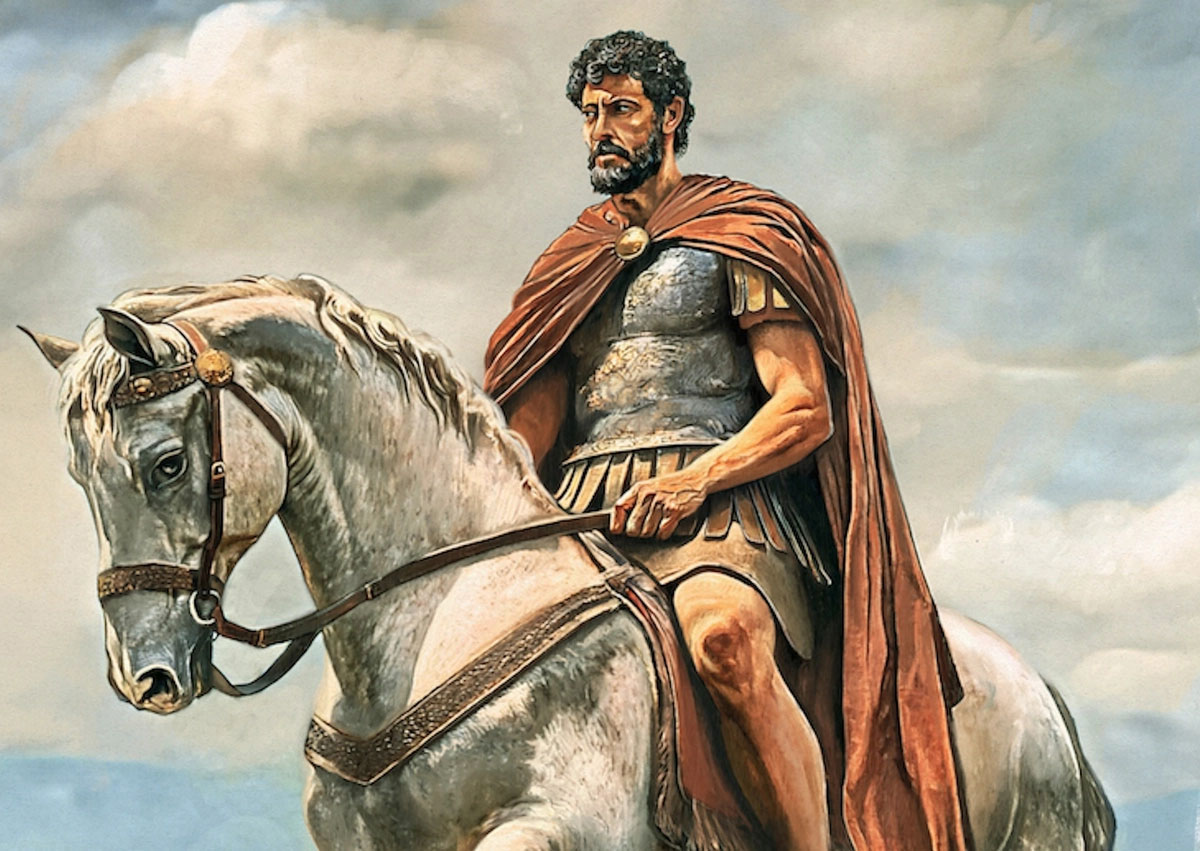
Roman emperor Marcus
Aurelius (121–180)
is known for his
"Meditations."
Biba Kayewich
The
Roman emperor's journal entries
help
contemporary readers
discover
how to master themselves
and
develop sustainable habits...
Marcus Aurelius was the most
powerful man on earth in the 2nd century.
Yet he did not use that position of power primarily for
self-enrichment
or to supply himself with pleasures.

Click above image...
Instead, he approached his role as emperor with
an awareness of the weight of responsibility.
He sought to hold himself accountable. Since he
wielded uncontested power over life and death, there was no one
besides himself to answer to.
One way Marcus Aurelius held himself accountable was by adhering to
a disciplined daily routine, an outgrowth of his dedication to
stoicism.
Stoicism was a philosophical
movement originating in ancient Greece and founded by Zeno of
Citium. It was later taken up by many important Romans -
including Marcus Aurelius.
Stoics believed in a universe governed by reason.
They sought to live in a rational, self-controlled, and virtuous
manner - taking responsibility for what they could control and
accepting with equanimity the things they couldn't.
We know about Marcus Aurelius's daily routine primarily from his
book "Meditations,"
which was really a manuscript composed of his journal entries.
It recorded his struggle to implement stoic
ideals and ethics in his daily life.
From the pressures of this interior battle,
recorded in his journals, emerged the pearls of disciplined habits
and a structured daily routine from which we can benefit from today.
Choosing the Lifestyle You Want
As the modern stoic
Ryan Holiday noted,
Marcus Aurelius was a morning person, not by
nature, but by an effort of the will.
Marcus Aurelius recognized that an early
start was an important component of a successful day. Acquiring
the habit required the right mindset.
In "Meditations," Aurelius wrote:
"At dawn, when you have trouble getting out
of bed, tell yourself:
'I have to go to work - as a human being.
What do I have to complain of, if I'm
going to do what I was born for - the things I was brought
into the world to do? Or is this what I was created for?
To huddle under the blankets and stay
warm? So you were born to feel "nice"? Instead of doing
things and experiencing them?...
You don't love yourself enough. Or you'd
love your nature too, and what it demands of you'."
It's a call to put aside personal comfort for the
sake of a higher calling.
Aurelius began the day,
with a conscious choice to do what was best,
not what was easy...
From there, he took time to pursue a period of
quiet and reflection.
He journaled in the early morning hours, before
the bustle of the day. In fact, he was penning his "Meditations" in
the hush and chill, the stark freshness and soft spreading blue
light of the hours on the threshold of day, often huddled in a tent
inside a military camp.
Along with this introspective practice, Marcus Aurelius also
began his day mentally preparing for what lay ahead.
"When you wake up in the morning, tell
yourself: the people I deal with today will be meddling,
ungrateful, arrogant, dishonest, jealous and surly," he wrote.
"They are like this because they can't tell
good from evil."
Here, Aurelius wasn't being morose, but rather
engaging the stoic idea of the "premeditatio malorum," the
"premeditation of evils."
The idea was that the unexpected blow lands the
hardest, and so, by taking stock ahead of time, he could prepare
himself for the blows of the day, develop resilience, and also store
up more patience and compassion for others.
The evil could do less harm to him if it
found him well-prepared...
He launched into the day's labors with a firm
sense of duty.
"Concentrate every minute like a Roman - like
a man - on doing what's in front of you with precise and genuine
seriousness, tenderly, willingly, with justice," he insisted.
"And on freeing yourself from all other distractions.
Yes, you can - if you do everything as if it
were the last thing you were doing in your life, and stop being
aimless, stop letting your emotions override what your mind
tells you, stop being hypocritical, self-centered, irritable."
Aurelius's ideal involved transcending
the distractions and pettiness of everyday life to focus on
completing his duties as excellently as possible.
What mattered was doing the right thing -
even when natural desires rebelled.
In modern parlance,
this would align closely with the
productivity advice to "eat the frog" - that is, perform your
most difficult yet important task first, ensuring that it gets
done right away.
This ensures that duties are fulfilled and also
prepares the way for a downhill coast over the remainder of the day.
Balancing Intensity With
Relaxation
Holiday noted that Marcus Aurelius admired his stepfather
Antoninus, whose work ethic was
so well-developed that he even scheduled bathroom breaks so he could
work uninterrupted for long periods.
Even when the long, unthinkably busy days of
running an empire grew tiresome, Marcus Aurelius insisted on
avoiding complaints.
"Never be overheard complaining, not even to
yourself," he said.
He did, however, find time to destress through
horseback riding, hunting, wrestling, and spending time in the
public baths for which the Romans were so famous.
Those baths would have helped to cleanse both
body and mind, wiping away the grime of the daily grind. Here,
Aurelius reminds us of the importance of balancing
labor with necessary relaxation and recuperation.
Holiday wrote,
"Nearly a dozen times in Meditations, Marcus
Aurelius talks about seeking and achieving 'stillness.' These
moments of quiet would have been essential too.
Without quiet, we can't think. We can't clear
our minds. We can't get the big picture. We can't be
philosophical."
Though Marcus Aurelius was clearly a strict,
disciplined man, he also had an appreciation for quiet, reflection,
and beauty.
A beautiful passage from "Meditations"
reads:
"Anyone with a feeling for nature - a deeper
sensitivity - will find it all gives pleasure. Even what seems
inadvertent. He'll find the jaws of live animals as beautiful as
painted ones or sculptures.
He'll look calmly at the distinct beauty of
old age in men, women, and at the loveliness of children. And
other things like that will call out to him constantly - things
unnoticed by others.
Things seen only by those at home with Nature
and its works."
Similarly, he treasured his family - he had more
than a dozen children with his wife
Faustina the Younger, though
only five or six lived to adulthood - and he made sure to conclude
his daily routine by tucking his children into bed in as mindfully
as possible.
As he kissed them goodnight he would remind himself not to rush the
process because it might be the last time he got to do it.
There was no guarantee either of them would
live through the night.
This awareness of mortality allowed him to be
committed to his ideals and also gratefully aware of the good
things in life.
Marcus Aurelius's mindful daily routine helped
him rule over nearly 100 million people with more justice than many
of his predecessors or successors could boast of.
Though he was certainly not a perfect man, he did
live by many noble principles.
As Igor Zanetti
pointed out for The Collector,
"Unlike many emperors who sought power for
personal glory, Marcus approached his position with a sense of
duty and responsibility.
From a young age, he was recognized for his
calm temperament and thoughtful nature...
Even though he wielded immense authority, he
consistently reminded himself, through his writing and habits,
to act with humility and restraint."
There's much to be gleaned from Marcus
Aurelius's routine and the attitudes with which he faced the
challenges of daily life...
|