|

by
The Curious Finance Girl
June 12, 2026
from
Medium Website
Article also
HERE
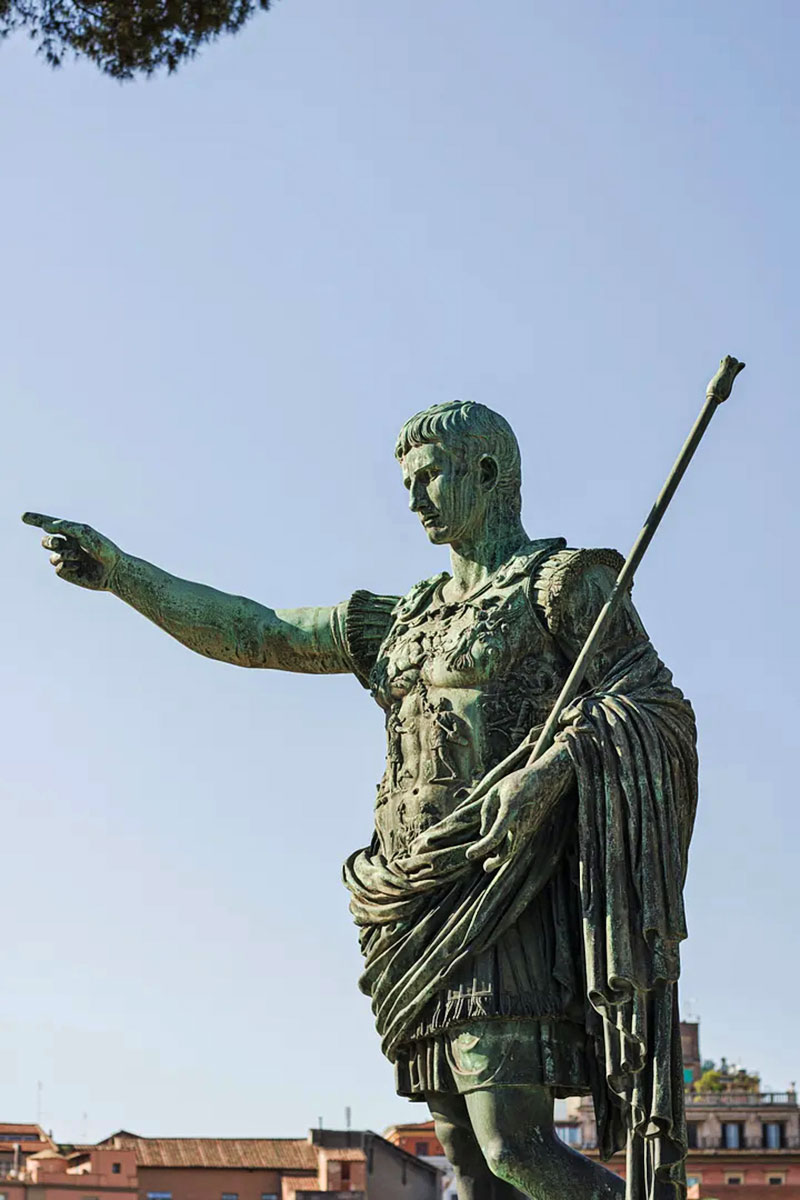
Photo by Adrian
Botica
on Unsplash
The overlooked
lesson
from one of
history's
greatest
economic collapses...
The
Roman Empire fell. You already know that part. What history
books don't cover is what happened to people's money when the end of
an empire comes close...
All the savings put in silver coins had become worthless. But some
families left that crash wealthier than when they went in.
The
Denarius, Rome's silver coin, was pure silver (approximately
95% silver) under Emperor Augustus.
It was confidence made solid.
Then inflation happened and the economy collapsed.
The Roman people
noticed. Merchants stopped accepting devalued coins for the import
of goods. Soldiers demanded raises. Farmers let their crops rot
rather than take cash that they knew to be worthless.
From 235 to 284 AD, the era historians call the
Crisis of the Third Century, Rome
suffered military collapse, plague, civil war and economic collapse.
In that setting, here is what did, in fact, stand its ground.
Gold
Emperor Constantine the Great came to power in the early 4th
century.
He also established a new coin,
the Solidus, in 312 AD.
The Solidus was a declaration of war against the monetary rot that
had been eating at the body of Rome for a century.
Merchants who no longer trusted the Denarius suddenly had a
trustworthy medium of exchange again. Anyone who had to do serious
cross-border business used it.
The Solidus remained important for another seven centuries, long
after the Western Roman Empire collapsed. In the 11th century,
Byzantine merchants were still
trading in it.
A Roman senator who was wealthy in 300 AD was financially ruined by
360 AD.
That senator who had turned his money into gold, whose purity could
be checked, and remained steady, maintained his economic status
through the worst of the collapse.
Not all gold was equal.
There was an underground market for gold. Clipped coins, false bars,
and fake weights spread.
Study on the collapse of Rome shows that rich classes asked payment
in pure gold weighted not in a currency unit.
It was the metal
itself that served as a store of value.
So gold as a safe bet did not come from Rome.
Rather, Rome taught us
what cannot be diluted, also cannot be devalued...
Debt
This is the one that no one mentions.
Financial historians know it.
This is documented in the academic literature.
When Rome was experiencing hyperinflation, debtors were favored.
Here is what that means.
In 230 AD, a Roman landowner borrows 100,000 Denarii. By that time,
those 100,000 Denarii are a fortune, enough to purchase a productive
farm in the countryside.
By 270 AD, the Denarius had lost
ninety-five percent of its silver
content. Prices have risen together. But the loan was still recorded
in Denarii. The contract says 100,000 Denarii and so 100,000 Denarii
had to be repaid.
But those 100,000 Denarii in 280 AD are worth far less than they
were when the debt was taken. The amount that the borrower paid back
was worthless.
Inflation was an empire-wide transfer of wealth from lenders to
borrowers.
The collapse of the currency caused every loan named in Denarii to
become, in real terms, cheaper and easier to repay over time.
The borrower's land remained.
But the value of debt didn't.
As the century went on, those who had borrowed against their land
holdings in the second century now held vast income-earning
productive farmland, while they paid off debts that had become
worthless due to inflation.
Even through the final collapse of empire, the landowning families
kept economic power...!
Debtors had assets free from debts that had once seemed hopeless.
Inflation isn't just a tax.
It is a way to transfer wealth...
And in
each of those transfers, the advantage has usually gone to those who
own real assets while those holding paper claims have been left
behind as inflation reduced their value.
Self-sufficient
Estates
Land alone did not save you. That is a difference that all
simplified versions of this story get wrong.
Rome at the peak of it was an
inter-linked market.
Imported
Spanish olive oil sold in Britain.
Egyptian grain fed the capital.
Syrian purple dye dressed senators.
And when it broke, it broke...
A landowner whose estate relied on that trade network (who grew cash
crops for export, who depended on imported tools, who wanted urban
markets for surplus) was left lost when the network stopped
operating.
His land was still there. Its economic function was gone...
The estates that remained were backed by a different kind of
thinking.
The self-sustaining house of the late-Roman period was
more than a farm.
It was a closed-loop economy.
The most meat, grain, vegetables, wood, wool and leather were all
produced internally.
Pots fired in estate ovens.
Cloth made by
estate workers.
The self-sufficient villa did not need outside trade when the trade
networks that had once held together the empire shrank and
eventually broke.
It had never relied on them.
Instead, these estate owners
built industrial workshops, expanded
grain bins and spread their farming production, at the moment when
the larger imperial economy collapsed around them.
These were carefully planned decisions. These estate owners
understood what the signs were saying. The system was becoming a
risk. The only protection against inflation was self-reliance.
The independent farm was more than a business.
With the state
failing, it became a center of local political power...
With roads in ruins and local administration collapsing under the
burden of its own failure, the big villa owner filled that empty
space.
He provided physical security.
He provided food.
He provided
stable employment.
Those landowners who had already shifted away from their dependence
on the Empire and built up internal productive capacity did not just
cling to their wealth through the collapse.
They evolved to become
the building blocks of the next regime...
That is not just survival.
That is what it looks like when an asset
not just survives a collapse, but defines the period after...!
Irreplaceable Skills
This indeed is the manner in which all economic collapse regardless
of circumstance, places you.
Your credential does not matter.
It does not matter what institution
proved your expertise.
The credential is only valuable if the
institutional framework supporting it has not collapsed.
What Rome's decline did show, and what has been confirmed by every
later social breakdown, across the ages, is that,
there are only two
classes of human skill that have exchange value when currencies
crash and supply chains fail.
-
The first is the ability to respond to an urgent, unavoidable human
need.
-
The doctor who prevents infection with native resources rather
than something from overseas trade routes in the east.
-
The blacksmith able to convert his scrap metal into a plow blade
-
The miller that transforms grain to flour with simple stones and levers.
-
The carpenter who could fix a roof before the winter rains.
-
The second is the cleverness that helps trade across failing
borders.
In a broken environment the merchant who could operate over
several warring political units, speaking many languages, that was
gold the Solidus coins were weighed in.
The state that had surrounded them had decayed. Their economic
function had not.
Lawyers who relied on the court system of Roman civil law courts
that no longer operated. The imperial officials, who were paid with
money from a treasury that went broke. Military supply officers of
an army that dissolved on account of no money.
In a failing system, your value is only as strong as the system.
The craftsman, the doctor, the merchant with a skill set that could
be carried everywhere:
these were those who survived Rome's
collapse.
The ones that survived are the ones that operate at less
sophisticated levels, skills, which work best when supply chains
have collapsed and institutions have failed.
The fall of Rome did not leave its system of laws intact.
Its
administrative structure and its financial sophistication were not
preserved.
What it preserved, imperfectly, but truly, were the
carpenters; its
doctors; its grain farmers; and metalworkers.
The people who could
perform those acts supported human existence, in any political
system.
Final Thoughts
In a currency collapse,
The Roman families that owned productive land purchased with debt
survived with their wealth not disappearing.
The villa estates that
could feed, clothe and house their people became the foundation of
what followed.
The truly irreplaceable skills survived because they met basic human
needs regardless of politics, money or institutions.
Four assets. One principle...
What survives
a collapse is not the most valued part of the system
in wealth.
It is the part that remains useful when the system
breaks.
Rome fell slowly, then all at once.
It is not whether systems fail.
The question is what do you have
when they do...!
|