|
failed to Fool Society...
They attached climate policy to,
Then they acted surprised when voters resisted.
Well,
The "climate crisis" headlines forced down the throats of the American people began to really ramp up when socialist Rep. Alexandria Ocasio-Cortez and unhinged leftist Sen. Ed Markey introduced the Green New Deal in early 2019.
Today, after a summer of climate hysterics about warming, as we shall see below, reality is asserting itself as we have record cold and ice gains where it counts.
When you see what is happening right now at the
poles, in Canada, South America, Russia, and Greenland, there is
really concerning climate news, but
it's cold news, bitterly cold.
This approach created fatigue, suspicion, and resentment.
As a result,
A Washington Post/Ipsos poll asked registered voters which issues would most influence their vote in November's midterms.
CNN data analyst Harry Enten said voters,
when it comes to climate change, "don't care."
The only climate scientist teaching at West Point, the US Army's military academy, was fired after he resisted an order to stop teaching about the human causes of
the climate emergency.
Data from the Danish Meteorological Institute show the mean 2-m temperature north of 80°N averaged approximately -0.91C (30.4F) across June, July and August 2026.
June averaged -2.20C (28F), July essentially 0C
(32F), and August -0.55C (31F).
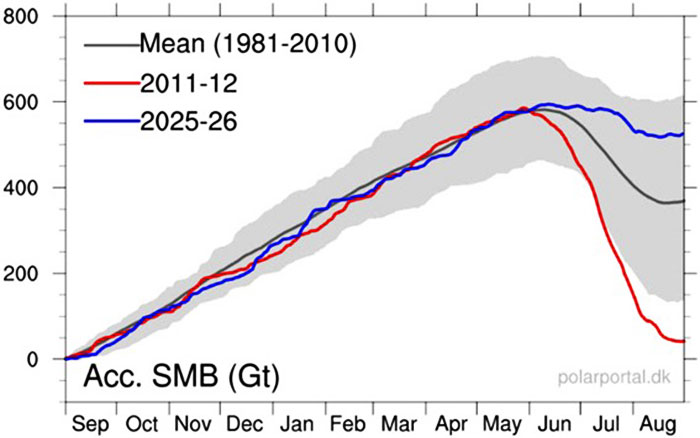
comparing the 2025–26 season with
the historical
average and 2011–12.
On Sept 5, Concordia Station at Dome C registered an unusually low -76.6C (-105.9F), roughly 12.5C (22.5F) below the typical September daily minimum, according to Italy's Antarctic Meteo-Climatological Observatory.
Concordia is holding below -100F for four
consecutive days, an intense run of cold even by Antarctic Plateau
standards - roughly 10–12C (18–22F) below the norm.
On Aug 25, Belgrano II posted a daily high of just -35.2C (-31.4F) - the station's lowest maximum temperature on record, edging below the previous -35C (-31F) mark reached in 2001.
Infoclimat's archive now ranks the reading as the station's coldest August daily maximum in data extending back to June 1956.
The finding comes from a 2026 study (Atmospheric rivers and winter sea ice drive recent reversal in Antarctic ice mass loss) in Communications Earth & Environment that used GRACE and GRACE-FO satellite measurements.
From the early 2000s to 2020, the continent lost roughly 90–142 gigatons (Gt) of ice per year.
But from 2020–2024, the researchers found a statistically significant mass-gain trend of +67.53 ±31.4 Gt per year.
At São Joaquim, Santa Catarina, the historical Epagri/INMET station fell to -4C (24.8F) on Sept 7 - the coldest Sept 7 in its 72-year record, beating the previous -3C (26.6F) set in 1973.
Nearby Caminhos da Neve reached -5.9C (21.4F).
Bom Jardim da Serra sank to -6.1C (21F), with Urupema at -5.4C (22.3F). Snow was observed across the highlands of Santa Catarina and Rio Grande do Sul, including around Urubici, Bom Jardim da Serra, Cambará do Sul and São José dos Ausentes.
These temperatures are very cold for Brazil, a
land where almost no houses have heating.
At Balmaceda, southern Chile, temperatures plunged to -9.4C (15.1F) on Sept 5, breaking the previous daily record of -9C (15.8F) from 1976.
The following morning dropped to -9C (15.8F), smashing the Sept 6 record of -7.2C (19F) set in 1994.
At Kandalaksha, Murmansk Oblast, -2C (28.4F) was posted on Aug 28, breaking the previous daily record of -1.6C (29.1F) set in 1989.
Sarapul, Udmurtia, dropped to 2.6C (36.7F),
beating 3C (37.4F) from 1937. The cold intensified Aug 29.
That reading broke the station's previous Aug 31
record of 1.1C (34F), set in 1962, and also undercut its previous
absolute August minimum of 0.0C (32F) from 1969 and 1978 (station
data extends back to 1948).
Sarapul, Udmurtia, reached 1C (33.8F), breaking 2.6C (36.7F) from 1993. And Remontnoye, Rostov Oblast, fell to 5.9C (42.6F), besting 6.8C (44.2F) from 1983.
The records extend the unusually cold finish to
August across large parts of Russia, from the Far East through the
Urals and into southern European Russia.
Sounds like a "real warming" trend, doesn't
it...?
Snow settled at Banff Sunshine Village, Lake
Louise and Kicking Horse, where several centimeters accumulated.
For decades, its establishment sold CO2
cuts as an existential necessity - worth any cost. Reversing course
without exposing the deception is proving a headache, particularly
with alarmist factions now so deeply invested and entrenched.
Instead, aggressive decarbonization collided with
expensive energy, industrial decline, dependence on imported fuels
and growing voter resistance.
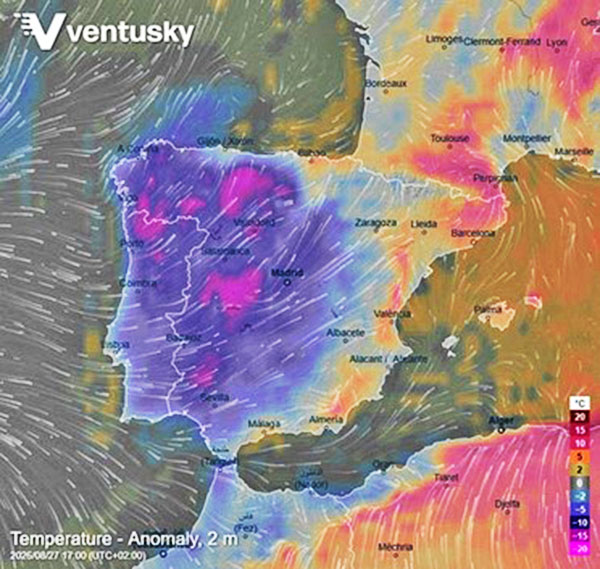
showing unusually cold temperatures across Spain and Portugal.
This is a substantial late-August departure, though one unlikely to receive any mainstream attention.
The end of summer will probably hold some
surprises for a public already disconnected from climate-expert
mania.
|