|
edited by Andrea Thompson
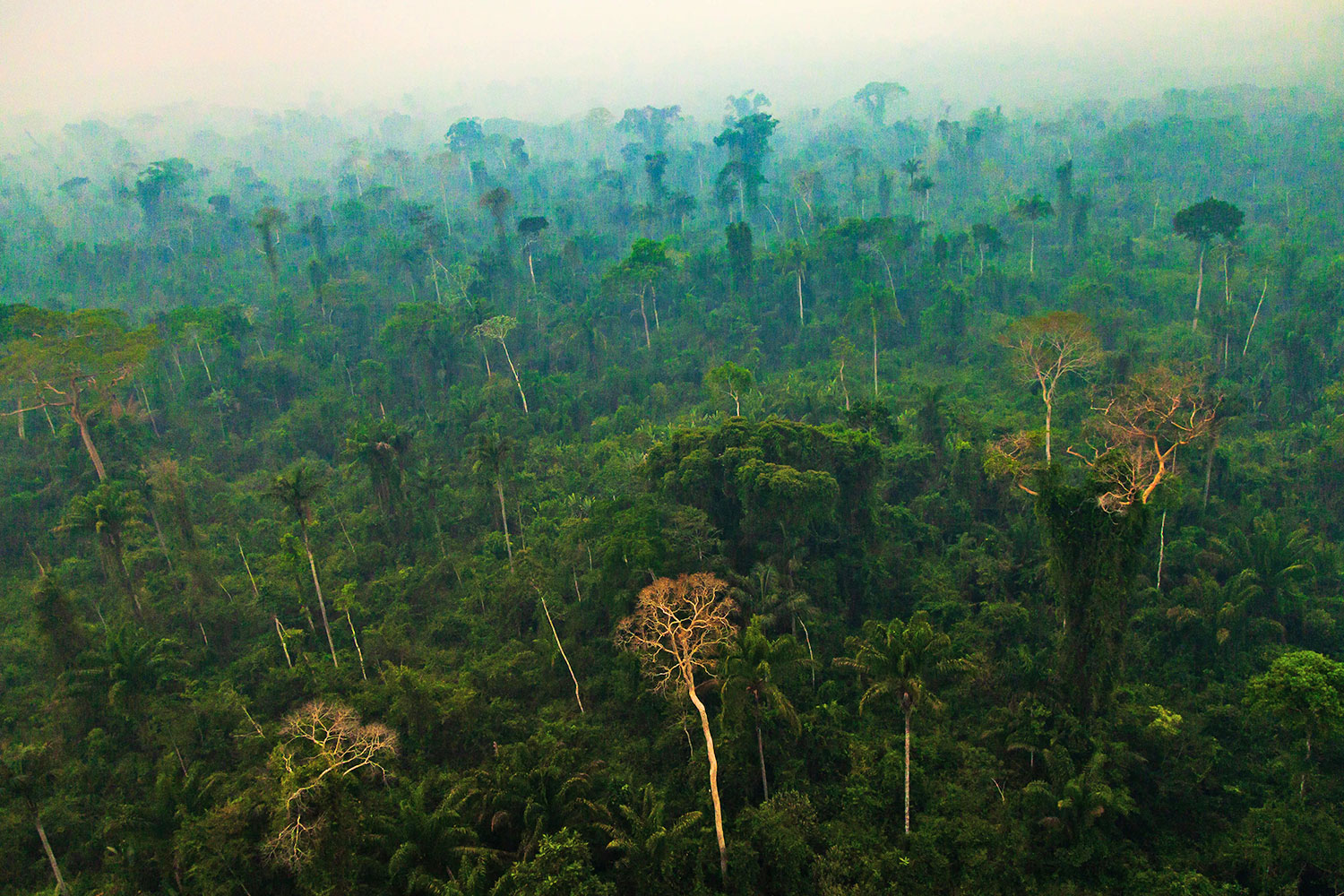
The Amazon rainforest covered by smoke from burning for cattle pasture and farming. Marcio I. Sa/Shutterstock
drives drought and fire, researchers warn the Amazon rainforest may be approaching a point of no return....
On October 17 it had the worst air quality in the world on that day, with fine particulate matter concentrations of nearly 30 times the World Health Organization's safe daily limit.
The country's civil defense agency has advised residents to wear N95 masks, and schools and universities temporarily suspended in-person classes.
In October Brazil's National Institute for Space Research (INPE) registered 2,271 fire hotspots in the state of Amazonas alone - a 160 percent increase over the same month last year.
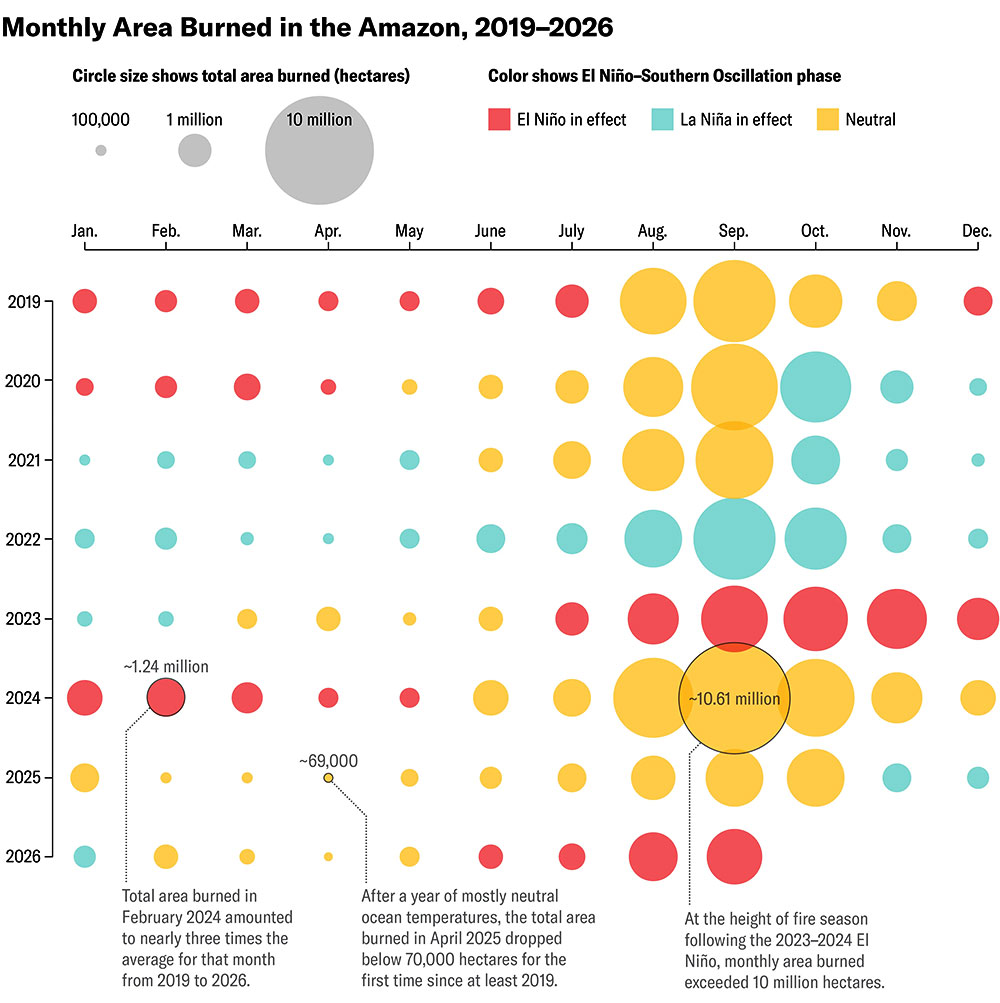
The blazes mark the beginning of what scientists suspect will be a long and severe fire season - "a year of fires," Flores says - spurred by a record-smashing El Niño that's on track to become the largest in living memory.
And that has scientists worried for the rainforest's long-term survival.
Source: MapBiomas (area burned data); Our World in Data (El Niño–Southern Oscillation data)
Some researchers fear the rainforest could soon reach a "tipping point" - the threshold beyond which a self-reinforcing, runaway cascade of drying, tree death and wildfire would begin to spread across the Amazon basin, irreversibly.
In just decades, that cascade could turn rainforest to savanna, releasing into the atmosphere tens of billions of tons of carbon and altering global rain and snowfall patterns.
As warm water shifts eastward in the tropical Pacific, so does the zone of rising air above it.
A corresponding area of sinking air then settles
over northern South America, suppressing clouds and rainfall,
typically bringing severe droughts to the Amazon basin.
But at the same time this El Niño of unprecedented strength is taking shape, the forest is reeling from unprecedented damage caused by the last event, when major rivers reached historic lows and some 15.8 million hectares of the Amazon - an area larger than England - went up in flames.
A
study published earlier this year
projected that more than half of the affected forest will not
recover within seven years, a larger share than after any previous
drought in the satellite record.
Like all rainforests, the Amazon generates much of its own rainfall:
In another study, Nico Wunderling, an
Earth system modeler at Goethe University Frankfurt and the
Potsdam Institute for Climate Impact Research, both in
Germany, and his colleagues
built a computer model of this
"atmospheric moisture recycling" system and ran it through a
gauntlet of global warming and deforestation scenarios.
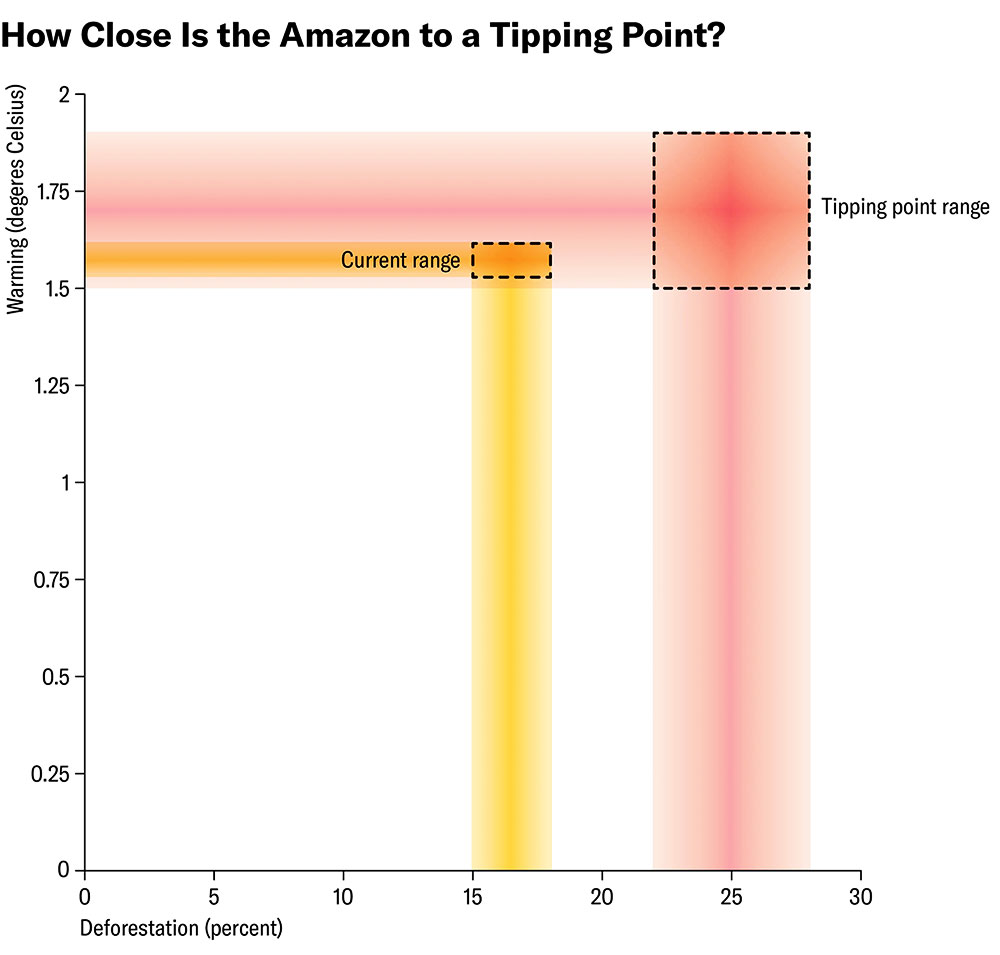
Left intact, the Amazon is relatively resilient up to about 3.7 to 4 degrees Celsius of temperature rise above preindustrial levels. But if 22 to 28 percent of the rainforest were deforested, warming of just 1.5 to 1.9 degrees C could be enough to trigger a near-basin-wide collapse.
The world is rapidly approaching 1.5 degrees C of warming, and roughly 17 percent of the Amazon has already been deforested between the 1970s and now.
The tipping point sits at 1.5 to 1.9 degrees C
and 22 to 28 percent deforestation.
Source: "Deforestation-Induced Drying Lowers Amazon Climate Threshold," by Nico Wunderling et al., in Nature, Vol. 654; June 4, 2026 (tipping point and deforestation data); "Temperature," Climate Dashboard. Updated November 10, 2026 (current warming data)
Another tenth of a degree of warming and another five percentage points of forest loss would put the Amazon in what he calls,
Fire Feeds Fire
After returning to office in 2023, he reversed forest clearing - largely for cattle pasture and cropland - to its lowest level since 1988 after it reached a 15-year high under his predecessor, Jair Bolsonaro.
But it's unclear if it will be enough.
Once a patch of the rainforest burns, Flores says, it remains more flammable for at least a decade - a factor Wunderling's study, which Flores co-authored, didn't account for.
Fire kills trees, opens the canopy and dries the forest floor - and the dead wood left behind becomes fuel for the next blaze.
In a September study of forests in the Colombian Amazon and Orinoco basins, Armenteras and a colleague found that of the areas that burned three or more times since 2001, only 37 percent were still intact by 2024; 35 percent had been deforested - the canopy permanently lost in a cascade that began with the fires.
Ultimately the land was converted, mostly to
cattle pasture.
The worst is still to come, the experts suspect. The El Niño's projected peak in the next month or so will likely coincide with the height of the dry season in the northern Amazon.
And the worst recent fire seasons, in 2016 and 2024, each came in the year after a previous El Niño had peaked.
|