|

by Pierre Kory, MD, MPA
May 18, 2026
from
PierreKoryMedicalMusings Website
Ancient texts,
water chemistry,
sound, plants,
and the nervous system
all kept
pointing to the same principle:
ordered input
supports alignment,
while chaotic
input disrupts it...
Since I was, in effect, writing two books at the same time, my mind
kept moving between lines in Scripture and deeper dives into water
chemistry and geology.
Going back and forth like that, I kept coming
back to the same impression.
Ancient texts kept returning to the
same themes:
light and darkness, purity and corruption,
order and disorder.
Scripture did it.
The War Scroll did it.
Alchemy did it...
Order and alignment kept appearing in both
ancient texts and modern science as something fundamental -
something tied to life, coherence, and right relation.
The more ordered a thing became, and the more its parts were brought
into alignment, the more it seemed to hold together, to function,
and to endure.
I started with a hunch and decided to follow it.
Water drew me in early because its mineral
composition - and the ionic environment that arises from it - shape
its state, and as that state becomes more ordered and internally
aligned, its capacity to carry, transmit, and sustain biological
processes changes with it.
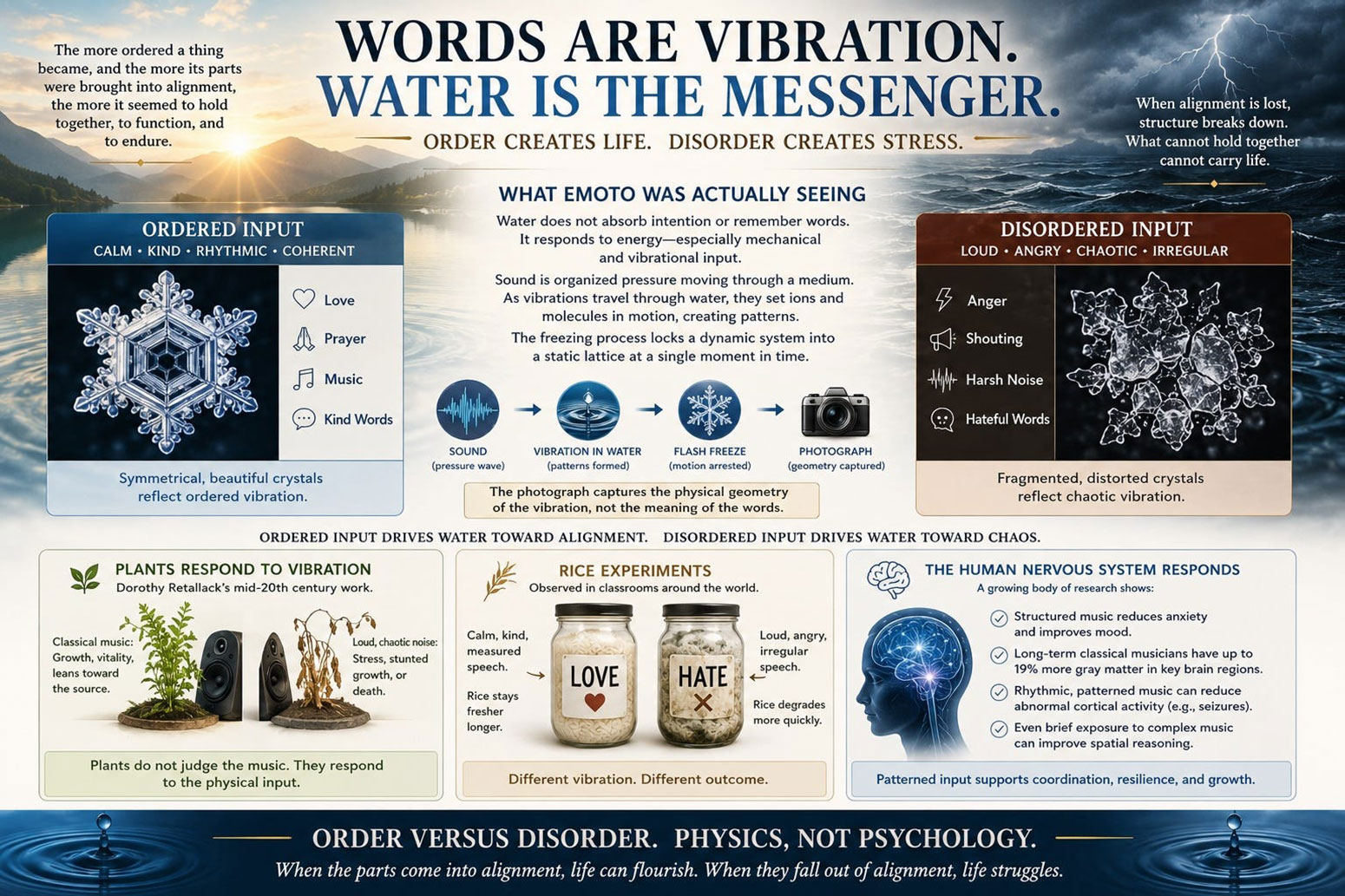
What Emoto was actually Seeing
That brought me back to a topic I had explored months earlier in
From Volcanoes to Vitality, the work of
Masaru Emoto, who became widely
known for,
flash-freezing and photographing water after
it had been exposed to different inputs - spoken words, written
labels, prayer, and music - and for reporting that "positive"
inputs produced ice crystals with symmetrical, ordered patterns
while "negative" ones yielded fragmented and irregular
formations.
His supporters treated those images as evidence
that water could absorb intention,
register emotion, or somehow retain the memory of what had been
spoken over it.
His critics dismissed the whole thing as
pseudoscience. I believe that both sides misunderstand the
chemistry of water itself.
Water does not respond to emotions or remember words. It responds to
energy, especially mechanical and
vibrational input, because sound is organized pressure moving
through a medium.
As vibrations propagate through water, they induce motion of ions
and water molecules in patterns that reflect the frequency,
wavelength, and amplitude of the input, sometimes promoting
alignment and symmetry, and at other times disrupting and
dispersing.
Water does not "understand" language in any
cognitive sense.
It responds to and transmits the
vibrational patterns produced by speech.
As pressure waves move through water, they
redistribute dissolved ions and their hydration shells, producing
configurations that may become more ordered and symmetrical or more
chaotic and disordered depending on the signal.
The critical step in Emoto's work was the freezing process,
which effectively flash-froze a dynamic system into a static lattice
at a single moment in time.
The photograph did not record the meaning of
what was said.
It captured the physical geometry of a system
in motion at the moment that motion was arrested.
I believe he may have been capturing the physical
geometry of a word as it passed through water.
That changed my interpretation of his work. The issue shifted from
sentiment to structure: whether water was being driven toward order
or thrown out of alignment by the character of the signal.
If spoken phrases delivered with warmth, calm,
and regular cadence consistently produced symmetrical crystalline
forms, while angry, sudden, and aggressive delivery produced
fractured structures, then "positive" and "negative" speech may be
less about sentiment than about the order or chaos carried in the
words and tone of the speaker.
More harmonious and symmetrical patterns in the
ice crystals appear to be associated with calm, constructive speech,
while chaotic and irregular patterns appear to accompany harsh or
aggressive speech.
Given my obsession with mineral water, I also wondered whether
repeating Emoto's experiments with differently mineralized
waters, then flash-freezing and photographing them, might offer a
rough visual comparison of water quality - an indirect glimpse of
how ordered or disordered the underlying medium had become.
I briefly considered building such a setup
myself, if only to see what Rock Water would look like next
to my tap water.
Then again, I might prefer not to know...
Ordered Input, Biological Response
Dorothy Retallack's work in the
mid-twentieth century showed a similar relationship in plants.
Plants exposed to classical music grew more
vigorously and leaned toward the source.
Plants exposed to loud, chaotic noise showed
stress or died.
Later work clarified the mechanism.
Plants were not judging the music being
played, just as water was not carrying meaning.
Plants were responding differently to
different physical inputs.
Similar observations have been reported in
informal classroom rice experiments in many places around the world.
Cooked rice is placed into two separate jars,
labeled "love" and "hate."
One is repeatedly exposed to speech delivered
in a calm tone, with a regular cadence and measured amplitude -
words expressing care, patience, and kindness.
The other is subjected to loud, irregular,
and aggressive speech - words expressing anger, hostility, and
contempt.
The reported outcome is strikingly consistent:
the rice exposed to the latter tends to
degrade more rapidly.
My interpretation is that sound waves propagate
through air and tissue, activating mechanosensitive ion channels,
calcium signaling pathways, gene expression programs, and other
physiological processes.
Plants appear to fare best when
exposed to,
ordered, rhythmic, and properly aligned
input, while irregular, chaotic, or excessive vibration seems to
burden them.
Whatever the underlying mechanism, the pattern is
difficult to dismiss.
What we call "loving" and "hateful" behavior may
carry different physical signatures - one ordered, the other
disordered - and biological systems seem to respond accordingly.
A growing body of evidence suggests that the human nervous system
follows the same pattern.
Studies have shown that highly structured auditory input can reduce
baseline anxiety, improve attentional focus, and enhance mood
regulation.
Long-term classical musicians have been found
to have gray matter volumes in regions governing memory,
emotion, and executive function that are 19 percent larger than
those of others.
Rhythmic, patterned music can reduce abnormal
cortical activity in some seizure disorders.
Even brief exposure to complex, highly
structured compositions has been associated with transient
improvements in spatial reasoning performance.
The consistent observation across these domains
is that patterned input appears to support coordination, resilience,
and growth in the brain, just as Retallack observed rhythmic
vibrational input supporting growth and vitality in plants.
Order versus disorder.
Physics, not psychology...
|