|
by David Hooker
from
ClassicalWisdom Website
Are Philosophy and Science the Same Thing?
An Entwined History...
As I read and re-read the philosophers, tragedians, poets, and other commentators of the ancient world, I am constantly amazed.
The insights they came up with regarding natural and speculative philosophy, nature (and human nature), and the universe oftentimes drop my jaw!
More than anything else, it's stunning how close
they were to our modern understanding of physics, the universe, and
much of the knowledge we take for granted in the "settled"
scientific world we live in today.
..et.al., however, that really set the stage for all of the great, critical philosophy to come.
I like to call their era 'the "Big Bang" of
Western philosophy'...
Here is a brief overview of three pre-Socratic
philosophers you've likely never heard of, who, nevertheless, were
really "on to something".
Unfortunately, like many of the more obscure
pre-Socratics, none of his original works is extant. As such, we
rely on mentions by other philosophers and writers, such as
Aristotle, to provide us with information about their thinking.
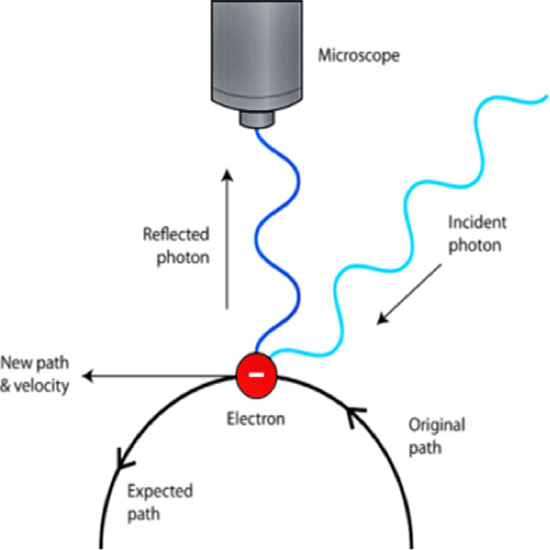
This sounds remarkably similar to one of the critical axioms of modern day quantum mechanics:
That is, the more exactly the position is determined - from human perspective - the less known the momentum, and vice versa.
By observation and participation, we humans stamp
our sense of "order" onto it, and it is thus a random universe to
which we bring meaning.
While I don't believe Hermotimus had anything
like quantum mechanics in mind (he was likely presaging
Aristotle's "Unmoved Mover" in cosmology - a Creator, or First Cause
in creation), he was definitely "on to something."
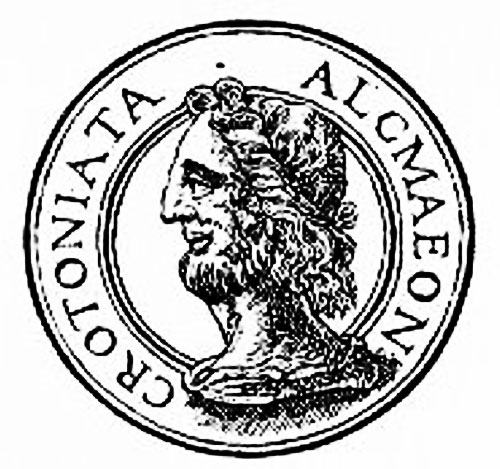
Alcmeon of
Croton
While none of his works is extant, we have comments from Aristotle and Theophrastus to enlighten us.
While traditionally medicine was wed to
philosophy and religion, it took a dramatic turn in the sixth
century BC.
Alcemeon of Croton
Instead, Alcmeon looked at the individual and wanted identifiable facts:
He introduced his doctrine of physical equilibrium (isonomia) to define and explain the state of health in the patient.
Alcmeon performed detailed physiological investigations of the different senses in order to explore the actual causes of the sensations and symptoms presented.
Moreover, he thought that the human body should be "in balance" in a healthy person.
Four aspects, or "powers," of cold, hot, wet, and dry should naturally be in balance in the human body. If any of them gets out of whack, problems present. While primitive, this "four humors" pathology persisted well into the Middle Ages...
And remember - physicians were blood-letting
routinely as recently as two centuries ago!
His efforts to focus on empirical data, with a
mind to keep the patient in equilibrium, were seminal in the advance
of the medicine of his era.
He was influenced by Anaxagoras' doctrine of Mind, and was indebted to the atomists' view that coming to be and passing away were caused by the mixing or separating of elements of the same kind.
Following Anaximenes, he proposed the physical theory that all things in the world are modifications (heteroioseis) of the same basic stuff:
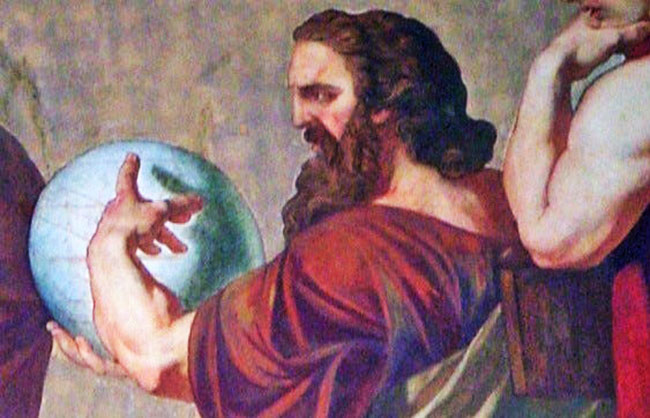
Portrayal of Anaxagoras
To deny these considerations would be equivalent, Diogenes thought, to ignoring the ways in which things mix, or help or harm each other, as well as the way things depend on each other (as in water to a plant, or any living thing breathing air).
It would be tantamount to overlooking the
balance, measure, and intelligible structure that characterize every
aspect of nature.
It is the most versatile and adaptable substance. Its capacity to manifest itself in a wide variety of forms, and under every conceivable condition - hot, cold, wet (humidity, vapor), and dry - is evidence of its rationality and divinity.
To the extent that,
Diogenes, in his time, was working in a period of transition in Greek thought.
He attempted to reconcile ancient insights with
new discoveries and bring pre-Socratic speculations inline with the
systematic details of biological and natural observation.
He speculated that had they been allowed to continue to flourish, we as a human species would have become a space faring civilization centuries before the modern era.
And the bedrock of their scientific and
philosophical ideas and speculations was formed by the
pre-Socratics...
|