|
Turning away from reality does not serve anyone.
But there is a profound difference between being informed and being immersed.
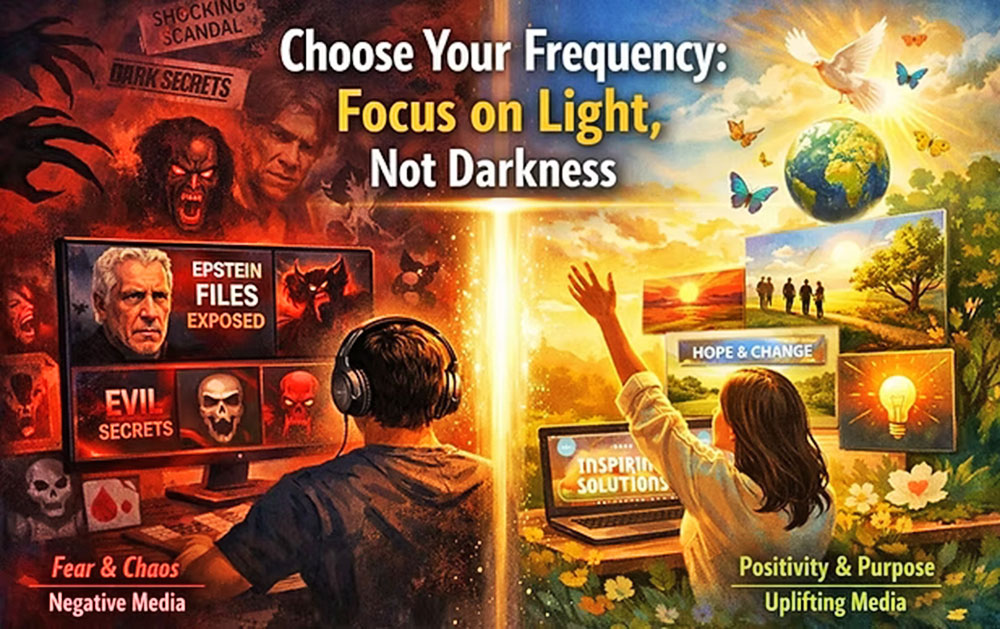
In today's digital ecosystem, especially on platforms like YouTube, many content creators capitalize on major events, such as the release of the Epstein files or other high-profile scandals, to generate traffic and grow their audiences.
Instead of sober analysis or constructive dialogue, what often emerges is a flood of sensationalized content:
This is not accidental. Shock sells. Fear spreads. Outrage clicks...
But at what cost?
Visual input directly influences our emotional state because images activate the amygdala, the brain's threat-detection center, often before the rational mind has time to interpret what we are seeing.
When we repeatedly expose ourselves to disturbing iconographies such as aggressive faces, violent symbols, demonic imagery, graphic details, we activate stress responses.
Neuroscience shows that repeated exposure to emotionally charged content strengthens neural pathways associated with those emotions.
This is a function of neuroplasticity...:
When we continually consume outrage, fear, and darkness, we reinforce those emotional circuits.
Over time, this can lead to heightened anxiety, increased cynicism, emotional desensitization and a skewed perception that the world is overwhelmingly dark.
When people speak of "dark frequencies" or "quantum resonance," they are often using metaphorical language to describe something very real:
While the term "quantum resonance" is not used in neuroscience to describe image perception, the metaphor points to an observable phenomenon:
Research in psychology shows that emotions are contagious.
In practical terms:
That alignment is "tuning into a frequency."
It is biological:
YouTube's algorithm 'rewards' engagement.
Strong emotional reactions, especially outrage and fear, generate comments, shares, and watch time.
But this creates a feedback loop.
What begins as "staying informed" can easily slide into obsession with the grotesque.
And here lies the danger:
the frequencies that our mind broadcasts into the ether.
our thoughts have the power to re-write the holographic matrix of reality.
We can read balanced reporting instead of watching sensationalized commentary, limit exposure time, avoid graphic or emotionally manipulative imagery, refuse to click on thumbnails designed to shock.
The question is not whether darkness exists - it does...!
The question is whether we must repeatedly
rehearse it in our minds...
Research in neuroplasticity and positive psychology shows that,
Studies on compassion, gratitude and positive visualization demonstrate that intentionally focusing on positive stimuli strengthens neural circuits linked to well-being.
Even brief daily exposure to calming or inspiring imagery can shift mood and perception over time.
In other words,
If we fill our visual field with beauty, creativity, light, and solutions-oriented action, we cultivate those internal states.
This does not deny 'reality':
Instead of endlessly dissecting dark events, we can ask:
Real change is not born from compulsive doom-scrolling. It emerges from grounded, focused, solution-oriented engagement.
Creators, too, have a responsibility.
We cannot control every event in the world, but we can control what we amplify in our own nervous system.
We do not need to tune ourselves to darkness to confront it.
In fact, we are far more effective when we are
steady, clear, and internally aligned with the world we want to
build.
but not hypnotized.
but not internalize its
vibration.
corruption, demons, predators,
or horror.
with symbols of creativity,
integrity, compassion, and light.
shapes who we become. will reflect the frequencies we choose to cultivate today.
|