|

by Olga Klimakhina
Teacher and journalist
May 20, 2026
from
Gazeta Website
translation by the RT Team
May 31, 2026
from
RT Website
Original version in Russian
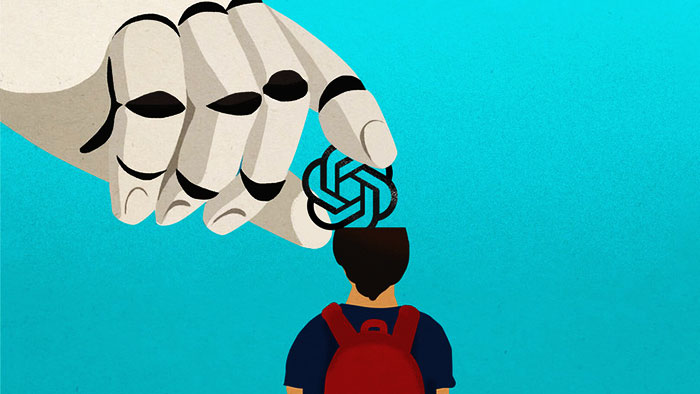
© Dasha Zaitseva / Gazeta.Ru
As
A.I.
becomes
part of everyday learning,
educators
face a growing challenge:
how to use
technology
without
weakening critical thinking...
"Would you like me to help with the other problems on the list?"
That was the sentence a physics teacher recently
found at the end of a pupil's homework assignment.
The solution itself was elegant and correct.
Unfortunately, it was not produced by the child. It was generated by
artificial intelligence and copied so carelessly that the pupil left
in the chatbot's question.
A video on this went viral because it was funny in the uneasy way
bad news can be funny.
Today's schoolchildren, it seems, are not
only forgetting how to think, but some are forgetting how to
cheat properly...
This might have remained another sad school
anecdote if President Vladimir Putin had not instructed the
State Council at around the same time to prepare proposals for
changing federal education standards and incorporating A.I. into
them.
So we are no longer discussing a toy, a novelty,
or a passing panic - we're discussing the future of Russian
education.
At first glance, ordinary citizens may think this only concerns
teachers and administrators. But the consequences won't remain
inside the classroom. They will shape the way children read, write,
argue, remember, and think.
The statistics already tell the story.
By 2025, the share of student work written
with the help of A.I. had risen from 17.8% to 24%.
Nearly a quarter of presentations, essays,
coursework, and even dissertations are now being produced with
A.I. assistance.
Among school pupils, the scale is greater still:
29% of Russian pupils admit they use A.I.
tools to do homework, while 23% use them out of boredom, as a
substitute for real conversation...
And those are the ones who admit it.
Teachers don't need surveys, because we see the problem every day. I
once had a pupil who wrote excellent essays at home but consistently
failed creative assignments in class. His homework passed
anti-plagiarism checks perfectly, and I couldn't accuse him without
proof.
The Russian language Unified State Exam
settled the matter, as when he was deprived of his digital
ghostwriter, he suffered a complete fiasco.
His supposed literary ability belonged to a
neural network...
If we don't stop and think seriously about this
uncontrolled integration of A.I. into education, the future looks
bleak.
The risks identified by teachers and experts are real.
In surveys,
-
36% of respondents say they fear reduced
mental effort will damage children's development
-
31% worry about the decline of
face-to-face interaction
-
27% fear a collapse in motivation and the
rise of catastrophic laziness
This is the central danger because
A.I. doesn't merely help a
child avoid effort,
it can imitate effort.
It can produce the appearance of thought and
even personality.
A bad essay written by a child is still a human
document as it contains errors, awkwardness, effort, fear, ambition,
and sometimes buried inside, a living voice.
A polished A.I. essay might contain none of
this...
It pioneer Natalya Kaspersky has said we
risk raising,
"a generation of complete idiots"...
You might not like the harshness of her words,
but there's a grain of truth in them.
If a child today cannot even thoughtfully rewrite
an answer produced by a machine,
what will happen in two or three years?
Will our children still write and formulate
thoughts of their own, or will they outsource these basic human
acts to an algorithm?
Still, pretending we can simply ban A.I. from the
classroom would be childish, and burying your head in the sand never
works. Nor does fanatically opposing innovation.
Those who try to keep technology out of school
entirely will lose, and the only serious answer is to teach children
how to use A.I. intelligently, without surrendering their own
minds to it.
A.I. can already help teachers.
It can prepare tests and presentations and
reduce the routine workload that consumes so much of a teacher's
time.
It can analyze written work and identify
recurring errors across many texts.
While this doesn't replace the teacher's
judgment, it does support it, and used properly, A.I. can become a
useful tool rather than a cheat sheet.
The problem is that neither teachers nor pupils have yet been
properly taught how to use this tool.
I remember how my parents, who were programmers, feared that
calculators would destroy mathematical thinking. In the end,
calculators destroyed nothing in those who had first learned to
count, and they freed the brain instead for more complex work - but
only after the basic skill was formed.
This is the principle we must apply to A.I.:
Children must first learn to think, read,
write, argue, doubt, calculate, and express themselves, and only
then should the neural network become an additional layer of
intellect.
What can a teacher or parent give a child that no
neural network can provide?
The answer is simple and old-fashioned:
Living human contact and real
conversation...!
The spark of shared thought and the
discipline of disagreement.
Emotion that hasn't been simulated.
Even the most advanced A.I. can't feel anything.
But it can imitate feelings, and a lonely child might accept this
imitation if nothing better is available.
Are teachers to blame?
Only partly, but as long as Russia remains
desperately short of teachers, neural networks will remain the most
accessible 'tutor' for many families.
For parents, they are convenient; for pupils,
they are obedient.
For administrators, they create the illusion
of improved results.
That's why the issue can't be resolved by
scolding children or laughing at them for copying chatbot replies.
If we don't restore the authority of the teacher,
reduce bureaucracy, fill staff shortages, and teach both adults and
children how to work with A.I. honestly, then the machine will take
the place of thought.
And our children will continue typing 'essay on the topic' into a
search bar, while the neural network politely finishes their
education with the same fatal question:
'Would you like me to help with anything
else?'
|
