|

by John Matson
November 13, 2008
from
ScientificAmerican Website
Two groups of researchers searching for
extrasolar planets—planets orbiting
stars other than our own sun—laid claim today to an astronomy
milestone:
photographing extrasolar planets directly, rather than
inferring their presence through
effects on their parent stars.

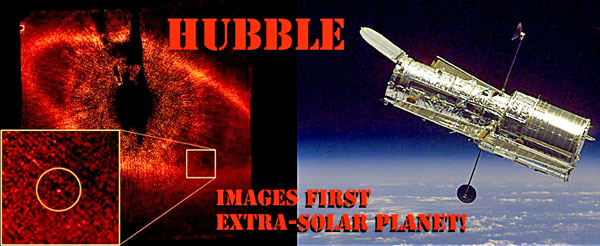
A team led by astronomer Paul Kalas of the University of
California, Berkeley, detected a planetary candidate orbiting
Fomalhaut, a star 25 light-years away in the constellation Pisces Australis (the Southern Fish), using visible-light observations from
the Hubble Space Telescope.
Another group, led by astronomer
Christian Marois of the Herzberg Institute of Astrophysics
in Victoria, British Columbia, used infrared to image a family of
three planets orbiting HR 8799, a star nearly 130 light-years
distant. (Marois was also a member of Kalas's group.)
Both teams report their findings online
today in the journal Science.

MOVING RIGHT ALONG:
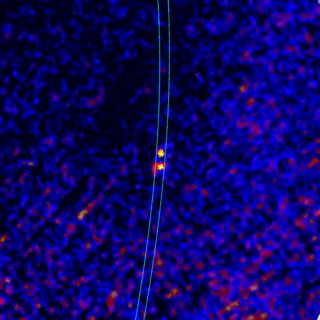
The first visible-light image of what appears to be a planet
orbiting the star Fomalhaut, 25 light-years away.
In this composite,
the object's position in 2004 [below] and in 2006 [above] follows
its projected counterclockwise orbit [green lines].
Courtesy of Paul Kalas, University of California, Berkeley
Of the more than 300
other known
exoplanets (see below insert), all have been detected indirectly by
their effects on their parent stars—either a wobble in induced by
the object's orbit or a decrease in detected light from the star as
the planet passes in front of it.
Other photographed objects have been too
massive to be conclusively labeled planets, falling instead into the
brown dwarf category (objects about eight to 80 Jupiters in size
that lack sufficient mass to ignite hydrogen fusion in their cores,
thereby never becoming true stars), have been found to themselves
orbit brown dwarfs rather than stars or have not been shown to be
gravitationally bound to a star.
"Finally, we now have separate
images where you can see, actually see, the planet," says
astronomer Mark Marley of the NASA Ames Research Center
at Moffett Field, Calif., who did not participate in the
research but wrote an article for Science summarizing and
analyzing the teams' results.
(Marley commented for SciAm.com as
a scientist in the field, not as a representative of NASA.)
"I've been using the analogy," he
says, that "it's like you're in an apartment building and you
can hear the people in the next apartment through the walls, so
you know they're in there, but now you have opened the door and
you can see the people."
Kalas and two of his co-authors,
astronomy professor James Graham of U.C. Berkeley and astrophysicist
Mark Clampin of the NASA Goddard Space Flight Center in
Greenbelt, Md., had ventured in 2005 that
Fomalhaut should harbor
planet-size objects in its orbit, based on the disk of dust ringing
the star.
"At that time we hypothesized that
there should be a planet shaping the ring," Kalas says.
By looking at Hubble images from 2004
and 2006, Kalas and his colleagues were able to track a speck,
dubbed Fomalhaut b, inside that ring that seemed to be orbiting the
star.
"When you look at Fomalhaut b, its
location is consistent with where we expected to find a planet,
interior to the dust ring, and it shows orbital motion—and
that's also encouraging," he says. "If this speck of dust had
moved in a different direction between 2004 and 2006, we
wouldn't believe that it was associated with Fomalhaut."

An artist's
impression of Fomalhaut b
Fomalhaut b is significant for
its small size, estimated to be between the mass of Neptune and
three times the mass of Jupiter, which would place it squarely in
the realm of planets.
An object larger than about 13
Jupiter-masses is considered a small brown dwarf rather than a large
planet.
"The upper bound to Fomalhaut b is
unprecedented," Kalas says. "Our upper bound definitively
excludes that Fomalhaut b is a brown dwarf or a star."
The planet, he says, "can't possibly be
more than three Jupiter-masses," because a more massive object would
clear its gravitational sphere of debris, meaning that the dust belt
would have to be farther away than it is.
Marley notes that Kalas and his colleagues saw the exoplanet at two
different wavelengths from Hubble, but attempts to see it from the
ground failed.
As a result, they lacked data points describing the
object and, so, still had to make some inferences about it.
"If you look at the other exoplanet
discoveries, or shall I say the other candidate exoplanets found
by ground-based observations, the contrast [between them and
their stars] is a factor of 10,000 or 100,000," Kalas says.
"The contrast between Fomalhaut b
and the central star is 100 million. And it's impossible to get
this from the ground" in visible wavelengths. "Our selection is
fairly rigorous and conservative. There may be specks in there
that are also planets, but we've not been able to confirm them
as such. Fomalhaut b is the most rigorously tested."
Marois and his team used ground-based
infrared detection to seek out exoplanets around nearby, young,
massive stars - those whose planets would have wide orbits and emit
significant amounts of radiation as they cool from their relatively
recent births millions of years ago.
After narrowing some 80 candidate stars
to 20 "really, really interesting" ones with infrared excess
(indicating the presence of orbiting dust), the researchers settled
on a particularly appealing star.
"For
HR 8799, the infrared excess
was consistent with dust orbiting at around 80 astronomical
units," or roughly 80 times the distance from the Earth to the
sun (7.4 billion miles, or 11.9 billion kilometers), Marois
says.
"And that's usually a sign of planet
formation, the residue of the planet formation. So that's
usually a very good sign."
By comparing data captured by various
telescopes in 2004, 2007 and this year, Marois's group selected
three objects, all estimated to be below the brown dwarf threshold,
orbiting HR 8799.
"These are the first images of a
multiplanet system, but these are as well the first detections
of planets at separations that are similar to the outer planets
of our own solar system," Marois says.
The innermost exoplanet around
HR 8799
has an orbit that would place it between Uranus and Neptune in our
solar system. (Fomalhaut b, by contrast, orbits at nearly twice the
distance of the farthest-flung planet around HR 8799, albeit around
a larger star.)
"Kepler himself would recognize
these as planets," Marley says, referring to the German
astronomer Johannes Kepler, who formalized his laws of planetary
motion in the 17th century.
"You can see the planets in close to
circular orbits, you can see them moving, and this system also
has a dust disk, as people now believe our own solar system out
beyond the orbit of Neptune has."
Marley acknowledges that the exact mass
of the objects could be called into question, even pushing two of
the masses into the realm of brown dwarfs, but does not view that
uncertainty as a deal-breaker given the magnitude of the discovery.
Further characterization of the objects from both groups will
enhance astronomers' understanding of star and planet formation.
Toward that end, Kalas is awaiting the repair of the Hubble's Space
Telescope Imaging Spectrograph, which failed in 2004, to give a more
detailed look at Fomalhaut b. Hubble could also help confirm the exoplanet's status next year by photographing it farther along its
predicted orbital path.
As for Marois,
"there are actually two other
objects that we're tracking" around another star, he says.
"We're not sure if these are background objects or planets, so
we're going to be confirming these next summer."
UPDATE: listen below, to a podcast about the exoplanet
discoveries
Multiple Planets Caught Orbiting Distant Star
by Cynthia Graber
November 17, 2008
from
ScientificAmerican Website
Using a technique called adaptive optics,
astronomers were able to produce the first image
of an entire solar system far from ours.
The following is an exact transcript of
this podcast:
Science fiction is filled with
stories of planets circling distant stars. Now astronomers have
produced the first image of multiple planets circling a star
that’s not our sun. The planets are five to thirteen times more
massive than Jupiter. And their order by size mimics our own
solar system. The discovery is in the November 14th issue of the
journal Science.
Astronomers faced a big challenge finding those planets:
telescopes can’t just catch a planet in orbit. So a common
method is to determine the planets’ gravitational pull on their
home star. But that only works for planets whose orbit is
relatively close to their sun.
Newer procedures measure infrared
radiation from recently formed planets. And a technique called
adaptive optics is also used to create images of planets. It
corrects for the fact that the glare of the home star makes
nearby planets difficult to see. It was adaptive optics that
made the new solar system visible to us.
In other world news, a planet’s been found orbiting the
star Fomalhaut, just 25
light-years from earth.
Next year they’ll find out who gets
elected President, Reagan or Mondale.
|