|

by Oliver Nichelson
1991
Reprinted from: ExtraOrdinary
Technology
(Volume 4, Issue 2; Apr/May/Jun 2006)
from
TeslaTech Website
|
In the 1880's, Nikola
Tesla invented the alternating current system we use
today. By the 1890's, he was working on a new type of
electrical generator that would not "consume any fuel."
This paper documents where in his writings the
description of this new generator is found, a theory of
how a fuelless generator could work and a suggestion as
to how Tesla's new device might have operated.
ABSTRACT
Ten years after patenting a successful method for producing
alternating current, Nikola Tesla claimed the invention of an
electrical generator that would not "consume any fuel." Such a
generator would be its own prime mover.
Two of Tesla's devices representing
different stages in the development of such a generator are
identified. |
INTRODUCTION
While in college Nikola Tesla claimed it should be possible to
operate an electrical motor without sparking brushes. He was told by
the professor that such a motor would require perpetual motion and
was therefore impossible. In the 1880's he patented the alternating
current generator, motor, and transformer.
During the 1890's he intensively investigated other methods of power
generation including a charged particle collector patented in 1901.
When the New York Times in June of 1902 carried a story about an
inventor who claimed an electrical generator not requiring a prime
mover in the form of an external fuel supply, Tesla wrote a friend
that he had already invented such a device.
Fuelless electrical generation raises
the same objection of perpetual motion as did the generator in use
today when it was first proposed. Research Nikola Tesla carried out
during his second creative period and the resulting devices that
were the basis for his assertion of fuelless electrical generation
will be examined.
Whether Tesla's fuelless generator was a
"perpetual motion scheme" of the sort his teacher warned him
against, or a creative application of recognized natural phenomena
will be discussed.
TESLA'S
STATEMENTS
In The Brooklyn Eagle, Tesla announced, on July 10th, 1931, that,
"I
have harnessed the cosmic rays and caused them to operate a motive
device."
Later on in the same article he said that,
"More than 25
years ago I began my efforts to harness the cosmic rays and I can
now state that I have succeeded."
In 1933, he made the same
assertion in an article for the New York American, November 1st,
under the lead in "Device to Harness Cosmic Energy Claimed by
Tesla."
Here he said:
This new power for the driving of the world's machinery will be
derived from the energy which operates the universe, the cosmic
energy, whose central source for the earth is the sun and which is
everywhere present in unlimited quantities.
Dating back "more than 25 years ago" from 1933 would mean that the
device Tesla was speaking about must have been built before 1908.
More precise information is available through his correspondence in
the Columbia University Library's collection. Writing on June 10th,
1902 to his friend Robert U. Johnson, editor of Century Magazine,
Tesla included a clipping from the previous day's New York Herald
about a Clemente Figueras, a "woods and forest engineer" in Las
Palmas, capital of the Canary Islands, who had invented a device for
generating electricity without
burning fuel.
What became of Figueras and his fuelless generator is
not known, but this announcement in the paper prompted Tesla, in his
letter to Johnson, to claim he had already developed such a device
and had revealed the underlying physical laws.
IDENTIFYING
THE INVENTION
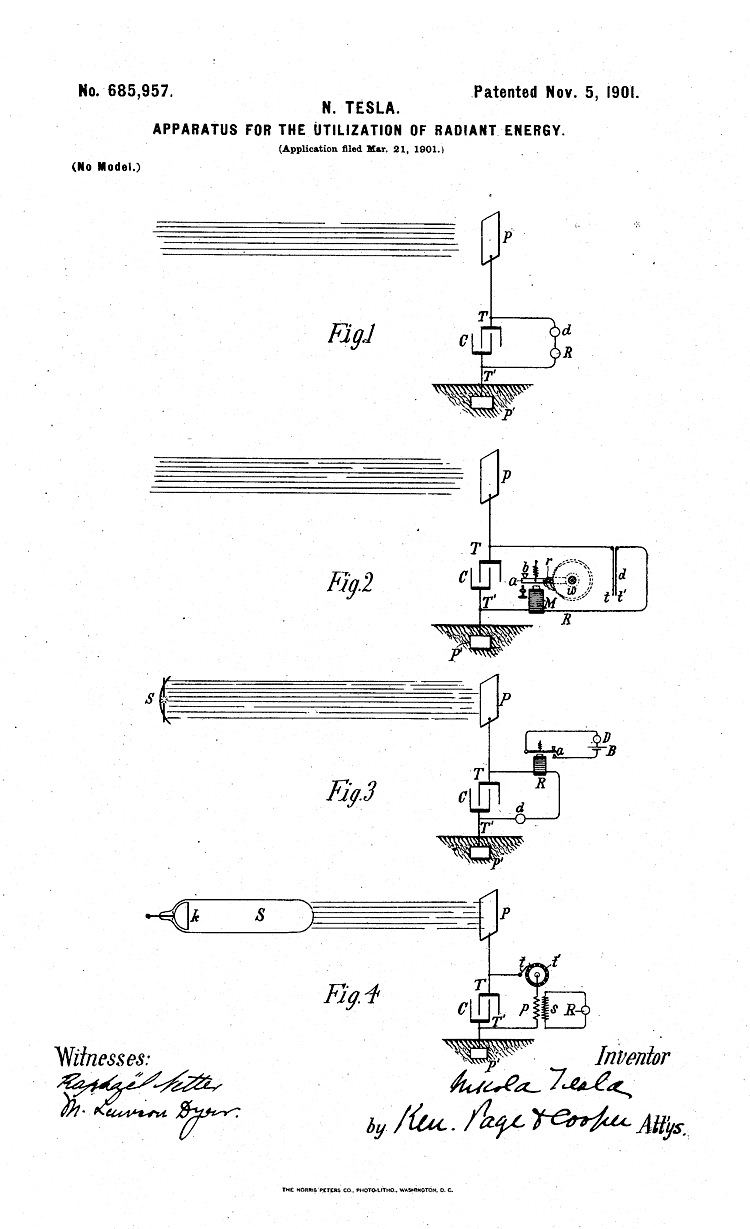
The device that, at first, seems to best fit this description is
found in Tesla's patent for an "Apparatus for the Utilization of
Radiant Energy,"
number 685,957, that was filed for on March 21,
1901 and granted on November 5, 1901.
The concept behind the older
technical language is a simple one.

US Patent 685,957
Apparatus For The Utilization of Radiant Energy
Nikola Tesla - November 5, 1901
An insulated metal plate is put as high
as possible into the air.
Another metal plate is put into the
ground. A wire is run from the metal plate to one side of a
capacitor and a second wire goes from the ground plate to the other
side of the capacitor.
Then:
The sun, as well as other sources of
radiant energy, throw off minute particles of matter positively
electrified, which, impinging upon [the upper] plate,
communicate continuously an electrical charge to the same. The
opposite terminal of the condenser being connected to ground,
which may be considered as a vast reservoir of negative
electricity, a feeble current flows continuously into the
condenser and inasmuch as the particles are ... charged to a
very high potential, this charging of the condenser may
continue, as I have actually observed, almost indefinitely, even
to the point of rupturing the dielectric. (1)
This seems like a very straightforward
design and would seem to fulfill his claim for having developed a
fuelless generator powered by cosmic rays, but in 1900 Tesla wrote
what he considered his most important article in which he describes
a self-activating machine that would draw power from the ambient
medium, a fuelless generator, that is different from his Radiant
Energy Device.
Entitled "The
Problem of Increasing Human Energy - With Special References to The
Harnessing of The Sun's Energy", it was published by his
friend Robert Johnson in The Century Illustrated Monthly Magazine
for June 1900 soon after Tesla returned from
Colorado Springs where
he had carried out an intensive series of experiments from June 1899
until January of 1900.
The exact title of the chapter where he discusses this device is
worth giving in its entirety:
A DEPARTURE FROM KNOWN METHODS -
POSSIBILITY OF A "SELF ACTING" ENGINE OR MACHINE, INANIMATE, YET
CAPABLE, LIKE AN LIVING BEING, OF DERIVING ENERGY FROM THE
MEDIUM - THE IDEAL WAY OF OBTAINING MOTIVE POWER
Tesla stated he first started thinking
about the idea when he read a statement by Lord Kelvin who said it
was impossible to build a mechanism capable of abstracting heat from
the surrounding medium and to operate by that heat. As a thought
experiment Tesla envisioned a very long bundle of metal rods,
extending from the earth to outer space. The earth is warmer than
outer space so heat would be conducted up the bars along with an
electric current. Then, all that would be needed is a very long
power cord to connect the two ends of the metal bars to a motor.
The motor would continue running until
the earth was cooled to the temperature of outer space.
"This would be an inanimate engine
which, to all evidence, would be cooling a portion of the medium
below the temperature of the surrounding, and operating by the
heat abstracted(2)," that is, it would produce energy directly
from the environment without "the consumption of any material."
Tesla goes on in the article to describe
how he worked on the development of such an energy device, and here
it takes a bit of detective work to focus on which of his inventions
he meant. He wrote that he first started thinking about deriving
energy directly from the environment when he was in Paris during
1883, but that he was unable to do much with the idea for several
years due to the commercial introduction of his alternating current
generators and motors.
It was not "until 1889 when I again took
up the idea of the self-acting machine(3)."
THE TURBINE
He quickly came to realize that an ordinary electrical machine, like
his generator, would not be able to directly extract energy from the
cosmos and turned his efforts to what he called a "turbine" design.
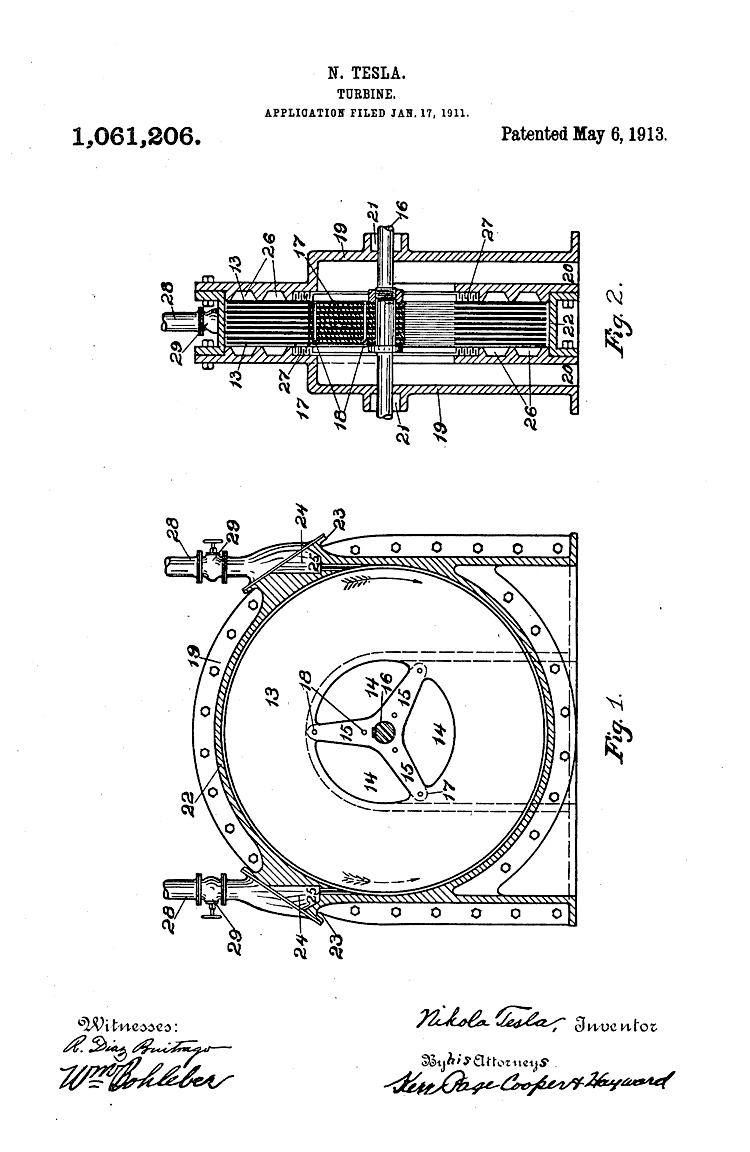
The best known turbine, that is, water pump, associated with Tesla
is his patent for such a device,
#1,061,206 (click below image), which was filed for in
1909 and granted in 1913. The unique point about this water pump is
that instead of using some form of paddle wheels inside a box to
move the water, he discovered that more water could be moved faster
by using a set of flat metal disks.

The turbine is, in itself, fascinating
and may yet prove to be another important overlooked invention, but
what is of concern regarding the electrical design is the general
shape of the turbine - metal disks turning inside a supporting box.
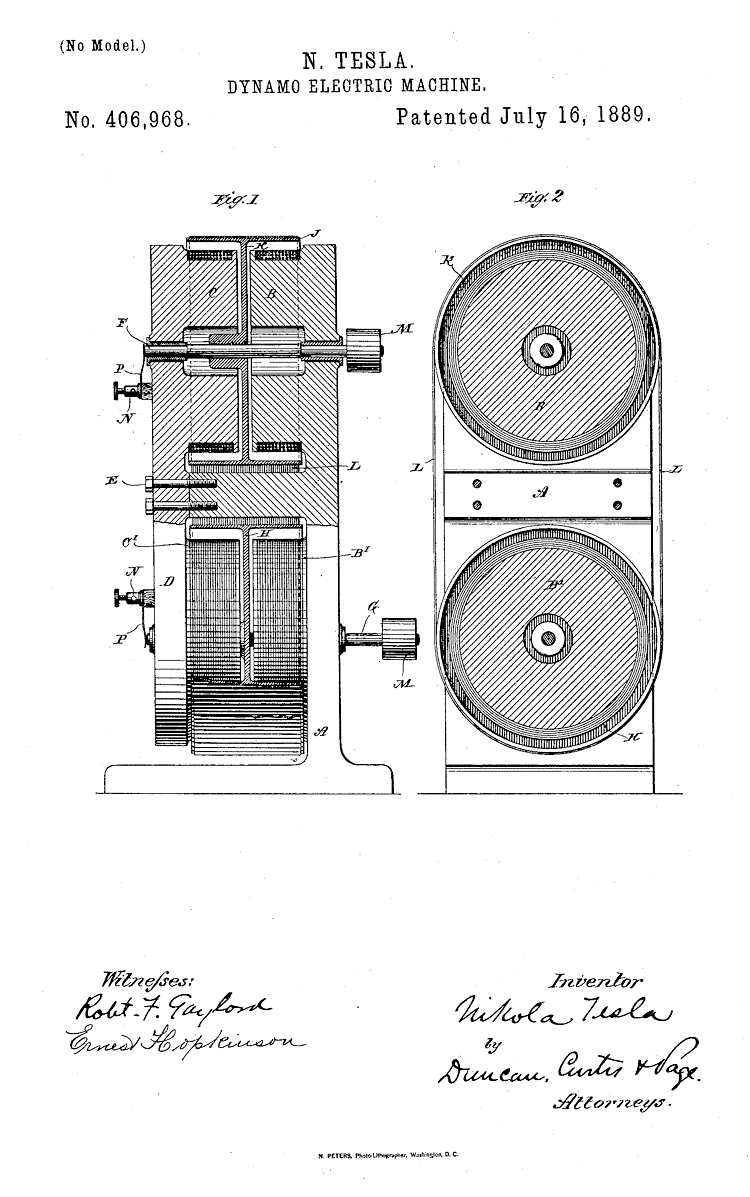
This same shape turns up in another
patent, this one for a "Dynamo-Electric Machine" - click
below image. This patent was
filed and granted in the same year that Tesla said he returned to
work on the "self-activating" machine, in 1889.
The dynamo consists
of metal disks that are rotated between magnets to produce an
electric current.

US Patent 406,968
Dynamo Electric Machine
Nikola Tesla - July 16, 1889.
Compared to his alternating current generator, this "dynamo"
represents something of a curious throwback to the days of Faraday's
early experiments with a copper disk and a magnet. Tesla makes some
improvement over the Faraday setup by using magnets that completely
cover the spinning metal disks and he also adds a flange to the
outside of the disks so current can be taken off more easily - all
of which makes for a better generator than Faraday's.
On the surface, though, it is hard to
see why Tesla patented such an anachronistic machine at this point
in his work.
The next piece of the puzzle is found in an article Tesla wrote for
The Electrical Engineer in 1891 entitled "Notes on a Unipolar
Dynamo." Here Tesla presents an in-depth analysis of the Faraday
disk generator, explains why it was an inefficient generator,
describes his improved variations on the Faraday machine, and, at
the bottom of the third page of the article, states that he has
devised a generator in which,
"the current, once started, may then
be sufficient to maintain itself and even increase in
strength(4)."
Then, at the close of the article, he states that,
"several machines ... were constructed by the writer two years
ago ..."(5)
Two years before the writing of that
article was 1889. All the evidence points to the turbine-shaped Unipolar Dynamo as being Tesla's first design for a machine that can
continue to produce electricity after being disconnected from an
outside source of power.
SELF-SUSTAINING CURRENT
Before going into the details of this invention it would be
worthwhile to have an idea of how any generator, even in theory,
could be capable of producing a self-sustaining current.
This has
been clearly explained by Walter M. Elsasser in a Scientific
American article (May 1958) titled "The Earth as a Dynamo."

Faraday Generator
with electromagnet.
Elsasser models the earth-dynamo,
conveniently for this explanation, on the Faraday generator of a
metal disk spinning over a bar magnet placed at the edge of the
disk. He notes, also, that the bar magnet could be replaced by an
electromagnet which could get its power from the spinning disk by
attaching one end of the electromagnet's wire to the outside of the
disk and the other end of the wire to the metal rod running through
the center of the disk.
Elsasser then points out that an ordinary disk generator,
"could not
maintain a current for very long because the current induced in the
disk is so weak that it would soon be dissipated by the resistance
of the conductor [the disk]."
This conventional arrangement would
not be an answer to "how currents could be built up and perpetuated
to maintain the earth's magnetic field." He does, though, propose
three options in the dynamo model that would explain the earth's
persistent magnetism.
If we had a material that could conduct electricity a thousand times
better than copper, the system would indeed yield a self-sustaining
current. We could also make it work by spinning the disk very
fast... a third way we could make such a dynamo self-sustaining ...
is to increase the size of the system: theory says that the bigger
we make such a dynamo, the better it will function. If we could
build a coil-and-disk apparatus of this kind of scale of many miles,
we would have no difficulty in making the currents
self-sustaining.(6)
Tesla did not have a material a thousand times more conductive than
copper, neither was he able to spin a disk at the ultra-high speeds
needed to produce such a current, nor did he plan on using a piece
of rotating metal several miles in diameter.
What he did was to use energy that is
usually wasted in a generator and turn it into a source of power.
UNIPOLAR
DYNAMO
Tesla's design varied from that of Faraday in two major ways.
-
First,
he used a magnet that was bigger in diameter than the disk so that
the magnet completely covered the disk.
-
Second, he divided the disk
into sections with spiral curves radiating out from the center to
the outside edge.
In the Faraday unipolar generator "the current," as Tesla noted,
"set up will therefore not wholly
pass through the external circuit ... and ... by far the greater
portion of the current generated will not appear
externally..."(7)

Tesla’s modifications
to the basic Faraday Generator also known as a unipolar generator.
By having the magnet completely cover
the disk, Tesla made use of the whole disk surface in current
generation instead of only a small section directly adjacent to the
bar magnet, as happened in the Faraday device.
This not only increases the amount of
current generated, but, by making the current travel from the center
to the outside edge, makes all of that current accessible to the
external circuit.
Eliminating the Back
EMF
More importantly, these modifications on
the Faraday design eliminated one of the biggest problems in any
physical system - the reaction to every action. It is this reaction
that works to cancel out whatever effort goes into causing the
original action. In an electrical system if there are two turns of
wire wound next to each other and a current is sent through the
wire, the current passing through the first loop will set up a
magnetic field that will work against the current passing through
the second loop.
The spiral divisions in the disk cause the current to travel the
full radius of the disk or, as in his alternative version of the
generator, to make a full trip around the outside edge of the disk.
Because the current is flowing in a large circle at the rim of the
disk, the magnetic field created by the current not only does not
work against the field magnet above the circular plate, as in
conventional generators, but it actually reinforces the magnet. So
as the disk cuts the magnetic lines to produce a current, the
current coming off of the disk strengthens the magnet, allowing it
to produce even more current.
Like conventional direct current generators, the unipolar dynamo
also functions as a motor if current is put into the disk while
under the magnet, and this seems to be the last element that could
make the device self-sustaining, that is, capable of generating a
current after being disconnected from an outside source of movement
like falling water or steam.
Self-Running Mode of
Operation
Rotation is started by, say, a motor powered by line current. Both a
generator and a motor disk are mounted in the magnetic enclosure. As
the disks gain speed, current is produced which, in turn, reinforces
the magnets, which cause more current to be generated. That current
is, likely, first directed to the motor disk which increases the
speed of the system. At a certain point the speed of the two disks
is great enough that the magnetic field created by the current has
the strength to keep the dynamo/motor going by itself.
What process might have kept the unipolar dynamo operating after the
powered start-up is speculation at this point, however two features
of the generator are significant.
-
First, when a resistive load, like a
light bulb is added to the circuit, it lowers the voltage at the
center of the disk. This lower voltage at the center means that
there is a greater difference in voltage between the center and
the outside edge of the disk than there was before the light
bulb was added. As the difference between the center and the
outside increases, the dynamo works harder and makes more
current.
-
Second, yet more important, the
dynamo takes either very little, or no energy to keep going
because the current coming off the generator is doing double
duty. The current makes the bulb glow, but on its way from the
generator to the filament in the bulb, it travels a path that
adds to the momentum of the dynamo and, therefore, consumes
energy at a very low rate. The process continues , it would
seem, until heat losses in the filament equal the rotational
energy of the generator's flywheel.
In terms of Elsasser's criteria for a
self-sustaining generator, the Tesla unipolar dynamo comes closest
to satisfying the condition of a better electrical conductor. It is
not that a new material is used, but a new geometry is applied so
that the current does not create its own opposing forces. This is
similar, but not equivalent, to having a better conductor.
Whether or not the dynamo is in fact a "fuelless" generator it
appears to be an ingenious feat of engineering that takes one of the
basic principles of nature, an equal and opposite action for every
action, and turns it, by the use of a novel circuit geometry, into a
reaction that is additive to the original action.
Instead of the opposite reaction slowing
down the system that created it, the reaction adds energy to the
system.
An Energy Extraction
Device
Tesla, however, was not satisfied with his mechanical
self-sustaining generator. The dynamo would provide the energy to
run a single machine, but his vision was to light cities and in the
1900 Century magazine article he elaborated on the theory of such a
machine.
Imagine, he suggested, an enclosed cylinder with a small hole in it
near the bottom. Let us say that this cylinder, he added, contains
very little energy but that it is placed in an environment that has
a lot of energy. In this case, energy would flow from the outside
environment, the high energy source, through the small opening at
the bottom of the cylinder, and into the cylinder where there is
less energy.
Also suppose that as the energy passing
into the cylinder is converted into another form of energy as, for
example, heat is converted into mechanical energy in a steam engine.
If it were possible to artificially produce such a "sink" for the
energy of the ambient medium then,
"we should be enabled to get at
any point of the globe a continuous supply of energy, day and
night."(8)
He continued, in the article, to elaborate on his energy pump but
changed the image slightly. On the surface of the earth we are at a
high energy level and can imagine ourselves at the bottom of a lake
with the water surrounding us equal to the energy in the surrounding
medium. If a "sink" for the energy is to be created in the cylinder,
it is necessary to replace the water that would flow into the tank
with something much lighter than water.
This could be done by pumping the water
out of the cylinder, but when the water flowed back in, we would
only be able to perform the same amount of work with the inflowing
water as we did when it was first pumped out.
"Consequently nothing would be
gained in this double operation of first raising the water and
then letting it fall down."
Energy, though, can be converted into
different forms as it passes from a higher to a lower state.
He
said,
"assume that the water, in its passage into the tank, is
converted into something else, which may be taken out of it without
using any, or by using very little power." (9)
For example, if the
energy of the ambient medium is taken to be the water, oxygen and
hydrogen making up the water are the other forms of energy into
which it could change as it entered the cylinder.
Corresponding to this ideal case, all the water flowing into the
tank would be decomposed into oxygen and hydrogen ...and the result
would be that the water would continually flow in, and yet the tank
would remain entirely empty, the gases formed escaping.
We would
thus produce, by expending initially a certain amount of work to
create a sink for...the water to flow in, a condition enabling us to
get any amount of energy without further effort. (10)
Tesla recognized that no energy conversion system would be perfect,
some water would always get into the tank, but,
"there will be less to pump out than
flows in, or, in other words, less energy will be needed to
maintain the initial condition than is developed [by the
incoming water], and this is to say that some energy will be
gained from the medium." (11)
He found that this pumping could be done
with a piston "not connected to anything else, but was perfectly
free to vibrate at an enormous rate."(12) This he was able to do
with his "mechanical oscillator," a steam-driven engine used for
producing high frequency currents. The faster the pump would work,
the more efficient it would be at extracting energy from the cosmos.
Research along this line culminated in the oscillator demonstrated
at the Chicago World's Fair in 1893.

Tesla’s Personal
Exhibit at the 1893 Columbian Exposition Chicago, Illinois
Tesla’s expertise with alternating currents and flair for
showmanship educated the general public
and insured his
prominence in the electrical energy field.
In addition to
numerous demonstration motors, the booth was highlighted by the
infamous “Egg of Columbus”
in which a spinning
egg illustrated the rotating magnetic field.
It was not until much later, in the 1900
article, he revealed:
"On that occasion I exposed the
principles of the mechanical oscillator, but the original
purpose of this machine is explained here for the first time
(13)."
It was also in 1893 that Tesla applied
for a patent on an electrical coil that is the most likely candidate
for a non-mechanical successor of his energy extractor.
This is his
"Coil for Electro-magnets,"
patent #512,340. It is another curious
design because, unlike an ordinary coil made by turning wire on a
tube form, this one uses two wires laid next to each other on a form
but with the end of the first one connected to the beginning of the
second one.

US Patent 512,340
Coil for Electro-Magnets
Nikola Tesla - July 9, 1894
In the patent Tesla explains that this
double coil will store many times the energy of a conventional
coil.(14) Preliminary measurements of two helices of the same size
and with the same number of turns, one with a single, the other with
a bifilar winding, show differences in voltage gain(15).
In below figure, the upper curve is from the Tesla design, the lower was produced
by the single wound coil.

Preliminary measurements
of two helices of the same size and with the same number of turns,
one with a single, the
other with a bifilar winding, show differences in voltage gain.
The upper curve is from
the Tesla design, the lower was produced by the single wound coil.
The patent, however,
gives no hint of what might have been its more unusual capability.
The patent, however, gives no hint of
what might have been its more unusual capability.
Energy Conversion
In the Century article Tesla compares extracting energy from the
environment to the work of other scientists who were, at that time,
learning to condense atmospheric gases into liquids. In particular
he cited the work of a Dr. Karl Linde who had discovered what Tesla
described as a "self-cooling" method for liquefying air.
As Tesla said,
"This was the only experimental
proof which I was still wanting that energy was obtainable from
the medium in the manner contemplated by me." (16)
What ties the Linde work with Tesla's
electromagnet coil is that both of them used a double path for the
material they were working with. Linde had a compressor to pump the
air to a high pressure, let the pressure fall as it traveled through
a tube, and then used that cooled air to reduce the temperature of
the incoming air
|

Linde’s
Condenser |
by having it travel back up the first tube through
a second tube enclosing the first.(17) The already cooled air added
to the cooling process of the machine and quickly condensed the
gases to a liquid.
Tesla's intent was to condense the energy trapped between the earth
and its upper atmosphere and to turn it into an electric current. He
pictured
the sun as an immense ball of electricity, positively
charged with a potential of some 200 billion volts. The earth, on
the other hand, is charged with negative electricity. The tremendous
electrical force between these two bodies constituted, at least in
part, what he called cosmic energy. It varied from night to day and
from season to season but it is always present.
The positive particles are stopped at the ionosphere and between it
and the negative charges in the ground, a distance of 60 miles,
there is a large difference of voltage - something on the order of
360,000 volts. With the gases of the atmosphere acting as an
insulator between these two opposite stores of electrical charges,
the region between the ground and the edge of space traps a great
deal of energy. Despite the large size of the planet, it is
electrically like a capacitor which keeps positive and negative
charges apart by using a non-conducting material as an insulator.
The earth has a charge of 90,000 coulombs. With a potential of
360,000 volts, the earth constitutes a capacitor of .25 farads
(farads = coulombs/volts).(18) If the formula for calculating the
energy stored in a capacitor (E = 1/2CV2) is applied to
the earth, it turns out that the ambient medium contains 1.6 x 10¹¹
joules or 4.5 megawatt-hours of electrical energy.
In order to tap this energy storehouse Tesla had to accomplish two
things - make a "cold sink" in the ambient energy and devise a way
of making the "sink" self-pumping.
Explaining how this process might
have worked requires, again, speculation.
Such a "sink" would have to be at a lower energy state than the
surrounding medium and, for the energy to continually flow into it,
the "sink" would have to maintain the lower energy state while
meeting the power requirements of the load attached to it.
Electrical energy, watt-seconds, is a product of volts x amps x
seconds. Because the period of oscillation does not change, either
voltage or current has to be the variable in the coil's energy
equation.
In that the double wound coil maximizes the voltage difference
between its turns, it is probable that it is the current that is
minimized to produce a low energy state in the coil. For the coil to
be initially "empty" and at low energy would mean it operated at
high voltage with a small amount of charge.(19)
The coil, then, would be set into oscillation at its resonant
frequency by an external power source. During a portion of its cycle
the coil will appear to the earth's electric field as one plate of a
capacitor. As the voltage across the coil increases, the amount of
charge it can "sink" from the earth's higher energy field will
increase.
The energy taken into the coil - through the "small opening" which
appears to be the atomic structure of the conductor according to the
physics of Tesla's time - is "condensed" into positive and negative
components of current, a lower energy state relative to the
originating field.
The current is equivalent to the water converted to gases in Tesla's
description of the self-acting engine. The current would "escape"
from the "sink" into whatever load was connected across the coil.
The movement of current into the load would produce a strong
magnetic field (the stated intention of the patent) which, when it
collapsed, would, again, produce a high potential, low charge "sink"
to couple with the earth's electric field.
Because the inflowing energy performs a double function similar to
the unipolar generator, supplying current to the load and aiding the
pumping function, the system's energy expenditure in moving charge
is low, allowing the system to gain more energy from the medium than
it expends in its operation. The coil needs no extra energy from an
outside source to pump the energy it has extracted.
Energy would come directly from the sun.
A more modern view of such a device, should it prove to operate in
this theoretical manner, would be to describe it as a
self-oscillating capacitive system. Once the device is set into
oscillation, very little power is expended in driving the load.
Because it is an electrostatic oscillating system, only a small
amount of charge moves through the load per cycle, that is, the
coulomb per seconds = amps are low.
If the charge is used at a low
rate, the energy stored in the capacitive system will be turned into
heat at a slow rate enabling the oscillations to continue for a long
period of time.
With his prominent position in the world of science at the time, it
is curious why Tesla's invention was not commercialized or at least
publicized more. Economics, not science, appear to have been the
main factor. The adoption of alternating current was opposed by
powerful financiers of the period.
Michael Pupin, another leading
electrical researcher at the turn of the century, noted in his
autobiography:
...captains of industry...were
afraid that they would have to scrap some of their direct
current apparatus and the plants for manufacturing it, if the
alternating current system received any support ... ignorance
and false notions prevailed in the early nineties, because the
captains of industry paid small attention to highly trained
scientists. (20) (21)
Tesla's patents for electrical
generators and motors were granted in the late 1880's. During the
1890's the large electric power industry, in the form of
Westinghouse and General Electric, came into being. With tens of
millions of dollars invested in plants and equipment, the industry
was not about to abandon a very profitable ten year old technology
for yet another new one.
Tesla saw that profits could be made from the self-acting generator,
but somewhere along the line he had pointed out to him the negative
impact the device would have.
At the end of the section in Century
where he described his new generator he wrote:
I worked for a long time fully
convinced that the practical realization of the method of
obtaining energy from the sun would be of incalculable
industrial value, but the continued study of the subject
revealed the fact that while it will be commercially profitable
if my expectations are well founded, it will not be so to an
extraordinary degree. (22)
Years later, in 1933, he was more
pointed in his remarks about the introduction of his fuelless
generator. In the Philadelphia Public Ledger of November 2nd, is an
interview with Tesla under the headline "Tesla 'Harnesses' Cosmic
Energy."
In it he was,
"Asked whether the sudden
introduction of his principle would upset the present economic
system, Dr. Tesla replied, 'It is badly upset already.' He added
that now as never before was the time ripe for the development
of new resources."
It has been nearly a century since
Nikola Tesla claimed a radically new method for producing
electricity. The need for the development of new resources is
greater now than at the end of the last century.
Perhaps these
overlooked inventions will make his vision of "increasing human
energy through the use of the sun's energy" become a reality.
Acknowledgment
Thanks to Mr. John Ratzlaff of Millbrae, California for generously
sharing a variety of Tesla material that helped make this paper
possible.
References
-
Nikola Tesla, U.S. Patent
#685,957, "Apparatus for the Utilization of Radiant Energy,"
reproduced in Nikola Tesla: Lectures * Patents * Articles
(hereafter LPA), Tesla Museum, Beograd, 1956, reprinted by
Health Research, Mokelumne Hill, CA., p. P-344, 1973.
-
Nikola Tesla, "The
Problem of Increasing Human Energy - With Special References
to The Harnessing of The Sun's Energy",
The Century Illustrated Magazine, reprinted in LPA, p.
A-140.
-
Reference 2, p. A-142.
-
Nikola Tesla, "Notes on a
Unipolar Generator," The Electrical Engineer," N.Y., Sept.
2, 1891, reprinted in LPA, p. A-24.
-
Reference 4, p. A-26.
-
W.M. Elsasser, "The Earth as a
Dynamo," Scientific American, p. 44-48, May 1958.
-
Reference 4, p. A-23.
-
Reference 2, p. A-140.
-
Reference 2, p. A-141.
-
Reference 2, p. A-141.
-
Reference 2, p. A-141.
-
Reference 2, p. A-142.
-
Reference 2, p. A-142.
-
Nikola Tesla, U.S. Patent
#512,340, "Coil for Electro-Magnets," reprinted in LPA, pp.
P-428-429. He explains that a standard coil of 1000 turns
with a potential of 100 volts across it will have a
difference of .1 volt between turns. A similar bifilar coil
will have a potential of 50 volts between turns. In that the
stored energy is a function of the square of the voltages
the energy in the bifilar will be 502/.12 = 2500/.01 =
250,000 times greater than the standard coil.
-
Measurements were made by M.
King and O. Nichelson at Eyring, Inc., with a HP 3577A
network analyzer on 3 inch diameter coils with 43 turns each
of number 20 wire.
-
Reference 2, p. A-143.
-
Carl Linde, "Process and
Apparatus for Attaining Lowest Temperatures for Liquefying
Gases, and for Mechanically Separating Gas Mixtures," The
Engineer, pp. 485-6, Nov. 13, 1896 and p. 509, Nov. 20,
1896.
-
"The Amateur Scientist,"
Scientific American, p. 160, May 1957.
-
This resembles the electrostatic
oscillator in Tesla's wireless transmission system: Oliver
Nichelson, "The Underwater Communication System of Nikola
Tesla," 1991.
-
Michael Pupin, From Immigrant to
Inventor, Charles Scribner's Sons, N.Y., pp. 285-286, 1930.
-
Reference 2, p. A-143.
-
For others who followed Tesla
with inventions to extract energy from the ambient medium
see: Christopher Bird and Oliver Nichelson, "Nikola Tesla:
Great Scientist, Forgotten Genius," New Age, p. 36 ff, Feb.
1977.
|