|
|
|

|
extracted from Collier's Weekly, February 19, 1901
from
EarlyRadioHistory Website
THE IDEA of communicating with the inhabitants of other worlds is an old one.
But for ages it has been regarded merely as a poet's dream, forever unrealizable. And with the invention and perfection of the telescope and the ever-widening knowledge of the heavens, its hold upon our imaginations has been increased, and the scientific achievements during the latter part of the nineteenth century, together with the development of the tendency toward the nature ideal of Goethe, have intensified it to such a degree that it seems as if it were destined to become the dominating idea of the century that has just begun.
The desire to know something of our neighbors in the immense depths of space does not spring from idle curiosity nor from thirst for knowledge, but from a deeper cause, and it is a feeling firmly rooted in the heart of every human being capable of thinking at all.
Whence, then, does it come? Who knows? Who can assign limits to the subtlety of nature's influences?
Perhaps, if we could clearly perceive all the
intricate mechanism of the glorious spectacle that is continually
unfolding before us, and could, also, trace this desire to its
distant origin, we might find it in the sorrowful vibrations of the
earth which began when it parted from its celestial parent.
This argument has never appealed to me. In the solar system, there seem to be only two planets - Venus and Mars - capable of sustaining life such as ours: but this does not mean that there might not be on all of them some other forms of life. Chemical processes may be maintained without the aid of oxygen, and it is still a question whether chemical processes are absolutely necessary for the sustenance of organized beings.
My idea is that
the development of life must lead to forms of existence that will be
possible without nourishment and which will not be shackled by
consequent limitations. Why should a living being not be able to
obtain all the energy it needs for the performance of its life
functions from the environment, instead of through
consumption of food, and transforming, by a complicated process, the
energy of chemical combinations into life-sustaining energy?
Nor is it necessary to go so far in our assumptions, for we can readily conceive that, in the same degree as the atmosphere diminishes in density, moisture disappears and the planet freezes up, organic life might also undergo corresponding modifications, leading finally to forms which, according to our present ideas of life, are impossible.
I will readily admit, of course, that if there should be a sudden catastrophe of any kind all life processes might be arrested; but if the change, no matter how great, should be gradual, and occupied ages, so that the ultimate results could be intelligently foreseen, I cannot but think that reasoning beings would still find means of existence.
They would adapt themselves to their constantly changing environment.
So
I think it quite possible that in a frozen planet, such as our moon
is supposed to be, intelligent beings may still dwell,
in its interior, if not on its surface.
This might have been a valid argument formerly. It is not so now. Most of those who are enthusiastic upon the subject of interplanetary communication have reposed their faith in the light-ray as the best possible medium of such communication.
True, waves of light, owing to their immense rapidity of succession, can penetrate space more readily than waves less rapid, but a simple consideration will show that by their means an exchange of signals between this earth and its companions in the solar system is, at least now, impossible.
By way of illustration, let us suppose that a square mile of the earth's surface--the smallest area that might possibly be within reach of the best telescopic vision of other worlds--were covered with incandescent lamps, packed closely together so as to form, when illuminated, a continuous sheet of light.
It would require not less than one hundred million horse-power to light this area of lamps, and this is many times the amount of motive power now in the service of man throughout the world.
But with the novel means, proposed by myself, I can readily demonstrate that, with an expenditure not exceeding two thousand horse-power, signals can be transmitted to a planet such as Mars with as much exactness and certitude as we now send messages by wire from New York to Philadelphia.
These means are the result of long-continued
experiment and gradual improvement.
At that time I had at hand only ordinary apparatus, which I found to be ineffective, and I concentrated my attention immediately upon perfecting machines for this special purpose.
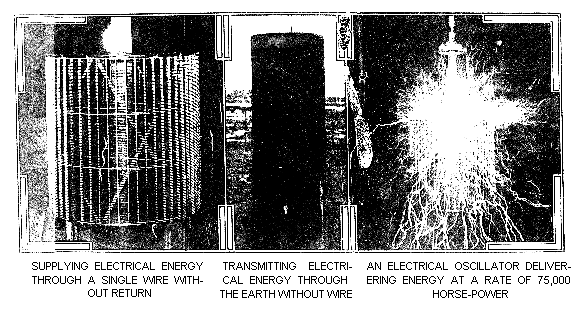
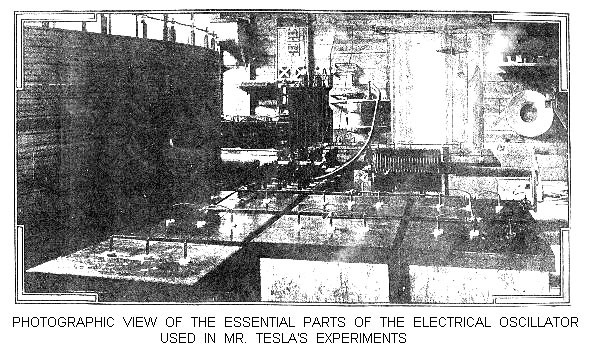
This work consumed a number of years, but I finally vanquished all difficulties and succeeded in producing a machine which, to explain its operation in plain language, resembled a pump in its action, drawing electricity from the earth and driving it back into the same at an enormous rate, thus creating ripples or disturbances which, spreading through the earth as through a wire, could be detected at great distances by carefully attuned receiving circuits.
In this manner I was able to transmit to a distance, not only feeble effects for the purposes of signaling, but considerable amounts of energy, and later discoveries I made convinced me that I shall ultimately succeed in conveying power without wires, for industrial purposes, with high economy, and to any distance, however great.
EXPERIMENTS IN COLORADO
The conditions in the pure air of the Colorado Mountains proved extremely favorable for my experiments, and the results were most gratifying to me.
I found that I could not only accomplish more work, physically and mentally, than I could in New York, but that electrical effects and changes were more readily and distinctly perceived.
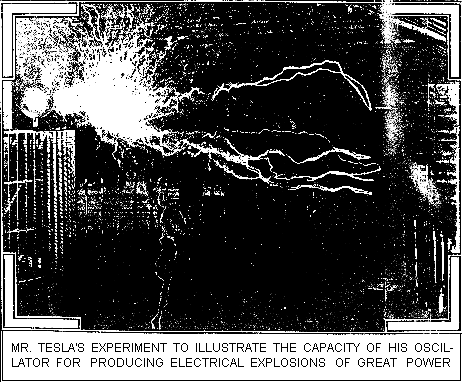
A few years ago it was virtually impossible to produce electrical sparks twenty or thirty foot long; but I produced some more than one hundred feet in length, and this without difficulty. The rates of electrical movement involved in strong induction apparatus had measured but a few hundred horse-power, and I produced electrical movements of rates of one hundred and ten thousand horse-power.
Prior to this, only insignificant electrical
pressures were obtained, while I have reached fifty million volts.
One of the immediate
consequences will be the transmission of messages without wires,
over sea or land, to an immense distance. I have already
demonstrated, by crucial tests, the practicability of signaling by
my system from one to any other point of the globe, no matter how
remote, and I shall soon convert the disbelievers.
When working with these powerful electrical oscillations the most extraordinary phenomena take place at times. Owing to some interference of the oscillations, veritable balls of fire are apt to leap out to a great distance, and if any one were within or near their paths, he would be instantly destroyed.
A machine such
as I have used could easily kill, in an instant, three hundred
thousand persons. I observed that the strain upon my assistants was
telling, and some of them could not endure the extreme tension of
the nerves. But these perils are now entirely overcome, and the
operation of such apparatus, however powerful, involves no risk
whatever.
One of the most interesting results, and also one of
great practical importance, was the development of certain
contrivances for indicating at a distance of many hundred miles an
approaching storm, its direction, speed and distance traveled. These
appliances are likely to be valuable in future meteorological
observations and surveying, and will lend themselves particularly to
many naval uses.
I had perfected the apparatus referred to so far
that from my laboratory in the Colorado mountains I
could feel the pulse of the globe, as it were, noting every
electrical change that occurred within a radius of eleven hundred
miles.
I felt as though I were present at the birth of a new knowledge or the revelation of a great truth. Even now, at times, I can vividly recall the incident, and see my apparatus as though it were actually before me.
My first
observations positively terrified me, as there was present in them
something mysterious, not to say supernatural, and I was alone in my
laboratory at night; but at that time the idea of these disturbances
being intelligently controlled signals did not yet present itself to
me.
The nature of my experiments precluded the possibility of the changes being produced by atmospheric disturbances, as has been rashly asserted by some. It was some time afterward when the thought flashed upon my mind that the disturbances I had observed might be due to an intelligent control.
Although I could not decipher their meaning, it was impossible for me to think of them as having been entirely accidental.
The feeling
is constantly growing on me that I had been the first to hear
the greeting of one planet to another. A purpose was behind
these electrical signals; and it was with this conviction
that I announced to the Red Cross Society, when it
asked me to indicate one of the great possible achievements of the
next hundred years, that it would probably be the confirmation and
interpretation of this planetary challenge to us.
I am constantly endeavoring to improve and perfect my apparatus, and
just as soon as practicable I shall again take up the thread of my
investigations at the point where I have been forced to lay it down
for a time.
Communication once established, even in the simplest way, as by a mere interchange of numbers, the progress toward more intelligible communication would be rapid.
Absolute certitude as to the receipt and interchange of messages would be reached as soon as we could respond with the number "four," say, in reply to the signal "one, two, three."
The
Martians, or the inhabitants of whatever planet had
signaled to us, would understand at once that we had caught their
message across the gulf of space and had sent back a response. To
convey a knowledge of form by such means is, while very difficult,
not impossible, and I have already found a way of doing it.
But I hope that it will also be demonstrated soon that in my experiments in the West I was not merely beholding a vision, but had caught sight of a great and profound truth.
|