
by Stephen Lendman, Laura Carlsen,
Constance Fogal
27 March 2010
VoltaireNet
Spanish version
|
The second 2009 Censored Project selection unmasks the agenda behind the
secretive Security and Prosperity Partnership of North America (SPP)
agreement,
in the works since 2005.
Its aim is to create a seamless North
American Union under U.S. control to maximize profits for its corporations
and to insure free and unlimited access to Canadian and Mexican resources,
mainly oil and water.
It is framed by a hard-core security strategy which
envisions, inter alia,
the military invasion of member countries should they
slide into "economic chaos".
- Student Researchers: Rebecca Newsome and Andrea Lochtefeld
- Faculty Evaluator: Ron Lopez, PhD
-
Stephen Lendman: he is a Research Associate of the Centre for Research on
Globalization. He lives in Chicago and can be reached at lendmanstephen@sbcglobal.net.
-
Laura Carlsen:
Director of the Americas Program of the International Relations Center
(IRC).
-
Constance Fogal:
Ex-leader of the Canadian Action Party. A lawyer and former teacher,
Constance Fogal lives in Vancouver, British Columbia. |
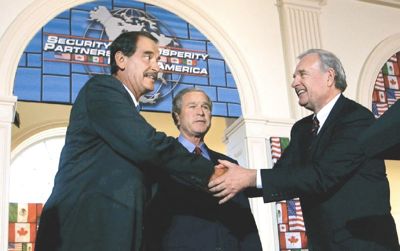
Mexican President Vincente Fox , U.S. President George W. Bush and Canadian
Prime Minister Paul Martin,
meet in Waco, Texas, on 31 March 2005 to seal
the tri-partite SPP agreement
Leaders of Canada, the US, and Mexico have been meeting to secretly expand
the North American Free Trade Agreement (NAFTA) with “deep integration” of a
more militarized tri-national Homeland Security force.
Taking shape under
the radar of the respective governments and without public knowledge or
consideration, the Security and Prosperity Partnership (SPP)
- headquartered
in Washington - aims to integrate the three nations into a single political,
economic, and security bloc.
The SPP was launched at a meeting of Presidents
George W. Bush
and Vicente
Fox, and Prime Minister Paul Martin, in Waco, Texas, on March 31, 2005.
The
official US web page describes the SPP as,
“...a White House-led
initiative among the United States and Canada and Mexico to increase
security and to enhance prosperity...”
The SPP is not a law, or a treaty,
or even a signed agreement. All these would require public debate and
participation of Congress.
The SPP was born in the “war on terror” era and reflects an inordinate
emphasis on US security as interpreted by the Department of Homeland
Security. Its accords mandate border actions, military and police training,
modernization of equipment, and adoption of new technologies, all under the
logic of the US counter-terrorism campaign.
Head of Homeland Security
Michael Chertoff, along with Secretary of State Condoleezza Rice and
Secretary of Finance Carlos Gutierrez, are the three officials charged with
attending SPP ministerial conferences.
Measures to coordinate security have pressured Mexico to militarize its
southern border. US military elements already operate inside Mexico and the
DEA and the FBI have initiated training programs for the Mexican Army (now
involved in the drug war), federal and state police, and intelligence units.
Stephen Lendman states that a Pentagon briefing paper hinted at a US
invasion if the country became destabilized or the government faced the
threat of being overthrown because of “widespread economic and social chaos”
that would jeopardize US investments, access to oil, overall trade, and
would create great numbers of immigrants heading north.
Canada’s influential Department of National Defence; its new Chief of
Defence Staff, General Rick Hillier; and Defense Minister Gordon O’Connor
are on board as well.
They’re committed to ramping up the nation’s military
spending and linking with America’s “war on terror.”
The SPP created the North American Competitiveness Council (NACC) that
serves as an official tri-national SPP working group. The group is composed
of representatives of thirty giant North American companies, including:
-
General Electric
-
Ford Motors
-
General Motors
-
Wal-Mart
-
Lockheed-Martin
-
Merck
-
Chevron
NACC’s recommendations centered on,
“private sector involvement” being “a key
step to enhancing North America’s competitive position in global markets and
is the driving force behind innovation and growth.”
The NACC stressed the
importance of establishing policies for maximum profits.
The US-guided agenda prioritizes corporate-friendly access to resources,
especially Canadian and Mexican oil and water.
The NACC’s policy states that,
“the prosperity of the United States relies heavily on a secure supply of
imported energy.”
US energy security is seen as a top priority encouraging
Canada and Mexico to allow privatization of state-run enterprises like
Mexico’s nationalized oil company, PEMEX.
In January 2008, Halliburton
signed a $683 million contract with PEMEX to drill fifty-eight new test
holes in Chiapas and Tabasco and take over maintenance of pipelines. This is
the latest of $2 billion in contracts Halliburton has received from PEMEX
during Fox’s and current Mexican president Felipe Calderone’s
administrations, which the opposition warns has become the public front for
US monopoly capital privatization. [1]
US policy seeks to insure America
gets unlimited access to Canada water as well.
Connie Fogal of Canadian Action Party says,
“The SPP is the hostile takeover
of the apparatus of democratic government... a coup d’etat over the
government operations of Canada, US and Mexico.”
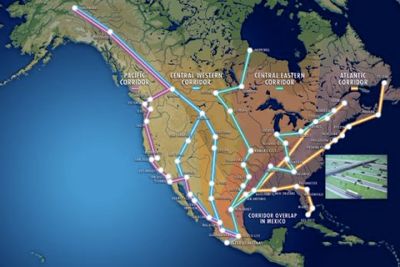
Conceptualized Version of the Final NAFTA SuperHighway
Update by Stephen Lendman
A fourth SPP summit was held in New Orleans from April 22 to 24, 2008.
George Bush, Canada’s Prime Minister Stephen Harper, and Mexico’s President
Felipe Calderon attended.
Protesters held what they called a “people’s
summit.” They were in the streets and held workshops to inform people how
destructive SPP is, strengthen networking and organizational ties against
it, maintain online information about their activities, promote efforts and
build added support, and affirm their determination to continue resisting a
hugely repressive corporate-sponsored agenda.
Opponents call the “Partnership” NAFTA on steroids. Business-friendly
opposition also exists.
The prominent Coalition to Block the North American
Union (NAU) is backed by the Conservative Caucus, which has a,
“NAU War
Room,” a “headquarters of the national campaign to expose and halt America’s
absorption into a North American Union with Canada and Mexico.”
It opposes
building “a massive, continental ‘NAFTA Superhighway.’”
This coalition has congressional allies, and on January 2007, Rep. Virgil
Goode and six co-sponsors introduced House Concurrent Resolution 40, which
expresses,
“the sense of Congress that the United States should not engage in
(building a NAFTA) Superhighway System or enter into a NAU with Mexico and
Canada.”
The April summit reaffirmed SPP’s intentions - to create a borderless North
America, dissolve national sovereignty, put corporate giants in control, and
assure big US companies most of it. It’s also to create fortress-North
America by militarizing the continent under US command.
SPP maintains a website. Its “key accomplishments” since August 2007 are
updated as of April 22, 2008. The information is too detailed for this
update, but can be accessed
here.
The website lists principles agreed to:
-
bilateral deals struck
-
negotiations
concluded
-
study assessments released
-
agreements on the “Free Flow of
Information”
-
law enforcement activities
-
efforts related to intellectual
property, border and long-haul trucking enforcement
-
import licensing
procedures
-
food and product safety issues
-
energy issues (with special
focus on oil)
-
infrastructure development
-
emergency management,
...and much
more.
It’s all laid out in deceptively understated tones to hide its
continental aim - to enable enhanced corporate exploitation with as little
public knowledge as possible.
Militarization includes the US Northern Command (NORTHCOM), established in
October 2002, which has air, land, and sea responsibility for the continent
regardless of
Posse Comitatus limitations that no longer apply or sovereign
borders that are easily erased. The Department of Homeland Security (DHS)
and its Immigration and Customs Enforcement (ICE) also have large roles.
So
does the FBI, CIA, all US spy agencies, militarized state and local police,
National Guard forces, and paramilitary mercenaries like
Blackwater
USA.
They’re headed anywhere on the continent with license to operate as freely
as in Iraq and New Orleans post-Katrina. They’ll be able to turn hemispheric
streets into versions of Baghdad and make them unfit to live on if things
come to that.
Consider other militarizing developments as well. On February 14, 2008, the
US and Canada agreed to allow American troops inside Canada. Canadians were
told nothing of this agreement, which was drafted in 2002. Neither was it
discussed in Congress or in the Canadian House of Commons.
The agreement
establishes “bilateral integration” of military command structures in areas
of immigration, law enforcement, intelligence, or whatever else the Pentagon
or Washington wishes. Overall, it’s part of the “war on terror” and
militarizing the continent to make it “safer” for business and being
prepared for any civilian opposition.
Mexico is also being targeted, with a “Plan Mexico” that was announced in
October 2007. It’s a Mexican and Central American security plan called the
Merida Initiative, supported by $1.4 billion in allocated aid. Congress will
soon vote on this initiative, likely well before this is published. It’s a
“regional security cooperation initiative” similar to Plan Colombia and
presented as an effort to fight drug trafficking.
In fact, the Merida Initiative is part of
SPP’s militarization of Mexico and
gives Washington more control of the country. Most of the aid goes to
Mexico’s military and police forces, with a major portion earmarked for US
defense contractors for equipment, training, and maintenance.
The touchy
issue of deploying US troops will be avoided by instead employing private US
security forces, i.e.,
Blackwater
and DynCorp.
Notes
[1] “Mexican Farmers Protest NAFTA Hardships,” People’s Weekly World,
February 7, 2008.
See #1 News Story selected by Project Censored in 2009: Over One Million
Iraqi Deaths Caused by US Occupation, by Michael Schwartz, Joshua Holland,
Luke Baker, Maki al-Nazzal, Dahr Jamail, Voltaire Network, 21 February 2010.
Leaders of Canada, the US, and Mexico have been meeting to secretly expand
the North American Free Trade Agreement (NAFTA) with “deep integration” of a
more militarized tri-national Homeland Security force.
Taking shape under the radar of the respective
governments and without public knowledge or consideration, the Security
and Prosperity Partnership (SPP)
- headquartered in Washington - aims to integrate the three nations into a
single political, economic, and security bloc.
The SPP was launched at a meeting of Presidents
George W. Bush and Vicente Fox, and Prime Minister
Paul Martin, in Waco, Texas, on March 31, 2005.
The official US web page describes the SPP as,
“...a White House-led initiative among the
United States and Canada and Mexico to increase security and to enhance
prosperity...”
The SPP is not a law, or a treaty, or even a
signed agreement. All these would require public debate and participation of
Congress.
The SPP was born in the “war on terror” era and reflects an inordinate
emphasis on US security as interpreted by the Department of Homeland
Security. Its accords mandate border actions, military and police training,
modernization of equipment, and adoption of new technologies, all under the
logic of the US counter-terrorism campaign.
Head of Homeland Security Michael Chertoff,
along with Secretary of State Condoleezza Rice and Secretary of
Finance Carlos Gutierrez, are the three officials charged with
attending SPP ministerial conferences.
Measures to coordinate security have pressured Mexico to militarize its
southern border. US military elements already operate inside Mexico and the
DEA and the FBI have initiated training programs for the Mexican Army (now
involved in the drug war), federal and state police, and intelligence units.
Stephen Lendman states that a Pentagon
briefing paper hinted at a US invasion if the country became destabilized or
the government faced the threat of being overthrown because of “widespread
economic and social chaos” that would jeopardize US investments, access to
oil, overall trade, and would create great numbers of immigrants heading
north.
Canada’s influential Department of National Defence; its new Chief of
Defence Staff, General Rick Hillier; and Defense Minister Gordon
O’Connor are on board as well. They’re committed to ramping up the
nation’s military spending and linking with America’s “war on terror.”
The SPP created the North American Competitiveness Council (NACC)
that serves as an official tri-national SPP working group. The group is
composed of representatives of thirty giant North American companies,
including General Electric, Ford Motors, General Motors, Wal-Mart,
Lockheed-Martin, Merck, and Chevron.
NACC’s recommendations centered on “private sector involvement” being,
“a key step to enhancing North America’s
competitive position in global markets and is the driving force behind
innovation and growth.”
The NACC stressed the importance of establishing
policies for maximum profits. The US-guided agenda prioritizes
corporate-friendly access to resources, especially Canadian and Mexican oil
and water.
The NACC’s policy states that,
“the prosperity of the United States relies
heavily on a secure supply of imported energy.”
US energy security is seen as a top priority
encouraging Canada and Mexico to allow privatization of state-run
enterprises like Mexico’s nationalized oil company, PEMEX. In January 2008,
Halliburton signed a $683 million contract with PEMEX to drill fifty-eight
new test holes in Chiapas and Tabasco and take over maintenance of
pipelines.
This is the latest of $2 billion in contracts
Halliburton has received from PEMEX during Fox’s and current Mexican
president Felipe Calderone’s administrations, which the opposition warns has
become the public front for US monopoly capital privatization.1
US policy seeks to insure America gets unlimited access to Canada water as
well.
1. “Mexican Farmers Protest NAFTA Hardships,”
People’s Weekly World, February 7, 2008.
Connie Fogal of Canadian Action Party says,
“The SPP is the hostile takeover of the
apparatus of democratic government... a coup d’etat over the government
operations of Canada, US and Mexico.”
UPDATE BY STEPHEN LENDMAN
A fourth SPP summit was held in New Orleans from April 22 to 24, 2008.
George Bush, Canada’s Prime Minister Stephen Harper,
and Mexico’s President Felipe Calderon attended. Protesters held what
they called a “people’s summit.”
They were in the streets and held workshops to
inform people how destructive SPP is, strengthen networking and
organizational ties against it, maintain online information about their
activities, promote efforts and build added support, and affirm their
determination to continue resisting a hugely repressive corporate-sponsored
agenda.
Opponents call the “Partnership” NAFTA on steroids. Business-friendly
opposition also exists. The prominent Coalition to Block the
North
American Union (NAU) is backed by the Conservative Caucus,
which has a “NAU War Room,” a,
“headquarters of the national campaign to
expose and halt America’s absorption into a North American Union with
Canada and Mexico.”
It opposes building “a massive, continental
‘NAFTA Superhighway.’”
This coalition has congressional allies, and on January 2007, Rep. Virgil
Goode and six co-sponsors introduced House Concurrent Resolution 40,
which expresses,
“the sense of Congress that the United
States should not engage in (building a NAFTA) Superhighway System or
enter into a NAU with Mexico and Canada.”
The April summit reaffirmed SPP’s intentions -
to create a borderless North America, dissolve national sovereignty, put
corporate giants in control, and assure big US companies most of it. It’s
also to create fortress-North America by militarizing the continent under US
command.
SPP maintains a website. Its “key accomplishments” since August 2007 are
updated as of April 22, 2008. The information is too detailed for this
update, but can be accessed from
this link.
The website lists principles agreed to:
-
bilateral deals struck
-
negotiations concluded
-
study assessments released; agreements
on the “Free Flow of Information”
-
law enforcement activities
-
efforts related to intellectual
property, border and long-haul trucking enforcement
-
import licensing procedures
-
food and product safety issues
-
energy issues (with special focus on
oil)
-
infrastructure development
-
emergency management,
...and much more.
It’s all laid out in deceptively understated
tones to hide its continental aim - to enable enhanced corporate
exploitation with as little public knowledge as possible.
Militarization includes the US Northern Command (NORTHCOM),
established in October 2002, which has air, land, and sea responsibility for
the continent regardless of
Posse Comitatus limitations that no longer
apply or sovereign borders that are easily erased. The Department of
Homeland Security (DHS) and its Immigration and Customs Enforcement (ICE)
also have large roles.
So does the FBI, CIA, all US spy agencies,
militarized state and local police, National Guard forces, and paramilitary
mercenaries like
Blackwater USA.
They’re headed anywhere on the continent with license to operate as freely
as in Iraq and New Orleans post-Katrina. They’ll be able to turn hemispheric
streets into versions of Baghdad and make them unfit to live on if things
come to that.
Consider other militarizing developments as well.
On February 14, 2008, the US and Canada agreed
to allow American troops inside Canada. Canadians were told nothing of this
agreement, which was drafted in 2002. Neither was it discussed in Congress
or in the Canadian House of Commons. The agreement establishes “bilateral
integration” of military command structures in areas of immigration, law
enforcement, intelligence, or whatever else the Pentagon or Washington
wishes.
Overall, it’s part of the “war
on terror” and militarizing the continent to make it “safer” for
business and being prepared for any civilian opposition.
Mexico is also being targeted, with a “Plan Mexico” that was announced in
October 2007. It’s a Mexican and Central American security plan called the
Merida Initiative, supported by $1.4 billion in allocated aid.
Congress will soon vote on this initiative, likely well before this is
published. It’s a “regional security cooperation initiative” similar to Plan
Colombia and presented as an effort to fight drug trafficking.
In fact, the Merida Initiative is part of SPP’s militarization of Mexico and
gives Washington more control of the country. Most of the aid goes to
Mexico’s military and police forces, with a major portion earmarked for US
defense contractors for equipment, training, and maintenance.
The touchy issue of deploying US troops will be
avoided by instead employing private US security forces, i.e., Blackwater
and DynCorp.