
by Terry Melanson
August 05, 2005
from
ConspiracyArchive Website
A Metaprogrammer at the Door of Chapel Perilous
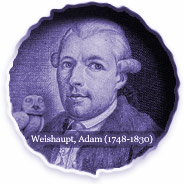 In
the literature that concerns the Illuminati relentless speculation
abounds. No other secret society in recent history - with the
exception of Freemasonry - has generated as much legend, hysteria,
and disinformation. I first became aware of the the Illuminati
about 14 years ago. In
the literature that concerns the Illuminati relentless speculation
abounds. No other secret society in recent history - with the
exception of Freemasonry - has generated as much legend, hysteria,
and disinformation. I first became aware of the the Illuminati
about 14 years ago.
Shortly thereafter I read a book, written by
Robert Anton Wilson, called
Cosmic Trigger: Final Secret of the Illuminati.
Wilson published it in 1977 but his opening remarks on the subject
still ring true today:
Briefly, the background of the Bavarian Illuminati puzzle is
this. On May 1, 1776, in Bavaria, Dr. Adam Weishaupt, a professor
of Canon Law at Ingolstadt University and a former Jesuit, formed
a secret society called the Order of the Illuminati within the
existing Masonic lodges of Germany. Since Masonry is itself a
secret society, the Illuminati was a secret society within a
secret society, a mystery inside a mystery, so to say. In 1785
the Illuminati were suppressed by the Bavarian government for
allegedly plotting to overthrow all the kings in Europe and the
Pope to boot. This much is generally agreed upon by all
historians.
1
Everything else
is a matter of heated, and sometimes fetid, controversy.
It has been claimed that Dr. Weishaupt was an atheist, a
Cabalistic magician, a rationalist, a mystic; a democrat, a
socialist, an anarchist, a fascist; a Machiavellian amoralist, an
alchemist, a totalitarian and an "enthusiastic philanthropist."
(The last was the verdict of Thomas Jefferson, by the way.) The
Illuminati have also been credited with managing the French and
American revolutions behind the scenes, taking over the world,
being the brains behind Communism, continuing underground up to
the 1970s, secretly worshipping the Devil, and mopery with intent
to gawk. Some claim that Weishaupt didn't even invent the
Illuminati, but only revived it.
The Order of Illuminati has been
traced back to the Knights Templar, to the Greek and Gnostic
initiatory cults, to Egypt, even to Atlantis. The one safe
generalization one can make is that Weishaupt's intent to
maintain secrecy has worked; no two students of Illuminology have
ever agreed totally about what the "inner secret" or purpose of
the Order actually was (or is . . .).
There is endless room for
spooky speculation, and for pedantic paranoia, once one really
gets into the literature of the subject; and there has been a
wave of sensational "ex-poses" of the Illuminati every generation
since 1776. If you were to believe all this sensational
literature, the damned Bavarian conspirators were responsible for
everything wrong with the world, including the energy crises and
the fact that you can't even get a plumber on weekends.
(pp. 3-4)
That short excerpt is perhaps the most honest and succinct
introduction to the Illuminati as you'll ever come across. So it is
more than a bit ironic that Wilson, throughout the rest of the
text, proceeds to perpetuate and expand upon similar myths, and in
the process manages to take it to a whole new level.
2 In
the end, the Illuminati had mystified Wilson as much as anyone in
the preceding centuries.
Robert Anton Wilson (RAW) is an enigma in his own right: an
archetypal Trickster in the tradition of Aleister Crowley or
Timothy Leary, both of whom he greatly admires.
3
The
Cosmic Triger
Trilogy is meant to awaken the reader to multiple mind-blowing
streams of thought and completely shatter preconceived notions of
perception, time and space - much as the writings of illuminists
themselves. Herein lies the seed of speculation to the effect that
he must surely be in on the conspiracy - some have gone so far as
to believe he's the Grand Master (or inner head) of the Illuminati
himself. Wilson has always toyed with the accusations, and in
typical RAW fashion, he's never denied it outright.
Cosmic Trigger wasn't the first book Wilson dedicated to the theme,
however. Two years earlier, in 1975, RAW and co-author Robert Shea
popularized the modern wave of Illuminati conspiracies with the
publication of the novel
Illuminatus! Trilogy. A veritable cult classic,
Illuminatus invigorated the underground market and
spawned a whole new generation of conspiracy authors. One cannot
read any of RAW's material without a healthy sense of humor,
though, and Illuminatus is definitely no exception. Written between
1969 and 1971 it reads like a subversive anarchist manual, yet
satirical and surreal at the same time. The cut-and-paste job of
excerpts right into the flow of dialogue - from books and pamphlets
on a wide range of conspiracy theories - probably boosted its
appeal from the beginning.
Any researcher investigating the Illuminati today would be remiss
not to mention RAW - especially in a book or document purporting to
cover the subject in detail. With the exception of Myron Fagan,
"Wild" Bill Cooper,
4 the John Birchers
and Biblical endtimes literature, the formation of the current
mythos surrounding the subject has a lot to do with the popularity
of Wilson's books: have you ever seen the Illuminati and the star
Sirius mentioned in the same paragraph?
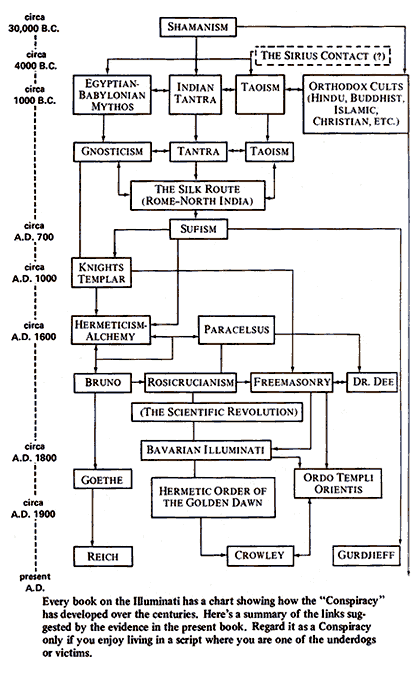
Before plunging headlong into the history of the Bavarian
Illuminati, it might be useful to have a look at Wilson's diagram -
his interpretation (at the time) of the "occult conspiracy" as it
has been transmitted through the ages (Cosmic Trigger: Final
Secret of the Illuminati, p.188):
New Promethean Possibilities
“European aristocrats transferred their lighted candles
from Christian altars to Masonic lodges. The flame of occult
alchemists, which had promised to turn dross into gold,
reappeared at the center of new "circles" seeking to recreate a
golden age: Bavarian Illuminists conspiring against the Jesuits,
French Philadelphians against Napoleon, Italian charcoal burners
against the Hapsburgs.”
The Bavarian Illuminati originated during an age replete with the
growing belief in the acquisition of truth through observation and
experience.
The Age of Enlightenment was in full swing and by the
end of the Eighteenth Century an explosion of natural philosophy,
science, the resurgence of hermeticism and occult experimentation,
all competed directly with the traditional teachings of the Church
and the Jesuit monopoly in the Universities and Colleges.
5 Numerous ideologies owe an intellectual and
political heritage to this period: skepticism, rationalism,
atheism, liberalism, humanism, reductionism, modernism, communism,
nihilism and anarchism - among the most apparent.
As the Eighteenth Century came to a close Baron de Montesquieu
(1689-1755), Denis Diderot (1713-1784), Voltaire (1694-1778),
Jean-Jacques Rousseau (1712-1778), Marquis de Condorcet
(1743-1794), Comte de Mirabeau (1749- 1791), David Hume
(1711-1776), Adam Smith (1723-1790), Immanuel Kant (1724-1804),
Emanuel Swedenborg (1688-1772) and Johann Wolfgang von Goethe
(1749-1832) were famous in their own time.
The instrument of reason
became a new faith, no less susceptible to its own breed of
dogmatism. The philosophers of the Enlightenment reasoned that the
physics of Newton might become applicable in all fields of
endeavor: the fundamental cosmic laws of nature could transform
society and man himself into a "noble savage."
6
The idea of a "glorious revolution" attained widespread acceptance,
but during Weishaupt's time it was still a relatively new concept
to link political change with social change. The "imminent
revolution of the human mind," promulgated by the "radical Bavarian
Illuminists," coincided with Mirabeau's doctrine of a coming
secular upheaval and universal revolution. Mirabeau proclaimed
Prussia to be the most likely place for the start of the
revolution, with the "German Illuminists as its probable leaders."
History records, however, that it was Mirabeau himself who became
one of the main catalysts to spark the "fire in the minds of men"
during the French Revolution.
7
At about the same time Weishaupt was embarking on an academic
career two important figures entered the world stage: Thomas Robert
Malthus,
8 born in 1766, a major influence on Darwinism,
population control and the eugenics movement; four years later we
see the birth of Georg Wilhelm Friedrich Hegel, in Stuttgart
Germany, the inventor of what would become known as the "Hegelian
Dialectic."
"For Hegelians," Antony C. Sutton reports, "the State
is almighty and seen as 'the march of God on earth.' Indeed, a
State religion. Progress in the Hegelian State is through contrived
conflict: the clash of opposites makes for progress. If you can
control the opposites, you dominate the nature of the outcome"
(Introduction to the 2002 edition of
America's Secret Establishment: An Introduction to the
Order of Skull & Bones).
Revolutionary radicals were impressed with the proof-of-concept
displayed by the ruthless conspirators in France. Malthusian and
Hegelian dogma became equally influential for anarchists,
communists, the intelligentsia and the new breed of revolutionaries
that surfaced in the 19th Century: Young Hegelians such as Bakunin,
Proudhon and Marx took up the cause in the "spirit of the times" to
"destroy in order to build."
The Bavarian Illuminati: The "Insinuating Brothers" of ☉
“Weishaupt . . . proposed as the end of Illuminism the
abolition of property, social authority, nationality, and the
return of the human race to the happy state in which it formed
only a single family without artificial needs, without useless
sciences, every father being priest and magistrate. Priest of we
know not what religion, for in spite of their frequent
invocations of the God of Nature, many indications lead us to
conclude that Weishaupt had, like Diderot and d'Holbach, no other
God than Nature herself. From his doctrine would naturally follow
German ultra-Hegelianism and the system of anarchy recently
developed in France, of which the physiognomy suggests a foreign
origin.”
- Henry Martin,
Histoire de France depuis les temps les
plus reculés jusqu'en 1789, XVI. 533.
9
“Do you realize sufficiently what it means to rule - to
rule in a secret society? Not only over the lesser or more
important of the populace, but over the best of men, over men of
all ranks, nations, and religions, to rule without external
force, to unite them indissolubly, to breathe one spirit and soul
into them, men distributed over all parts of the world? . . . And
finally, do you know what secret societies are? What a place they
occupy in the great kingdom of the world's events? Do you think
they are unimportant, transitory appearances?”
- Adam Weishaupt,
Nachtrag von weitern
Originalschriften, II, pp. 44, 51.
10
A quick perusal on the World Wide Web will show the disparity of
opinions and irreconcilable differences about the history of the
Illuminati - Bavarian or otherwise.
It's getting better though,
If you never buy a single book on the Illuminati, and just read the
internet references cited above, you would have an excellent grasp
- much greater than your average conspiracy theorist - on the facts
(as we can safely say) concerning the rise and fall of the Bavarian
Illuminati. I have taken it a bit further, however.
For the last
six months I've engaged in a crash course on the Illuminati and
related subjects:
-
absorbing and taking notes from Proofs of a
Conspiracy ..., and other internet references;
-
buying
Barruel's Memoirs Illustrating the History of
Jacobinism,
-
Billington's Fire In the Minds of Men:
Origins of the Revolutionary Faith, Webster's Secret
Societies & Subversive Movements,
-
Antelman's To
Eliminate the Opiate Vol. 1,
-
Yates'
The Rosicrucian Enlightenment,
-
Fulop-Miller's The Power and Secret of the Jesuits,
-
Carr's
Pawns in the Game;
...and at the same time consulting
other works, in my own personal library, when needed.
12
A Chronological Overview
In an effort to keep the notes to a minimum and still provide
thorough citation, the following abbreviations will be applied:
-
AB -
Memoirs Illustrating the History of
Jacobinism, by Augustin Barruel, 1798, Real-View-Books
Classics Reprint, 2002 edition
-
VS - Chapter III: The
European Illuminati, from New England and the
Bavarian Illuminati, by Vernon L. Stauffer Ph.D., 1918
-
JB -
Fire In the Minds of Men: Origins of
the Revolutionary Faith, by James H. Billington, 1980
-
NW -
Secret Societies & Subversive
Movements, by Nesta H. Webster, 1924, A&B Publishers
Group, 1998
-
JR -
Proofs of a Conspiracy Against all the Religions and Governments
of Europe, by John Robison, 1798
-
MA -
To Eliminate The Opiate, by
Rabbi Marvin S. Antelman, 1974
-
CG -
The
Enlightenment, Freemasonry, and The Illuminati, by Conrad
Goeringer
-
TM -
A Bavarian Illuminati
Primer, by Trevor W. McKeown
-
MI -
The Illuminati and Angels & Demons FAQ - Do the Illuminati
Really Exist?, by Massimo Introvigne
-
CE -
Catholic Encyclopedia:
Illuminati
1748
February 6. Adam Weishaupt is born (d. 1830) of Westphalian parents
[CE] in Ingolstadt Bavaria. Fittingly, the Weishaupt family name
first appeared in Baden and was anciently associated with tribal
conflicts around the area. [House of Names:
Weishaupt Family Crest]
1755
Weishaupt's father, George, dies. He is turned over to his liberal
godfather, Baron Johann Adam Ickstatt (1702-1776), curator of the
University of Ingolstadt and a member of the Privy Council. [VS,
CG]
While growing up Weishaupt was educated by the Jesuits and was
"accorded free range in the private library of his godfather, the
boy's questioning spirit was deeply impressed by the brilliant
though pretentious works of the French 'philosophers' with which
the shelves were plentifully stocked." [VS] He studies law,
economics, politics, history and philosophy; voraciously devouring
every book which he came across. [VS]
1768
Weishaupt graduates from the University of Ingolstadt. He serves
for four years as a tutor and catechist. [VS]
1772
Weishaupt is appointed as professor of civil law at the University
of Ingolstadt. [CE]
1773
Pope Clement XIV dissolves the Jesuit Order.
Weishaupt becomes the first layman to occupy the chair of canon
law; the prestigious position had been held by a Jesuit for the
previous 90 years. [VS, CE]
Weishaupt marries, against the wishes of Ickstatt. [VS]
1775
Weishaupt is promoted to dean of the faculty of law. [VS]
1776
May 1. Weishaupt founds the Order of the Illuminati with an
original membership of five.
13 The Order is
secret, hierarchical and modeled on the Jesuits. The original name
for the Order was uncertain: Perfectibilists and Bees were both
considered, but Weishaupt settled on Illuminati - chosen, perhaps,
because of the "image of the sun radiating illumination to outer
circles" [JB: 94-95]
The Order was, therefore, always represented
in communications between members as a circle with a dot in the
center ☉ This symbolic imagery - the point within a circle,
the Perfectibilists and the Bees - is also reflective of
Weishaupt's fascination with Eleusinian
14 and Pythagorean
Mysteries; no doubt learning of this early on having access to
Ickstatt's considerable library.
Like most secret societies the basic structure of the Order was
divided into classes and degrees, in the following manner:
-
The Nursery
-
Preparatory Literary Essay
-
Novitiate (Novice)
-
Minerval (Brethren of Minerva, Academy of Illuminism)
-
Illuminatus Minor
-
Symbolic Freemasonry
-
Apprentice
-
Fellow Craft
-
Master
-
-
Scots Major Illuminatus
-
Scots Illuminatus Dirigens (Directory)
-
Mysteries
-
Lesser
-
Presbyter, Priest, or Epopt
-
Prince or Regent
-
Greater
-
Magus
-
Rex or King
"The Zoroastrian-Manichaean cult of fire was central to the
otherwise eclectic symbolism of the Illuminists; their calendar was
based on Persian rather than classical or Christian models." [JB:
95] Weishaupt explains: "The allegory in which the Mysteries and
Higher Grades must be clothed is Fire Worship and the whole
philosophy of Zoroaster or of the old Parsees
15
who nowadays only remain in India; therefore in the further degrees
the Order is called 'Fire Worship' (Feuerdienst), the 'Fire Order,'
or the 'Persian Order' - that is, something magnificent beyond all
expectation." [NW: 201]
Weishaupt constructed the Illuminati
calendar to commemorate the date of the Persian King Yazdegerd III
(632 AD) [MI] - the Parsees (Parsis) still use the same dating
system to this day.
16 Barruel relates
how the Illuminati Novice in-training "must … learn how to
date his letters, and be conversant with the Illuminized Hegira or
Calendar; for all letters which he will receive in future will be
dated according to the Persian era, caled [sic] Jezdegert
and beginning A.D. 630. The year begins with the Illuminees on the
first of Pharavardin, which answer to the 21st of March.
Their first month has no less than forty-one days; the following
months, instead of being called May, June, July, August, September,
and October, are Adarpahascht, Chardad,
Thirmeh, Merdedmeh, Shaharimeh,
Meharmeh: November and December are Abenmeh,
Adameh: January and February, Dimeh, and Benmeh: The month of March only has twenty days, and is
called Asphandar." [AB: 429; emphasis in original]
17
For the Novice, the letters to his Superior are to be written in
cipher: "he must make himself master of that cypher, which is to
serve him until initiated into the higher degrees, when he will be
entrusted with the hieroglyphics of the Order." [AB: 429] Barruel
(p.438) displays the first cipher
18 introduced to
the Illuminati Novice:
| A |
B |
C |
D |
E |
F |
G |
H |
I |
K |
L |
M |
| 12 |
11 |
10 |
9 |
8 |
7 |
6 |
5 |
4 |
3 |
2 |
1 |
| N |
O |
P |
Q |
R |
S |
T |
U |
W |
X |
Y |
Z |
| 13 |
14 |
15 |
16 |
17 |
18 |
19 |
20 |
21 |
22 |
23 |
24 |
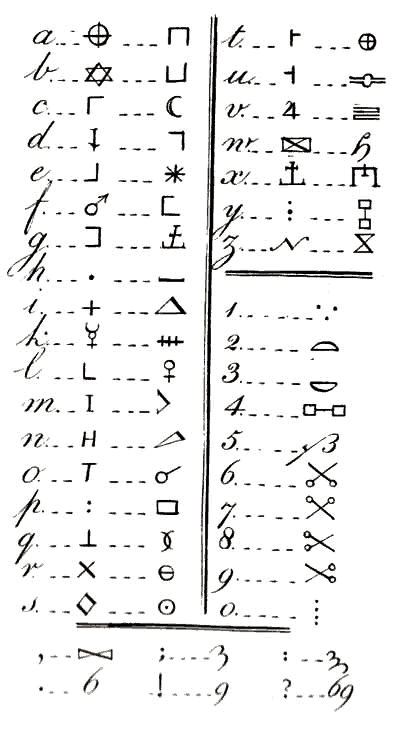
The Hieroglyphic cipher used in the higher Scotch Knight degrees is
also reproduced by Barruel:
The Bavarian Illuminati were set up for "political intriguing
rather than in speculation" [NW: 201], the Illuminati became "much
more characteristic of a militia in action than an order with
initiations." [JB: 95]
Weishaupt's contempt for certain esoteric
pursuits - as a "thing-in-itself" - was widely known: "... in
Weishaupt's system the phraseology of Judaism, the Cabalistic
legends of Freemasonry, the mystical imaginings of the Martinistes,
play at first no part at all.
For all forms of 'theosophy,'
occultism, spiritualism, and magic Weishaupt expresses nothing but
contempt, and the Rose-Croix masons are bracketed with the Jesuits
by the Illuminati as enemies it is necessary to outwit at every
turn. Consequently no degree of Rose-Croix finds a place in
Weishaupt's system, as in all the other Masonic orders of the day
which drew their influence from Eastern or Cabalistic
19
sources." [NW: 200]
Weishaupt seems to have shown the most disdain towards the occult
pursuits of his own time; of the ancient mysteries he has nothing
but high regard. The Insinuators, while in pursuit of potential
recruits, "must remark, that there exists doctrines solely
transmitted by secret traditions, because they are above the
comprehension of common minds. In proof of his assertions he will
cite the Gymnosophists in the Indies, the Priests of Isis in Egypt,
and those of Eleusis and the Pythagorean School in Greece." [AB:
422]
Ascending the Illuminati hierarchy wasn't so much for the purpose
of attaining wisdom as to be "remade into a totally loyal servant
of a universal mission." [JB: 94] In a letter to fellow Illuminist,
Xavier Zwack, dated Mar 10 1778, Weishaupt had said, "We cannot use
people as they are, but begin by making them over." [JB: 94]
1777
Weishaupt is initiated into Freemasonry, in Munich, at the Lodge
Theodore of Good Counsel. By the middle of 1779, Weishaupt's
"Insinuators" had completely wrestled control of the Lodge and it
was regarded as part of the Order of the Illuminati. [VS]
1780
February 8. Weishaupt's wife dies. [VS]
July. Baron von Knigge is initiated into the Order. [VS] Knigge was
connected to the court of Hesse-Cassel [VS] and a prominent Strict
Observance freemason. He subsequently restructured the Order and
recruited many prominent members: "the notion of restricting the
field of recruiting solely to the young was abandoned, and this
phase of the propaganda was widened so as to include men of
experience whose wisdom and influence might be counted upon to
assist in attaining the objects of the order." [VS]
By 1784, largely due to Knigge's circle of influence, the Illuminati had
"between two and three thousand members." [VS]
1782
July 16. Congress of Wilhelmsbad convened. Probably the most
significant event of the era as far as any official coalition
between secret society factions:
“At Wilhelmsbad, near the city of Hanau in Hesse-Cassel, was held the most important Masonic Congress of the eighteenth
century. It was convoked by Ferdinand, Duke of Brunswick,
20 Grand Master of the Order of Strict Observance
... there were delegates from Upper and Lower Germany, from
Holland, Russia, Italy, France, and Austria; and the order of the
Illuminati was represented by the Baron Von Knigge. It is not
therefore surprising that the most heterogeneous opinions were
expressed.”
"...it was not until the Congress de Wilhelmsbad that the alliance
between Illuminism and Freemasonry was finally sealed....What
passed at this terrible Congress will never be known to the outside
world, for even those men who had been drawn unwittingly into the
movement, and now heard for the first time the real designs of the
leaders, were under oath to reveal nothing. One such honest
Freemason, the Comte de Virieu, a member of Martiniste Lodge at
Lyons, returning from the Congre's de Wilhelmsbad could not conceal
his alarm, and when questioned on the 'tragic secrets' he had
brought back with him, replied: 'I will not confide them to you. I
can only tell you that all this is very much more serious than you
think. The conspiracy which is being woven is so well thought out
that it will be, so to speak, impossible for the monarchy and the
Church to escape from it." From this time onwards, says his
biographer, M. Costa de Beauregard, 'the Comte de Virieu could only
speak of Freemasonry with horror.'"
Nesta H. Webster.
World
Revolution - The Plot Against Civilization, p. 18.
1784
April 20. Baron von Knigge resigns from the Illuminati. His
quarrels with Weishaupt over the direction and management of the
Order had reached a boiling point. A certain amount of jealousy was
apparent from both parties - though Weishaupt certainly was a
Machiavellian, by all accounts. On July 1st Knigge signs a formal
agreement to return all property, rituals and initiations belonging
to the Order, and to maintain silence about Illuminati secrets.
Knigge was convinced of Weishaupt's Jesuitism; he accused him of
being "a Jesuit in disguise." [VS, CE]
June 22. The Elector of Bavaria, Duke Carl Theodore, issues the
first edict against secret societies not authorized by the law or
the sovereign.
This first edict seems to have been brought upon by ex-member,
Professor Joseph Utzschneider, who had quit the Order in August
1783. Just a few months later, in October, Utzschneider along with
Grünberger and Cosandey, fellow professors with him in the
Marianen (Marienburg) Academy
21 and members of
the Order, presented the Duchess Maria Anna with an internal
Illuminati document, and a membership list. The Duchess was
thoroughly alarmed and passed it on to the Duke. [VS, JR]
1785
February. Some members of the Illuminati appeal to Carl Theodore
for an appearance before him to prove their innocence. The offer is
rejected. [VS]
March 2. The Bavarian Monarch issues the second edict against
secret societies, specifically naming the Illuminati and
Freemasonry; shortly after a considerable amount of important
documents were concealed or put to the flames. [VS] This second ban
was more forceful, it "left no room for evasion." The government
enforcers were giving weapons to "wage an effective command." [VS]
Weishaupt had already left his post at the University two weeks
earlier, obviously knowing about the approaching storm.
"He fled
across the border to Regensburg, and finally settled at Gotha"
under the protection of Illuminati member Duke of Saxe-Gotha. [VS]
Thirteen years later Barruel writes, "[Weishaupt] now banished from
his country as a traitor to his Prince and to the whole Universe,
peacefully at the court of Ernest Lewis, Duke of Saxe Gotha, enjoys
an asylum, receives a pension from the public treasury, and is
dignified with the title of Honorary Councellor to that Prince."
[AB: 400]
Judicial inquiries were held at Ingolstadt. Subsequent government
measures were taken and some members made formal confessions. A
considerable membership was found to be held within the military;
officers and soldiers were ordered to come forward and confess any
involvement. State officials, professors, teachers, and students
who were found out to be members were summarily dismissed. Some
were even banished from the country. [VS]
September 9. Utzschneider, Grünberger, and Cosandey make a
joint Juridical Deposition before the Elector:
"The object of the first degrees of Illuminism is at once to
train their young men, and to be informed of every thing that is
going forward by a system of espionage. The Superiors aim at
procuring from their inferiors diplomatic acts, documents, and
original writings. With pleasure they see them commit any
treasons or treacherous acts, because they not only turn the
secrets betrayed to their own advantage, but thereby have it in
their power to keep the traitors in a perpetual dread, lest, if
they every showed any signs of stubbornness, their malefactions
should be made known.- Oderint dum metuant, let them hate,
provided they fear, is the principle of their government.
"The Illuminees from these first degrees are educated in the
following principles:
-
"The Illuminee who wishes to rise to the highest degree must be
free from all religion; for a religionist (as they
call every man who has any religion) will never be admitted to
the highest degrees."
-
The Patet Exitus, or the doctrine on Suicide, is
expressed in the same terms as in the preceding deposition.
-
"The end sanctifies the means. The welfare of the
Order will be a justification for calumnies, poisonings,
assassinations, perjuries, treasons, rebellions; in short, for
all that the prejudices of men lead them to call
crimes.
-
"One must be more submissive to the Superiors of Illuminism,
than to the sovereigns or magistrates who govern the people;
and he that gives the preference to sovereigns or governors of
the people is useless to us. Honor, life, and fortune, all are
to be sacrificed to the Superiors. The governors of nations are
despots when they are not directed by us.-They can have no
authority over us, who are free men.
-
"The love of one's prince and of one's country are incompatible
with views of an immense extent, with the ultimate ends of
the Order, and one must glow with ardour for the
attainment of that end.
"The Superiors of Illuminism are to be looked upon as the most
perfect and the most enlightened of men; no doubts are to be
entertained even of their infallibility."
"It is in these moral and political principles that the
Illuminees are educated in the lower degrees; and it is according
to the manner in which they imbibe them and show their devotion
to the Order, or are able to second its views, that they are
earlier or later admitted to the higher degrees.
"They use every possible artifice to get the different
post-offices in all countries entrusted to the care of their
adepts only. They also boast that they are in possession of the
secret of opening and reclosing letters without the circumstance
being perceived.
"They made us give answers in writing to the following questions:
How would it be possible to devise one single system of morals
and one common Government for all Europe, and what means should
be employed to effectuate it? Would the Christian Religion be a
necessary requisite? Should revolt be employed to accomplish it?
&c. &c.
"We were also asked, in which Brethren we should place the most
confidence if there were any important plan to be undertaken; and
whether we were willing to recognize the right of life and death
as vested in the Order; and also the right of the sword, Jus
Gladii.
"In consequence of our acquaintance with this doctrine of the
Illuminees, with their conduct, their manners, and their
incitements to treason, and being fully convinced of the dangers
of the Sect, we the Aulic Counsellor Utzschneider and the Priest
Dillis left the Order. The Professor Grünberger, the Priest
Cosandey, Renner, and Zaupfer, did the same a week after, though
the Illuminees sought to impose upon us shamefully, by assuring
us that his Electoral Highness was a member of their Order.
We
clearly saw that a Prince knowing his own interests, and wholly
attending to the paternal care of his subjects, would never
countenance a Sect, spreading through almost every province under
the cloak of Free-masonry; because it sows division and discord
between parents and their children, between Princes and their
subjects, and among the most sincere friends; because on all
important occasions it would install partiality on the seats of
justice and in the councils, as it always prefers the welfare of
the Order to that of the state, and the interests of its adepts
to those of the prophane. Experience had convinced us, that they
would soon succeed in perverting all the Bavarian youth.
The
leading feature in the generality of their adepts were
irreligion, depravity of morals, disobedience to their Prince and
to their parents, and the neglect of all useful studies. We saw
that the fatal consequence of Illuminism would be, to create a
general distrust between the prince and his subjects, the father
and his children, the minister and his secretaries, and between
the different tribunals and councils.
We were not to be deterred
by that threat so often repeated, That no Prince can save him
that betrays us. We abandoned, one after the other, this
Sect, which under different names, as we have been
informed by several of our former Brethren, has already spread
itself in Italy, and particularly at Venice, in Austria, in
Holland, in Saxony, on the Rhine, particularly at Frankfort, and
even as far as America.-The Illuminees meddle as much as
possible in state affairs, and excite troubles wherever their
Order can be benefited by them."
"We are not acquainted with the other
Invisibles, who in
all probability are chiefs of a higher degree.
"After we had retired from the Order, the Illuminees calumniated
us on all sides in the most infamous manner. Their cabal made us
fail in every request we presented; succeeding in rendering us
hateful and odious to our superiors, they even carried their
calumnies so far as to pretend that one of us had committed
murder. After a year's persecution, an Illuminee came to
represent to the Aulic Counsellor Utzschneider, that from
experience he must have learned that he was every where
persecuted by the Order, that unless he could contrive to regain
its protection, he would never succeed in any of his demands, and
that he could still regain admission." [AB: 684-88; emphasis in
original]
1786
On October 11 police search Xavier Zwack's residence in Landshut. A
number of books and over two hundred letters, between Weishaupt and
the Areopagites, were confiscated. The documents were published by
the Bavarian government under the title Einige
Originalschriften des Illuminaten Ordens. [VS, TM]
The evidence discovered at Zwack's residence was considerable:
besides the secret communications between the Illuminati Adepts,
the authorities found tables containing the Order's symbols and the
Persian calendar; membership rosters, statutes, instructions for
recruiters, ceremonies of initiation and imprints of the Order's
insignia; a eulogy of atheism and a copy of a manuscript entitled
Better Than Horus; a proposal for a branch of Illuminism
for woman;
22 several hundred
impressions of Government seals (with a list of their owners,
princes, nobles, clergymen, merchants, etc.), for the purposes of
counterfeiting; instructions for the making of the poison
Aqua Toffana, poisonous gas and secret
ink; "an infernal machine" for the safeguarding of secret papers -
apparently a strong box that would blow up, destroying its
contents; and receipts for procuring abortion and a formula for
making a tea to induce the procedure. [VS, JR, MA: 51, NW: 228, AB:
692-93]
In the space of a few months, in 1786 - in order to save face -
Weishaupt pens 9 different apologetic pamphlets, most notably: Apologie der Illuminaten, Frankfort and Leipzig, 1786,
and Vollständige Geschichte der Verfolgung der
Illuminaten in Bayern, Frankfort and Leipzig, 1786. [VS]
1787
As a result of further police searches of Baron Bassus' castle at
Sandersdorf, the Bavarian government published more secret
documents of the Order: Nachtrag von weitern Originalschriften ... [VS]
August 16. The third and final edict against the Order is put into
effect by the Duke of Bavaria.
The former edicts were reemphasized,
"and in addition, to give maximum force to the sovereign's will,
criminal process, without distinction of person, dignity, state, or
quality, was ordered against any Illuminatus who should be
discovered continuing the work of recruiting. Any so charged and
found guilty were to be deprived of their lives by the sword; while
those thus recruited were to have their goods confiscated and
themselves to be condemned to perpetual banishment from the
territories of the duke. Under the same penalties of confiscation
and banishment, the members of the order, no matter under what name
or circumstances, regular or irregular, they should gather, were
forbidden to assemble as lodges."
[VS]
Illuminati Membership List: Alias, Occupation, Residence and
Associates
Partial List of Known Illuminati: 1776 - 1787
|
|
Code Name (Alias)
|
Occupation
|
Circle of Influence
|
|
Abel, Jacob Friedrich von (1751-1829)
|
Pythagoras Abderites
|
Professor of philosophy in Stuttgart; general superintendent in
Urach and Reutlingen
|
Friedrich Schiller
23
|
|
Baader, Ferdinand M. (1747-1797)
|
Celsus
|
Professor, Munich; Physician to the Electress Dowager
|
|
|
Baierhammer, Alois
|
Zoroaster, then Confucius
|
Monastery judge in Diessen
|
|
|
Banffy, Count
|
|
Governor of Transylvania
|
|
|
des Barres, Karl
|
Archelaus
|
Major in the French service
|
|
|
Bassus, Thomas Maria De (1742-1815)
|
Hannibal
|
Baron; Court adviser, Munich; printer
|
Weishaupt; Johann Simon Mayr;
24
Switzerland, Austria and Northern Italy
|
|
 I was lucky enough
to find a small write-up on Bassus. Here
are some extracts taken from Massimo Lardi, Italianopera
correspondent from Coira; Luca Bianchini and Anna Trombetta,
Italianopera correspondents from Sondrio; and published in
Grigionitaliani Notebooks, July 2000: I was lucky enough
to find a small write-up on Bassus. Here
are some extracts taken from Massimo Lardi, Italianopera
correspondent from Coira; Luca Bianchini and Anna Trombetta,
Italianopera correspondents from Sondrio; and published in
Grigionitaliani Notebooks, July 2000:
"The baron Thomas Maria Freiherr De Bassus was born in
Poschiavo, Switzerland, in 1742. He studied jurisprudence at
the University of Ingolstadt. Weishaupt (code name
Spartacus), who founded the Order of the Bavarian Illuminati,
on the 1 May 1776, was his schoolmate. De Bassus practiced
for a year as an Adviser of court to Münich in Bavaria.
In 1767 he became Patron [Podestà] of Poschiavo, a
task already taken from his father Giovanni Maria. He married
Cecilia Domenica Massella, from a family of notaries. At the
premature death of his father, he inherited the palace of
piazza del Borgo in Poschiavo, known today as the Albrici
Hotel, in addition to his wealthy possessions in Valtellina
and in Val di Poschiavo. After he had engaged the position of
legal Assistant in Tirano (in the province of Sondrio, under
the power of Grigioni), De Bassus became Podestà of
Traona in 1781 and inherited in that period the goods of the
German family branch, e. g. the feuds of Sandersdorf,
Mendorf, Eggersberg, Harlanden and Dachenstein.
"Entering the Order of the Bavarian Illuminati with the code
name of Hannibal, De Bassus had the assignment, like the
pseudonym suggests, to spread Illuminism beyond the Alps,
above all in the Three Leagues (Swiss) and in the north of
Italy. De Bassus acquired a printing company that, with the
help of the Illuminatus typographer Joseph Ambrosioni, became
the center of the diffusion of Weishaupt's ideas from
Poschiavo. The edition of De Bassus (1782) of the first
Italian translation of the Werther of Goethe, written by
Gaetano Grassi from Milan, was famous."
In 1787, police searches of the Baron's castle turned up
incriminating evidence against himself and the Illuminati. He
was a great recruiter for the Order. In letters to Weishaupt
he boasted of his conquests at Bozen (in the south of
Austria), initiating "the President, the Vice-President, the
principal Counsellors of Government, and the Grand Master of
the Posts." Later, in his travels to Italy, he sends back
word of having initiated "his Excellency the Count W…"
in Milan. [AB: 605]
|
|
Bleibtreu, Karl
|
Busius
|
Counsellor of the Chamber at Neuwied
|
|
|
Bleibtreu, Leopold
|
Alberoni
|
Counsellor of the Chamber at Neuwied
25
|
|
|
Bode, Johann Joachim Christoph (1730-1793)
|
Amelius
|
Privy Counselor, Weimar; musician, composer, music teacher;
translator, publisher, tutor
|
Nicholas Bonneville; Goethe; Gotthold Ephraim Lessing ->
Moses Mendelssohn's wife
|
|
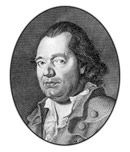 Rabbi Marvin S. Antelman declares
that Bode was the tutor of Mendelssohn's wife [MA: 76]; very
likely true since Bode was good friends with Mendelssohn's
publishing partner, Lessing. Rabbi Marvin S. Antelman declares
that Bode was the tutor of Mendelssohn's wife [MA: 76]; very
likely true since Bode was good friends with Mendelssohn's
publishing partner, Lessing.
Goethe was another one of Bode's good friends, and it was
probably through the latter that Goethe was "insinuated" into
the Illuminati - he was certainly one of "
Goethe's best Masonic advisers." Bode, according to
Billington (p.96), was the "decisive channel of Illuminist
influence" on Nicholas Bonneville, during his "first of two
visits to Paris (June of 1787)" - which, by itself, is enough
to support the theory for a real Illuminati influence on the
French Revolution. The importance of Bonneville on the ideas
and progression of the French Revolution, and on other groups
and figures of the time, is fleshed out masterfully by
Billington (Bonneville, Nicholas, 12, 25,
35-44, 56, 67, 73, 160, 259; Babeuf and, 83-86
3:234,240; German culture and, 60-62, 112;
Illuminism and, 96-97, 99; journalism of, 35-38, 307, 458,
3:233,236; Pythagorean influence on, 100-3; Social
Circle of, 33, 39, 42-44, 60, 72, 76, 84-85, 103,
484).
|
|
Bronner, Franz Xaver (1758-1850)
|
Aristoteles
|
A former Benedictine monk who left the monastery to become a
teacher, poet and librarian in Switzerland;
26 German-Swiss writer and professor
|
|
|
Brigido, Count Joseph (d. 1817)
|
|
Governor of Galicia from 1780 to 1794
|
Viennese Lodge, The Truthful Harmony; Archbishop of Ljubljana,
Ivan Michael
|
|
Busche, Georg Baron von dem
|
Bayard
|
Hanoverian Lieutenant-General
|
|
|
Cobenzl, Count Johann Ludwig von (1753-1809)
|
Arrian
|
Treasurer at Eichstatt; Austrian Envoy to St. Petersburg; Court
Chancellor, State Vice Chancellor and Foreign Minister
27
|
|
|
Cobenzl, Johann Philipp Graf von (1741-1810)
|
Numa Pompilius Romanus
|
Austrian Vice Chancellor, successor to W. Kaunitz in the office
of Court Chancellor and Vice Chancellor; Foreign Minister
28
|
|
|
Compe
|
Aristodemes
|
High Bailiff at Weinberg in the Electorate of Hanover
|
|
|
Costanzo, Marquis Const. von
|
Diomedes
|
Counselor at Munich
|
|
|
Dalberg, Karl Theodor, Baron Von (1744-1817)
|
Baco v. Verulam (also Crescens
29 )
|
Grand Duke of Frankfort-on-the-Main; Archbishop-Elector of
Mainz, Arch-Chancellor of the Holy Roman Empire, Archbishop of
Regensburg
|
Mayer Amschel Rothschild; Goethe, Schiller, Wieland
|
|
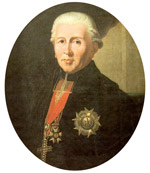 Archbishop Dalberg was an
emancipator of the Jews. In 1811 he enacted a special law
"decreeing that all Jews living in Frankfort, together with
their descendants, should enjoy civil rights and privileges
equally with other citizens."
30 In
exchange for these newfound liberties the Jews had to pay him
440,000 florins;
31 financed
by Mayer Amschel Rothschild,
32 at a
substantial profit, no doubt. A number of Masonic Jews at the
time also petitioned von Karl for the "exclusive right to
maintain lodges in the city."
33 Archbishop Dalberg was an
emancipator of the Jews. In 1811 he enacted a special law
"decreeing that all Jews living in Frankfort, together with
their descendants, should enjoy civil rights and privileges
equally with other citizens."
30 In
exchange for these newfound liberties the Jews had to pay him
440,000 florins;
31 financed
by Mayer Amschel Rothschild,
32 at a
substantial profit, no doubt. A number of Masonic Jews at the
time also petitioned von Karl for the "exclusive right to
maintain lodges in the city."
33
According to Niall Ferguson, Mayer Amschel was soon acting as
Dalberg's "court banker." During the emancipation of the
Frankfort Jews, Rothschild had also advanced him 80,000
gulden "to finance his journey to Paris for the baptism of
Napoleon's son." Afterwards, Rothschild assisted him in
speculative purchases of land and Dalberg returned the favor
by appointing Mayer Amschel to the electoral college of
Hanau. Mayer Amschel's son, also named Amschel, continued the
relationship after his father's death and advanced 250,000
gulden for Dalberg to purchase horses for the French army.
34
This Illuminated Prince had a spectacular career in the Roman
Catholic church. According to the
Catholic-Hierarchy.org,
Archbishop Dalberg was a Priest for twenty-nine years and a
Bishop for twenty-eight. At the time of his initiation though
he had only been "Coadjutor of Mentz." [AB: 699]
Interestingly, Lord Acton (John Emerich Edward Dalberg Acton)
inherited the title of baronet from his grandfather, whose
cousin had married the only daughter of Karl's nephew
Emmerich Joseph Dalberg (Emeric Joseph, duc de Dalberg).
35
|
|
Ditfurth, Franz W. v. (1738-1813)
|
Minos
|
Assessor to the Imperial Chamber of Wetzlar
|
|
|
Dorsch, Anton Josef (1758-1819)
|
Ptolemäus Lathurus
|
Professor of theology in Mainz; Professor of Moral Theology at
the Episcopal Academy in Strassburg
36
|
|
|
Drexel, Anton (1753-1830)
|
Pythagoras
|
Libraran at Munich
|
|
|
de Duffrene (Dufresne), Franz Paul
|
Maevius
|
Commissary at Munich
|
|
|
Eckartshausen, Karl von (1752-1803)
|
Atilius Regulus
|
Aulic Advisor and Councilor to Karl Theodor, Elector and Duke
of Bavaria; Censor of the Library at Munich; Keeper of the
Archives of the Electoral House; prolific writer in Munich:
Sciences, fine Art, Drama, Politics, Religion and History,
Magic and Alchemy
|
The Court of Karl Theodor; reader's of his numerous literary
works - posthumously, and most significantly, A. E. Waite -
> Aleister Crowley -> Order of the Golden Dawn
|
|
Major details of Eckartshausen's life can be read
at Controverscial.com, and in the Introduction
to Eckartshausen's
The Cloud upon the
Sanctuary.
|
|
Ecker (Egkher), Ludwig Baron von (1757-1826)
|
Pericles
|
Judge at Amberg
|
|
|
Ernst II, Ludwig Herzog von (1745-1804)
|
Quintus Severus (also Timoleon)
|
Duke of Saxe-Gotha Altenburg
|
House of Wettin
|
|
Full title: Ernst II Ludwig Herzog von
Sachsen-Gotha-Altenburg; Weishaupt's protector in Gotha.
Barruel (or his English translator, Robert Clifford) calls
him "Ernest Lewis, Duke of Saxe Gotha." [AB: 400]
37
|
|
Falcke, Ernst Friedrich Hector (1751-1809)
|
Epimenides
|
Counselor and Burgomaster at Hanover
|
|
|
Feder, Johann Georg Heinrich (1740-1821)
|
Marcus Aurelius
|
Professor of philosophy at Göttingen
|
|
|
Ferdinand, Duke von Brunswick (1721-1792)
|
Aaron
|
Duke of Brunswick-Lüneburg; Military General; Grand Master
of Strict Observance Freemasonry
|
Frederick the Great; House of Orange; his Masonic brethren
|
|
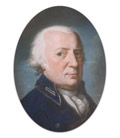 "Illuminated name" gleaned from
Barruel, p.699: "This adept is only mentioned under the
initials P. F. V. B. (Prince Ferdinand von
Brunswig), both when he sends for Knigge, and when he
promises his protection to the adept who is to
Illuminize England." So it's only a guess as to his
alias, but it's a good one. That he was a member of the Order
is never in dispute by all sources consulted. "Illuminated name" gleaned from
Barruel, p.699: "This adept is only mentioned under the
initials P. F. V. B. (Prince Ferdinand von
Brunswig), both when he sends for Knigge, and when he
promises his protection to the adept who is to
Illuminize England." So it's only a guess as to his
alias, but it's a good one. That he was a member of the Order
is never in dispute by all sources consulted.
|
|
Fronhofer, Ludwig (1746-1800)
|
Raimundus Lullus
|
Professor and counsellor in Munich
|
|
|
Goethe, Johann Wolfgang von (1749-1832)
|
Abaris
|
Chief advisor to Karl August, Duke of Saxon-Weimar; poet,
playwright, novelist, philosopher, painter, composer,
scientist, economist, sociologist, politician
|
Too numerous to mention
|
|
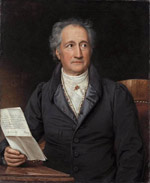 Goethe is one of the most
influential literary figures of all-time. He is often
described as the "last Renaissance man." Goethe undertook the
task to reintegrate the fragmented hermetic doctrines,
culminating in his seminal work
Faust. Michael Baigent writes, "…
behind the encyclopedic scope and breadth of his activities
lay essentially the same impetus that had motivated Agrippa
and Paracelsus … Goethe was the true heir of the
Hermetic magus of the Renaissance, working primarily in
solitude and making himself the real subject and object of
his alchemical experiment. Goethe not only depicted a Faust
figure. As his contemporaries recognized, he was himself a
Faust figure, whose fictional depiction of the magus was but
an adjunct of his own personal Hermetic quest."
38 Goethe is one of the most
influential literary figures of all-time. He is often
described as the "last Renaissance man." Goethe undertook the
task to reintegrate the fragmented hermetic doctrines,
culminating in his seminal work
Faust. Michael Baigent writes, "…
behind the encyclopedic scope and breadth of his activities
lay essentially the same impetus that had motivated Agrippa
and Paracelsus … Goethe was the true heir of the
Hermetic magus of the Renaissance, working primarily in
solitude and making himself the real subject and object of
his alchemical experiment. Goethe not only depicted a Faust
figure. As his contemporaries recognized, he was himself a
Faust figure, whose fictional depiction of the magus was but
an adjunct of his own personal Hermetic quest."
38
Goethe's Faust has put him in the company of
Homer, Dante and Shakespeare. Academics praise this work and
lecture on the "wide panorama of scenes from the vulgar to
the sublime, with passages of wondrous poetry that can be
sensed even through the veil of translation."
39 His scientific investigations impressed
future generations as well: "Awed by Goethe's literary fame,
dazzled by his reputation as the universal man, in decades
after his death even noted scientists like Ernst Haeckel
early praised him as the bold amateur precursor of Darwin."
40
Carl Jung was another intellectual/mystic in awe of Goethe.
Faust for him, throughout his life, was to
remain his most sacred book: "I regard my work on alchemy as
a sign of my inner relationship to Goethe. Goethe's secret
was that he was in the grip of that process of archetypal
transformation which has gone on through the centuries. He
regarded his Faust as an opus magnum or
divinum. He called it his 'main business,' and his
whole life was enacted within the framework of this drama.
Thus, what was alive and active within him was a living
substance, a super personal process, the great dream of the
mundus archetypus (archetypal world)."
41 Baigent elaborates: "For Jung, Goethe
exemplified the premise enunciated by Hermetic magi of the
more distant past, from Paracelsus and Agrippa back to
Zosimus and the practitioners of ancient Alexandria - that
the alchemist must ultimately be the subject and object of
his own experiment, an experiment by which he himself is
transmuted."
42
|
|
Haeffelin, Kasimir Frhr. von (1737-1827)
|
Philo of Byblos
|
Vice-President of the Spiritual Council at Munich, and Bishop
in Partibus
|
|
|
Herder, Johann Gottfried von (1744-1803)
|
Damasus pontifex
|
General Superintendent, Weimar; philosopher, poet, critic,
theologian
|
Goethe; Hegel; Immanuel Kant; Schleiermacher -> Böckh;
Johann Georg Hamann; Karl August, Duke of Saxe-Weimar ->
University of Jena
|
|
Hertel, Jakob Anton
|
Marius
|
Canon of Munich
|
|
|
Hoheneicher, Franz von Paula (1753-1844)
|
Alcibiades
|
Counselor and archivist in Freising
|
|
|
Hornstein, Max Frhr. von
|
Vespasian
|
Baron, of Munich
|
|
|
Karl August (1757-1828)
|
Aeschylus
|
Grand Duke of Saxe-Weimar-Eisenach
|
Karl Ludwig von Knebel; Goethe; Herder -> University of
Jena; Frederick the Great -> "League of Princes"
|
|
Karl, Landgraf von Hessen-Kassel (1744-1836)
|
Aaron
|
Prince of the Hesse Royal Family (Prince Karl of
Hessen-Kassel); Office of Regent of Schleswig-Holstein; Grand
Master of the "Asiatic Brethren"
|
Mayer Amschel Rothschild -> Nathan Mayer Rothschild ->
British East India Company; Princess of Denmark, Mary Hanover
(wife); King of Denmark, Frederik V Oldenburg (father in-law);
Ephraim Joseph Hirschfeld; Comte de St. Germain; Hans Heinrich
von Ecker und Eckhoffen (Magister Pianco); Isaak Daniel Itzig
-> Moses Mendelssohn
|
|
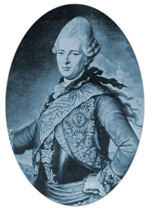 The Asiatic
Brethren is an important subject, and crucial to
uncovering the occult roots of various secret societies that
appeared, seemingly out of nowhere, in the 18th Century. In
fact, there is an entire site devoted to the subject, called
the "Authentic Tradition," which
has an unbelievable amount of research on the subject. The
"Asiatics" link together Hermeticism, Gnosticism,
Rosicrucianism, Templar Freemasonry, Jewish Cabalistic
Frankist/Sabbatian occultism and the Illuminati. That our
illuminated Prince was the Grand Master of the Asiatic Lodge
43 is significant: it definitively ties the
two secret societies together. The Asiatic
Brethren is an important subject, and crucial to
uncovering the occult roots of various secret societies that
appeared, seemingly out of nowhere, in the 18th Century. In
fact, there is an entire site devoted to the subject, called
the "Authentic Tradition," which
has an unbelievable amount of research on the subject. The
"Asiatics" link together Hermeticism, Gnosticism,
Rosicrucianism, Templar Freemasonry, Jewish Cabalistic
Frankist/Sabbatian occultism and the Illuminati. That our
illuminated Prince was the Grand Master of the Asiatic Lodge
43 is significant: it definitively ties the
two secret societies together.
St. Germain - Another intriguing connection
is that of the famous occultist and alchemist, St. Germain:
"[Germain] soon makes another interesting acquaintance -
Prince Karl of Hesse-Kassel, Governor of Schleswig-Holstein
and ardent Mason and occultist. St-Germain informs his new
friend that he will be a permanent houseguest. Karl is
reluctant, but finally agrees, and the two settle in
Schleswig, where they study chemistry and distribute herbal
remedies to the poor. Karl calls him 'the greatest
philosopher who ever lived,' and nicknames him 'Papa'.
After five years, the Count catches pneumonia from his
draughty lab. He dies on 27 February 1784. Karl is away at a
Masonic conclave, but the death is witnessed by his doctor."
44
Maurice the Learned - It is revealing to
note the long association of the Hessen-Kassel family to the
occult. One particular ancestor is noteworthy. Karl is a
direct descendant of "Maurice
the Learned" of Hesse-Cassel (Landgraf Moritz von
Hessen-Kassel, 1572-1632). Maurice procured the services of
Rosicrucians and Alchemists such as Johannes Rhenanus and
Michael Maier. The former served the Prince in many
capacities, "working first in his chemical laboratory and
towards the end of his life as the Prince's family doctor. He
was also the author of a number of Paracelsian and
iatrochemical texts (e.g. Urocriterium
Chymiatricum, Marburg, 1609) and clearly a practising
alchemist."
45 As for
the latter, Maier was a very important figure and
well-connected with many of the leading nobility of Europe
and other famous occultists such as Robert Fludd. Maier
produced an incredible amount of Rosicrucian/alchemical
treatises and became the court physician to Maurice around
1614.
46 Francis
Yates also underscores the fact that the town of Cassel is
where the Rosicrucian Manifestos were first published (1614
and 1615).
47 Hardly a
coincidence, Maurice had already founded the
Collegium Mauritianum in
1599, which taught all sorts of advanced arcane studies -
while at the same time he controlled "an extensive hermetic
alchemical circle."
48 The
sudden open appearance of the Rosicrucians and their
manifestos - perplexing to most historians - isn't all that
mysterious in an environment such as existed under his rule.
Much more research should be done on the House of Hesse as a
whole; they appear to be the fulcrum of the most significant
major revivals in western occult tradition.
Rothschild - Prince Karl and the House of
Hesse represent the strongest connection yet between the
Rothschild Dynasty and the Illuminati. The two families had
such an intimate relationship that there's a strong
possibility for the Rothschilds having at least contributed
financially to the Bavarian Illuminati - if only in Karl's
name.
Beginning with Karl's father Friedrich (Friedrich II Landgraf
von Hessen-Kassel), the Hessen-Kassel Royal Family made a
fortune from leasing Hessen-Kassel mercenaries to various
monarchies: "Hessen-Kassel contributed 16.000-23.000 men to
the Anglo-Prussian army"; "17,000 Hessians fought the rebels
in the WAR OF AMERICAN INDEPENDENCE - Count Friedrich
'earned' 20 million Thalers."
49 "His
banker, since 1783, was Frankfurt Jew MEYER AMSCHEL
ROTHSCHILD; by clever management of the fund he and his
sons made Friedrich's successor, WILHELM IX. (Karl's
brother), one of the wealthiest monarchs of his time."
(Ibid.; italic emphasis mine, caps in the original)
From the Jewish
Encyclopedia: "Mayer [Amschel Rothschild] was a general
agent and banker, and traded also in works of art and curios.
In the latter connection he became an agent of William
IX., Landgrave of Hesse-Cassel, who on his father's
death in 1785 had inherited the largest private fortune in
Europe, derived mainly from the hire of troops to the British
government for the putting down of the Revolution in the
United States." (italic emphasis mine)
 From the very beginning the
Rothschild patriarch sought to secure favor with the Hesse
Royal Family. In 1769, after a letter of flattery to Karl's
brother Prince William, Mayer Amschel Rothschild receives
permission to nail a gold-letter sign to his shop, which
read: "M. A. Rothschild, by appointment court factor to his
serene highness, Prince William of Hanau." (The Rothschilds Part 1)
By 1816 after the Austrian minister of finance proposed the
Rothschilds receive official nobility, the Hesse Coat of Arms
became a key component: "The Rothschilds were asked to submit
a coat of arms, which Solomon did: it consisted in
quarterly: 1) or an eagle sable surcharged in dexter by a
field gules, 2) gules a leopard passant proper, 3) a lion
rampant, 4) azure, an arm bearing 5 arrows; in center a
shield of gules. The supporters were a greyhound and a
stork, the crest a coronet with a lion issuant. […]
The eagle alluded to Austria, the lion to
Hesse-Kassel." (Jewish Heraldry; bold emphasis
mine) From the very beginning the
Rothschild patriarch sought to secure favor with the Hesse
Royal Family. In 1769, after a letter of flattery to Karl's
brother Prince William, Mayer Amschel Rothschild receives
permission to nail a gold-letter sign to his shop, which
read: "M. A. Rothschild, by appointment court factor to his
serene highness, Prince William of Hanau." (The Rothschilds Part 1)
By 1816 after the Austrian minister of finance proposed the
Rothschilds receive official nobility, the Hesse Coat of Arms
became a key component: "The Rothschilds were asked to submit
a coat of arms, which Solomon did: it consisted in
quarterly: 1) or an eagle sable surcharged in dexter by a
field gules, 2) gules a leopard passant proper, 3) a lion
rampant, 4) azure, an arm bearing 5 arrows; in center a
shield of gules. The supporters were a greyhound and a
stork, the crest a coronet with a lion issuant. […]
The eagle alluded to Austria, the lion to
Hesse-Kassel." (Jewish Heraldry; bold emphasis
mine)
The Hesse-Kassel mercenary blood-money, in turn, became the
catalyst for the beginning of the Rothschild family fortune.
The
Jewish
Encyclopedia informs us that Nathan Rothschild was on
such good terms with (Illuminati) Prince Dalberg, that
Napoleon had made him a member of the Electoral College of
Darmstadt in 1810. Meanwhile, the Landgrave of Hesse-Cassel
(William IX) had already fled to Denmark after the battle of
Jena in 1806. He sent his money "to Nathan in London, who in
1808 utilized it to purchase £800,000 worth of gold
from the East India Company, knowing that it would be needed
for Wellington's Peninsular campaign. He made no less than
four profits on this: (1) on the sale of Wellington's paper,
(2) on the sale of the gold to Wellington, (3) on its
repurchase, and (4) on forwarding it to Portugal. This was
the beginning of the great fortunes of the house, and its
early transactions may be divided into three stages, in each
of which Nathan was the guiding spirit: namely, (1) from 1808
to 1815, mainly the transmission of bullion from England to
the Continent for the use of the British armies and for
subventions to the allies; (2) from 1816 to 1818, 'bearing'
operations on the stock exchange on the loans needed for the
reconstruction of Europe after Napoleon's downfall; and (3)
from 1818 to 1848, the undertaking of loans and of refunding
operations, which were henceforth to be the chief enterprises
of the house."
|
|
Kapfinger, Georg
|
Thales milesius
|
Secretary to Count Tattenbach
|
|
|
Kleucker, Johann Friedrich (1749-1827)
|
Terentius Varro
|
Philosopher and theologian, rector at Osnabrueck; author of
occult subjects
|
Gotthold Ephraim Lessing; the Martinist Order; Franz Xaver von
Baader
|
|
Knigge, Adolph Franz Friedrich Ludwig Freiherr von (1752-1796)
|
Philo
|
Writer; Freemason
|
Weishaupt, Goethe, Nicolai; German Masonic lodges; House of
Hessen-Kassel
|
|
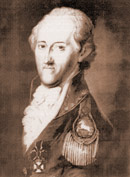 Baron Knigge was instrumental to the
spread of Illuminism. He was "a man of considerable
distinction in his day." [VS] He studied law at
Göttingen and was subsequently attached to the courts of
Hesse-Cassel and Weimar. [VS] He penned works of "romance,
popular philosophy, and dramatic poetry" [VS] and wrote
reviews for Nicolai's Allgemeine Deutsche
Bibliothek.
50 Baron Knigge was instrumental to the
spread of Illuminism. He was "a man of considerable
distinction in his day." [VS] He studied law at
Göttingen and was subsequently attached to the courts of
Hesse-Cassel and Weimar. [VS] He penned works of "romance,
popular philosophy, and dramatic poetry" [VS] and wrote
reviews for Nicolai's Allgemeine Deutsche
Bibliothek.
50
He became fascinated with secret societies and, at the
earliest age possible, joined a lodge of Strict Observance.
He was very interested in the subjects of theosophy, magic,
alchemy, and the Rosicrucians. [VS] Strict Observance
freemasonry had been started in Germany by Baron von Hund.
The "Knights of Strict Observance" swore allegiance to
"unknown superiors" and claimed direct descent from the
Knights Templar and the Rosicrucians.
51
The Strict Observance lodges created an occult pedigree to
attract recruits with the promise of joining an Order of a
continuous, ancient descent. Secrets that began in antiquity
were more appealing than something only recently devised.
Weishaupt understood this from the beginning
52 and had created his own mythical genealogy
for the Illuminati, and when Knigge joined the Order he
immediately asked Weishaupt for proof. Weishaupt admitted it
was only a ruse, but rather than being offended, Knigge -
knowing that this was an important part of a secret society's
appeal - immediately "proceeded to build one of his own,
where the Illuminati were declared as having originally been
founded by Noah, and revived after a period of decline by St
John the Evangelist." [MI]
|
|
Kolborn, Joseph Hieronymus Karl Freiherr von (1744-1816)
|
Chrysippus
|
Priest, later Bishop; personal secretary to Illuminati Baron
Dalberg
|
|
|
Kolowrat-Krakowsky, Count Leopold von (1727-1809)
|
Numenius
|
Vice-Chancellor for Austria and Bohemia
|
|
|
 "Kolowrat-Krakowsky, Count
Leopold, b. Dec. 31, 1727, d. Vienna, Nov. 2, 1809,
high-ranking state-official and minister, served for 63 years
under 4 monarchs. 1869 Vice-Chancellor for Austria and
Bohemia, 1871 President of the Hofkammer (Court Treasury) and
Chairman of the "Ministerial-, Banco-, Hof-Deputation", 1782
Highest Chancellor and head of the joint financial and
political administration of the court, 1792 First Minister of
a newly-established central authority, 1796-1808 first
directing Minister of State."
53 "Kolowrat-Krakowsky, Count
Leopold, b. Dec. 31, 1727, d. Vienna, Nov. 2, 1809,
high-ranking state-official and minister, served for 63 years
under 4 monarchs. 1869 Vice-Chancellor for Austria and
Bohemia, 1871 President of the Hofkammer (Court Treasury) and
Chairman of the "Ministerial-, Banco-, Hof-Deputation", 1782
Highest Chancellor and head of the joint financial and
political administration of the court, 1792 First Minister of
a newly-established central authority, 1796-1808 first
directing Minister of State."
53
The higher degrees of the Illuminati were reserved for
atheistic teachings.
54 In a
letter to Zwack, Weishaupt expresses his doubt about
Kolowrat's conversion to the illuminist ideology, worrying
that he still clings to a traditional view on religion: "Do
put Brother Numenius in correspondence with me," he
says, "I must try to cure him of his Theosophical ideas, and
properly prepare him for our views." [AB: 505]
|
|
Koppe, Johann Benjamin (1750-1791)
|
Accacius
|
Theology professor, Göttingen; writer; Superintendent at
Göttingen and afterward at Hanover
|
|
|
Kressel, Baron
|
|
Vice chancellor of Bohemia
|
|
|
Kröber, Karl
|
Agis
|
Governor of the Prince of Stolberg's children at Neuwied
|
|
|
Lange, Franz Georg (b. 1747?
55)
|
Tamerlane
|
Counsellor in Eidistatt
|
|
|
Lanz, Johann Jakob (1745?
56 -1785)
|
Socrates
|
Secular priest in special service to the diocese (Ger.
Weltpriester) in Erding
|
Weishaupt
|
|
There's a lot of controversy surrounding this Illuminatus;
and he is an initiate as Professor Dülmen confirms.
In 1785 Lanz was struck by lightning, and killed, at the side
of Weishaupt in Regensburg. Here's
Weishaupt's account of the
incident: "When my late friend Lanz was struck by lightning
at my side in the year 1785 in Regensburg, what an
opportunity this could have provided me to play the penitent
and remorseful hypocrite, and thus gain the confidence of my
persecutors."
Barruel says "Among his adepts was one LANZ, an apostate
priest. Weishaupt designed him as the person to carry his
mysteries and conspiracies into Selesia. His mission was
already fixed, and Weishaupt was giving him his last
instructions, when a thunder-bolt from Heaven struck the
apostate dead, and that by the side of Weishaupt.
The Brethren, in their first fright, had not recourse to
their ordinary means for diverting the papers of the deceased
adept from the inspection of the magistrate. [footnote] See
the Apology of the Illuminees, P. 62." [AB: 683]
Lanz could very well have been on a mission to carry out
"conspiracies into Selsia;" afterall, that is what they did:
carry out conspiracies, that's the whole purpose behind the
Order!
Illuminati apologists, such as the Freemasons, take issue
with the fact that Barruel had called Lanz "an apostate
priest," when in fact he was only a "Weltpriester." Minor
detail, because Lanz was in fact an illuminatus. The Masons
would
have you believe the following: "As an example
of the mythology that surrounds the history of the
Illuminati, note that Barruel claimed that Lanz, an
Illuminati courier and apostate priest, was struck by
lightning, thus revealing Weishaupt's papers to the
authorities, but this does not appear to be substantiated.
This error was widely reprinted and enlarged on by subsequent
anti-masons whose lack of research and disdain for historical
accuracy has lead them to confuse Johann Jakob Lanz
(d.1785), a non-Illuminati secular priest in Erding, and
friend of Weishaupt, with Franz Georg Lang, a court advisor
in Eichstätt who was active in the Illuminati under the
name Tamerlan.
"Barruel mistakenly translated "weltpriester", or secular
priest, as apostate priest and subsequent writers such as
Webster and Miller have repeated this error. Eckert renamed
Weishaupt's friend as Lanze and had him struck by lightning
while carrying dispatches in Silesia. Miller cited Eckert but
renamed Lanz as Jacob Lang and placed the lightning strike in
Ratisbon. This is a minor detail in the history but
it demonstrates the lack of accuracy often displayed by
detractors of the Illuminati." (emphasis mine)
"Minor detail" is right! As I said, all that matters is Lanz
WAS Illuminati. That there were secret documents found on his
person hasn't been substantiated by any historian. But he was
struck by lightning, and subsequently died; he was
Illuminati; and most likely, he was carrying out some
nefarious plot on behalf of his master and brethren.
I don't know why the Grand Lodge of Yukon and BC continue to
falsely state that Lanz was "a non-illuminati"; after all, it
is
at their site that
Professor Dülmen's list is published. Exact entry:
"x Lanz, Joh. Jakob, Weltpriester in Erding [Sokrates], 89,
99, 101, 268, 392, 400." The "x" denotes a "secure"
membership and long association; a double x (xx) represents
an "unsecured" membership - they're not sure about the
candidate yet, but an illuminated alias was given
nonetheless. The reason I have published the present document
is to be as historically accurate as possible; the masons
profess the same thing, and giving Dülmen's membership
list, a correction on their part is warranted.
|
|
Lodron, Maximilian Graf von (1757-1823)
|
Numa Pompilius graecus
|
Counsellor at Munich
|
|
|
Mändl, Theodor
|
Colbert
|
Court chamber advisor, Munich
|
|
|
Massenhausen, Anton von
|
Ajax
|
Counsellor of the fiscal authority, Munich
|
Weishaupt and the whole of the Order ("Ajax" was an original
member and the Illuminati's treasurer)
|
|
Mauvillon, Jakob (1743-1794)
|
Agesilaus (and also Arcesilas)
|
Professor in Kassel; French economic philosopher (Physiokrat)
|
Mirabeau; Baron von Knigge
|
|
 According to Wikipedia,
during a secret mission to the court of Prussia in July of
1786, Mirabeau had made the acquaintance of Mauvillon "whom
he found possessed of a great number of facts and statistics
with regard to Prussia; these he made use of in a great work
on Prussia published in 1788 [De la monarchie
prussienne sous Frédéric le Grand]." According to Wikipedia,
during a secret mission to the court of Prussia in July of
1786, Mirabeau had made the acquaintance of Mauvillon "whom
he found possessed of a great number of facts and statistics
with regard to Prussia; these he made use of in a great work
on Prussia published in 1788 [De la monarchie
prussienne sous Frédéric le Grand]."
Weishaupt's second-in-command, Baron von Knigge, had also
struck up a friendship with Mauvillon - to the benefit of the
Illuminati. In a letter to Weishaupt, he writes: "I have now
found in Cassel the best man, on whom I cannot congratulate
ourselves enough: he is Mauvillon, Grand Master of one of the
Royal York Lodges. So with him we have the whole lodge in our
hands. He has also got from there all their miserable
degrees." [NW: 210]
|
|
Meggenhofen, Ferdinand Baron von (1760-1790)
|
Sulla
|
Regiments auditor, Burghausen; Captain in the Bavarian service
|
|
|
Metternich, Franz Georg Karl von (1746-1818)
|
Ximenez
|
Imperial Ambassador at Coblenz
|
Prince Clemens Metternich (son) -> the Rothschilds and Henry
Kissinger
|
|
Metternich was a diplomat, his son Count Clemens Metternich
followed in his father's footsteps; very famous in his time
and one of the principal negotiators of the Congress of
Vienna, he also became involved with the Rothschilds.
Interestingly, Henry Kissinger would write his PhD thesis in
1957 on the life of Clemens Metternich, titled A World
Restored: Metternich, Castlereagh and the Problems of Peace
1812-22.
57
|
|
Merz, Max Edler von
|
Tiberius
|
Envoy in Regensburg; later Secretary to the Ambassador of the
Empire at Copenhagen
|
|
|
Michl, Anton (1753-1813)
|
Solon
|
Ecclesiastic at Freising
|
|
|
Mieg, Johann Friedrich (1700-1788)
|
Epictetus
|
Counsellor at Heidelberg
|
|
|
Montgelas, Maximilian Josef Garnerin, Count von (1759-1838)
|
Musaeus
|
Bavarian Electorate adviser
|
Bavarian Elector; Countess von Arco (wife)
|
|
Münter, Friedrich (1761-1830)
|
Spinoza
58
|
Theologian in Copenhagen, church historian and archaeologist;
Danish Bishop
|
|
|
Nicolai, Christoph Friedrich (1733-1811)
|
Lucian
|
Bookseller and publisher, Berlin; founder, along with Lessing
and Mendelssohn, of the Bibliothek der schonen Wissenschaften
(Library of Fine Philosophy) and the periodical, Briefe,
die neueste Literatur betreffend; editor of the journal
Allgemeine Deutsche Bibliothek
|
Lessing, Mendelssohn, Herder, Goethe, Schiller, Kant and
Fichte; and, perhaps most notably for the present study, Adam
Weishaupt himself
|
|
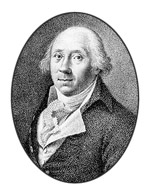 Nicolai was the focal point of the
German/Prussian Aufklädrung (Enlightenment);
and, along with his partners Lessing and Mendelssohn,
he was largely responsible for it. Nicolai was
undoubtedly Weishaupt's main source for procuring books and
journals, and from that acquaintance was likely initiated
into the Order himself. Subsequently, the Illuminati would
publish many pamphlets, articles and revolutionary tracts
through this most important channel. Nicolai was the focal point of the
German/Prussian Aufklädrung (Enlightenment);
and, along with his partners Lessing and Mendelssohn,
he was largely responsible for it. Nicolai was
undoubtedly Weishaupt's main source for procuring books and
journals, and from that acquaintance was likely initiated
into the Order himself. Subsequently, the Illuminati would
publish many pamphlets, articles and revolutionary tracts
through this most important channel.
To stress the importance of Nicolai to the dissemination of
ideas during the German Enlightenment it is reported that his
journal Allgemeine Deutsche Bibliothek, for
instance, reviewed a staggering 80,000 books in forty years.
It was "intended to review (and thereby to expose to as large
a public as possible) the entire prose production of
the time …" (The Eighteenth Century German "Trivialroman" As Constructed
By Literary History And Criticism)
|
|
Pappenheim, Friedrich Lothar Ferdinand Graf von (1727-1792)
|
Alexander
|
General and Governor of Ingolstadt
|
|
|
Pestalozzi, Johann Heinrich (1746-1827)
|
Alfred
|
Swiss Educator, Interlaken
|
Johann Herbart -> John Dewey; Friedrich Froebel
|
|
Poelffy, Count
|
|
Chancellor of Hungary
|
Johann Herbart -> John Dewey; Friedrich Froebel
|
|
Riedl, Midiael von
|
Euclid
|
Counsellor at Munich
|
|
|
Röntgen, Ludwig
|
Averroes
|
Lutheran minister
|
England
|
|
Karl Kröber (Agis) makes a revealing report to
Areopagites concerning Röntgen: "This week we shall
receive a Lutheran minister, who by slight of hand has
collected nine thousand florins for the community … As
soon as peace is made he is to set of for London, with a
multitude of letters of recommendation. The Pr._F_O.B, uncle
of the reigning Duke, has promised to second him in that
country for the Order. He must slyly Illuminize the English
…" [AB: 653] Abbé Barruel says that his copy of
the Original Writings Vol. I contained a note in
the margins stating that the initials refer to Prince
Ferdinand of Brunswick.
|
|
Ruedorfer, Franz Xaver (1752-1811)
|
Livius/Plinius minor
|
Secretary of the States at Munich
|
Bavarian Academy of Sciences
|
|
Ruef, Kaspar (1748-1805)
|
Fabius
|
Professor at Freiburg
|
|
|
Sauer, Georg Conrad (1754-1797)
|
Attila
|
Chancellor at Ratisbon
|
|
|
Savioli-Corbelli Alexander Graf von (1742-1811)
|
Brutus
|
Court treasurer Munich
|
Bavarian Academy of Sciences
|
|
Schmerber, Sigmund
|
Agathocles
|
Merchant at Frankfurt am Main
|
|
|
Schröckenstein, Friedrich Freiherr von
|
Mahomet
|
Domherr (canon or "cathedral gentleman") in Eidistatt
|
|
|
Seinsheim, Maximilian Joseph Graf von (1751-1803)
|
Alfred
|
Vice-President and Treasurer at Munich
|
Bavarian Academy of Sciences
|
|
Socher, Joseph (1755-1834)
|
Hermes Trismegistus
|
Curate in Haching; Philosopher and theologian
|
|
|
Sonnenfels, Joseph von (1733-1817)
|
Fabius - Numa pompilius romanus
|
Lawyer and writer in Vienna; Law professor at Vienna University
for political science; Adviser to the empress
59
|
Viennese justice system; Joseph II
60
|
|
"Sonnenfels was professor of police and cameral sciences in
Vienna and together with Justi the major figure in Austrian
eighteenth century cameralism. He held several high offices
in the Austrian administration and also was involved in the
reform of the penal system and in various philanthropic
activities. His Grundsätze der Polizey, Handlung
und Finanzwissenschaft (2 volumes 1765-67) has been
used as an official textbook for decades. Sonnenfels
represented 'an improved version of the mercantilist
theory... in several respects superior to Justi'"
61
"A son of the Jewish teacher of Hebrew Berlin Lipmann, an
outstanding Austrian lawyer and writer; he is an author of
excellent textbook Grundsätze der Polizei a
Abschaffung der Tortur. His brother František
belonged to the greatest benefactors in the town."
62
|
|
Stadion, Friedrich Lothar Joseph baron von (1761-1811)
|
Romulus
|
Envoy in Munich
|
|
|
Stadion, Johann Philipp von (1763-1824)
|
Remus
|
Ambassador at London; Count of Stadion-Warthausen
|
|
|
Stolberg-Rossla, Johann Martin, Count of (1728-1795)
|
Ludovicus Germanicus also Campanella
|
Maternal uncle to the Prince of Neuwied
|
|
|
Barruel says that along with Stolberg, the whole Court of
Neuwied is under the control of the Illuminati: "and with him
may be comprised the whole court, the favorites, secretaries,
and council without exception." [AB: 699]
Count Johann Martin Stolberg-Rossla is an ancestor of the current
Royal Houses
of Hesse and
Mecklenburg-Schwerin.
|
|
Swieten, Baron Gottfried van (1733-1803)
|
|
Minister of public instruction; patron of music
|
Mozart, Haydn and Beethoven; Frederick
the Great
63
|
|
Tropenegro, Ernst Leopold
|
Coriolanus
|
Counsellor at Munich
|
|
|
Utzschneider, Joseph von (1763-1840)
|
Hellanicus Lesbius
|
Professor and Scientist at the original Munich Institute;
entrepreneur, optical instrument maker
|
Thomas John Hussey, Rector of Hayes, Kent; William Henry Fox
Talbot; Sir John Herschel; Carl Friedrich Gauss; King
Maximilian I Joseph (cousin of Karl Theodor)
|
|
His correspondence with
Hussey and
Talbot is well-known, as was his business
for making telescopes (Reichenbach,
Utzschneider und Liebherr). Sir John Herschel, Carl
Friedrich Gauss, Bavarian Minister Montgelas (fellow
Illuminatus, code name "Musaeus") and King Maximilian I
Joseph (cousin of Elector Karl Theodor, who published the
edicts against the Order) were among the notables
to visit his world famous
optical factory.
Along with Cosandey, Renner, and Grünberger,
Utzschneider played a major role in the Illuminati's
downfall. [VS, JR, CE]
|
|
Weishaupt, Adam (1748-1830)
|
Spartacus
|
Founder; Professor at Ingolstadt
|
Revolutionaries for the next two-hundred years
|
|
Werner, Erasmus von
|
Menelaus
|
Counsellor at Munich
|
|
|
Will, Anton (1756-1827)
|
Agrippa
|
Professor, Ingolstadt
|
University of Strasbourg, Lyon and Charenton
|
|
Wundt, Karl Kasimir (1744-1784)
|
Raphael
|
Professor, Heidelberg University; pastor, Wieblingen
|
Wilhelm Maximilian Wundt (grandson) -> Order of the Skull
and Bones -> American Educational Establishment
|
|
This member has the distinction of being the grandfather to
the experimental educational psychologist, William Wundt.
Wundt's methods were grafted onto the American Educational
Establishment by three Skull and Bones members: "Daniel Coit
Gilman (First President of University of California and First
President of Johns Hopkins University), Timothy Dwight
(twelfth President of Yale University) and Andrew Dickson
White (First President of Cornell University)." (Professor
Antony Sutton, America's Secret Establishment;
PDF, no pagination, section titled "Memorandum Number Ten:
Keeping The Lid On The Pot") The "revolutionary trio" of
Bonesmen set off for the University of Berlin to receive
post-graduate degrees while the "Hegelian philosophical
ferment" was still in full swing. (Ibid.) This would mark the
beginning of the plot to turn the education system into a
humanistic "experimental laboratory." (See
World
Government Fronts, Psycho-social Change Agents, for
instance)
I credit Sutton for citing Dülmen's work: the source for
the majority of the members used to compile the present
membership outline. After finding out Wundt had a grandfather in
the Illuminati I looked at the basis of Sutton's find:
Richard van Dülmen's, Der Geheimbund der
Illuminaten. Darstellung, Analyse, Dokumentation
(Stuttgart, 1977, p. 269) To my utter astonishment a simple
Google search turned up the relevant portions of the book;
published at the site of the
Grand Lodge of British Columbia and Yukon, along with the
accompanying large list of members. According to Sutton, the
list is from the "Illuminati Provincial Report from Utica
(i.e., Heidelberg) dated September 1782." (America's
Secret Establishment; PDF, no pagination; section
titled "The Hegelian Influence On Hall")
Robison and Barruel wrote their paltry lists based upon the
available information at the time. During the 1790s
investigations were still continuing and more material has
since seen the light of day - unfortunately most of it still
remains in German. In 1918 Vernon L. Stauffer wrote that
there were 96 principle works devoted to the Illuminati. I
imagine the number of titles is much higher now. At any rate,
we owe Professor Richard van Dülmen
a debt of
gratitude for making the list a part of the historical
record. If anyone would like to have the Dülmen excerpts
professionally translated into English, please let me know -
I will be more than willing to pay for the service.
|
|
Zwack, Baron Franz Xavier von (1755-1843)
|
Cato (also Danaus & Phil.-Strozzi)
|
Lawyer, Judge; Aulic Counselor, and Counselor of the Regency
|
Weishaupt (Cato was his closest confidant); Prince von
Salm; Count (Baron) Montgelas
|
|
Zwack, Simon
|
Claudius
|
Lawyer, Aichad
|
|
An Intimate Look inside the Illuminati
By 1787 the Illuminati had enormous tentacles inside every branch
of authority in Bavaria and greater Germany.
The sheer size and
scope of the conspiracy alarmed the Duke to no end. They had also
spread into France, Italy, Austria, Poland and England - even to
America, by their own account. In the third year of operation Weishaupt boasts to Zwack that they have more than a thousand
initiates. [AB: 596]
Knigge recruits an additional 500 [AB: 649] -
mostly masons - very shortly after his initiation in 1780; and by
the third edict against the Order the Illuminati were estimated to
have between 2000 and 3000 members. [VS]
John Robison compiles an
interesting statistic concerning the different lodges and
locations: Munich, Hesse (many), Ingolstadt, Buchenwerter,
Frankfort, Monpeliard, Eichstatt, Stuttgart (3), Hanover,
Carlsruhe, Brunswick, Anspach, Calbe, Neuwied (2), Magdeburg, Mentz
(2), Cassel, Poland (many), Osnabrueck, Turin, Weimar, England (8),
Upper Saxony (several), Scotland (2), Austria (14), Warsaw (2),
Westphalia (several), Deuxponts, Heidelberg, Cousel, Mannheim,
Treves (2), Strasburg (5), Aix-la-Chappelle (2), Spire, Bartschied,
Worms, Bahrenberg, Düsseldorf, Switzerland (many), Rome,
Cologne, Naples, Hannibal, Bonn (4), Livonia (many), Ancona,
Courland (many), Florence, Franken Dahl, France, Alsace (many),
Holland (many), Vienna (4), Dresden (4), America (several). [JR]
The whole plan for governing the Order is reprinted in Barruel's
Memoirs …, pp. 541-78. It entails Weishaupt's
instructions to his Regents, Local Superiors, Provincials and
National Directors. The international character is stressed in a
letter to the National Superiors:
"In every nation there shall be a
National Director associated and in direct communication with our
Fathers, the first of whom holds the helm of the Order."
[AB: 565]
I have created a graphic based on the system described by Weishaupt:
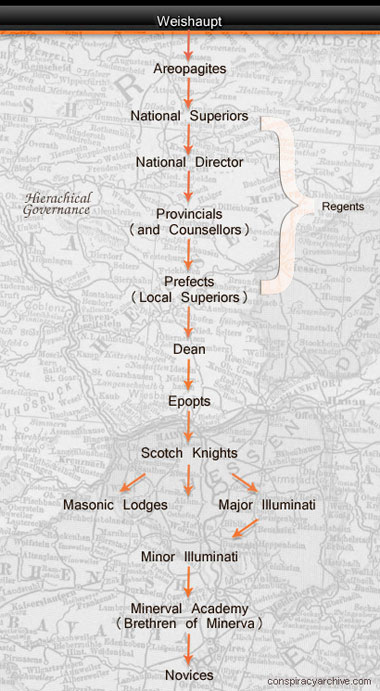
At the helm of course was Weishaupt, the absolute dictator. In
order to maintain complete secrecy he conceived a plan which would
have been successful had the initiates carried it through without
deviation.
In two letters, first to Zwack and then to Baader, he
explains:
"For the present, direct nobody to me but
Cortez, that I
may have some leisure to digest my speculations, and determine each
one's place; for every thing depends on that. My operations with
you shall be directed by the following table:
"Immediately under me I have two adepts, into whom I infuse my
whole spirit; each of these corresponds with two others, and so on.
By this method, and in the simplest way possible, I can inflame and
put in motion thousands of men at once. It is by such means that
orders are to be transmitted and political operations carried on."
Then to Baader, a few days later, he writes:
"I have sent to Cato a
table (schema) showing how one may methodically
and without much trouble arrange a great multitude of men in
the finest order possible. He will probably have shown it to
you; if he has not, ask for it. Here is the figure (then follows
the figure).
"The spirit of the first, of the most ardent, of the most profound
adept daily and incessantly communicates itself to the two A, A; by
the one to B, B; by the other to C, C: B B and C C communicate it
to the eight following; these to the next sixteen, from thence to
the thirty-two and so downwards. I have written a long explanation
of it all to Cato. In a word, every man has his Aide-Major, by
whose means he immediately acts on all the others. The whole force
first issues from the center and then flows back again to it.
Each one subjects, as it were, to his own person, two men whom
he searches to the bottom, whom he observes, disposes,
inflames, and drills, as it were, like recruits, that they may
hereafter exercise and fire with the whole regiment. The same plan
may be followed throughout all the degrees."
[AB: 575; emphasis in
original]
With that explanation we see the seeds of many revolutionary groups
and the way to operate within cells - never apprehending the
"unknown superiors" directing them from above.
Despite the confessions of a few Illuminati, secrecy was rigidly
imposed and obeyed. From the very beginning, the initiate is thrust
into a culture of total surveillance - on himself, his family and
associates. We'll begin from the Novice degree to see how this was
accomplished.
Insinuators and Scrutators
The initiate is expected to recruit as many members as possible. A
"Brother Insinuator" has as an ultimate goal the job of making new
proselytes for the Order. Some are specifically giving this task,
but as a general rule everyone is obliged and all the brethren are
Insinuators with varying success. Moreover, the laws of the Order
decree that each Insinuator is the superior over every new recruit
he has brought to the cause. In this manner every Illuminatus "may
form to himself a petty empire; and from his littleness, emerge to
greatness and power." [AB: 415]
From the beginning he is instructed how to judge the character of
those he might enlist. This process begins with himself, his
immediate family and friends. Each Novice is giving a notebook with
tables, which is to be kept and maintained as a journal; he is
ordered to write down all his observations.
His undertaking is to
assiduously pry,
"into every thing that surrounds him, he must
vigilantly observe all persons with whom he becomes acquainted, or
whom he meets in company, without exception of relations, friends,
enemies, or entire strangers; he must endeavor to discover their
strong and their weak side; their passions and prejudices; their
intimacies, and above all, their actions, interests, and fortune;
in a word, every thing relating to them: and the remarks of every
day he must enter in his Diary."
[AB: 416]
A twofold advantage is gained from this information: first, by the
Illuminati and its superiors; second, by the adept himself. Barruel
eloquently describes the mutual benefit this scheme has for both
parties:
"Twice every month he will make a general statement of his
observations, and he will transmit it to his superiors. By these
means the Order will be informed what men, in every town or
village, are friendly or inimical to it. The means of gaining over
the one or destroying the other will naturally occur. With respect
to the Insinuator, he will learn how to judge of those who
are proper persons to be received or rejected, and he will
carefully insert his reasons for the admission or rejection of
those persons in his monthly statements."
[Ibid. 416]
The Insinuator cannot pursue either Pagans or Jews, and above all
he is to "shun the Ex-Jesuits like he would the plague." [AB, NW,
VS]
The Illuminati had a particular rabid hatred towards the
Jesuits, beginning with Weishaupt's own disdain. A whole covert
unit was constructed within the Minerval Academies to publish and
disseminate anti-Jesuit material. They even had their own printer
in Munich to produce new editions, at their own expense, of
propaganda opposing the Jesuits. [AB: 586] Members who are
schoolmasters and professors are commissioned to guard against the
Jesuits, and to obtain the expulsion of all those discovered.
[Ibid. 608]
They had great success in this endeavour, and
particularly in Ingolstadt:
"Through the intrigues of the Brethren the Jesuits have been
dismissed from all the Professorships; we have entirely cleared
the University of Ingolstadt of them."
"The Dowager Duchess has modeled her Institute for the
Cadets entirely on the plan prepared by the Order. That
house is under our inspection; all its Professors belong to our
Order; five of its members have been well provided for, and all
the pupils will be ours."
[Zwack, on the progress of
Illuminism; AB: 611, emphasis in original]
The trial period for a Novice could last from one to three years,
depending on the age of the initiate. Secrecy is instilled from the
start as the Novice receives his new alias; his characteristic or
adoptive name. He is then tasked to write a history of his new
patron, to help him understand the qualities and actions that he is
to emulate.
For Weishaupt, Spartacus is an apt alias; for
Goethe, Abaris is particularly appropriate as well.
64
The Novice is also let in on the secret names applied to towns and
regions.
He learns that,
"Bavaria, the country of their
founder, is denominated Achaia; Swabia, Pannonia; Franconia,
Austria, and Tyrol are denoted by Illyria,
Egypt, and Peloponnesus; Munich is called Athens;
Bamberg, Antioch; Inspruck, Samos; Vienna in Austria,
Rome; Wurtzburg, Carthage; Frankfort on the Mein
becomes Thebes; and Heidelberg, Utica.
Ingolstadt, the natal soil of the Order, was not
sufficiently denoted by Ephesus; this privileged town was
to be decorated with a more mysterious name, and the profound
adepts bestowed on it that of Eleusis."
[AB: 429; emphasis
in original]
To the Illuminati the greatest of all study was the "knowledge of
men." Weishaupt himself became very good at psychology and
sociological manipulation. The Insinuator - by this time, his
Brother Teacher - will examine everything the Novice has written in
his journal; and exercises on ancient authors and the heroes of
antiquity will help the Novice in constructing a proper outline of
those around him. [AB: 431] All the while he is constantly pressed
by his Superiors "to propose those whom he may think fit for the
Order."
While studying the art of knowing himself and others, the Novice
fills his journal with every detail; his age, occupation, country
and place of residence; what he likes to study, the books in his
library, secret writings he may possess; his revenue, his enemies,
and reason thereof; outlines of his acquaintances, protectors and
friends. [AB: 433]
In all, there are seventeen columns to fill,
[Ibid. 597] and a second table is subjoined which is reserved for
complete descriptions of his family, particularly his father,
mother and siblings.
65
The discourse
to the next degree says it all:
"for men may be turned to any thing
by him who knows how to take advantage of their ruling passions."
[Ibid. 449]
And one might add, by taking advantage of his family's
"ruling passions" as well.
Later on, in the Minor Illuminatus degree, Weishaupt admonishes:
"Assiduously observe every Brother entrusted to your care; watch
him particularly on all occasions where he may be tempted not to be
what he ought to be."
[AB: 448]
Weishaupt is seeking to create the
perfect spy in each of them. Upon admission to the Major
Illuminatus degree the candidate is told of the code "Nosce te
ipsum" (know thyself), and when another Brother pronounces it he is
supposed to reply "Nosce alios" (know others). [Ibid. 455]
In this
degree, the spying is taken to a whole other level. The candidate
is told to scrutinize his inferiors in the form of questions about
his physiognomy; his countenance; his gait; his language; his
education - and each topic has multiple questions to elicit precise
descriptions. The "Scrutators," in order to answer the questions
posed, gather the facts when the target least expects it.
Amazingly, they actually go so far as to follow their prey into his
bedroom,
"where they will learn whether he is a hard sleeper,
whether he dreams, and whether he talks when dreaming; whether he
is easily or with difficulty awakened; and should he be suddenly,
forcibly, or unexpectedly awakened from his sleep, what impression
would it make on him?"
[Ibid. 455-56]
It is also in the Major Illuminatus degree that the candidate
delivers up a sealed history of his life. This is then compared
with the tables already in the possession of his superiors - the
complete picture drawn up of his person. And if it coincides with
the surveillance conducted he is then admitted into the deeper
mysteries. [AB: 456] By this time the adept is well accustomed to
the investigations, and no objection would be forthcoming.
The
all-seeing eye of the Order had become habitual.
The "Brethren of Minerva"
I will end part one with a description of the class above that of
Novice. The degree of the "Academy of Illuminism," or the "Minerval
Schools," was a natural extension of Weishaupt's proclivity to
initiate young pliable minds to his cause. It was his wish to
establish a sort of "academy of literati" to study the ancients,
the art of the scrutator, and to better determine those who had a
penchant for the "Mysteries."
By these means, in Weishaupt's words,
he can
"discern those who show a disposition for certain special
Doctrines relative to Government or to Religion."
[AB: 440]
The
statutes of the degree state that it "wishes to be considered only
as a learned society or academy," and a Pythagorean ideal is most
definitely the aim.
They are called the Brethren of Minerva. The academy is composed of
ten, twelve and sometimes fifteen Minervals, and directed
by a Major Illuminatus. The Illuminati's calendar is marked holy on
the days in which the academy is to meet and they call their
meeting place a Church.
The gathering is held twice a
month, always on the full moon. The Church is preceded by an
anti-chamber,
"with a strong door armed with bolts, which is to be
shut during the time of the meeting; and the whole apartment is to
be so disposed, that it shall be impossible for intruders either to
see or hear anything that is going forward."
[AB: 441]
At the commencement of each meeting, the President reads chosen
passages from the Bible, Seneca, Epictetus, Marcus Aurelius, or
Confucius. Barruel notes the care taken to give all the works the
same weight and authority.
After the lecture, each pupil is
questioned on the,
"books which he has read since the last meeting;
on the observations or discoveries he may have made; and on the labours or services toward the progress of the Order."
[AB: 441]
There are multiple academies for the Minervals, and in each one
there is an appropriate library. The Illuminati supply the books
with money from the brethren; from the list of books the candidate
has said belong to him, which are extracted from his possession if
found useful; and third, by any means necessary - theft and robbery
being encouraged. The precious volumes are usually stolen from the
courts of Princes, Nobles and Religious Orders.
Periodically lists
are drawn up and the brethren are encouraged to procure them anyway
they can:
"all these would be of much greater use if they were in
our hands. What do those rascals do with all those books?"
[AB:
441]
Each year the Superiors pose questions to the pupils which they are
to answer in the form of dissertations. These are meant for public
consumption and the Illuminati have booksellers (like Nicolai) who
put the works into circulation. [AB: 442-43]
An important symbol for the "Brethren of Minerva" is of course the
owl.
David Livingstone first
proposed a theory to me in the following manner:
In Greece, the dying-god was known as Dionysus, a practice
adopted by the Greeks from the worship of Mithras by the
Babylonian Magi. Similarly, child sacrifice was also involved in
his cult.
Dionysus is interchangeable with Apollo, and Apollo's counterpart
is Athene or Minerva, whose symbol is the owl.
Thus the owl became an important Illuminati symbol, and was
adapted to the name of one of their grades, the "Minervals".
Likewise, Hegel, who undoubtedly would have been a member,
stated:
"When philosophy paints its gray on gray, then has a form of
life grown old, and with gray on gray it cannot be rejuvenated,
but only known; the Owl of Minerva first takes flight with
twilight closing in." - "Preface," Philosophy of Right
And so, the name of the Journal of the Hegel Society of North
America is the "Owl of Minerva".
Take note of the mention of Dionysus as being directly linked,
through Apollo, to Minerva. The Eleusinian mysteries were revered
by the Illuminati above all the
 ancient practices - and Dionysus
is associated with the rites
performed at Eleusis. ancient practices - and Dionysus
is associated with the rites
performed at Eleusis.
The "Bird of Minerva" has
been a symbol for the goddess of wisdom (Athena/Minerva) for
thousands of years. Hegel used it, the
Journal of the
Hegel Society of America employs the symbol, and the Bohemian
Club uses it as well.
In the Cremation of Care ceremony, ritualized
at the Bohemian Grove, we hear the "Priest" intone:
"O thou, great
symbol of all mortal wisdom, Owl of Bohemia, we do beseech thee,
grant us thy counsel."
66
Turning to Hegel, according to Jacques d'Hondt in Hegel
Secret, Hegel and Schelling "were avid readers of a Journal
dedicated to the events in France from a more or less Girondist
point of view, Minerva, the title of which found its way
into Hegel's
Philosophy of Right … The engraving on the
first issue of Minerva shows the owl of Minerva, which
according to d'Hondt is Masonic but which is also the ancient
symbol of Athena, the Greek Goddess of wisdom among other things,
taking flight from a basket at the top of a monumental column."
67
The correlation with the Illuminati seems obvious in hindsight, but
at the time David suggested the connection, I did not know for sure
whether the Minerval Degree was meant to allude to Minerva. It does
indeed. Each member of the Academy is called a Minerval, but the
whole of the school is called the "Brethren of Minerva."
Moreover,
the discourse for initiation into the Major Illuminatus degree -
the superiors of the Brethren of Minerva - makes the case concrete:
"Seek faithful co-operators, but seek them not in tumults and
storms; they are hidden in darkness. Protected by the shades
of night, solitary and silent, or reunited in small numbers,
they, docile children, pursue the grand work under the direction
of their Superiors. They call aloud to the children of the
world, who pass by in the intoxication of pleasure-how few
hearken to them! He alone who has the eye of the bird of
Minerva, who has placed his labours under the protection
of the star of night, is sure of finding them." [AB: 458; bold
emphasis mine]
As if this wasn't enough, later in the book, Barruel makes this
matter-of-fact statement:
"Weishaupt had adopted the bird of night
for his emblem."
(p. 582)
End Notes
→
|