|
|
|

|
by John Lash October 2006 Flanders from MetaHistory Website
Who wrote these documents, and where did the authors came from? It is exasperating to delve into this material with no concrete idea of its human origin in cultural, historical, or geographic terms.
Even assuming that the Egyptian
codices are translations of "original writings" by Gnostics who
belonged to cults scattered around Egypt and the Near East, we are
left in bafflement as to where the Gnostic movement originated in
the first place.
They were copied down and translated - not written - by Coptic scribes using an improvised language. The desert monks who may have understood precious little of what they were translating. We do not know anything about the condition of the Greek texts they used, or why they were charged to make these translations.
This being so, my educated guess is probably as good as anyone’s: I’d say the "originals" were rough notes taken by students in the Mystery Schools, or what remained of them. The notes may have been translated into Coptic - in my opinion, a form of scribal shorthand or stenography, rather than a genuine language - as a writing exercise for the scribes, rather than to faithfully preserve the materials.
This is hard to imagine, perhaps, and
painful to admit. But the awful fact is, these precious documents
are appallingly shoddy, flawed, and incoherent.
We have no idea where the originals may have been written and stored, but the Royal Library of Alexandria is one possibility. There is some artifactual and architectural evidence that Gnostic sects were established around the Mediterranean basin, including Palestine, close to the Dead Sea encampment of the Zaddikim.
The "originals" could have originated in
hundreds of places.
Their only take interest in the Coptic materials as they reveal something about the origins of Christianity, not Gnosticism. No serious scholar considers the content of Gnostic teachings and Mystery School instruction as such to be worthy of discussion.
This disregarding attitude extends to
the cultural, historical, and geographical origins of the Gnostic
movement.
When Doresse published
The Secret Books of the
Egyptian Gnostics in 1958, there was still some debate over where
the Gnostic movement originated. Amazingly, Doresse, a Catholic
archeologist who was overtly hostile to the Gnostics, was the only
post-Nag Hammadi scholar to cite what the Gnostics themselves had to
say about the sources of their movement.
Then on to Ctesiphon, fabled for the soft heaps of amber in its marketplace, and into Parthia, home of the greatest archers in the world, past the scattered encampments of the Sabaeans, star-gazers who read in mystic trance the secrets of the thirteen heavenly Aeons.
Then deeper into Asia, beyond Nineveh,
rich in courtesans, and beyond Hecbatana, smoke-filled city of a
hundred gates, turning north toward the rugged Elbruz Mountains, and
mounting to the high plain before Mount Hermon, the White Mountain
of Seir, not far from the glittering, gunmetal blue of the Caspian
Sea.
There, bounded to the north by the Araxes River, a high plateau fed by Lake Urmia marks the geographic matrix of the Gnostic movement.
Doresse wrote:
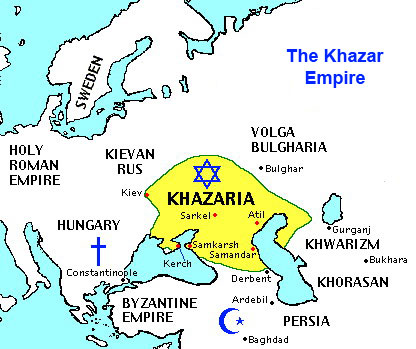
Once the homeland of the Gnostic movement is located geographically (black diamond, upper center of map), a remarkable fact comes to light:
See in below insert, enlarged view of map for more details.
The name Seth occurs in the Bible, in Genesis 4:25:
Significantly, this is the only time it occurs. Seth belongs to "another seed," a lineage set apart from the Judeo-Christian narrative of "sacred history."
From the inception of their story,
Gnostics are situated outside the conventional narrative of Western
spiritual life.
German scholars such as,
...who are largely ignored today, delved deeply into the prehistoric roots of Iranian religion known as Zurvan.
This is the germ of the doctrine of cosmic duality attributed to the Persian prophet, Zoroaster, and spread throughout the world by the members of his religious order, the Magi.
Reitzenstein in particular intuited that Gnostic ideas were
influenced by Persian duality, or
Zurvanism, but he was unable to
work out how. No one since his time has done any better. The
investigation is complicated by the remoteness of Iranian religion,
dating to the 6th millennium BCE.
In his elegant little book on the Gnostics, Jacques Lacarriere asserts that Gnosis was a path of illumination based upon ancient star-wisdom.
The Jewish historian Josephus says that the Children of Seth were widely revered as celestial seers who,
All through the Near East and into Europa, the astronomer-priests of the Magian Order was known in late times as "Chaldeans," a rather misleading nickname.
This term is a derivation of the Sumerian Kasdim, related to the Hebrew Chesed (a sepiroth of the Tree of Life) and Chassidim, "the pious," an ultra-conservative sect linked to the Zaddikim.
The tendency of Biblical editing is to conflate Chaldean motifs with the Magian Order, conferring legitimacy on the patriarchs by way of association.
Abraham's father, Terah, was a priest of the temple of the lunar god, Sin, in the city of Ur.
There is a great deal of astro-mythological lore
encoded in the Old Testament - evidence of Magian and Sethian
influences. And, of course, the Magi figure vividly in the New
Testament fable of the birth of the savior.
In her extraordinary
and little-known book,
Plato Prehistorian, Mary Settegast situates
the rise of the Magian Order, the original priesthood of ancient
Iranian religion, in the Age of the Twins, around 5500 BCE, a date
supported by the Greek sources. Settegast refers here to Zodiacal
timing based on the precession of the equinoxes.
In Not in His Image, I distinguish single-source duality from two-source duality (the two-source hologram of Philip K. Dick). The latter is typical of Gnostic writings.
In the Sophia mythos, there is no internal split
in the Godhead (the Pleroma), but there is an anomalous projection
from it, setting up a two-world scenario.
In my own researches with the master tool of precession, the Dendera Zodiac, I have found that Zodiacal Ages correlate to known historical and archeological evidences with impressive consistency, and often in astonishing detail.
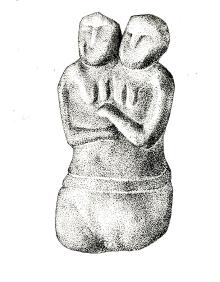
Axis C of the Dendera Zodiac, dated to 5,600 BCE, marks the Age of the Twins. A white marble figure of the "double goddess" from Catal Huyuk VI (pictured on right, from Mellaart, The Archeology of Ancient Turkey, p. 21) clearly present the Twins motif.
At Catal Huyuk archeologists have found twelve successive layers of building, representing distinct stages of the city and reflecting different eras of its history. The top layers of the mound, containing the most recent buildings, are dated at 5,600 BCE, the date of Axis C and the double goddess relic.
I could offer dozens of similar
examples....
The Magi brought this method down from the Urmian Plateau and spread it throughout the Fertile Crescent.
At Eridu (Ur in the Chaldees), directly south from the hidden navel of the Gnostic movement, precessional timing would have been imparted to the first Sumerian theocrats. But once it was turned over to state-supported priests and social controllers of the early Near Eastern theocracies, precession lost its value as a tool for educational planning and guidance.
The telestai consecrated to guiding humanity fell into
conflict with other Magians whose aims were political. The eventual
split in the Magian Order devolved upon such arcane matters.
The
culture is named after an excavated site at the southern
Over Lake Van looms Mount Ararat, where Noah’s ark is said to have come to rest.
Over Lake Urmia looms Mount Kuh-I-Khwaga, the "White Mountain of Seir" held sacred by Gnostics down into a period some five or six thousand years after their tradition was founded there.
(Map detail left, from Mary Settegast, Plato Prehistorian. Radius of circle, about 165 miles.)
Mandaeans of the Iraq marshes, whose beliefs show many similarities to Gnosticism, recount a parallel legend of a founding couple, Anosh-Uthra and Yohanna, who established their base at the White Mountain.
Urmia derives from the ancient Persian word for water.
Lake Urmia is an UNESCO Biosphere
Reserve.
Some traces of this early settlement survive on the ground.
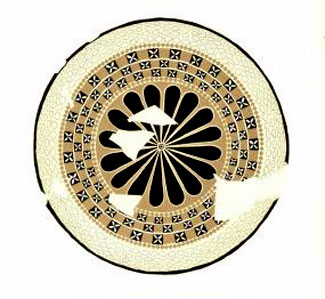
Excavations at Hajii Firuz have produced rich archeological evidence, including a fired ceramic dish from the Halafian culture of Palestine, contemporary with it - i.e., the dish was brought to Urmia from Palestine.
The décor shows the sixteen petal motif, the
signature of the Mystery cells. (Settegast, plate 121a.) It is
likely that the organization of the Mystery cults in the Near East,
as well as the technique and teaching they transmitted, derive from
the remote Iranian matrix.
But as dissemination proceeded, the Order gradually split into two distinct branches, Gnostics and Illuminati, as we might now call them.
Each branch operated on different motives and methods.
Masters of Learning
Within the Order, Gnostics were given the title of
vaedemna, "seer,
wise one," as distinguished from the priest, the zoatar, who
officiated openly in society and advised Middle Eastern theocrats on
matters of statecraft and social morality, not to mention
agricultural planning - for Zoroaster was by all accounts
responsible for the introduction of planned, large-scale
agriculture.
In Christianity, it is Jesus as the incarnation of Christ, the only-begotten son of God, following the hybrid theology of Saint Paul.
In Islam, the redeemer figure is plural, assuming the form of various Imams and hidden masters. The Sunni-Shi'ite conflict is about the succession of Imans after Mohammed.
In all cases the
soter
is a patriarchal figure, the central authority in a theocratic cult
whose ultimate aim, make no mistake, is to dominate the entire world
by imposing a social-spiritual order based on the dictates of an
off-planet father god who speaks exclusively to white male
demagogues (WMDs).
In the Coptic codices soter occurs frequently to designate the Gnostic master or teacher. But another term, phoster, is closer to the meaning of vaedemna, a wise or illuminated person (cognates: veda, vidya, wisdom, wit).
Lest the reader despair, believing that I am unduly quibbling over terms, I must point out that a huge problem for humanity hinges on the difference between a seer and a priest, especially a state-sponsored priest.
Mary Settegast astutely notes that Iraniologists "hold conflicting views regarding the historical milieu of the prophet."
The crucial problem is this:
Here is that distinction that has baffled all scholars: between the shaman-seer and the sacerdotal priest who plays a hand in court politics. For the latter, agriculture was part of a sacred vocation.
Since the cultivation of the earth was central to Zoroaster’s message,
Does this sound creepily familiar?
In the mission of the Zoroastrian Magi who took control of social
organization under the theocratic paradigm, we have the ancient
model of invasive colonialism and all it entails, a model still in
operation today.
According to scholarly opinion today and popular tradition in ancient times, the Magi were regarded, not as missionaries with a state agenda to execute, but,
Guides and
Leaders
This is not just a problem for scholars, however, it is a matter that concerns the very fate of humanity.
It determines the way we view human potential and how we
frame moral and ethical criteria by which society is guided. This
long and tangled tale from northwestern Iran brings us to the core
issue of human social experience: how we define what is evil, what
works against life.
Reitzenstein and others who placed the origins of Gnosticism in Iranian duality did not have enough source material to recognize that Gnostic dualism is a two-world system, not a split-source system.
By split source, I mean that good and evil come from the same source. Gnostics rigorously denied this view.
This is,
however, the central Zoroastrian doctrine, inherited by an extremist
sect of Palestine, the
Zaddikim of the Dead Sea, and absorbed into
Christianity like a lethal virus.
Absolute opposition of good and evil was an erroneous concept, and completely alien to their worldview. Gnostic ideas are wonderfully finessed, and their teachings are most finely nuanced when it comes to the problems of error and human responsibility.
One finds none of this
sophistication in the rigid, conflictual dualism of Zoroaster.
The vaedemna does not enter into the politics of social control, not even to proffer advice, because he or she is consumed with other priorities.
For Gnostic seers, the priorities were to maintain the lineage of the Revealers, preserve the sacred method of instruction by the Divine Light, and teach and transmit what they knew to the world at large.
They were consecrated to a sacred aim, a telos, that embraced two dimensions: the art of guidance and the work of culture-making. They did guide others, but they did not manipulate them in the way the zaotar or state-priest did.
They guided individuals by mystic instruction and the example of character.
In short, they maintained a rigorous boundary between their consecrated aim, to teach, and the political ambition to lead. The best guides are not leaders.
The best guides are like spies, who do not like to
be followed.
Know-It-Alls
He notes that respected initiates such as the Pagan emperor Marcus Aurelius did not use it. Neither was it common in Greek-language Judaism.
It seems to have been used for the first time by Plato!
In the Politicus 258e-267a, Plato refers to gnostike techne,
Plato asserts that,
Well, there it is, as plain as day: Plato plays the deification card.
His notion of a gnostikos is an expert advisor in theocratic government. i.e., rulership by the gods or those descended from gods. But how can this be. It is known that Plato was initiated at Eleusis.
If he had intimate contact with telestai, how could he have embraced and endorsed the program of the Illuminati, the Magians who
run the theocratic agenda?
But the Organic Light casts no shadow.
I
conclude that Plato, though initiated, never witnessed the Organic
Light, the secret medium of Mystery instruction. Had he done so, he
would never have invented the analogy of the Cave.
This is the oldest text in the NHL, dating to almost 700 years earlier than the other documents. Yet no scholar has remarked on the highly unusual fact of its inclusion into the corpus.
I have pointed out before that the guardians of the Mysteries did not call themselves gnostikoi, but telestai, "those who are aimed."
It is known that gnostokoi was the term directed at them in ridicule by the Church Fathers:
I maintain that the
telestai renounced this name because it was associated (via Plato)
with the social engineers and special advisors of theocracy.
The Carpocratians tended to embrace the Hindu doctrine of avataric descent, i.e., flesh-and-blood embodiment of superhuman beings - an element of the theocratic scenario.
The cult of personality was totally incompatible with the
mission and demeanor of the telestai. They would never have
tolerated such statues, but glorification of "great men" is typical
of the theocratic agenda.
The names ascribed to Gnostics and initiates were actually titles rather than proper names:
The names of very few Gnostics - Simon Magus, Valentinus, Basilides, Hypatia - have come down to us.
Today we use the insult "Gnostic" to characterize the ancient
movement whose members opposed, not only their own
self-glorification, but the theocratic program of great men and male
leaders established and enforced by the politically oriented Magians.
If the tyrant who afflicts and rewards his people can convince them he is appointed to do so by god, or that he himself is a god, then divine authority rules the day (as Constantine, the faux convert, understood so well).
But theocracy, and the entire dominator complex it focalizes, was totally alien to the telestic mission to teach, enlighten, guide, enrich - in short, to encourage and cultivate human potential. The will to control and manipulate human potential can never be reconciled with such a mission.
This is why the original Gnostics, adepts of shamanic ecstasy who taught from instruction by the Light, defected from the Magian Order.
The
Order around in the Urmian Plato in the Age of the Twins, around
6000 BCE. The split devolved after 4400 BCE, when the vernal point
was shifting from the Bull into the Ram.
Alexander the Great ruled the ancient world when the spring equinox was located in the head-stars of the Ram, known as Amun to the Egyptians.
Consequently, Alexander had himself pictured on coins with the horns of Amun, and he staged an initiation at the Amun sanctuary of Siwa with the purpose of having himself elevated to a god-like status (yet another example of historical and artifactual verification of precessional timing).
All this is totally consistent with the advancement of
theocratic agenda in the Arien Age.
Their status as nomadic sages, the famous "Chaldeans" of antiquity, would have given them every advantage to observe three momentous developments:
They could not have closely analyzed this progression, not detected the pathological violence driven by redemptive beliefs as deeply as we can, however.
At least, I don’t think so...
The sheer force of it may even have taken them by surprise, not to mention the insidiousness of Illuminati techniques, perverting the regenerative rites of the Mysteries....
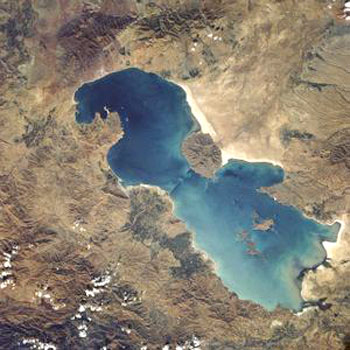
View of Lake Urmia with salt crystals and island
We are at the other end of the long drama that began by the shore of
Lake Urmia, with 2000 years worth of hindsight on the Illuminati
program and what the message of divine love packaged in the redeemer
complex can do to life on a small, lonely planet.
|


 Danielou and cultural historian
William Irwin Thompson also adopt this technique. I myself have
applied it extensively for over thirty years.
Danielou and cultural historian
William Irwin Thompson also adopt this technique. I myself have
applied it extensively for over thirty years.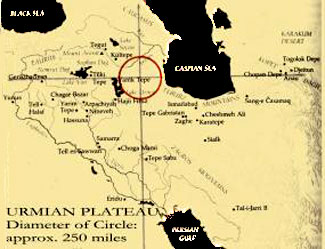 end of Lake Urmia, due east of Lake Van in Armenia.
  Seir is an Indo-Iranian root, cognate with
Syr and Shri, "holy, hallowed, sacred."
Seir is an Indo-Iranian root, cognate with
Syr and Shri, "holy, hallowed, sacred."