
Appendices
|
|
353
Appendix 1
The only master of this kind of observation hitherto has been Marcel Griaule (d. 1956) but he left an impressive cohort of disciples. They have renewed the understanding of African studies, showing that such systems are still alive with the Dogon, whom Griaule "discovered," in the true sense of the word.
As Germaine Dieterlen writes: "The smallest everyday object may reveal a conscious reflection of a complex cosmogony. . . Thus for instance African techniques, so poor in appearance, like those of agriculture, weaving and smithing, have a rich, hidden content of significance . . . The sacrifice of a humble chicken, when accompanied by the necessary and effective ritual gestures, recalls in the thinking of those who have experienced it an understanding that is at once original and coherent of the origins and functioning of the universe.
"The Africans," she continues, "with whom we have worked in the region of the Upper Niger have systems of signs which run into thousands, their own systems of astronomy and calendrical measurements, methods of calculation and extensive anatomical and physiological knowledge, as well as a systematic pharmacopoeia. The principles underlying their social organization find expression in classifications which embrace many manifestations of nature. And these form a system in which, to take examples, plants, insects, textiles, games and rites are distributed in categories that can be further divided, numerically expressed and related one to another. It is on these same principles that the political and religious authority of chiefs, the family system and juridical rights, reflected notably in kinship and marriages, have been established. Indeed, all the activities of the daily lives of individuals are ultimately based on them." [n1 Introduction to Conversations with Ogotemmeli, Marcel Griaule (1965), p. xiv.].
It goes without saying that we need not subscribe to the author's opinion that the Mande peoples invented "their own systems of astronomy . . .”
354
Appendix 2
The father of Saxo's Amlethus was Horvandillus, written also Orendel, Erentel, Earendel, Oervandill, Aurvandil, whom the appendix to the Heldenbuch pronounces the first of all heroes that were ever born.
The few data known about him are summarized by Jacob Grimm [n1 TM, pp. 374f. See also K. Simrock, Der ungenahte Rock oder Konig Orendel (1845), p. ix.]:
He suffers shipwreck on a voyage, takes shelter with a master fisherman Eisen [n2 Also written Ise or Eise, and derived from Isis, by Simrock; considering that the fisherman's modest home has seven towers, with 800 fishermen as his servants, Ise/ Eisen looks more like the Fisher King of Arthurian Romances.], earns the seamless coat of his master, and afterwards wins frau Breide, the fairest of women: king Eigel of Trier was his father's name. The whole tissue of the fable puts one in mind of the Odyssey: the shipwrecked man clings to a plank, digs himself a hole, holds a bough before him; even the seamless coat may be compared to Ino's veil, and the fisher to the swineheard, dame Breide's templars would be Penelope's suitors, and angels are sent often, like Zeus's messengers. Yet many things take a different turn, more in German fashion, and incidents are added, such as the laying of a naked sword between the newly married couple, which the Greek story knows nothing of. The hero's name is found even in OHG. documents: Orendil . . , Orentil . . . a village Orendelsal, now Orendensall, in Hohenlohe . . . But the Edda has another myth, which was alluded to in speaking of the stone in Thor's head. Groa is busy conning her magic spell, when Thorr, to requite her for the approaching cure, imparts the welcome news, that in coming from Jotunheim in the North he has carried her husband the bold Orvandill in a basket on his back, and he is sure to be home soon; he adds by way of token, that as Orvandil's toe had stuck out of the basket and got frozen, he broke it off and flung it at the sky, and made a star of it, which is called Orvandils-ta. But Groa in her joy at the tidings forgot her spell, so the stone in the god's head never got loose (Snorri's Skaldskap. 17).
Powell [n3 In his introduction to Elton's translation of Saxo, p. cxxiii.], in his turn, compares the hero to Orion in his keen interpretation: .
The story of Orwandel (the analogue of Orion the Hunter) must be gathered chiefly from the prose Edda. He was a huntsman, big enough and brave enough to cope with giants. He was the friend of Thor, the husband of Groa, the father of Swipdag, the enemy of the giant Coller and the monster Sela.
355
The story of his birth, and of his being blinded, are most apparently in the Teutonic stories, unless we may suppose that the bleeding of Robin Hood till he could not see, by the traitorous prioress, is the last remains of the story of the great archer's death. Dr. Rydberg regards him and his kinsfolk as doublets of those three men of feats, Egil the archer, Weyland the smith, and Finn the harper, and these again doublets of the three primeval artists, the sons of Iwaldi, whose story is told in the prose Edda.
It is not known which star, or constellation, Orvandils-ta was supposed to be. Apart from such wild notions as that the whole of Orion represented his toe [n4 R. H. Allen, Star Names (1963), p. 310.]—to identify it with Rigel, i.e., beta Orionis, would be worth discussing—even Reuter tries to convince himself that Corona borealis "looks like a toe," [n5 Germanische Himmelkunde (1934), p. 255.] because he could not free himself from the fetters of seasonal interpretation of myth, nor dared he attack the Romantic authority of Ludwig Uhland who had coined the dogma that Thor carried the sign for spring in his basket; accordingly a constellation had to be found which could announce springtime, and Reuter, choosing between Arcturus and Corona, elected the latter.
It is not his toe alone, however, which grants to Hamlet's father his cosmic background: some lines of Cynewulf's Christ dedicate to \he hero the following words:
Hail, Earendel, brightest of angels thou,
sent to men upon this middle-earth!
Thou art the true refulgence of the sun,
radiant above the stars, and from thyself
illuminest for ever all the tides of time.
[n6 See TM, p. 375; I. Gollancz, Hamlet in Iceland (1898), p. xxxvii; Reuter, p.256.].
The experts disagree whether Earendel, here, points to Christ, or to Mary, and whether or not Venus as morning star is meant, an identification which offers itself, since ancient glosses render Earendel with "Jubar," [n7 O jubar, angelorum splendidissime . . . See R. Heinzel, Uber das Gedicht von Konig Orendel (1892), p. 15.] and Jubar is generally accepted for Venus on the presupposition that "morning star" stands every single time for Venus, which is certainly misleading: any star, constellation or planet rising heliacally may act as morning star.
356
With respect to juba, i.e., literally "the mane of any animal," jubar, “a beaming light, radiance," we have, however, Varro's clear statement: “iuba dicitur stella Lucifer." [n8 See W. Gundel, De stellarum appellatione et religione Romana (1907), p. 106; Reuter, pp. 256, 295ff.]. Nonetheless, several experts are against the equation Orendel/Earendel = Venus [n9 E.g., A. Scherer, Gestirnnamen (1953), pp. 79-81.]. Gollancz abstains from precise identifications, but he procures the one more existing piece of evidence concerning the word Earendel:
In Anglo-Saxon glosses "earendel" . . . or "oerendil" is interpreted jubar, but "dawn" or "morning star" would probably be a better rendering, as in the only other passage known in old English literature, viz. the Blickling Homilies (p. 163, I. 3): "Nu seo Cristes gebyrd at his aeriste, se niwa eorendel Sanctus Johannes; and nu se leoma thaere sothan sunnan God selfa cuman wille"; i.e., And now the birth of Christ (was) at his appearing, and the new day-spring (or dawn) was John the Baptist. And now the gleam of the true Sun, God himself, shall come [n10 Gollancz, p. xxxviin.].
Orendel/Earendel, then, seems to be the foremost among those which announce some "advent," not unlike the passage in the Odyssey (13 .93f.) dealing with Odysseus' arrival in Ithaca: "When that brightest of stars (aster phaantatos) rose which comes to tell us that the dawn is near, the travelling ship was drawing close to an island." That might point, again, to Venus, but there are reasons to think of Sirius, the brightest of all fixed stars, as will come out later.
Another subject of discussion has been the etymology of the name, and since the identity of Orendel might depend on its etymology, we have to look into the matter, at least superficially. Jacob Grimm admitted freely:
I am only in doubt as to the right spelling and interpretation of the word: an OHG. orentil implies AS. earendel, and the two would demand ON. aurvendill, eyrvendill; but if we start with ON. orvendill, then AS. earendel, ORG. erentil would seem preferable. The latter part of the compound certainly contains entil = wentil [n11 In a footnote. Grimm asks (and we wish we knew the answer!): “Whence did Matthesius [in Frisch 2, 439a] get his 'Pan is the heathens' Wendel and head bagpiper?' Can the word refer to the metamorphoses of the flute-playing demigod? In trials of witches, Wendel is a name for the devil, Mones anz. 8, 124'"]. The first part should be either ora, eare (auris), or else ON. or, gen. orval (sagitta). Now, as there occurs in a tale in Saxo Grammaticus . . . , a Horvendilus filius Gervendili, and in OHG. a name Kerwentil. . . and
357
Gerenti1 . . , and geir (hasta) agrees better with or than with eyra (auris), the second interpretation may command our assent; a sight of the complete legend would explain the reason of the name. I think Orentil's father deserves attention too: Eigil is another old and obscure name. . . Can the story of Orentil's wanderings possibly be so old amongst us, that in Orentil and Eigil of Trier we are to look for that Ulysses and Laertes whom Tacitus places on our Rhine? The names show nothing in common.
Scherer (p. 179) states shortly: "Earendel does not belong to ausos 'dawn,' nor to OE. éar 'ear' (Ahre), but to OE. ae, ear m. 'wave, sea,' ON. aurr 'humidity’" Gollancz, who is inclined to connect Earendel with Eastern (ushas, eos, aurora, etc.), mentions more current derivations, among which is that from aurr "moisture," and from the root signifying "to burn" in Greek, euo, Latin uro, Ves- uvius, etc. Decisive seems to us the derivation from or = arrow, suggested by Grimm, and by Uhland, who explained Orendel as the one "who operates with the arrow" (in contrast to his grandfather, Gerentil, who worked with the ger = spear), and Simrock gives the opinion that the very gloss "Earendel Jubar" designate Earendel explicitly as "beam" (or "ray"), "which still in MHG. and Italian means 'arrow.' " [n12 Handbuch der Deutschen Mythologie (1869), § 82, P.233.].
Simrock did more Taking into consideration that in the Heldenbuch Orendel is spelled Erendelle, and at some other place Ernthelle, he thinks it probable that "Ern" was dropped as epithet on ornans [n13 lbid. See also Simrock, Die Quellen des Shakespeare (1870), pp. 129f.: “Dies ward aber wohl in Tell gekurzt, weil man die erste Silbe fur jenes vor Namen stehende 'Ehren' ansah, as nach dem d. Worterb, III 52 aus 'Herr' erwachsen, bald fur ein Epitheton ornans angesehen wurde."], and he concludes from there that the story of Tell shooting the apple from the head of his son was once told of Orendel himself. That the historical (?) Tell was not the inventor of this famous shot, or even performed it, seems rather certain. As Grimm aptly stated:
The legend of Tell relates no real event, yet, without fabrication or lying, as a genuine myth it has shot up anew in the bosom of Switzerland, to embellish a transaction that took hold of the nation's inmost being [n14 TM 3, p. xxxiv.].
358
Now there is no arrow to be found that could contest with Sirius in mythical significance. We know mulKAK.SI.DI, the "Arrow-Star" from Sumer, as well as "Tishtriya," the arrow from Ancient Iran—it is shot from a bow built up by stars of Argo and Canis Major (Sumerian: mulBAN). The very same bow is to be found in the Chinese sphere, but there the arrow is shorter and aims at Sirius, the celestial Jackal, whereas the same Egyptian arrow is aimed at the star on the head of the Sothis Cow, as depicted in the so-called "Round Zodiac" of Dendera—Sirius again. In India, Sirius is the archer himself (Tishiya), and his arrow is represented by the stars of Orion's Belt. And about all of them manifold legends are told. Thus, "Earendel, brightest of angels thou," might well point to the brightest among the fixed stars, Sirius.
But even the derivation from the root aurr = moisture, ear = sea, would not exclude Sirius. Quite the contrary. The Babylonian New Year's ritual says: "Arrow Star, who measures the depth of the sea"; the Avesta states: "Tishtriya, by whom the waters count." And as Tishtriya, "the Arrow," watches Lake Vurukasha (see p. 215), so Teutonic Egil is the guardian of Hvergelmer, the whirlpool, and of Elivagar, south of which "the gods have an 'outgard,' a 'saeter' which is inhabited by valiant watchers—snotrir vikinger they are called in Thorsdrapa, 8—who are bound by oaths to serve the gods. Their chief is Egil, the most famous archer in the mythology. As such he is also called Orvendel (the one busy with the arrow)." [n15 V. Rydberg, Teutonic Mythology (1907), pp. 424ff., 968ff.].
We had better stop getting diffuse concerning Sirius the Arrow and his role as guardian and as "measurer of the depth of the sea"; the few hints that were given here must suffice to show the level at which to look for the father of Hamlet.
Since, however, we can never resist the temptation to quote beautiful poems, we have still to confess our suspicion that the "Stella Maris" is Sirius too. Enough is known about Isis/Sirius as guardian-deity of navigators, to whom belongs the "carra navalis," and was it not "Mary or Christ" who was addressed with "Hail, Earendel"? In the same manner, the hymn "In Annunciatione Beatae Mariae" begins with the verses:
Ave, maris stella
Dei mater alma
atque semper virgo
felix caeli porta
359
Sumens illud Ave
Gabrielis ore
funda nos in pace
mutans nomen Evae.
And there is another hymn which was sung, according to the Roman Breviary, after Compline during Advent and Christmastide, and which has been ascribed to Herimanus Contractus of Reichenau (d. 1054), who would appear to have lived and died a cripple in his monastery:
Alma redemptoris mater, quae pervia caeli
porta manes et stella maris, succurre cadenti,
surgere qui curat, populo, tu quae genuisti
(natura irante) tuum sanctum genitorem,
Virgo pius et posterius, Gabrielis ab ore
sumens illud Ave, peccatorem miserere.
"What I have been attempting to suggest," says the interpreter of this hymn [n16 H. Musurillo, S.J., "The Medieval Hymn, Alma Redemptoris," Classical Journal 52 (1957), pp. 171-74.], "is that the attraction of this charming mediaeval prayer and hymn would seem to form, in large measure, from the intentional ambiguity, the different levels of meaning, and the sunken imagery. . . The 'nourishing mother' is perhaps pictured as a fixed constellation in the heavens, or perhaps as the morning star, guiding those on the sea. She is a celestial passage-way, always passable and ever accessible. . . The falling and rising has now (besides the constantly falling sinners) perhaps the further overtones of heavenly bodies rising and falling, perhaps of ships rising and falling on the sea, 'and lastly of tottering children who need their mother's help to walk. . . The poem. . . is a very striking one, and its force derives, in my view, from the subtle imagery of the first three lines. . . They offer us a symbol, a verbal icon, of the entire situation of man on earth in his struggle to rise to the stars, of his need of an otherworldly force which is at once strong and loving."
360
Appendix 3
Now, apart from the circumstance that the snowy burial ascribed to the followers of Kai Khusrau, Enoch, and Quetzalcouatl could hardly be claimed to be an "obvious" feature, the fate of Quetzalcouatl's companions might further our understanding; more correctly, the topos where this event is supposed to have happened might do so. The "five mountains" of Mexican myth, their "gods" respectively, the Tepictoton [n1 See E. Seler, Gesammelte Abhandlungen, vol. 2, p. 507, for an Aztec drawing of the Tepictoton.], appear to represent the five Uayeb (= Maya; with the Aztecs: Nemontemi), the Epagomena, those days gained by Mercury from the Moon during a game of checkers, in order to help Rhea/Nut to days "outside of the year," when she could bring forth the five planets. As a matter of fact, in his chapter on the clothes and emblems of the gods, Sahagun puts the "Mountain-Gods" at the end of the list [n2 See T. S. Barthel, "Einige Ordungsprinzipein im Aztekischen Pantheon," Paideuma 10 (1964), pp. 80f., 83. In this paper, Barthel has established, in a rather convincing manner, the presence of decans in Mexican astronomy.].
Worth mentioning might be two more traits which Quetzalcouatl shares with his old-world brethren: Quetzalcouatl and Uemac, like Kai Ka'us and Kai Khusrau, are said to have ruled together, and Quetzalcouatl is accused of incestuous relations with his sister, as were Hamlet, Kullervo, Yama and, we might add, King Arthur [n3 See W. Krickeberg, "Mexicanisch-peruanische Parallelen," in Festschrift P. W. Schmidt, p. 388.].
Appendix 4
It is as yet too early in the day to deal with "Uncle Kamsa," whom lexicographers make a "mura-deva," allegedly a "venerator of roots" (mula/mura = root). In his Eine Beitrage (p. 11), Jarl Charpentier earnestly wishes us to accept as that "among the Indian natives fighting against the invading Aryans there were such," namely, "venerators of roots" (and venerators of worms as well). Although we do not doubt that the species Homo sapiens is capable of any "belief," we cannot perceive any cogent reason for subscribing to Charpentier's view.
361
Mula/mura, the "root," is a Nakshatra, a lunar mansion woven around with tales: it is the sting of Scorpius, serving as Marduk's weapon in: the "Babylonian Genesis" and as Polynesian Maui's fishhook; with the Copts it is "statio translationis Caniculae . . . unde et Siot vocatur," i.e., the Coptic table of lunar stations takes lambda upsilon Scorpii as the precise opposite of Sirius/Sothis, as we are informed by Athanasius Kircher, whereas Indian tables ascribe the role of exact opposition to Betelgeuse, ruled by 'Rudra-the-destroying-archer." Although we cannot pursue these and other tales further here, we think it at least appropriate to mention the concrete problems arising with such characters as "Uncle Kamsa," instead of accusing a true Asura of "veneration of roots."
Appendix 5
Sem Snaebjoern krad:
Hwatt kveda hraera Grotta
hergrimmastan skerja
ut fyrir jardar skauti
Elyudrs niu brudir;
ther er, lungs, fyrir laungu
lid-meldr, skipa hlidar
baugskerdir ristr bardi
bol, Amloda molu
Her er kallat hafit Amloda Kvern.
Gollancz (Hamlet in Iceland, p. xi) retranslated his translation into Old Norse so that the original and the nolens volens interpreting translation might be compared. The retranslation runs thus: kveda niu brudir eyludrs hraera hvat hergrimmastan skerja grotta ut fyrir jardar skauti, thaer er fyrir longu molu Amloda lid-meldr; baugskerdir ristr skipa hlidar bol lungs bardi. Elton translates the passage:
362
"Men say that the nine maidens of the island-mill (the ocean) are working hard at the host-devouring skerry-quern (the sea), out beyond the skirts of the earth; yea, they have for ages been grinding at Amlodi's meal-bin (the sea)." [n1 Saxo Grammaticus, Danish History, p. 402.].
Rydberg, too, offers a translation:
"It is said, that Eyludr's nine women violently turn the Grotte of the skerry dangerous to man out near the edge of the earth, and that those women long ground Amlode's lid-grist." [n2 Teutonic Mythology, § 80, p. 568].
In spite of the trickiness and the traps of the text Gollancz tries to solve the case; in fact, he tries too frantically (p. xxxvi): "The compound ey-ludr, translated 'Island-Mill,' may be regarded as a synonym for the father of the Nine Maids. Ludr is strictly the square case within which the lower and upper Quernstones rest,' hence the mill itself, or quern."
With this we wish to compare O. S. Reuter's explanation: "ludr = Muhlengebalk (dan. Luur = das Gerust zu einer Handmuhle)" (Germanische Himmelskunde, p. 239; he also includes a drawing of the mill). On p. 242, note, he renders the lines of Skaldskap. 25: "Neun Scharenbraute ruhren den Grotti des Inselmuhlkastens (eyludr) draussen an der Erde Ecke (ut fyrir jardar skauti)," adding: "Das (kosmische?) Weltmeer ist als 'Hamlets Muhle' gesehen." At least he thought, even if within brackets and with a quotation mark, of "cosmic" –Rydberg is the only one who has grasped this point completely.
"Ey-ludr," Gollancz continues, "is the 'island quern,' i.e., 'the grinder of islands,' the Ocean-Mill, the sea, the sea-god, and, finally, Aegir. 'Aegir's daughters' are the surging waves of the ocean; they work Grotti 'grinder,' the great Ocean-Mill (here called 'skarja grotti,' the grinder of skerries, the lonely rocks in the sea), 'beyond the skins of the earth' or perhaps, better, 'off yonder promontory.' The latter meaning of the words 'ut fyrir jardar skauti' would perhaps suit the passage best, if Snaebjorn is pointing to some special whirlpool." Non liquet: neither Aegir = eyludr, nor the nine maidens = waves, whether surging or not.
As concerns "off yonder promontory" which sounds ever so poetical and indistinct, see J. de Vries [n3 Altnordisches Etymologisches Worterbuch (1961)]: skaut n. Ecke, Zipfel, Schoss, Kopftuch, eig. "etwas Hervorragendes" . . . Dazu skauti m. "Tuch zum Einhullen," ae. sceata "Ecke, Schoss, Segelschote." fyr. praep. praef. "vor," durch,
363
wegen, trotz, fur. . . –lat. prae "voran, voraus," lat. prior "der fruhere" –which tells us either nothing at all or, if we take "prior" fort the proper translation, tells us the whole "story" by means of one single word; in the same manner as the mere fact that the pillars of Hercules were "fyr," called the pillars of Briareos, and before that time, the pillars of Kronos.
We stick, however, to Gollancz for some more lines. "The real difficulty," he says, "in Snorri's extract from Snaebjoern is . . . in its last line; the arrangement of the words is confusing, the interpretation of the most important of the phrases extremely doubtful. 'Lid meldr' in particular has given much trouble to the commentators: 'meldr,' at present obsolete in Icelandic, signifies 'flour or corn inl the mill'; but the word 'lid' is a veritable crux. It may be either the neuter noun 'lid,' meaning 'a host, folk, people,' or ship, or the masculine 'lidr,' 'a joint of the body.' The editors of the Corpus Poeticum Boreale read 'meldr-lid,' rendering the word 'meal-vessel'; they translate the passage, 'who ages past ground Amlodi's meal-vessels = the ocean'; but ‘mala,' 'to grind,' can hardly be synonymous with 'hraera,’ 'to move,' in the earlier lines, and there would be no point in the waves grinding the ocean. There seems, therefore, no reason why meldr-lid should be preferred to lid-meldr, which might well stand for 'shipmeal' (sea-meal), to be compared with the Eddic phrase 'graedis meldr,' i.e., sea-flour, a poetical periphrasis for the sand of the shore. Rydberg [Teutonic Mythology (1907), pp. 570ff. = pp. 388-92 in the 1889 edition], bearing in mind the connection of the myth concerning the fate of Ymer's descendant Bergelmer, who, according to an ingenious interpretation of a verse in Vafthrudnismal 'was laid under the millstone,' advanced the theory that 'lid-meldr' means 'limb-grist.' According to this view, it is the limbs and joints of the primeval giants, which in Amlodi's mill are transformed into meal. . . Snorri does not help us. The note following Snaebjoern's verse merely adds that here the sea is called "Amlodi's kvern.' "
In a note Gollancz adds that in some other manuscript he found the version: "Here the sea is called 'Amlodi's meal'" (Amloda melldur), and concludes: "No explicit explanation is to be found in early Northern poetry or saga. ‘Hamlet's Mill' may mean almost anything." It is not as bad as that. Moreover, Gollancz (p. xvii, note) detected more relevant figures of speech in the four lines cited below which he
364
ascribes to Snaebjorn: "The island-mill pours out the blood of the flood goddess's sisters (i.e., waves of the sea), so that (it) bursts from the feller of the land: whirlpool begins strong."
svad or fit jar fjoetra,
flods asynju bolde
(roest byrjask roemm) systra
rytr, eymylver snyter.
To which he adds: "In no other drottkvoett verse does eymylver occur: cp. eyludr above."
Appendix 6
It is not as easy to dispose of Mysing, as the specialists pretend, e.g., by preferring to interpret his name as "mouse-gray" instead of the equally possible "son of a mouse." Olrik (pp. 459f.) proposes to identify straightaway "King Mysing who killed Frith-Frothi, and the cow that struck down Frothi the Peaceful. . . King Mysing is merely a rationalistic explanation of the ancient monster." (For the death of Frodi by means of a sea cow, see also P. Herrmann's commentary on Saxo, pp. 380-84. This "cow"—in Iceland they remain within the frame of zoology and make it a stag—was, according to Saxo, a witch, who was pierced through by Frodi's men. Afterwards they kept Frodi's death a secret for three years, in the same manner as told by Snorri in his Heimskringla about Frey.)
A. H. Krappe, more observant, compared Mysing with Apollon Smintheus, the old "mouse-god" (ARW 33 [1936], pp. 40-56). He had in his mind, however, only the connection—undeniable as it is—between mice and rats and the plague, and the dragging-in of Smintheus does not much further the understanding of Mysing. This state of things was changed with the publication of the work by Henri Gregoire, R. Goossens and M. Matthieu, "Asklepios, Apollon Smintheus et Rudra: Etudes sur le dieu a la taupe et le dieu au rat dans la Grece et dans l'Inde," although they do not even mention our Mysing, and although they loudly praise (p. 157) the merit of "Meillet . . . d'avoir fait
365
descendre la mytholgie du ciel sur la terre"; with Rudra, and with the rat of Ganesha (who, by the way, acquired his elephant's head because the planet Saturn, not being invited to the infant's "baptism," had looked upon the baby with his evil eye, thus destroying his head which was successfully replaced by that of an elephant), the mouse plot has got much deeper background. Nevertheless, the identity and the role of the mouse deity is hardly going to be settled without taking into account (1) "the tailed Mus Parik, arrayed with wings; the Sun [fettered her to his own ray, so that she could not perpetrate harm; When she becomes free, she will do much injury to the world, till she is recaptured, having come eye-to-eye with the Sun"; this enigmatical winged mouse come from the world horoscope in the Iranian Bundahishn (chapter V, Anklesaria translation, p. 63); (2) the colorful Polynesian myths dealing with the rat that gnawed through the "Nets of Makalii," i.e., Hyades and Pleiades; she could do so unpunished being Makalii's very own sister; (3) the warriors, in the guise of mice, of Llwyd, son of Cil Coed, "who cast enchantment over the seven cantrefs of Dyfed . . . to avenge Gwawl son of Clud," in the third branch of the Mabinogi. There are more items, to be sure, but we have to leave it at that.
Appendix 7
We want to stress the point that the haughty verdicts as given by Genzmer, Olrik, and others on Snorri's tale are not unknown to us. Their opinions run along these lines: "The last part of the story of Grotti and Mysing is 'How the sea grew salt.' This is a different motif, in no wise connected with the peace of Frothi." [n1 A. Olrik, The Heroic Legends of Denmark (1919), p. 460.]. Genzmer's wording is more arrogant still. The transportation of the mill by Mysing and the grinding of salt aboard the ship is "die Anschweissung einer zweiten selbstandigen Sage; der grossartig einfache, ahnungsvolle Schluss unserer Dichtung wird durch ein solches Anhangsel todlich geschadigt." [n2 Edda, trans. F. Genzmer (1922), Thule I, p. 181].
It would be more adequate to state that the myth has been "fatally damaged" by the modern experts, and not by Snorri. When we come to the little salt-mill of Kronos, the reader will understand the plot better.
366
Olrik (pp. 457f.), however, has some pretty survivals to offer:
In 1895, Dr. Jakob Jakobsen, the well-known collector of the remnants of the ancient "Norn" language of the Western Islands, was informed by an old Shetlander, whose parents had come from the Orkneys (Ronaldsey) that near the most northerly of these islands there was an eddy called "the Swelki" [that is, Snorri's svelgr, "seamill, where the waters rush in through the eye of the mill-stone"]. On that spot a mill stood on the bottom of the sea and ground salt; and a legend of Grotti-Fenni and Grotti-Menni was connected with it. In the course of later investigations in the Orkneys themselves (South Ronaldsey) he learned about the sea mill in the Pentland Firth grinding salt. In 1909, Mr. A. W. Johnstone was told by a lady from Fair Isle that Grotti Finnie and Lucky Minnie were well known in her native island, being frequently invoked to frighten naughty children. Although the legend in those parts is in a fragmentary condition, reduced to incoherent survivals, the tenacity of the oral tradition shows how deeply rooted the legend is in these islands. Outside of the Orkneys neither Mysing nor his salt mill are known to tradition except in the songs of the Edda which themselves bear the stamp of Western provenience.
Appendix 8
Vafthrudnismal 35 is rendered by Gering: "Ungezahlte Winter vor der Schopfung / geschah Bergelmirs Geburt. / Als fruhestes weiss ich, dass der erfahrene Riese / Im Boote geborgen ward." Simrock translates similarly, and he remarks (Hdb. Dt. Myth., § 9): "Das dunkle Wort ludr fur Boot zu nehmen, sind wir sowohl durch den Zusammenhang als durch die Mythenvergleichung berechtigt."
R. B. Anderson (The Younger Edda [1880], pp. 60f.) translates the verse—quoted by Snorri (Gylf. 7)—as follows: "Countless winters / Ere the earth was made, / Was born Bergelmer. / The first I call to mind / How the crafty giant / Safe in his ark lay."
Neckel and Niedner (Die Jungere Edda, pp. 54f.) state that Bergelmer and his wife "stieg auf seinen Muhlkasten und rettete sich so." The lines above they render with the words: "Als fruhestes weiss ich, dass der vielkluge Riese in die Rohe gehoben ward," adding in a footnote: "Das oben mit 'Muhlkasten' wiedergegebene Wort ubersetzt man gewohnlich
367
mit 'Boot' oder auc mit 'Wiege,' ohne Begrundung und gegen den Wortlaut der Prosa. Gegen den gewohnlichen Wortsinn 'Mahlkasten' (Muhlsteinbehalter auf Pfosten) spricht nichts. Freilich kennen wir den angedeuteten Vorgang des Naheren nicht und wissen daher auch nicht, warum der Riese gehoben ('gelegt') werden musste, und wer ihn aufhob."
The ominous word ludr occurs again in Helgakvida Hundingsbana II, 2-4, where Helge—seeking refuge from king Hunding—works in a mill, disguised as a female, and almost wrecks the ludr.
In common with the mythologists who defend the "boat," in Vafthrudnismal 35, eeling entitled to it on account of comparative mythology (see Simrock, quoted some lines ago), and whom he fights
explicitly, Rydberg upholds the notion that the Ark was a ship. It will come out later that this general notion is incorrect.
Appendix 9
As a matter of fact, Simrock already (Handbuch der Deutschen Mythologie, pp. 240f.) ventured to interpret Fengo (Amlethus' evil uncle) as "the grinding," and Amlethus as "the grain"; "wo selbst der Name mit Amelmehl [Greek amylon], Starkemehl, Kraftmehl ubereinstimmt." He even thought of the possibility (although taking this thought for audacious, "gewagt") to derive the family name of Thidrek's clan, i.e., the name of the Amelunge, from "Amelmehl" We shan't dwell upon the strange information given by Athenaeus (Deipnosophistai 3.1 14f.) about "Achilles, or very fine barley" (cf. Theophr. 8.4-2. Aristoph. Eq. 819: Achilles cake), or on the surname of Ningishzida, namely Zid-zi "Meal of Life" (K. Tallqvist, Akkadische Gotterepitheta, p. 4p6; cf. Riemschneider, Augengott, p. 133), and we point only to Ras Shamra texts, where the lady Anat ground Mot. (See C. Gordon, Ugaritic Literature, p. 45.) H. . Ginsberg (ANET, p. 140) translates I AB, col. II:
She seizes the Godly Mot
With swords she does cleave him
With fan she does winnow him
With fire she does burn him
368
With hand-mill she grinds him
In the field she does sow him.
Birds eat his remnants
Consuming his portions
Flitting from remnant to remnant.
An astonished footnote states: "But somehow Mot comes to life entire in col. VI, and Baal even earlier." But there is absolutely nothing astonishing enough to shake the firm belief of experts in "chthonic" deities.
Appendix 10
For the first Irish harp (cruit), see Eugene O'Curry, On the Manners and Customs of the Ancient Irish, vol. 3 (1873), pp. 236f.; see also Rudolf Thurneysen, Die irische Helden- und Konigssage bis zum 17. Jahrhundert (1911), pp. 264f.
There once lived a couple . . . And the wife conceived a hatred to him, and she was flying from him through woods and wilderness; and he continued to follow her constantly. And one day that the woman came to the sea shore of Camas, . . . she met a skeleton of a whale on the strand, and she heard the sounds of the wind passing through the sinews of the whale on the strand, and she fell asleep from the sounds. And her husband came after her; and he perceived that it was from the sounds the sleep fell upon her. And he then went forward into the wood, and made the form of a Cruit [n1 "The word Cruit . . . signifies literally, a sharp high breast, such as of a goose, a heron, or a curlew" (O'Curry, loc. cit.).]; and he put strings from the sinews of the whale into it; and that was the first Cruit that was ever made.
Marbhan's legend about the beginnings of instruments and verses continues:
And again Lamec Bigamas had two sons, Jubal and Tubal Cain were their names. One son of them was a smith, namely, Jubal; and he discovered from sounds of two sledges (on the anvil) in the forge one day, that it was verses (or notes) of equal length they spoke, and he composed a verse upon that cause, and that was the first verse that was ever composed.
369
The legend goes on to report, why the timpan—another stringed instrument, different from the cruit—was called Timpan Naimh (or saint's Timpan), because "at the time that Noah, the son of Lamech, went into the Ark, he took with him a number of instruments of music into it, together with a Timpan, which one of his sons had, who knew how to play it:" When they finally left the ark, Noah caused his son to name the instrument after his own name, and only under this condition would he give it to him. "So that Noah's Timpan is its name from that time down; and that is not what ye, the ignorant timpanists, call it, but Timpan of the saints."
We introduce the legend for several reasons; first, because we felt reminded at once, as O'Curry did (p. 237), "of Pythagoras, who is said to have been led to discover the musical effect of vibrations of a chord by observing he sound of various blows on an anvil, though the Irish legend. . . does not appear to bear on the tones so much as on the rhythm of music." Second, because here we learn again about two successive stringed instruments, separated, so to speak, by a flood; Vainamoinen lost his Kantele when going to steal the Sampo, and had to construct a new one from wood, afterwards. These traditions must be thoroughly compared, one day, with the different lyres of Greece; we know that one was destroyed by Apollon—allegedly in a fit of repentance—after he had flayed Marsyas, and that Hermes made another one and presented it to Apollon; pike and whale of the northern seas have apparently replaced the turtle of Greek myth. We also know that the Pleiades, called the Lyre of the Muses by the Orphics, existed side by side with Lyra And Michael Scotus still knew about a turtle figuring, so to speak, as prow of Argo, and "out of which the celestial lyre is made." [n2 Testudo eius (navis) est prope quasi prora navis. , . de qua testudine facta est lyra caeli. Cf. F. Bolll Sphaera, p. 447]. But before being trapped between the devil and the deep sea, we prefer to stop, although this turtle seems to be placed exactly there, wher it "should" be, considering that upon its back the Amritamanthana w s accomplished. We shall hear more about that considerable and mysterious man, Michael Scotus, later (see p. 258).
The long and the short of the various traditions is that with a new age new instruments, new strings, or, as in the case of Odysseus, a new peg are called for: new "Harmony of the Spheres."
370
Appendix 11
Christensen, in his work on the Kayanids [n1 A. Christensen, Les Kayanides (1932), p. 43], states: "La tradition nationale fait grand cas du forgeron Kavag, qui s'insurgeait contre l'usurpateur Dahag (le Dahaka des Yashts) et hissait son tablier de cuir sur une lance, ce qui flit l'origine du drapeau de l'empire sassanide, appelé drafs e kavyan, 'drapeau de Kavag.' Cette légende, née d'un malentendu, la vraie signification du nom de drafs e kavyan etant 'le drapeau royal,' est inconnue dans la tradition religieuse."
By means of such statements—apart from "modestly" insinuating that Firdausi spun whole chapters of his Shahnama out of "malentendus" the way to relevant questions is effectively blocked. The story of the smith Kavag—also written Kaweh [n2 F. Justi, Iranisches Namenbuch (1895), p. 160. In the most recent translation of the Shahnama (Firdousi: Das Konigsbuch [1967 ]—so far, only Pt. I, Bks. 1-5 have come out), H. Kanus-Credé boldly identifies the smith Kawa with "awestisch Kawata," i.e., with Kai Kobad, the first Iranian ruler.], or Kawa—is told by Firdausi in the book dealing with the 1000 years' rule of Dahak, that fiendish tyrant out of whose shoulders grew two serpents [n3 Dahak with his two additional serpent heads is the same as the "powerful, raving Dasa with his 6 eyes and 3 heads" of RV 10.99.6.: Visvarupa, son of Tvashtri, and "Schwestersohn der Asura"; cf. Mbh. 12.343 (Roy trans., vol. 10, p. 572).] that had to be fed with the brains of two young men every day. The predestined dragon-slayer, and much expected savior, Faridun—Avestan Thraethona—a true predecessor of Kai Khusrau, had been saved from the snares of Dahak as a baby, and hidden away in the mountains. When the archdevil Dahak claimed the sacrifice of the last son of Kaweh—seventeen sons had already been fed to the dragon-heads—the smith started the revolution for the sake of Faridun:
He took a leathern apron, such as smiths
Wear to protect their legs while at the forge,
Stuck it upon a spear's point and forthwith
Throughout the market dust began to rise. . .
He took the lead, and many valiant men
Resorted to him; he rebelled and went
To Faridun. When he arrived shouts rose.
He entered the new prince's court, who marked
371
The apron on the spear and hailed the omen.
He decked the apron with brocade of Rum
Of jewelle patterns on a golden ground,
Placed on the spear point a full moon—a token
Portending gloriously—and having draped it
With yellow, red, and violet, he named it
The Kawian flag. Thenceforth when any Shah
Ascended to the throne, and donned the crown,
He hung the worthless apron of the smith
With still more jewels, sumptuous brocade,
And painted silk of China. It thus fell out
That Kawa's standard grew to be a sun
Amid the gloom of night, and cheered all hearts.
Now, if there was only the ""royal" flag to explain, why should Firdausi (or his source) invent a smith with the name Kaweh (Kavag, Kawa), if there was no connection whatever between kingship and the smith? Even if we leave out of consideration the widely diffused motif of great smiths as foster-fathers and educators of the hero [n4To mention only Mimir, Regin, Gobann. Kaweh's son Karna, by the way, whose life was spared thanks to the rebellion, became a famous paladin of Faridun, as Wittige/Wittich, son of Waylant the smith, became a strong paladin of Thidrek.] as well as the Chinese mythical imperial smiths, and all the material collected by Alfoldi in his article on smith as a title of honor among the kings of Mongols and Turks [n5 Cf., for Turkish traditions, R. Hartmann, "Ergeneqon," in Festschrift Jacob (1932), pp. 68-79.]: the very name of the dynasty of Iranian kings which is of the greatest interest for us, i.e., the Kayanides, is derived from Kavi/Kawi [n6 For the word kavi, see H. Lommel, Die Yashts des Awesta (1927), pp. 171f.; E. Herzfeld, Zoroaster and His World (1947), pp. 100-109.]. The most "kawian" Shah is Kai Ka'us, whose
name even contains the relevant word twice, the "Kavi Kavi-Usan," who cannot be separated from Kavy Usa (or Usanas Kavya) of the Rigveda and the Mahabharata [n7 See Lommel's article "Kavy Usan," in Melanges linguistiques offerts a Charles Bally (1939), pp. 21of. That C. Bartholomae (Altiranisches Worterbuch [1904], col. 405) confesses that he is "unable to find relations" between Iranian Kavi Usan and Rigvedian Kavy Usha is a precious gem in the collection of philological atrocities. "Falls meine etymologie richtig ist, entfallt auch die Namensahnlichkeit." Similarity he calls it! It will come out in the course of this essay that his proposition to derive the name Usan from “usa- m. (I) Quelle, Brunnen; (2) Abfluss, Leck . . ," is no obstacle at all to the understanding of Kavy Usan. Kronos too has been derived from Greek krounos, i.e., “source," “spring" (see Eisler, Weltenmantel, pp. 3782, 3850, reminding us also of the Pythagorean formula concerning the sea: "Kronou dakryon, the tear of Kronos").],
372
who shows several of the decisive characteristics of the Deus Faber. Not alone is he said to have forged the weapon for Indra [n8 RV 1.51.10; 121.12, 5.34.2. It is particularly the Shushna-myth, where K. U. replaces Tvashtri.]—instead of Tvashtri—and to have given Soma to Indra who, otherwise, has stolen (or has just drunk) the Soma in the "House of Tvashtri" (e.g., RV 3.48.2f.), but we are told that, during one of the never-ceasing wars between Asura and Deva for the "three worlds," the Asura elected Kavya Ushanas for their "priest" or "messenger," [n9 Taittiriya Sanhita 2.5.8 (Keith trans., vol. 1, p. 198)], the Deva elected Brihaspati (or Vrihaspati, i.e., Jupiter, in Taittiriya Sanhita Agni). Many warriors were slain on both sides, but—so the Mahabharata tells— “the open-minded Vrihaspati could not revive them, because he knew not the science called Sanjivani (re-vivification) which Kavya endued with great energy knew so well. And the gods were, therefore, in great sorrow." [n10 Mbh. 1.76 (Roy trans., vol. 1, p. 185). For this role of Kavya Ushanas, cf. Geldner, in R. Pischel and K. F. Geldner, Vedische Studien, vol. 2 (1897), pp. 166-70; for a life-restoring lake or well, owned by the “wicked Danavas," see Mbh. 833 (Roy trans., vol. 7, p. 83). In Ireland the Tuatha de Danann were able to revivify the slain (in the Second Battle of Mag Tured), the Fomorians were not.]. The Bundahishn, in its turn, gives the following report in chapter 32, dedicated to "the mansions which the Kayans erected with glory, which they call marvels and wonders," [n11 Zand-Akasih: Iranian or Greater Bundahishn, trans. by B. T. Anklesaria (1956), p. 271; cf. Christensen, p. 74.] in verse II: "Of the mansions of Kay Us one says: 'One was of gold wherein he settled, two were of glass in which were his stables, and two were of steel in which was his flock; therefrom issued all tastes, and waters of the springs giving immortality, which smite—old-age, that is, when a decrepit man enters by this gate, he comes out as a youth of fifteen years from the other gate,—and also dispel death." According to Firdausi, Kai Ka'us had a kind of balm by means of which he could have restored Shurab to life, but he did not give it to Shurab's father Rustem who implored him for this gift [n12 In the same manner, Lug—the strength and heart of the Tuatha De Danann as Krishna was that of the Pandava—denies the revivifying pig's skin to Tuirill who, by means of it, could have restored to life his three sons, Brian, Juchair, and Jucharba.]
373
To which Lommel remarks (Mélanges Bally, p. 212): "Und das ist der hasslichste lug im Bilde des Kay Kaus, dass er die Herausgabe des Wunderheilmittels verweigert, da Rostem und Sohrab, wenn beide am Leben waren, vereint ihm zu machtig waren." It is a rather idle occupation to look for "ugly traits" in the "character" of the Demiurge, even if he comes our way in the disguise of a Shah. These few hints must suffice for now; it is bad enough that the burden of "proof" rests with the defenders of sense in our deteriorated century, whereas everyone who presupposes non-sense and "malentendus" can get away with the most preposterous claims. In other words: even if the individual Kaweh/Kavag should have been "invented" by Firdausi, the notion of the Deus Faber and Celestial Smith as the disposer and guardian of kingship [n13 To repeat: the "Lord of the Triakontaeteris," the period of thirty years, i.e., the Egyptian and Persian "Royal Jubilee" (Saturn's sidereal revolution), is Ptah-Hephaistos.], as the original and legitimate owner of the "water of life," [n14 Also of the intoxicating beverage replacing it; Soma belonged to Tvasthri; Irish Goibniu brewed the ale which made the Tuatha De Danann immortal, and the beer of the Caucasian smith Kurdalogon played the same role. When Sumerian Inanna was almost lost in the underworld, it was Enki who gave to his messengers the life-restoring fluid with which to besprinkle the goddess. And, last but not least, it is Tane/Kane, the Polynesian Deus Faber, whose are "the Living Waters."] is by no means an accidental fancy [n15 Leo Frobenius, when accused—as happened sometimes—of having been deceived by African informants who "made up" any amount of fairy tales which were not "true," used to smile benevolently, and to point to what he called "stilgerechte Phantasie."], and the significance and meaning of the smith's apron as "Kawian flag" would have been understood from China to Ireland.
Appendix 12
It should be stressed that the disinclination of philologists to allow for the "essential" connection of Chronos and Kronos rests upon the stern belief that the "god" Saturn has nothing to do with the planet Saturn, and upon the supposition that an expert in classical philology has nothing whatever to learn from Indian texts. Were it not so, they might have stumbled over Kala, i.e., Chronos, as a name of Yama, i.e., Kronos, alias the planet Saturn.
374
Indians have indeed, written more about their Kala—and the Iranians about their Zurvan—than the Greeks about Chronos, but with the translated Vedas being what they are, we won't claim the relevant texts to be transparent, nor the scholarly interpretations to be particularly elucidating, all of the experts starting, as they do, from the unfounded conviction that "astrology" must be a "late" phenomenon.
To throw "identifications" around, does not lead anywhere, in our opinion, so we do not mean to simplify by nailing down, once and for all, Kala/Chronos as being the very same as Yama/Kronos/ Saturn. To recognize Kronos/Saturn as auctor temporum is quite sufficient for the time being [n1 We do not think it is an "accident" that this originator of time begins with the letter X, representing the obliquity of the ecliptic in Plato's Timaeus.], and so are the Indian notions, according to which Yama is often called Kala; in other passages he is the commander of Kala (and Kala, in his turn, the commander of Mrityu, Death) [n2 See J. Scheftelowitz, Die Zeit als Schicksalsgottheit in der indischen und iranischen Religion (1929), pp. 18ff. See also Burgess (Surya Siddhanta, p. 5), who generalizes: "To the Hindus, as to us, Time is, in a metaphorical sense, the great destroyer of all things; as such, he is identified with Death, and with Yama, the ruler of the dead."].
Kala plays his unmistakable role already in Rigveda 164, but the Atharva Veda dedicates to this "god" two whole hymns (19.53 and 19.54), and it is worth recalling Eisler's statement (Weltenmantel, p. 499): "Zu dieser Kala-Lehres des Atharvaveda ist spater nichts mehr dazugekommen; die jungeren Quellen fuhren nur die Vorstellungen weiter aus."
Here are some verses from these two hymns dedicated to Kala, without the numerous notes and comparisons with other translations, as treated by Bloomfield and Whitney (Atharva Veda, trans. by Bloomfield [I964],PP. 224f.):
19.53:
(1) Time, the steed, runs with seven reins (rays), thousand-eyed, ageless, rich in seed. The seers, thinking holy thoughts, mount him, all the beings (worlds) are his wheels.
( 2) With seven wheels does this time ride, seven naves has he, immortality is his axle. He carries hither all these beings (worlds). Time, the first god, now hastens onward.
(3) A full jar has been placed upon Time; him, verily, we see existing in many forms. He carries away all these beings (worlds); they call him Time in the highest heaven.
375
(4) He surely did bring hither all the beings (worlds), he surely did encompass all the beings (worlds). Being their father, he became their son; there is, verily, no other force higher than he.
(5) Time begot yonder heaven, Time also (begot) these earths. That which was, and that which shall be, urged forth by Time, spreads out.
(6) Time created the earth, in Time the sun burns. In Time are all beings, in Time the eye looks abroad. . . .
(8) ... Time is the lord of everything, he was the father of Prajapati.
(9) By him this (universe) was urged forth, by him it was begotten, and upon him this (universe) was founded. Time, truly, having become the brahma (spiritual exaltation), supports Parameshtin (the highest lord).
(10) Time created the creatures (prajah), and Time in the beginning (created) the lord of creatures (Prajapati), the self-existing Kashyapa and the tapas (creative fervour) from Time were born.
19.54:
(1) From Time the waters did arise, from Time the brahma (spiritual exaltation), the tapas (creative fervour), the regions (of space did arise). Through Time the sun rises, in Time he goes down again.
( 2) Through Time the wind blows, through Time (exists) the great earth; the great sky is fixed in Time. In Time the son (prajapati) begot of yore that which was, and that which shall be.
(3) From Time the Rks (= the Rig Veda) arose, the Yajus (= the Yajur Veda) was born from Time; Time put forth the sacrifice, the imperishable share of the gods.
(4) Upon Time the Gandharvas [n3 See A. Weber (Die Vedischen Nachrichten uber die Naksbatras, Pt. 2, p. 278, n. 3) about the Gandharvas as representing the days of the "year" of 360 days, according to the Bhagavata Purana 4.29.21 (Sanyal trans., vol. 2, p. 145); the Indians reckoned with several types of "years" at the same time, and so did the Maya.] and Apsarases are founded, upon Time the worlds (are founded), in Time this Angiras and Atharvan rule over the heavens.
(5) Having conquered this world and the highest world, and the holy (pure) worlds (and) their holy divisions; having by means of the brahma conquered all the worlds, Time, the highest God, forsooth, hastens forward.
376
Where we alternately read once "beings," and "worlds," the Sanskrit word is bhuvana, from the radical bhu- (= Greek phyo-) as discerned from the radical as-, bhil- meaning "to be" in the sense of perpetual change, "coming to be and passing away," as- being reserved for the changeless, timeless existence beyond the planetary "instruments of time," the organa chronou of Plato's Timaeus. As a matter of fact, Plato would have understood at once the verbs bhu- and as-, and he might well have applauded the utterance of the vanquished Daitya King Vali [n4 Bhagavata Purana 8.11 (Sanyal trans., vol. 3, p. 126).]:
"O Indra! Why are you vaunting so much? All persons are practically urged on by Kala in engaging themselves in an encounter. To the heroes, glory, victory, defeat and death gradually come to pass. This is the reason that the wise behold this universe as being guided by Kala, and they therefore neither grieve nor are elated with joy."
Nor is there much "primitive belief" to be squeezed out of such statements as "many thousand Indras and other divinities have been overtaken by Kala in the course of world periods." [n5 Quoted by Eisler, Weltenmantel, p. 501. What the author (pp. 385f.) has to say about "anthropomorphic, most primitive empathies" (?Einfuhlungen), connected with Ouranos, Ge, Helios and Selene, which are, allegedly, miles away from the "step of highly abstract conceptions about eternal Time," is not only a contradictio in adjecto, but plain thoughtlessness.]. But the classicists usually prefer to keep silent about the most revealing sentence of Anaximander, handed down to us by Cicero (De Natura Deorum 1.25): "It is the opinion of Anaximander, that gods are born in long intervals of rising and setting, and that they are innumerable worlds (or the—much discussed—innumerable worlds. Anaximandri autem opinio est, nativos esse deos longis intervallis orientis occidentisque eosque innumerabiles esse mundos)"; and if they do not keep silent, they claim it to be "much more natural" to understand these intervals as being in space than in time (Burnet), by which means every way to understanding is effectively blocked.
This much only for the time being: a broader discussion of Iranian Zurvan would wreck our frame; we do not think, however, that Zurvan/Chronos represents a "Zoroastrian Dilemma"; to style it thus (with Zaehner) is one more mistake: it is not the "beliefs" and "religions" which circle around and fight each other restlessly; what changes is the celestial situation.
377
Appendix 13
Some say, he bid his angels turn askance
The poles of earth, twice ten degrees and more
From the sun's axle, they with labour pushed
Oblique the centric globe: some say, the sun
Was bid turn reins from the equinoctial road. . .
. . . else had tbe spring
Perpetual smiled on earth with vernant flowers
Equal in days and nights, except to those
Beyond the polar circles; to them day
Had unbenighted shone; while the low Sun
To recompense his distance, in their sight
Had rounded still the horizon, and not known
Of east or west; which had forbid the snow
From cold Estotiland, and south as far
Beneath Magellan. At that tasted fruit
The sun, as from Thyestean banquet, turn'd
His course intended; else how had the world
Inhabited, though sinless, more than now
Avoided pinching cold and scorching heat?
MILTON, Paradise Lost, 10
Appendix 14
The name Mundilfoeri (Mundel-fere) raises a cluster of problems, and nothing is gained by evasive statements such as that given by de Vries (Altnord. Etym. Wb., p. 395): "Mundilferi. Name of the father of the Moon. . . Mundill. Name of a legendary figure."
As concerns mund, feminine, it means "hand" (Cleasby-Vigfusson, s.v.), but mund comprises the meaning of tutelage, guardianship (cf. German Vormund). Mund as a neutrum means "point of time, mood, humor, measure, and the right time" (de Vries, loc. cit.).
378
Mundill (Mundell) is an unknown "legendary figure," certainly; we should be glad to know what the name indicates precisely, but the specialists do not tell us. There is a small but promising hint: Gering, in his commentary on the Edda (vol. 1, p. 168), remarked, "The name occurs again among the saekonunga heiti Sn. E. II, 154." Heiti are a kind of denominations (Neckel renders it "Furnamen") which the skalds used side by side with kenningar (circumlocutions); the list of "heiti of seakings" is to be found in the Third Grammatical Tract contained in Snorri's Edda (ascribed to Snorri's nephew Olaf), and among the twenty-four heiti, no. 11 is Mysingr, no. 15 is Mundill [n1 Den tredje og fjaerde grammatiske afhandling i Snorres Edda, ed. by Bjorn Magnusson Olson (1884), 1II.15 (vol. 2, pp. 154f.).]. Everyone who is familiar with the many names given to the cosmic personae—specific names changing according to the order of time—in Babylonian, Indian, Chinese, etc., astronomy, is not likely to fall for the idea that these heiti were names of historical kings [n2 Olson, apparently a hardened euhemerist, stated in a note: "Hoc versu memoriali viginti quatuor nomina archipiratorum sive regulorum maritimorum continentur."]. The consequences resulting from the understanding of Mysing and Mundill (together with twenty-two more heiti) as representatives of the same cosmic function will not be worked out in detail here: he who keeps his eye on the different fords, ferrymen, pilots, personified divine ships, and kings of the deep sea that cross his path in the course of this essay may eventually work out his own solution. As for the word fere (in Mundelfere), Gering feels certain that it is the same word as OHG ferjo, MHG verge, i.e., ferryman, the name meaning "ferryman of Mundell." Gering refers to Finnur Johnsson who understood the mund in the name as "time," and "explained the name which he took for the name of the moon, originally, as 'den der bewaeger sig efter bestemte tider,'" i.e., somebody who moves according to definite times, let us say: according to his timetable (or schedule).
There is no reason at all to take Mundilfori for "originally" the name of the moon, this luminary not being the only timekeeper at hand. Vafthrudnismal 23 says of the Sun and Moon, the children of Mundilfori, that they circle around the sky serving as indicators of time [n3 Gering, loc. cit.: "himen hverfa . . . 'den Himmel umkreisen' . . . aldom at artale, 'urn den Menschen die Zeitrechnung zu ermoglichen.' Daher fuhrt auch der Mond den Namen artale 'Zeitberechner.'"].
"Ferryman of Time" would make a certain sense, but not enough yet to enlighten us about Mundill "himself."
379
The same goes for Simrock's rather imaginative Mundilfoeri = "Achsenschwinger," i.e., "axisswinger," but Simrock has at least thought about a sensible meaning, and maybe he has hit the mark quite unbeknownst. Ernst Krause, too, racked his brains, modestly asking the experts to examine the relation of this mundil with Latin mundus [n4 Tuisko-Land (1891), p. 326; see also p. 321]. We do not mean to meddle earnestly with this particular question, the less so as mundus translated into "the world" has become an empty and insignificant word altogether, but it certainly is depressing to watch the progressists working out their latest "solutions" for Latin mundus, namely, (1) "ornament," (2) "jewelIery of women," [n5 I.e., (1) "Schmuck," (2) "Piltz der Frauen"; see Walde-Hofmann, Lat. Etym. Wb., vol. 2, pp. 126f.] without recalling Greek kosmeo which does mean also "to adorn," to be sure, but not "originally," and not essentially; to establish order, especially in the sense of getting an army into line, is what kosmeo means, whence kosmos. And we are not entitled to give the silliest of all imaginable meanings to such a central word as mundus.
We should like to approach the words in question by means of the common objective significance underlying the vast family of word-images engendered by the radical manth, math, whence also (Mount) Mandara, mandala, Latin mentula (penis), and also our mondull [n6 Cf. A. Kuhn (Die Herabkunft des Feuers und des Gottertranks [1886], p. 116) where he refers to Aufrecht: "mondull m., axis rotarum, cotis rotatilis et similium instrumentorum"; ibid. note 2, quoting Egilson: "mondull m. lignum teres, quo mola trusatilis circumagitur, mobile, molucrum; mondultre m. manubrium ligneum, quo mola versatur."], which is supposed to have replaced the older form mandull. True, mandull/mondull is not yet mundill, and mundus is not identical with mandala, yet the whole clan of words depends from a central conception sticking firmly to mnt/mnd, and these consonants connote a swirling, drilling motion throughout. We are, here, up to a veritable jungle of misunderstandings, and the closer we look into the "ars interpretandi" of professionals, the more impenetrable the jungle becomes. But let us try to get a shred of sense by laying bare the more or less "subconscious" blunders accomplished by the interpreters dealing with the radical manth, the heart and center of the Indian Amritamanthana, the "Churning of Ambrosia," i.e., the Churning of the Milky Ocean in order to gain Amrita/Ambrosia, the drink of immortality. It is some sort of case history, the "case" being that manth, math appears to have two fundamentally different meanings (and some more),
380
for which we quote Macdonell’s Sanskrit dictionary (p. 218): “manth—á churning, killing, mixed beverage (= the Soma mixture); mantha-ka m. churning stick; manth-ana, producing fire by attrition." On page 214 we find s.v. math, manth: "whirl around (agnim), rub (a fire stick), churn, shake, stir up, agitate, afflict, crush, injure, destroy, . . . mathita bewildered, . . . strike or tear off, . .. uproot, exterminate, kill, destroy, . . . strike or tear off, drag away." [n7 See also H. Grassmann, Worterbuch zum Rig Veda (1955), col. 976f.].
So far, so good. But why insist on such misleading verbs as "striking" or "tearing off," etc.? Did not we hear about Fenja and Menja who "ground out a sudden host" for Frodhi, i.e., Mysing? And this is not an isolated instance. We know, for instance, of an extremely relevant Hittite prayer to the Ishtar of Nineveh who is asked "to grind away from the enemies their masculinity, power and health" [n8 See L. Wohleb, "Die altromische und hethitische evocatio," in ARW 2; (191.7), p. 209, n. 5: "Ferner mahle den Mannern (namlich des feindlichen Landes) Mannheit, Geschlechtskraft (?) Gesundheit weg; (ihre) Schwerter, Bogen, Pfeile, Dolch(e) nimm und bringe sie ins Land Chatti."]—the Hittites are quite respectable members of the Indo-European family of languages. Whether something is gained, or something is lost-peace, gold, health, heads, virility, and what else—it is ground out, or ground away, when the underlying image is a mola trusatilis; it is drilled out, or drilled away, when the motion of the cosmos is understood as alternative motion, as in the case of the Indian churn. We have sufficient reasons to take alternative motion for the older conception, but this is irrelevant right here and now; relevant is the general conception, expressed by the manifold words engendered by the radical manth/math, that every event is due to the rotary motion (whether "true" or alternate, compare appendix # 17) of the celestial mill or churn [n9 We touch only slightly the family of Amlodhi's kvern; it must be enough to state that quairnus means "millstone, mill" in Gothic, whereas Old Norse kirna is the churn. Jacob Grimm (Geschichte der deutschen Sprache [1848], p. 47) wanted to derive quairnus from Zarna, zrno, Lith. girna, Latv. dsirnus = corn, kernel, but there seems to be no way from there to English churn, and kirna, the Old Norse churn. Kuhn (p. 104) cans attention to Sanskrit curna, ground powder, derived in the Petersburger Wb. from carv, to crush, to chew.], i.e., of the combined motions of the planetary spheres and the sphere of fixed stars.
At the same moment, when we understand mill and churn as the celestial machinery, the stumbling stone of "to drill" versus "to rob, to destroy" becomes insignificant, and this is important enough, since it helps to clear the decent name of the hotly debated Prometheus.
381
Adalbert Kuhn, surely a great scholar, has dealt broadly with the radical manth, with Mount Mandara, the churning stick used by the Asura and Deva for the churning of the Milky Ocean, and he tried hard to bring about a happy marriage between this manthana and Greek manthano "to learn," confronting us with his rather strange opinion of what is "natural.” This is what he says (pp.15ff.):
Mit der bisher entwickelten Bedeutung der Wurzel manth hat sich abet schon in den Veden die aus dem Verfahren naturlich sich entwickelnde Vorstellung des Abreissens, Ansichreissens, Raubens entwickelt und aus dieser ist die Bedeutung des Griech. manthano hervorgegangen, welches demnach als ein an sich reissen, sich aneignen des fremden Wissens erscheint. Betrachten wir nun den Namen des Prometheus in diesem Zusammenhang, so wird wohl die Annahme, dass sich aus dem Feuer entztindenden Rauber der vorbedachtige Titane erst auf griechischem Boden entwickelt babe, hinlanglich gerechtfertigt erscheinen und zugleich klar werden, dass diese Abstraktion erst aus der sinnlichen Vorstellung des Feuerreibers hervorgegangen sein konne. Was die Etymologie des Wortes betraft, so hat auch Pott . . . dasselbe auf manthano in der Bedeutung von mens provida, providentia zuruckgefuhrt . . . , aber er hatte, sobald er das tat, das Sanskritverbum nicht unberticksichtigt lassen sollen . . . Ich halte daher an der schon fruher ausgesprochenen Erklarung fest, nach welcher Prometheus aus dem Begriff von pramatha, Raub, hervorgegangen ist, so dass es einem vorauszusetzenden Skr. pramathyus, der Rauberische, Raub liebende, entspricht, wobei jedoch wohl auch jener oben besprochene pramantha—i.e. the upright drilling stick—auf die Bildung des Wones mit eingewirkt hat, zumal Pott auch noch einen Zeus Promantheus . . . aus Lycophron 537 nachweist, so dass in dem Namen auch der Feueranztindende zugleich mit ausgedruckt ware.
It goes without saying that we do not think it either "natural" or “obvious" to "develop" learning from robbing, or providence from learning: Prometheus (Lykophron's Promantheus)-pramantha drilled new fire, at a new place, at new crossroads of ecliptic and equator; the "gods" did not like that (about which more later).
Now, pramantha, alias the male fire stick, having the well-known naughty connotations, and with the Fecundity-Trust standing around the corner, classical philologists fought bitter battles against Kuhn's proposition, for the sake of noble Prometheus who simply should not be a fire stick or, worse, the fascinum.
382
The highly emotional classicists remained victorious upon the battlefield until very recently, when we learn the newest tidings from Mayrhofer [n10 Kurzgefasstes Etymol. Worterbuch des Altindischen, vol. 2 (1963), pp. 567f., 578ff], who rules firmly: "manth, 'quirlen' ist etymologisch von math-, mathnati 'raub en' (offenbar nasallos) verschieden." After having dealt with the different meanings of the words, already known to us, he continues: "An ausserindischen Nachweisen der Vorstufe von ai. math- 'raub en' . . . besteht vorerst nur die vorsichtig ausgesprochene, aber sehr glaubhafte Zusammenstellung von ai. pra- math- mit griech. Prometheús, dor. Promatheús (Narten)."
That is exactly what "progress" means nowadays: that we are offered as a brand-new, "cautiously uttered, but very credible connecting of Sanskrit pra-math with Greek Prometheus" in 1963, when Kuhn's second edition had been published in 1886. We do not wish to dwell upon the claimed "etymological difference" of the radicals manth and math: if philologists do not understand a subject, they invent different radicals, which are "mixed" in later times, allegedly, as here math- and manth "in post-Vedic times." [n11 The worst among the relevant cases is the Greek radical lyk, which the experts insist upon being two different ones, i.e., lyk = light, and lyk = wolf, without spending a thought on Pythagoras, who taught us: "The planets are the dogs of Persephone"; all mythical canines have just everything to do with light.].
Prometheus was a "pramantha," as were Quetzalcouatl, Tezcatlipoca, the four Agnis, and very many more, drilling or churning with "Mount Mandara," or with Mondull: why not call him Mundilfoeri, the axis-swinger? We have, indeed, Altaic stories about one or the other Mundilfoeri "begetting" Sun and Moon. Uno Holmberg states (Die religiosen Vorstellungen der altaischen Volker [1938], pp. 22,63,89f.):
In the myths of the Kalmucks the world mountain—Sumeru, Meru, alias Mandara—appears as the means of creation. The world came into being, when four powerful gods got hold of Mount Sumeru, and whirled it around in the primordial sea, just as a Kalmuck woman turns the churning stick when preparing butter. Out of the vehemently agitated sea came, among others, Sun, Moon, and stars. The same significance has, doubtless, the story of the Dorbots, according to which once upon a time, before Sun and Moon existed, some being began to stir the primordial ocean with a pole of 10,000 furlongs, thus bringing forth Sun and Moon. A similar creation is described in a Mongolian myth, where a being coming from heaven—a Lama it is supposed to have been, see Holmberg, Finno-Ugric Mythology, p. 328—stirs up the primeval sea, until part of the fluid becomes solid.
383
These "creation stories" are more or less deteriorated survivals of the Amritamanthana, "the incomparably mighty churn," in the course of which one constellation after the other emerged from the wildly agitated Milky Ocean [n12 The collector of merely funny survivals might enjoy the following yarn from Switzerland (Grimm, TM, p. 697): "In the golden age when the brooks and lakes were filled with milk, a shepherd was upset in his boat and drowned; his body, long sought for, turned up at last in the foamy cream, when they were churning, and was buried in a cavity which bees had constructed of honeycombs as large as town-gates.]. And the same goes for the "creation" brought forth by the Japanese "parents of the world," who, standing upon the Celestial Bridge, stirred with the celestial jewel-spear the primordial sea until parts of it thickened and became islands. The Amritamanthana survived also in Greece, in the beginning of Iliad 8, and in the myth of Plato's Statesman, and Plutarch spotted it in Egypt: but this subject would make another book. The relevant point was, here, to place figures as Mundilfoeri, or some surviving Lama, or Vishnu Cakravartin On the cosmological stage, where their modes of "creation" make sense.
Appendix 15
As concerns the removing of the Pole star, the most drastic version is told by the Lapps:
When Arcturus (alpha Bootis, supposed to be an archer, Ursa Major being his bow) shoots down the North Nail with his arrow on the last day, the heaven will fall, crushing the earth and setting fire to everything [n1 U. Holmberg, Finno-Ugric and Siberian Mythology (1964), p. 221. See the drawing made by J. Turi in Das Buch des Lappen Turi (1912), plate XIV: Arcturus = Favtna, Polaris/North Nail = Boaje-naste, or Bohinavlle.].
Other legends prefer to deal with the fate of circumpolar stars, the result being the same.
The Siberian Kirghis call the three stars of the Little Bear nearest the Pole star, which form an arch, a "rope" to which the two larger stars of the same constellation, the two horses, are fastened. One of the horses is white, the other bluish-grey. The seven stars of the Great Bear they call the seven watchmen, whose duty it is to guard the horses from the lurking wolf. When once the wolf succeeds in killing the horses the end of the world will come.
384
In other tales the stars of the Great Bear are "seven wolves" who pursue those horses. Just before the end of the world they will succeed in catching them. Some even fancy that the Great Bear is also tied to the Pole Star. When once all the bonds are broken there will be a great disturbance in the sky [n2 Holmberg, p. 425; cf. Holmberg's Die Religiosen Vorstellungen der altaischen Volker (1938), p. 40.].
According to South Russian folklore, a dog is fettered to Ursa Minor, and tries constantly to bite through the fetter; when he succeeds, the end of the world has come.
Others say that Ursa Major consists of a team of horses. with harness; every night a black dog is gnawing at the harness, in order to destroy the world, but he does not reach his aim; at dawn, when he runs to a spring to drink, the harness renews itself [n3 A. Olrik, Ragnarok (1919), pp. 309f. The author regards it as "ein neues Motiv, dass der Hund am Himmel angebracht ist und mit den Sternbildern zu tun hat. Sonst haben wir die Hunde in einem Berg am Ende der Welt..."].
A very strange and apparently stone-old story is told by the Skidi-Pawnee about the end and the beginning of the world [n4 H. B. Alexander, North American Mythology (1916), pp. 116f.].
Various portents will precede: the moon will turn red and the sun will die in the skies. The North Star is the power which is to preside at the end of all things, as the Bright Star of Evening was the ruler when life began. The Morning Star, the messenger of heaven, which revealed the mysteries of fate to the people, said that in the beginning, at the first great council which apportioned to star folk their stations, two of the people fell ill. One of these was old, and one was young. They were placed upon stretchers, carried by stars (Ursa Major and Ursa Minor) [n5 The Sioux take Ursa Major for a coffin, accompanied by mourners. This picture is not too "obvious," so it is significant that Ursa is banat na'sh with the Arabs, i.e., the bier and its daughters; the bier is formed by the chest of the wagon, El-na'sh, the handle of the Dipper being the daughters. See Ideler, Sternnamen, pp. 19f. Kunitzsch, Arabische Sternnamen in Europa, p. 149, no. 71, adds that, according to Athanasius Kircher, christianized Arabs recognized in the constellation the coffin. of Lazarus, followed by the mourners Maryam, Marta, and their maid (al-ama). See also Henninger, ZfE 79, p. 81. Due to Islamic influence, the constellation is called bintang al'nash, star of the bier, by the people of Minangkabau, Southern Sumatra. (See H. Werner, "Die Verstirnung des Osiris-Mythos," IAfE 16 [1954], p. 154.)], and the two stretchers were tied to the North Star. Now the South Star, the Spirit Star, or Star of Death, comes higher and higher in the heavens, and nearer and nearer to the North Star, and when the time for the end of life draws nigh, the Death Star will approach so close to the North Star that it will capture the stars that bear the stretchers and cause the death of the persons who are lying ill upon those stellar couches.
385
The North Star will then disappear and move away and the South Star will take possession of earth and its people. The command for the ending of all things will be given by the North Star, and the South Star will carry out the commands. Our people were made by the stars. When the time comes for all things to end our people will turn into small stars and will fly to the South Star where they belong."
To return to better known provinces, Proclus informs us that the fox star nibbles continuously at the thong of the yoke which holds together heaven and earth; German folklore adds that when the fox succeeds, the world will come to its end [n6 (Proklos ad Hesiod, opp. 382) Boll and Gundel, in Roscher s.v. Sternbilder, col. 876.]. This fox star is no other than Alcor [n7 For the name Alcor, and its tradition, see Kunitzsch, pp. 125f], the small star g near zeta Ursae Majoris (in India Arundati, the common wife of the Seven Rishis, alpha-eta Ursae; see p. 301 about Arundati and Elamitic Narundi, sister of the Sibitti, the "Seven"), known as such since Babylonian times [n8 See F. X. Kugler, S.J., Erganzungsheft zum I. u. 2 Buch (1935), pp. 55f.; P. F. Gassmann, Planetarium Babylonicum: "The star at the beam of the wagon is the fox star: Era, the powerful among the gods. In astrological usage, it represents above all the planet Mars/Nergal." See also E. F. Weidner, Handbuch Babyl. Astr. (1915), p. 141; E. Burrows, S.J., "The Constellation of the Wagon and Recent Archaeology," in Festschrift Deimel (1935), pp. 34, 36. The said Nergal, i.e., Mars, to whom "belongs" Alcor in the Series mulAPIN. starts the first flood, as we learn from Utnapishtim—see p. 297—under the name of Era, he succeeds in starting a new one, according to the Era-Epos.].
The same star crosses our way again in the Scholia to Aratus [n9 257; E. Maass, Commentariorum in Aratum Reliquae (1898), p. 391, 11. 3ff] where we are told that it is Electra, mother of Dardanus, who left her station among the Pleiades, desperate because of Illion's fall, and retired "above the second star of the beam. . . others call this star 'fox.'"
This small piece of evidence may show the reader two things: (1) that the Fall of Troy meant the end of a veritable world-age. (For the time being, we assume that the end of the Pleiadic age is meant; among various reasons, because Dardanos came to Troy after the third flood, according to Nonnos.); (2) that Ursa Major and the Pleiades figuring on the shield of Achilles, destroyer of Troy, have a precise significance, and are not to be taken as testimony for the stupendous ignorance of Homer who knew none but these constellations, as the specialists want us to believe.
386
There are, indeed, too many traditions connecting Ursa and the Pleiades with this or that kind of catastrophe to be overlooked. Among the many we mention only one example from later Jewish legends, some lines taken out of a most fanciful description of Noah's flood, quoted by Frazer [n10 Folk-Lore in the Old Testament (1918), vol. I, pp. 143f.]:
Now the deluge was caused by the male waters from the sky meeting the female waters which issued forth from the ground. The holes in the sky by which the upper waters escaped were made by God when he removed stars out of the constellation of the Pleiades; and in order to stop this torrent of rain, God had afterwards to bung up the two holes with a couple of stars borrowed from the constellation of the Bear. That is why the Bear runs after the Pleiades to this day; she wants her children back, but she will never get them till after the Last Day.
Appendix 16
For Hallinskidi see Reuter, p. 237; Simrock, Handbuch, p. 277; Gering (Edda trans., p. 320): "gebogene Schneeschuhe habend." Much (in Festschrift Heinzel, p. 259), connecting -skidi with Celtic sketo, skeda (English: humerus, scapula) and taking halle for "stone," ventures to propose the reconstruction "he with the stone shoulder. . . which would presuppose a similar story as that about Pelops and his ivory shoulder."
As concerns mjotvidr, A. V. Strom renders vol. 2 [n1 "lndogermanisches in der Voluspa," Numen 14 (1967), pp. 173.]:
Ich erinnere mich neun Welten
Neun im Baume (oder neun Heime) ,
des ruhmvollen Massbaums
unter der Erde.
And he quotes Hallberg's statement: "Der Baum selbst ist das Mass fur die Existenz der umgebenden Welt—in der Zeit." [n2 Why the author, in this excellent article, drags in "ecstatic visions," remains incomprehensible, unless we prefer to call every account of astronomical situations "ecstatic visions," which would be a true miotvidr to measure the vast abyss between sciences and humanities in our time.].
387
The last remark goes without saying, mythic measures are time measures, generally, but this fact is so seldom recognized that this white raven has to be welcomed enthusiastically. The "localization under the earth" points to the (invisible) South of the world, as will come out later. By which we do not mean to say we understood the enigmatical picture of this measuring tree.
Now, Heimdal and Loke, perpetual enemies as they are, kill each other at Ragnarok, but Heimdal's death is accomplished by means of a very strange weapon, i.e., by a "head." Snorri's Skaldskaparmal 8 (see also 69) offers an ambiguous kenning: "Heimdal's head is the sword, or, the sword is Heimdal's head," [n3 Heimdalur hoefut heitir sverdh; cf. Simrock, Handbuch, pp. 272f] or we learn that the sword was called "miotudr Heimdaler," and that is, according to Jacob Grimm [n4 TM, p. 22 (see also p. 1290); the English translation says "the wolf's head, with which Heimdal was killed," but the original (Deutsche Mythologie, p. 15) does not mention a wolf.], "the measurer (sector, messor)." Thus, Heimdal measures—or is he measured?—by means of a sword that is also said to be his very own head. Strange goings-on, indeed. Ohlmarks [n5 Heimdalls Horn (1937), p. 151.] declared the sword to be the Sun—a pleasant change for once, otherwise everything and everybody is the Moon, with him—but although the measuring instrument, whether the "golden rope" or not, usually is the sun (see p. 154 on Varuna, and p. 246 on Theaethetus 153c [the latter is by Plato] ), we have the suspicion that the case of Heimdal's head/sword is more complicated, and that it may not be settled until we know much more about Loke.
Appendix 17
To prevent rash critics from hurling into our faces the—maybe they will style it thus—“complete absence of technological knowledge," we hasten to assert that the relevant inquiries are not as foreign to us as they might assume [n1 To mention only a few useful titles: Joseph Needham, Science and Civilisation in China, vol. 4, Pt. II, (1965); Gordon Childe's chapter on "Rotary Motion," in Singer et al., eds., A History of Technology, vol. 1 (1954), pp. 187ff.; Hugo Theodor Horwitz, "Die Drehbewegung in ihrer Bedeutung fur die Entwicklung der materiellen Kultur," Anthropos 28 (1933), 29 (1934). John Storck and Walter Dorwin Teague, Flour for Man's Bread: A History of Milling (1952); Lynn White, Medieval Technology and Social Change (1962)—this title is a grotesque understatement!].
388
Curwen might point to his enlightened sentence: We are, happily, emerging from that state of blissful ignorance of the subject which made possible such an anachronism as Decamps' well-known picture of "Samson grinding in the Prison-house," wherein Samson is seen turning a huge mill-stone by means of a long lever like a capstan-bar, after the fashion of the Roman slaves a thousand years later [n2 "Querns," Antiquity 11 (1937), pp. 133f. See also L. A. Moritz, Grain-Mills and Flour in Classical Antiquity (1958), p.12—he makes it a medieval mill.].
There are, indeed, "a number of reasons for questioning the common belief that grain-mills were rotary," as Moritz states (p. 53). And whereas Forbes (Studies in Ancient Technology, vol. 3, p. 155, n. 3) votes for "rotary querns . . . in Assyrian times," Lynn White (p. 108) says: "But while continuous rotary motion was used in this large mola versatilis and, of course, in the water mill which appears in the first century B.C., it is by no means clear how early such a motion was used with querns," which is certainly true. That true rotary motion was used with the potter's wheel much earlier is unquestionable, which is the more relevant, as the potter's wheel, too, belongs to the cosmological instrumentation, e.g., in the hands of Ptah and Khnum. Decisive is the Ancient Egyptian instrument for drilling out stone vessels, which was perhaps even cranked, but there is no unanimity among the historians of technology as to the real nature of this device. In this case and in that of the mill, the accent goes with "true" rotary motion, because there are two kinds of rotary motion, to which we quote Gordon Childe (Singer, p. 187) on the difference "between continuous, true and complete rotary motion, and partial or discontinuous rotary motion. For true rotary motion, the revolving part of the instrument must be free to turn in the same direction indefinitely. There are, however, a number of processes which involve a partial turn of the instrument, such as boring and drilling by hand. There are even machines like the bowdrill or the pole-lather which allow a number, but only a limited number, of complete revolutions of the revolving part. Partial rotary motion of this sort has been used by man much longer than true rotary motion."
Now, we do not wish to suppress White's footnote (p. 109), where he claims Fenja's and Menja's Grotte to have been an apparatus involving alternative motion, "no doubt."
389
This might be the case, although we do not agree with the “no doubt": several doubts are permitted. We shall abstain, however, from discussing this and similar questions as long as we do not understand precisely and thoroughly how the "Churning of the Milky Ocean" was thought to work, in India, and in Egypt, where the specialists insist upon calling the celestial churn a "symbol of uniting the two lands," and in the survivals in Homer and Plato. For the time being we do think that the oldest technological device used in cosmological terminology was, indeed, a churn or a drill, implicating alternative motion.
The point is this: whether or not Samson, or Fenja and Menja, waited on an oscillating quern or on a true rotary mill is a cosmological question, and will hardly be decided by historians of technology. To illustrate this, we have a look at that "mill" of the Cherokee Indians, mentioned in the chapter on the Galaxy, where it is told that "people in the South had a corn mill," from which meal was stolen again and again; the owners discovered the thief, a dog, who "ran off howling to his home in the North, with the meal dropping from his mouth as he ran, and leaving behind a white trail where now we see the Milky Way, which the Cherokee call to this day. . . 'Where the dog ran.' " In his supplementary notes (p. 443), Mooney explains: "In the original version the mill was probably a wooden mortar, such as was commonly used by the Cherokee. . ." Well, in the "original version," as told by the Cherokee, we may rely on their talking of a mortar—but certainly not in the truly "original" myth. There is no possible way whatsoever of "developing" out of "primitive" mortars (or grindstones) cosmological imagery; in other words: the Cherokee mortar is a "deteriorated" mill (whether oscillating or not).
The cosmic machine (mill, drill, or churn) produces periods of time, it brings about the "separation of heaven and earth," etc. Along the way of diffusion into unfamiliar surroundings, particularly tropical ones (lacking grain, plow culture, etc.), the Mill (or churn) ceases to be understood, while the memory sticks to an instrument for crushing foodstuff. And, suddenly, we are told in several continents how Heaven, who once was lying closely upon Earth, withdrew in anger because of women who, busy with their mortars, kept bumping with their pestles against Heaven's body. An extremely pointless idea, the origin of which is only to be understood when we follow it back to the highly complicated machinery which stood at its beginning (historically as well as "sinngemass"), and begot quite innocently such strange offshoots.
390
Although we do not like to apply strictly scientific models to historical phenomena, here we abuse the case of entropy: to derive Grotte (the Amritamanthana, etc.) from those utterly nonsensical females bumping their pestles against "Heaven" would be on the same level as to derive the original substances from the state of randomly mingled gases.
These minima only for the technological problem. We keep these questions under lock and key on purpose, and not because it has not dawned upon us that the technological aspect is a very important one. On the contrary, we nurse the suspicion that next to nobody has an idea of the huge difficulties that arise with churn, mill, and fire drill, if one understands them properly as machines which were meant to describe the motions of nested spheres.
Appendix 18
Compare Popol Vuh: The Sacred Book of the Ancient Quiche Maya (Eng. trans. by D. Goetz and S. Morley, [1951], pp. 90-102). As concerns the escape of Zipacna, compare the distribution map, given by Frobenius (Paideuma I [1938], p. 8, map 3-"Der Lausbub im Hauspfeiler") .
For the whole motif of pillars and houses pulled down, compare Eduard Stucken, Astralmythen (1896-1907): pp. 73f. for the death of Nebrod, according to Cedrenus—of Cain, according to Leo Grammaticus Chron. p. 8 (Kain, hos legei Moyses, tes oikias pesouses ep'auton eteleutesen); pp. 329f. for the case of Susanowo; p. 348 for Turkish Depe Ghoz; pp. 402f. for Zipacna; there, he also wants to incorporate Job 1.18. Stucken's complete blindness to the mere existence of planets has prevented him from better understanding; thus, he claims for the case of Job 1.18: "Auch hier ist die Orion-Gottheit (Satan-Ahriman), welche den Hauseinsturz verursacht, urn die Plejaden-Gottheit (Hiob) zu ziichtigen." This blindness is the more astonishing as Stucken has read Eisenmenger's huge opus, "Entdecktes Judenthum" (1711), where he should have detected the identity (as claimed by rabbinical literature) of the planet Mars with the serpent in Paradise, with Kain, Esau, Abimelech, Goliath, Sammael, the Scape-Goat, and many others.
391
Appendix 19
A remarkable amount of information about submarine creatures is contained in Mansikka's inquiry into Russian magic formulae, already mentioned [n1 Uber russische Zauberformeln (1909), pp. 168-213: "The Sea, the Stone, the Virgin Mary."]; intermingled as the material is with the author's rather violent "interpretatio christiana," it is well-nigh impossible to lay one's hands on the bare facts. This much can be said, however: in the middle of the "Blue Sea" (or "the middle of the whole earth"), there is either (a) an island-most of the time called Bujan, from the same radical as buoy—“the center of celestial power," upon which there is a tree, or a stone, or a tree upon a stone, sometimes the cross or the "mountain of Zion" itself [n2 Thus it is said that "upon the mountains of Zion, upon the white stone stands the pillar and the altar of Christ," or, "a pillar from the earth to heaven." In a prayer Christ is addressed: "O, thou deadly stone pillar" (O, du todliche Steinsaule, Mansikka, p. 187).]; or there is (b) the "White Altar-Stone," which is a "fiery" one, lying in the navel of the sea without being supported by an island; under this stone, there is "a green fire, the king of all fires," or an "eternal, unquenchable fire" that "has to be procured from under the stone" (Mansikka, p. 188—we are not told for what purpose the fire has to be fetched from there; the text says only "for burning"). Sometimes it is said that upon this stone-regardless of its being "holy" and the "Stone of the Altar," and even "Christ's Throne"—was the "habitation of the Devil himself" [n3 Mansikka, p. 189; see also the formula on pp. 35f.: "Es gibt ein heiliges Meer Ozean, in seiner Mitte liegt ein weisser stein, aus dem weissen Stein kommt eine grimmige Schlange, der Skorpion, hervor . . . In dem teuflischen Sumpf liegt der weisse Stein Latyr; auf dem weissen Stein Latyr aber sitzt der leibhaftige Teufel"]; in other formulae the point is stressed that this fire "scorches and burns the decayed and impure power of the devil" (i.e., "die verfallene, unreine Macht des Teufels," where "verfallen" may mean either "decayed" or "forfeited"). As long as this unquenchable fire remains safely under a stone, nothing dangerous is going to happen; accordingly, a German formula (Mansikka, p. 37) says: "In Christ's Garden there is a well, in the well there is a stone, under the stone lies a golden snake." That snake can also be a scorpion, as we have just seen (footnote 3).
392
The Mordvinians [n4 O. Dahnhardt, Natursagen (1907-1912), vol. I, pp. 60-61.] have a long story to tell about God, Tsham-Pas, who was rocking to and fro upon a stone in the primordial sea, thinking deeply about how to create the world and how to rule it afterward, and complaining: “I have neither a brother nor a companion with whom to discuss the matter." Angrily he spat into the sea, the spittle turned into a large mountain from which emerged Saitan and offered himself as partner in the discussion. Tsham-Pas sent his new companion to the bottom of the sea to fetch sand, admonishing him to mention his (God's) name before touching the sand. Saitan did not do so, and was burned heavily by the flames which came out of the bottom of the sea; this happened twice, and Tsham-Pas warned Saitan that, should he not mention the divine name when diving for the third time, the flames would consume him completely. The bad companion obeyed and brought, finally, the sand necessary for the creation. But since he could not abstain from playing tricks, God chased him away, saying: "Go away to the bottom of the sea, to the other world, in that fire that burned you when you were too proud to mention the name of your creator. Sit there and suffer for all eternity."
In India, where the word “eternity" is not applied as thoughtlessly as in European legends, the Harivamsa tells us the following about the offspring of the sage Aurva (i.e., "born from the thigh," uru), as we hear from Dowson [n5 J. Dowson, A Classical Dictionary of Hindu Mythology (8th ed. 1953), pp. 32f]:
The sage was urged by his friends to beget children. He consented, but he foretold that his progeny would live by destruction of others. Then he produced from his thigh a devouring fire, which cried out with a loud voice, 'I am hungry; let me consume the world.' The various regions were soon in flames, when Brahma interfered to save his creation, and promised the son of Aurva a suitable abode and maintenance. The abode was to be at Badava-mukha, the mouth of the ocean; for Brahma was born and rests in the ocean, and he and the newly produced fire were to consume the world together at the end of each age, and at the end of time to devour all things with the gods, Asuras, and Rakshasas. The name Aurva thus signifies, shortly, the submarine fire. It is also called Badavanala and Samvarttaka. It is represented as a flame with a horse's head, and it is also called Kakadhwaya, from carrying a banner on which there is a crow.
In the Mahabharata [n6 Mbh. 1.180-82 (Roy trans., vol. I, pp. 410-14)], this story is told by the Rishi Vasishtha (zeta Ursae Majoris) in order to appease his grandson, who likewise wished
393
to destroy the whole world without delay: "Then, O child, Aurva cast the fire of his wrath into the abode of Varuna [n7 “The water from which the world took its origin," according to H. G. Jacobi, Mahabharata (1903), p. 20.]. And that fire which consumeth the waters of the great Ocean, became like unto a large horse's head which persons conversant with the Vedas call by the name of Vadavamukha. And emitting itself from that mouth it consumeth the waters of the mighty ocean."
This fiery horse's head guides the curious straight into the mazes of the Mahabharata and the Shatapatha Brahmana where they are most impenetrable because they deal with the enigmatic story of the Rishi Dadhyafik, whose horse's head was dwelling in Lake Saryanavant, after it had revealed the "secret of madhu" (madhuvidya; madhu = honey mead) to the Ashvins, the Dioscures [n8 Cf. RV 1.116.12; SB 14.1.1.18-25 (Eggeling trans., vol. 5, pp. 444f.); Saunaka's Brihad Devata 3.16.25 (Macdonell trans., vol. 2, pp. 82-85).], and out of whose bones (the bones of the horse's skull) Tvashtri forged the thunderbolt for Indra, thus enabling him to slay "the 99 vritras" [n9 Cf. RV 1.84.13; Mbh. 12.343 (Roy trans., vol. 10, p. 578). Compare for the whole tradition, K. Rannow, "Zur Erklairung des Pravargya, des Agnicayana und des Sautramani," in Le Monde Oriental (1929), pp. 113-73; see also A. Keith, "Indian Mythology," MAR 6 (1917), pp. 61, 64.]—as Samson killed the Philistines with the jaw-bone of an ass—whereas Vishnu used this head to reconquer the Vedas that had been carried away by two Daityas during one of those time-swallowing "Yoga-sleeps" of Vishnu. Bereft of the Vedas, Brahma, to whom they served as "eyes," was unable to continue the work of creation, so that he implored the Lord of the universe to awake. "Praised by Brahma, the illustrious Purusha . . . shook off his slumber, resolved to recover the Vedas (from the Daityas that had forcibly snatched them away). Applying his Yoga-puissance, he assumed a second form. . . He assumed an equine head of great effulgence, which was the abode of the Vedas. The firmament, with all its luminaries and constellations, became the crown of his head. . . Having assumed this form endued with the equine head. . . the Lord of the universe disappeared then and there, and proceeded to the nether regions" ;n10 Mbh. 12.348 (Roy trans., vol. 10, p. 605).]—to return with the Vedas, successfully, and resuming his sleep, as goes without saying.
In other words, the "equine head" is as important a "form" of Vishnu as an enigmatical one, so much so, in fact, that the more "popular" tradition seems to ignore it, although the Great Epic tells us the following:
394
In days of yore, for doing good to the world, Narayana [Vishnu] took birth as the great Rishi Vadavamukha [see above, Aurva's son, the mouth of the ocean, Vadavamukha]. While engaged in practising severe austerities on the breast of Meru, he summoned the Ocean to his presence. The Ocean, however, disobeyed his summons [Greek Okeanos, too, was in the habit not to make his appearance, when Zeus summoned everybody to assemble.] Incensed at this, the Rishi, with the heat of his body, caused the waters of the Ocean to become as saltish in taste as the human sweat. The Rishi further said, 'Thy water shall henceforth cease to be drinkable. Only when the Equine-head, roving within thee, will drink thy waters, they will be as sweet as honey.'—It is for this curse that the waters of the Ocean to this day are saltish to the taste and are drunk by no one else than the Equine head [n11 Mbh. 12.343 (Roy trans., vol. 10, p. 583).].
The translator, Pratap Chandra Roy, remarks in a footnote (p. 583), without referring to the first book of the epic:
The Hindu scriptures mention that there is an Equine-head of vast proportions which roves through the seas. Blazing fires constantly issue from its mouth and these drink up the sea-water. It always makes a roaring noise. It is called Vadava-mukha. The fire issuing from it is called Vadava-nala. The waters of the Ocean are like clarified butter. The Equine-head drinks them up as the sacrificial fire drinks the libations of clarified butter poured upon it. The origin of the Vadava fire is sometimes ascribed to the wrath of Urva, a Rishi of the race of Jamadagni. Hence it is sometimes called Aurvya-fire.
None of the authorities quoted hitherto thought it worth mentioning where this Vadava-mukha was supposed to be. Only when checking the word in Macdonell's Practical Sanskrit Dictionary (p. 267) did we learn—exactly as foreseen, although Macdonell means a terrestrial South Pole, presumably—that "vadaba, f. = mare; Vivasvat's wife, who in the form of a mare became the mother of the Ashvins . . . vadaba-agni, m. submarine fire (supposed to be situated at the south pole) . . . vadaba-mukha, n. mare's mouth = entrance of hell at the south pole."
We are not likely to change these dark plots into a lucid and coherent story by dealing, here and now, more closely with Dadhyafik, whose name is said to mean "milk-curdling," and who is a "producer of Agni," and by comparing the several characters who are accused of swallowing up the ocean: we only hope to guide the attention to one among the many unperceived concrete problems.
395
We might be suspected of proposing to identify the sea-swallowing horse's head with the equally thirsty Agastya-Canopus [n12 See p. 263. Cf. also Varahamihira, The Brihad Sanhita, trans. by H. Kern, in JRAS 5 (1871), p. 24. For a related and very peculiar legend of the Maori, see The Lore of the Whare-wananga, trans. by S. Smith, in Mem. Polynesian Soc. 3 (1913), pp. 156f., 164, and M. Makemson, The Morning Star Rises: An Account of Polynesian Astronomy (1941), p. 157, for a summary. There, the heavenly waters of Rangi-tamaku (i.e., the sky which lies directly above the visible one) became overheated and evaporated, so that whole tribes of celestial fish had to emigrate by descending on the "Road of the Spider," where they met Tawhaki ascending on his expedition to avenge his father.], just to simplify the situation, and there are factors which invite such a "solution." [n13 E.g., Stephanus of Byzantium mentions a temple of Poseidon-Canopus; see P. Casanova, "De quelques Legendes astronomiques Arabes," in BIFAO 2 (1902), p. 11.]. But the horse is the animal of Mars, and it is "the khshatriya Apam Napat with the swift horses" who "seizes the hvarnah," hiding it in the "bottom of the deep sea, the bottom of the deep lake" [n14 Yasht 19.51; see E. Herzfeld, Zoroaster and His World (1947), p. 571; to the Iranian conceptions one has to compare the Rigvedian hymn dedicated to Apam Napat (RV 2.25), where he is said to "shine in the waters," blazing unquenchably, the driver of horses (2.35.5: "Er hat sich in den Gewassern-apsu-ausgestreckt" . . . 2.35.6: "Dort ist der Geburtsort des Rosses und dieser Sonne"]: the "nephew" (napat) of the waters (apam), and not the original (and highest) ruler of the "mouth of the ocean," alias pi narati, "the confluence of the rivers," i.e., Canopus, which the Tahitians of old called "Festivity-from-whence-comes-the-flux-of-the-sea" (T. Henry, Ancient Tahiti [1928], p. 363). Aurva's frightening son is, moreover, a "newly produced fire," as we have heard, and Apam Napat is by no means the one and only "Agni"; the Rigveda knows of four "fires," Agnis, allegedly consumed by the sacrificial service, one after the other. No valid insight is likely to be gained before we cease to disregard the only mythical dimension that counts: time.
Horses' heads not being connected with deep waters quite "naturally," we might close with some stories collected by Jacob Grimm (TM, pp. 597f.) which go to show that
Lakes cannot endure to have their depth gauged. On the Mummelsee, when the sounders had let down all the cord out of nine nets with a plummet without finding a bottom, suddenly the raft began to sink, and they had to seek safety in a rapid flight to land. . . A man went in a boat to the middle of the Titisee, and payed out no end of line after the plummet, when there came out of the waves a terrible cry: "Measure me, and I'll eat you up!" In a great fright the man desisted from his enterprise, and since then no one has dared to sound the
396
depth of the lake. . . There is a similar story. . . about Huntsoe, that some people tried to fathom its depth with a ploughshare tied to the line, and from below came the sound of a spirit-voice: "i maale vore vagge, vi skal maale jeres lagge!" Full of terror they hauled up the line, but instead of the share found an old horse's skull fastened to it.
Appendix 20
Such stories are no jokes, although they make this impression when they cross our way in Eurasian folklore. "Air" is a strictly astronomical and, therefore, also a "religious" term. Thus, we hear from Rabbi Eleazar b. Pedath (ca. A.D. 270): "Als def Pharaoh aus Agypten auszog, die Israeliten zu verfolgen, erhoben sie ihre Augen gen Himmel und sahen den Engelsfursten Agyptens in der Luft fliegen."
"That signifies the fall of Egypt," adds Bertholet, who mentions this case in his article on the "guardian angel of Persia" (Festschrift Pavry, p. 38), starting from Isa. XXIV.21 and its rabbinical interpretations. He also points to the utterance of Rabbi Chanina (ca. A.D. 225): "Nicht bestraft Gott fine Nation eher, als bis er zuvor ihren Engelfursten im Himmel bestraft hat," to which he compares Ps. XXIV.21: "On that day the Lord will punish the host of heaven, in heaven, and the kings of the earth, on the earth."
These "guardian angels" will be identified sooner or later, insofar as this has not yet been accomplished in older literature which our contemporaries disdain as "obsolete"; one among them, the "angel-lord" of Esau/Edom, with whom, according to the Zohar, Jacob wrestled (Gen. xxxii.24-33), is the planet Mars [n1 See J. Eisenmenger, Entdecktes Judenthum I (1711), pp. 844-46; cf. The Zohar, 144a, 146a (trans. by H. Sperling and M. Simon, [1956], vol. 2, pp. 63, 70f.): "For Jacob conquered the serpent with prudence and craft, but chiefly by means of the he-goat; and although the serpent and Sammael are the same, yet he also conquered Sammael by another method, as described in the passage, saying: and there wrestled a man with him until the breaking of the day (Gen. xxxii.25-26)." And: "Another blessing he [Jacob] received from that angel, the chieftain of Esau." A. Jeremias (ATAO, p. 324) maintains that the wrestling took place at "Nibiru," which he identifies, here, with the solstice, but see appendix #39. For angels as stars, see also M. Knapp, Antiskia (1927), pp. 33-36.]. How the whole system really works e.g., these punishments first in "heaven," subsequently "on earth"—will not be understood before Plato's Timaeus is taken as earnestly as it was taken by the Pythagorean Timaios himself, whom Plato introduced as
397
"astronomikotaton hernon," i.e., the most astronomically-minded among us, and before it is accepted as the foundation from which to proceed further. (See below, chapter XXII, for a superficial touching on this cosmic system.)
Appendix 21
A faint, though rather pleasant, echo of such huge events, comes from an Esthonian story about the Lake Eim changing his bed (Grimm, TM, p. 599):
On his banks lived wild and wicked men, who never mowed the meadows that he watered, nor sowed the fields he fertilized, but robbed and murdered, so that his bright wave was befouled with the blood of the slain. And the lake mourned; and one evening he called his fish together, and mounted with them into the air. The brigands hearing a din cried: "The Eim has left his bed, let us collect his fish and hidden treasure." But the fish were gone, and nothing was found at the bottom but snakes, toads and salamanders, which came creeping out and lodged with the ruffian brood.
But the Eim rose higher and higher, and swept like a white cloud through the air; said the hunters in the woods: "What is this murky weather passing over us?" and the herdsmen: "What white swan is flying in the sky?" All night he hung among the stars, at morn the reapers spied him, how that he was sinking, and the white swan became as a white ship, and the ship as a dark drifting cloud. And out of the waters came a voice: "Get thee hence with thy harvest, I come to dwell with thee." Then they bade him welcome, if he would bedew their fields and meadows, and he sank down and stretched himself in his new couch. They set his bed in order, built dikes, and planted young trees around to cool his face. Their fields he made fertile, their meadows green; and they danced around him, so that old men grew young for joy.
In a note, Grimm quotes F. Thiersch's opinion on this lake:
Must not Eim be the same as Embach (mother-beck, fr. emma mother. . . ) near Dorpat, whose origin is reported as follows? When God had created heaven and earth, he wished to bestow on the beasts a king, to keep them in order, and commanded them to dig for his reception a deep broad beck, on whose banks he might walk; the earth dug out of it was to make a hill for the king to live on. All the beasts set to work, the hare measured the land, the fox's brush tailing after him marked the course of the stream; when they had finished hollowing out the bed, God poured water into it out of his golden bowl.
398
How tough the life of tradition is! And how obvious—here, we mean it—that more is meant than the changing of the bed of a river or a lake; that rivers have their own method of establishing a new course, instead of flying, fish included, in the air and hanging among stars, is a fact that, we trust, was not unknown to our ancestors, whether Esthonians or not.
Appendix 22
A survival, vague as it is, and evidently mistaking a chariot for a wain, we find in India. The Surya-Siddhanta states: "In Taurus, the 17th degree, a planet of which the latitude is a little more than two degrees, south, will split the wain of Rohini." [n1 Surya-Siddhanta, trans. by E. Burgess (1860; repro 1935),8.13, pp. 248ff.].
According to Burgess (p. 214), Rohini's (= Aldebaran) wain "contains five stars, in the grouping of which Hindu fancy has seen the figure of a wain," i.e., the Hyades, containing epsilon, delta, gamma, nu, alpha Tauri. Burgess continues (p. 249): "The Siddhanta does not inform us what would be the consequences of such an occurrence; that belongs rather to the domain of astrology than of astronomy. We cite from the Pancatantra (vv. 238-241) the following description of these consequences, derived from the astrological writings of Varahamihira:
'When Saturn splits the wain of Rohini here in the world, the Madhava rains not upon the earth for 12 years.
When the wain of Prajapati's asterism is split, the earth, having as it were committed a sin, performs, in a manner, her surface being strewn with ashes and bones, the Kapalika penance.
If Saturn, Mars, or the descending node splits the wain of Rohini, why need I say that, in a sea of misfortune, destruction befalls the world?
When the moon is stationed in the midst of Rohini's wain, the men wander recklessly about, deprived of shelter, eating the cooked flesh of children, drinking water from vessels burnt by the sun.'
By what conception this curious feature of the ancient Hindu astrology is founded, we are entirely ignorant."
399
The bad experiences which Saturn had with Auriga's vehicle—whether beta zeta Tauri, or the Hyades—seem to have left a trace in the memory of Indian astrologers.
Appendix 23
See J. Kepler, "De Stella Nova in Pede Serpentarii et qui sub ejus exortum de novo iniit Trigono Igneo," in Opera Omnia, ed. C. Frisch (1859), vol. 2, p. 636. See also J. Kepler, "De vero anno quo Aeternus Dei Filius humanam naturam . . . assumsit," in Opera Omnia (1863), vol. 4, pp. 346ff.
Kepler was less interested in the revolution of one angle of the trigon through the whole zodiac than in the span of time which the conjunctions needed to pass through all four "elements," particularly between conjunctions in the "fiery triplicity." The zodiac is divided into four "elementary" trigons or triplicities in the following manner:
Fire: Aries, Leo, Sagittarius
Earth: Taurus, Virgo, Capricornus
Air: Gemini, Libra, Aquarius
Water: Cancer, Scorpio, Pisces
The "great conjunction" of Saturn and Jupiter, occurring every twenty years, remains about 200 years within one triplicity; it moves through all four "elements" in 800 years (more exactly: in 794 1/3 years). By means of the average of 800 years which it took the conjunction to pass from one "fiery triplicity" to the other, Kepler reconstructed history:
4000 B.C. Adam Creatio mundi
3200 Enoch Latrocinia, urbes, artes, tyrannis
2400 Noah Diluvium
1600 Moses Exitus es Aegypto. Lex
800 Isaiah Aera Graecorum, Babyloniorum, Romanorum
0 Christ Monarchia Romana. Reformatio orbis
800 A.D. Carolus Magnus Imperium Occidentis et Saracenorum
1600 Rudolphus II Vita, facta et vota nostra, qui haec disserimus
400
As concerns the-faraway-2400 A.D., Kepler remarks: "Ubi tunc nos et modo Florentissima nostra Germania? Et quinam successores nostri? An et memores nostri erunt? Siquidem mundus duraverit." ("Florentissima Germania": this was written before the Thirty Years' War started. )
Compare H. H. Kritzinger (Der Stern der Weisen [1911], pp. 35, 44, 59), who deals broadly with the significance of "great conjunctions," and who adds: "The same table was repeated, with more precise data, by Riccioli in his Almagestum Novum (Tom. I, 672-75), beginning with the verses:
Ignea Triplicitas, coniunctio Maxima dicta
Saturniq. Jouisque, annis redit Octingentis.
What is called here "great conjunction"—occurring every twenty years—has been styled in earlier times, i.e., in Sasanian and Arabian astrology, "small conjunction," as we learn from E. S. Kennedy [n1 "The Sasanian Astronomical Handbook Zij-i Shah, and the Astrological Doctrine of 'Transit' (Mamarr)," JAOS 78 (1958), p. 259]:
After about 12 such small conjunctions the next conjunction will pull forward into the next triplicity. This event, called the shift or transit (intiqal al-mamarr) is also known as the middle conjunction. . . Four middle conjunctions carry the phenomenon through all the triplicities and make up a big conjunction. But in order that the entire cycle recommence from a particular initial sign, taken as Capricorn, three big conjunctions are required, these making up a mighty conjunction.
A "mighty conjunction" thus corresponds to the revolution of one angle or corner of the trigon of Jupiter-Saturn conjunctions—built up in sixty years (more correctly: 59.6 years)—through the whole zodiac, completed in 2400 years (2383 years, respectively).
For one particular reason why the "big conjunction" of 800 years should be multiplied by 3, see Oscar Marcel Hinze's article [n2 "Studien zum Verstandnis del archaischen Astronomie," in Symbolon, Jahrbuch fur Symbolforschung 5 (1966), pp. 162-219, esp. pp. 203ff.]: within the frame of archaic "Gestalt-Astronomie," it was the revolution of the trigon as a whole that "counted." (Hinze deals also with the hexagon, i.e., the "Gestalt" of Mercury-revolution of one corner about twenty years-and with the famous "Pentagramma Veneris.")
401
As concerns the role of Saturn-Jupiter conjunctions in Iran and India, cf. also D. Pingree ("Astronomy and Astrology in India and Iran," ISIS 54 [1963], p. 244), and the forthcoming paper by B. L. van der Waerden on "the conjunction of 3102 B.C.”—this very conjunction introduces the flood of the Mahabharata. Allegedly, there is no trace of big conjunctions in Hindu and Hellenistic astrology. Astrology, however, is not found in texts only which are recognizable as such at first glance. Apart from Greece, where we have—besides the wrestling of Kronos and Saturn at Olympia, also the Daidalia, held in the interval of sixty years—sixty-year cycles in India, or in the West Sudan, are not likely to be understood, if the scholars prefer to inhibit the trigon of the Saturn-Jupiter conjunction; this inhibition being the logical outcome of the persistent refusal to recognize Saturn and Jupiter as Saturn and Jupiter.
The decisive conjunction of 6 B.C. (that "opened" our age of Pisces) having been near zeta Piscium, it is slightly surprising to learn from Burgess (Surya-Siddhanta, p. 14) the following—he explains the Indian notion of nutation (also called libration): "The vernal equinox librates westwards and eastwards from the fixed point, near zeta Piscium, assumed as the commencement of the sidereal sphere," the "libration" moving in eastern and western directions for twenty-seven degrees from this fixed point. On p. 230 he states about zeta Piscium that "it coincided in longitude with the vernal equinox in the year 572 of our era."
Appendix 24
Eduard Stucken (Astralmythen, pp. 190ff.) and, later, F. W. Albright (JAOS 40, pp. 329f.) drew attention to the very same method employed when Rishyasringa, son of Vibhandaka (son of Kashyapa) and a hind, was lured by a courtesan, ordered by King Lomapada, into the latter's town, because only with Rishyasringa present would the country have rain. (Compare H. Luders, "Die Sage von Rsyasrnga," in Philologica Indica [1940], pp. 1-42; also Luders, "Zur Sage von Rsyasrnga," Philologica Indica, pp. 43-73.)
The major difference between GE and the story told in the Mahabharata 3.1 la-I 3 (Roy trans., vol. 2, pp. 242-48) is that Father Vibhandaka is the one "whose body was covered with hair down to the tip of the nails. . . and whose life was pure and was passed in religious medita tion"; seduced is the son, not a hairy one, apparently, but "there was a horn on the head of that magnanimous saint."
402
"Saints" they were both—those Indians of "high and far-off times" were in the habit of building up tapas, "ascetic heat," an instrument of the utmost cosmic "efficiency," if we may style it thus.
Appendix 25
It is not yet securely established what the word sippu means. (See W. Baumgartner, "Untersuchungen zu den akkadischen Bauausdrucken," ZA 36 [1925], pp. 27, 63; A. Schott, "Zu meiner Ubersetzung des Gilgamesh-Epos," ZA 42 [1934], pp. 105f.) For the style of this battle, characterized by Cyrus Gordon as "Beltwrestling" ONES 7, p. 264), see A. Oppenheim, Or. 17, pp. 29f. "They seized each other (by their girdles), like experts/ they wrestled.! They destroyed the doorpost/ The wall shook" See also E. A. Speiser, "Akkadian Myths and Epics," ANET, p. 78. This "doorpost" is no quantitté négligeable, because some similar "object" comes our way again at the "entrance" of the Cedar Forest, and does the most devilish things to poor Enkidu. (Compare J. Friedrich, "Die hethitischen Bruchstucke des Gilgamesh-Epos," ZA 39 [1920-30], pp. 48f., dealing with the Hittite fragments; he established at least that it was not the bolt.) In fact, were we to have started from GE, instead of paying it a casual visit, the several "doors" with their "posts," or "pillars," with their "fillings" and "thresholds" would have had as much of a paralyzing effect upon us as the eye of Medusa. Meanwhile, detrimental translations are quite enough to turn the reader to stone.
Appendix 26
See P. Gossmann, Planetarium Babylonicum (1950), 99: "ilDapinu, 'the prevalent, the strong,' surname of Nusku (passim), of Nabu, of Marduk . . . As star-god ilDapinu is the Marduk-star Jupiter, identical with dSUL. PA.E3 . . . , mulUD.AL.TAR . . .
403
Since UD.AL.TAR can also mean the fixed star Procyon, also ilDapinu should have this significance (Jensen, "der Furchtbare, Gewaltige (= Humbaba)," ZDMG 67, S. 517)." (For the identification of Nusku with Mercury, see H. and J. Lewy, "The God Nusku," Or. 17 [1948], pp. 146-59.) See also Gossmann, 137 s.v. mulUD.AL.TAR: "I. Akkadian as much as umu dapinu. . . the full name of Jupiter, II. Procyon. Procyon seems to have been counted with Jupiter's hypsoma, Cancer." See also E. Weidner, Handbuch der Babylonischen Astronomie (1915), p. 25. (For Procyon as part of Cancer, see RLA 3, p. 77; for al. lu5, representing sometimes the zodiacal sign Cancer, otherwise Procyon, see B. van der Waerden, "The Thirty-Six Stars," JNES 8 [1949], p. 2 I.)
Langdon (SemiticMythology [1931], p. 268) mentions the identification Humbaba = Procyon, without giving the source, and without paying heed to such notion.
As concerns Humba with the determinant mul (Babylonian kakkab, respectively), Weidner (RLA 2, p. 389) informs us of the existence of two lists dealing with "7 astralen Enlil-Gottheiten." List 1 states—we give it according to Weidner, since it is not essential, right here, to establish whether or not his identifications are right throughout: "Perseus is the Enlil of Nippur, g Ursae Majoris is the Enlil of Enamtilla, alpha Cassiopeiae is the Enlil of Hursag-kalama, Columba is the Enlil of Kullab, Taurus is the Enlil of Aratta, kHumba (=?) is the Enlil of suba (? )—Elam, Arcturus is the Enlil of Babylon." List 2 omits mulHumba (compare also Weidner, Handbuch, pp. 58-60). Gossmann 188 states, pointing to F. Boll-C. Bezold (Antike Beobachtungen farhiger Sterne [1916], p. 121), that, according to VAT 0418 III 3, "mulHUMBA replaces mulAPIN." The latter, the "plow constellation," is triangulum and gamma Andromedae (see van der Waerden, JNES 8, p. 13).
Now it is of considerable interest to learn from Husing (Die einheimischen Quellen zur Geschichte Elams [1916], pp. 11,95) that "the highest god of Elam . . . Humban (Hanubani, Hamban-Umman, Imbi)" is (supposedly) the same as Hanuman, the monkey-god, the crafty adviser of Rama (Husing also takes Humban for a monkey); and from Charles Dupuis (Origine de tous les cults et toutes les religions [1795], vol. 3, p. 363) the following: "Dans l'explication des Fables Indiennes, nons avons toujours trouve que Procyon etoit le fameux singe Hanuman. Il fixe le lever du Sagittaire, avec lequel le singe est en aspect (Kircher: Oedipus 2 II, p. 201)."
404
Considering that Procyon has been counted among the stars of Cancer, a constellation which had the name Nangar = Carpenter, the Twelfth Tablet of GE, of pure Sumerian origin, might gain a completely new significance. Gilgamesh does, there, a lot of "wailing" and "lamenting" about some objects that he left (or failed to leave) there, where they might have been in safety, in "the house of the Carpenter," nangar. Apart from Procyon, the fixed representative of Jupiter and Mercury, once Humbaba is purged from his "ogrish" reputation, the time will have come to approach Kombabos and his doubles in Iranian and Indian mythology [n1 Lucian, "De Dea Syria," in Lucian, trans. by A. M. Harmon, vol. 4, cols. 19-27, LCL. Lucian claims that Kombabos was the prototype of the galloi, i.e., that after his example the priests of the Great Goddess castrated themselves and put on female garments. See also F. Liebrecht, Des Gervasius van Tilbury Otia lmperialia (1856), pp. 216f.; Ganschinietz, in RE 11, cols. 1132-39; E. Benveniste, "La Legende de Kombabos," in Melanges Syriens offerts a Rene Dussaud (1939), pp. 249-58.]. The story of young Kombabos, who castrated himself as a precaution when he was appointed the traveling companion of "Caesar's wife," has been hitherto incompatible with the "monster" of the cedar forest, although the scholars agree that the names Humbaba and Kombabos are identical. It would be worth investigating whether or not the proposed equation Humbaba = Mercury might also fit Kombabos. F. K. Movers, however, was inclined to take Kombabos for Saturn [n2 Die Phonizier (1841/1967), vol. I, pp. 154,306-09,686-89].
Appendix 27
See A. Oppenheim, “Mesopotamian Mythology," Or. 17 (1948), p. 40: "After Enkidu tossed towards her. . . what is euphemistically termed the 'right thigh' of the bull, the goddess and her devotees performed age-old rites over the part of the bull."
True as this statement certainly is, it does not explain much—nor is it even asked why it must be the right thigh (imittu; compare H. Holma, Die Namen der Korperteile im Assyrisch-Babylonischen [1911], pp. 131 f. See for the "euphemism" Holma, pp. 96f.).
The consensus of the experts, in overlooking that the GE talks explicitly of the celestial bull, keeps them from asking relevant questions, and their conviction that Mesopotamians and Egyptians had not much in common prevents them from recognizing the "bull's thigh" when they see it.
405
Yet it is there: Maskheti, the thigh of the bull, Ursa Major, depicted on the astronomical ceilings in the tombs of Senmut, Seti, in the Ramesseum, etc. In Altaic mythology, Ursa turns into the leg of a stag; in Mexico we find it as the lost "foot" of Tezcatlipoca.
The constellations are named according to a system, and if we meet "incomplete" or mutilated characters among them, we have to ask for the sufficient reason, e.g., why the ship Argo is a stern only, why Pegasus is barely half a horse-apart from its standing on its head and having wings-and why Taurus is the head and first third of a bull, his "thigh" turning around in the circumpolar region. Thus, it might be something to think about that in the Round Zodiac of Dendera (Roman period), the circumpolar "thigh" shows a ram sitting on it, looking back, moreover, as befits the zodiacal Aries (see F. J. Lauth, Zodiaques de Denderah [1865], p. 44). G. A. Wainwright, in "A Pair of Constellations," Studies presented to F. L. Griffith (1932), p. 373, with reference to Benedite, mentions a thigh with the head of a ram from Edfu, called the "Foreleg of Khnum" (cf. Monumenti dell'Egitto e della Nubia, Ippolito Rosellini, ed. [1844], vol. 3, plate 24).
Appendix 28
In the GE Enkidu appears later on the stage of events than Gilgamesh. This does not entitle us to take him for the prototype of the "younger brother" (see, e.g., W. Albright, "Gilgamesh and Engidu," JAOS 40 [1920J, pp. 312, 318). Actually, the hairy partner of the Twins, the "Dog," is the prototype of the older one who is cheated out of his primogeniture in various ways. Esau, the hairy, is the first born; so is Hono-susori no Mikoto (Nihongi, trans. by W. G. Aston [repro 1960], pp. 92-108; K. Florenz, Die historischen Quellen der Shinto-Religion [1919], pp. 204-21) who, together with his offspring, after having been passed by the Japanese "Jacob," had to serve as "dogs," as clowns, playactors, guardians of the imperial palace for eighty generations; at New Year and during coronation ceremonies these Hayahito had to bark three times.
Particularly obvious is the case in Egypt, where we learn from H. Kees (Der Gotterglaube im Alten Agypten [1956J, p. 193, n. 3):
406
"wtw means 'jackal' and 'the eldest,' " and it happens that Kees made this remark when dealing with a classical case of cheating: when Geb/Kronos declared Horus the eldest, cutting out Seth/Typhon completely, as reported in the Shabaka Inscription. Actually Geb claims Horus to be Upuaut, the Opener of the Way—Upuaut being the Upper Egyptian Jackal or Wolf. The complex of the "Dog-Twin" is, however, of such a size and weight that it cannot be attacked here.
A particularly relevant and revealing case of inseparable "twins" comes our way in Cherokee mythology, where the thunder-boys are called "Little Men." At the beginning we hear of one boy only, born in proper wedlock by "The Lucky Hunter" and "Corn," but soon the boy "finds" his "Elder Brother" in the river, and the latter has the name "He-who-grew-up-wild." These two arrange the world and human life as it is now, model cases of what ethnologists call "heroes of culture." Gilgamesh and Enkidu all over, they were asked to give "verdicts," alias oracles, after they had finally left the "earth." [n1 J. Mooney, "Myths of the Cherokee," 19th ARBAE 1897-98 (1900), pp. 243-50].
Appendix 29
We might call it Lethe, and feel happy about it, were it not for the deplorable uncertainty of Lethe's localization, with respect to the celestial itinerary of the soul particularly. The Milky Way being as large as it is, it does not help to state that one has to look for a galactical section. Worse, it remains unclear at which occasion the souls were supposed to drink from the water of this river of forgetfulness, whether they did so shortly after having arrived in Hades or before their reincarnation, or at both times. Although the supposition of an intake of Lethe right at the entrance of Hades would deprive the underworld jurisdiction, together with the good or bad recompenses for former conduct, of its significance, both views were upheld. (See Stoll, in Roscher s.v. Lethe, col. 1957; O. Gruppe, Griechische Mythologie und Religionsgeschichte [1906], pp. 403-405, 1036-41. On p. 760, n. 8, Gruppe quotes a passage, according to which a soul which has not yet crossed the river Lethe comes back to molest the living.)
407
Our most competent witnesses for Orphic-Pythagorean tradition take Lethe for the last "station" before rebirth, e.g., Plato in the myth of Er (Republic 10.620), and Virgil in the sixth book of the Aeneid (748-51), but only Macrobius (Commentary on the Dream of Scipio, trans. by W. Stahl [1952], 1.12.8) pretends to know the source of the drink: the constellation Crater, the "bowl of Bacchus." This does not make sense [n1 Macrobius' "uranography" is most embarrassing. He claims that "so long as the souls heading downwards still remain in Cancer they are considered in the company of the gods, since in that position they have not yet left the Milky Way. But when in their descent they have reached Leo, they enter upon the first stages of their further condition. . . The soul, descending from the place where the Zodiac and the Milky Way intersect, is protracted in its downward course from a sphere, which is the only divine form, into a cone. . ." We have remarked already (p. 242) that Macrobius, in calling the "Gate of Cancer" the crossroads of Galaxy and zodiac, talks of signs, not of constellations. And so he does, when pinning down the "bowl of Bacchus"—Crater—“in the region between Cancer and Leo": Crater is "between" Leo and Virgo, i.e., south of these constellations. How the souls, coming "down" from those crossroads of Galaxy and ecliptic, i.e., between Taurus and Gemini, should get hold of Lethe in Crater, south of Leo and Virgo, remains a mystery.
Macrobius was, apparently, not in the habit of looking at the sky, and in this respect he was a very modern character.] but, anyhow, he makes the souls descend through the northern intersection of Galaxy and zodiac, taking the southern crossroads, between Scorpius and Sagittarius for the entrance, which fits the "Hades-constellations" of the Sphaera barbarica. Yet we have observed, in other parts of our globe (see pp. 242f.), some uncertainty concerning entrance and exit: the Nicaraguan "Mother Scorpion at the end of the Milky Way" receives the souls of the dead, and takes care of the babies going to be reborn, whereas the Cherokee appear to assume the entrance at the "Northern End" of the Milky Way (Gemini-Taurus), from where the souls migrate to the "Spirit-Star" in Scorpius. We are not informed precisely whether the souls follow the Milky Way for a whole half-circle, either turning to the north or to the south, or whether they go first in one direction and return later on the same way. The latter seems to be expressed in the Vishnu Purana which restricts the "Way of the Fathers" to the region on the north of Canopus, and south of three lunar mansions in Sagittarius and Scorpius; the "Road of the gods" ( devayana) runs north of three lunar stations in Taurus and Aries, and south of the Seven Rishis, the Big Dipper. Vishnu Purana 2.8 (Wilson trans. [196 I], p. 186) reads:
On the north of Agastya, and south of the line of the goat [Ayavithi, i.e., the said three nakshatras in Scorpius and Sagittarius] lies the road of the Pitris. There dwell the great Rishis, the offerers of oblation with fire, reverencing the Vedas, after whose injunctions creation
408
commenced, and who were discharging the duties of ministrant priests: for as the worlds are destroyed and renewed, they institute new rules of conduct, and reestablish the interrupted ritual of the Vedas. Mutually descending from each other, progenitor springing from descendent, and descendent from progenitor, in the alternating succession of births, they repeatedly appear in different houses and races along with their posterity, devout practices and instituted observances, residing to the south of the solar orb, as long as the moon and the stars endure.
In a similar direction might point the report given by Pausanias about the oracle of Trophonios in a deep cave (9.39.8): the visitor comes first to "fountains of water very near to each other [n2 So are the rivers of lust and mourning (Redone and Lype) of Theopompus (Book 8 of his Philippika) which have been compared to our rivers by E. Rohde ("Zum griechischen Roman," Rh. Mus. 48 [1893], pp. 123f.). In Polynesia we meet near together the "water of life" and the "water of death" (see R. Williamson, Religious and Cosmic Beliefs of Central Polynesia [1924], vol. 1, pp. 334, 344; vol. 2, pp. 169f.).]. Here he must drink water called the water of forgetfulness (Lethes hydor), that he may forget all that he has been thinking of hitherto, and afterward he drinks of another water, the water of memory (hy dor mnemosynes) which causes him to remember what he sees after his descent." Not enough, after the oracle has been given, and the inquirer ascended from the chasm (9.39.13), "he is again taken in hand by the priests, who set him upon a chair called the chair of memory (epi thronon mn.) and they ask of him, when seated there, all he has seen or learned. After gaining this information they then entrust him to his relatives. These lift him, paralyzed with terror and unconscious both of himself and of his surroundings . . . Afterwards, however, he will recover all his faculties, and the power to laugh will return to him." [n3 Of considerable interest are several terrestrial rivers called Lethe, mentioned by Gruppe (Griechische Mythologie [1906], p. 817): they are flowing at the foot of several "White Rocks" (Leuketes skopelos), one among which has the name agelastos petre, the laughterless rock.].
Nor does this "chair of memory" remain without its partner: Apollodorus (Epit. 1.24) tells us of the "Chair of Forgetfulness," to which Theseus and Pirithous "grew and were held fast by coils of serpents." That we learn also of "houses" of Lethe (Plutarch, Consolatio ad Appolonium, ch. 15, 110E, quoting an unknown poet) does not make this quarter more lucid. On the Etruscan Bronze Liver of Piacenza, letham, the river, divides the lower—otherwise empty—side into approximately equal parts—the invisible southern arch of the Milky Way?
409
Considering this state of confusion and uncertainty, we abstain from calling it rightaway either the drink of forgetfulness or the drink of memory, although one or both of them could very well be found upon the shelves of Ishara tamtim, alias Mother Scorpion.
Appendix 30
See P. F. Gossmann, Planetarium Babylonicum (1950), 94: “mulGIR2”TAB dIshara tam-tim. Anton Deimel (Pantheon Babylonicum [1914], pp. 148f.) takes mulGIR.TAB for beta delta alpha Scorpii only: 'Ishara est dea quaedam partus, quae relationem habet ad Gestin anna, Adad.'" See also W. J. Hinke, A New Boundary Stone of Nebuchadnezzar I from Nippur (1907), pp. 223, 243; A. Jeremias, HAOG (1929), pp. 223, 385; F. Hommel, Ethnologie und Geographie des Alten Orients (1926), pp. 563, 770-74, 783; and D. O. Edzard, "Die Mythologie der Sumerer und Akkader," in Worterbuch der Mythologie, vol. 1, P.9.
We might be accused of a clumsy contradiction because of having claimed Sirius to be the "Sea-Star" in appendix #2, when here it is evident that Ishara tamtim, the goddess of Scorpius, is entitled to this dignity. We are not only aware of this apparent "contradiction," but we also hope to unravel the mystery in the future. It is a mysterious scheme, but not a hopeless case. Clue number one is contained in the Coptic list of lunar mansions, already mentioned in appendix #4 (cf. A. Kircher, Oedipus Aegyptiacus [1653], vol. 2, pt. 2, p. 246), where it is stated with respect to the twentieth lunar mansion, the sting of the scorpion (lambda upsilon Scorpii): "Aggia, Sancta, Arabice al-Sa'ula [i.e., "the sting" ]; statio translationis caniculae in coelum, unde et siot vocatur . . . Longitudo huius stationis est a quarto Sagittarii usque ad decimum septimum eiusdem. Haec statio ab Aegyptiis quoque vocatur soleka sive Astrokyon . . . statio venationis." Eduard Stucken (Der Ursprung des Alphabets und die Mondstationen [1913], p. 7) identified this soleka immediately with Egyptian Selket/Serqet, the Mesopotamian Ishara tamtim, the Scorpion goddess. Whether or not this is permissible under the stern laws of linguists, it is a fact that we find regularly on the Egyptian astronomical ceilings Selket standing above, i.e., beyond, the
410
bull's thigh (Big Dipper), which means that Selket represents the opposition to the perpetual center of attention: Sirius/Sothis. (Yes, we are aware of the circumstance that fourteen degrees is no ideal opposition to one star.) Clue number two are the stories spun around Indian mura, "the root" (or "tearer out of the root"), again lambda upsilon Scorpii—compare appendices #4 and #39—which have to be combined with the ocean of most atrocious yarns dealing with Mandragora (Alraun), the famous root that can be pulled out only by a dog that dies immediately after having completed this feat. Clue number three is carefully hidden away in the Mexican traditions concerned with the hunting festival Quecholli (statio venationis, and Quecholli is not to be separated from the "hunt" for hikuli, the peyote, as undertaken by Huichol and Tarahumare), which rehearses the great "fall" of the gods who had plucked the forbidden flowers, in Tamoanchan, "the house of descending."
Appendix 31
These unknown factors, crucial as they are, resist successfully every decoding for the time being. Su-ut abne, "those of stone," represent "an expression which recurs and has not been explained" (S. Langdon, Semitic Mythology [1931], pp. 213f., 405). Alexander Heidel (The Gilgamesh Epic and Old Testament Parallels [1963], p. 74, n. 157) remarks: "The Hittite Version has 'two images of stone.' These images may perhaps have been idols of an apotropaic character enabling Urshanabi to cross the waters of death." Speiser ("Akkadian Myths and Epics," ANET, p. 91, n. 173) makes it "apparently stone figures of unusual properties. . . "
According to Speiser (Assyrian version, Tabl. 10, col. 3, 37f., ANET, p. 92; cf. Heidel, p. 76) Urshanabi states: "Thy hands, Gilgamesh, have hindered [the crossing]: Thou hast broken the Stone Things. . . ," which can hardly be correct, since they do cross, after all.
F. M. Th. de Liagre Bohl, in his translation of GE, seems to have boldly claimed that the "stone objects" were "part of the fence of Siduri's yard," to which I. M. Diakonoff (Review article on the GE translations of F. M. Th. Bohl and P. L. Matous, Bibliotheca Orientalis 18 [1961], p. 65) remarked: "The slit abne cannot have any connection with Siduri's yard (indeed, no such yard is mentioned)."
411
Luckenbill (AJSL 38 [1922], pp. 96-102) seems to have voted for anchors (see Gilgamesh et sa légende, ed. by P. Garelli [1958], p. 17, item 146). Orally, three years ago, Florence Day proposed "load stones." For further keen propositions, see A. Salonen, Die Wasserfahrzeuge in Babylonien (1939), pp. 13d.
Some new light falls upon these objects through a Neo-Babylonian fragment published by D. J. Wiseman (Gilgamesh et sa légende, pp. 128-30), but the author himself states that the new reading (u su-ut NA4.MES) "appears at present to help little towards the understanding of this much discussed term. The restoration of parts of ll.35-41, now possible, shows that the end of this column describes the manner in which Gilgamesh met Ur-shanabi and obtained the boat and its equipment for his journey over the 'waters of death.'
When Gilgamesh heard this,
he took up the axe in his hand,
drew the dagger from the belt,
crept along and went down. . .
Like a lance he fell among them. . .
within the forest he sat down and. . .
Ur-shanabi saw the flashing of the dagger,
heard the axe and. . .
Then he smote his head. . . Gilgamesh
seized the wings. . . its breast
and the sutabne . . . the boat. . ."
More annoying still, these stone-things are not the only vexing items to be found in the neighborhood of Urshanabi. Heidel simply drops them, and renders line 29 of the Assyrian version (Tabl. 10, col. 2, p. 74): "With him are the stone images (?), in the woods he picks. . . , " and accordingly he deals with column 3, 38f.: only the stone-things are mentioned. Speiser (ANET, p. 91) continues after the "Stone-Things": "In the woods he picks ['urnu'-snakes]." And column 3 he renders: "Thou hast broken the Stone Things, hast picked [the 'urnu' -snakes]. The Stone Things are broken, the 'urnu' is not [in the woods]."
412
In note 174 Speiser refers to Landsberger (Die Fauna des Alten Mesopotamien [1934], p. 63), who "points out that the urnu snake has long been supposed to be a favorite with sailors. At all events, whatever the meaning of the term may be in the present connection, its properties seem to be on a par with those of the “Stone Things."
Now, let us first express our disapproval of Urshanabi's lack of "fairness," just in case this translation might be correct: Siduri states it as well known that "Urshanabi, with whom are the stone-things, picks urnu-snakes" in the woods, and here he accuses Gilgamesh of having done so, taking it, evidently, for an improper thing to do! In the second line, B. Landsberger (Fauna, p. 63; cf. pp. 45f., 52, 60) identified tentatively the "urnu-snake" (maybe also "the yellow (green) snake," mus. sig7. sig7) with the waran, and considers, since even today warans are eaten, that the urnu were collected in order to serve as roast meat for the sailors. He thinks it possible that in later times "urnu" was meant as "land-crocodile." If urnus belonged to the usual travel provisions, why should the picking of these animals be an impediment for the crossing of the waters of death? Although one should not criticize others, least of all scholars of the rank of Landsberger, if one has no positive propositions to offer, reading through this learned work, it becomes less and less comprehensible how he could misapprehend these animals, particularly the snakes, for a veritable terrestrial fauna, these seven-headed, one-eyed, unicorned creatures belonging to Anu, Nergal, Ningishzida, etc.
Appendix 32
Considering that removed posts or pegs, pulled-out pins, wrecked axles, and felled trees have accompanied this whole investigation as a kind of basso ostinato, we cannot pass in silence over these superimportant posts; considering, on the other hand, that technical details are not likely to make pleasant reading, we prefer to deal with this specimen outside the main text, although we deem it essential indeed.
413
The object that Irragal is tearing out is called tarkullu, Sumerian DIM. GAL, which has been translated into "(Anchor- ) post," "ship's mast," "mooring-post" (Heidel), also "anchor" itself, and even "steering-oar" (Jensen) [n1 See P. Jensen, Die Kosmologie der Babylonier (1890), pp. 377, 422f.; K. Tallqvist, Akkadische Gotterepitheta (1934), p. 244 (see also p. 283; Dim gul-an-na “Himmelspfahl" = Ninurta, and Dim gulkalam-ma "Weltpfahl" = Ninurta). See C. Bezold, Babylonisch-Assyrisches Glossar (1926), p. 296: "Pfahl, Prugel, Schiffspfahl, Mast"; A. Salonen, Nautica Babyloniaca (1942), p. 85; "(Anker)pfahl." On p. 104 Salonen explains tarkulla as "the mast," and it is the mast of Ea's ship: "sein (des Ea-Schiffs) Mast ist in der Schiffsmitte aufgestellt, schwebt am Himmelsband." See also R. Labat, Manuel d'Epigraphie Akkadienne (1963), no. 94, p. 81: DIM riksu, lien; dimmu, colonne; DIM-GAL tarkullu, mat; no. 122a, p. 93: DIM GUL tarkullu, mat. Cf. B. Meissner, Beitrage zum Assyriscben Worterbuch 1 (1932), pp. S8f., and A. Schott, Das Gilgamesch-Epos (1958), p. 90, n. 19: "Das Weltenruder?" ]. In the Era Epic, Era (=Irragal=Nergal), when announcing a new catastrophe, threatens that he is going to tear out the tarkullu, that he will make the ship drift off, break the steering oar so that the ship cannot land, and remove the mast and all that belongs to it [n2 For the explanation of the several termini, see P. F. Gossmann, Das Era-Epos (1956), p. 55; see also Ebeling, AOTAT, p. 227.].
We meet the word also in names given to temples, as we learn from Burrows [n3 Eric Burrows, S.J., "Some cosmological patterns in Babylonian religion," in The Labyrinth, ed. by S. H. Hooke (1935), pp. 46ff. (That we do not share the author's too-simple opinions goes without saying.)], who considers "the evidence for the relation of the temples to (1) heaven, (2) earth, (3) underworld," and tells us what follows:
413
The object that Irragal is tearing out is called tarkullu, Sumerian DIM. GAL, which has been translated into "(Anchor- ) post," "ship's mast," "mooring-post" (Heidel), also "anchor" itself, and even "steering-oar" (Jensen) [n1 See P. Jensen, Die Kosmologie der Babylonier (1890), pp. 377, 422f.; K. Tallqvist, Akkadische Gotterepitheta (1934), p. 244 (see also p. 283; Dim gul-an-na “Himmelspfahl" = Ninurta, and Dim gulkalam-ma "Weltpfahl" = Ninurta). See C. Bezold, Babylonisch-Assyrisches Glossar (1926), p. 296: "Pfahl, Prugel, Schiffspfahl, Mast"; A. Salonen, Nautica Babyloniaca (1942), p. 85; "(Anker)pfahl." On p. 104 Salonen explains tarkulla as "the mast," and it is the mast of Ea's ship: "sein (des Ea-Schiffs) Mast ist in der Schiffsmitte aufgestellt, schwebt am Himmelsband." See also R. Labat, Manuel d'Epigraphie Akkadienne (1963), no. 94, p. 81: DIM riksu, lien; dimmu, colonne; DIM-GAL tarkullu, mat; no. 122a, p. 93: DIM GUL tarkullu, mat. Cf. B. Meissner, Beitrage zum Assyriscben Worterbuch 1 (1932), pp. S8f., and A. Schott, Das Gilgamesch-Epos (1958), p. 90, n. 19: "Das Weltenruder?" ]. In the Era Epic, Era (=Irragal=Nergal), when announcing a new catastrophe, threatens that he is going to tear out the tarkullu, that he will make the ship drift off, break the steering oar so that the ship cannot land, and remove the mast and all that belongs to it [n2 For the explanation of the several termini, see P. F. Gossmann, Das Era-Epos (1956), p. 55; see also Ebeling, AOTAT, p. 227.].
We meet the word also in names given to temples, as we learn from Burrows [n3 Eric Burrows, S.J., "Some cosmological patterns in Babylonian religion," in The Labyrinth, ed. by S. H. Hooke (1935), pp. 46ff. (That we do not share the author's too-simple opinions goes without saying.)], who considers "the evidence for the relation of the temples to (1) heaven, (2) earth, (3) underworld," and tells us what follows:
(1) The idea of the Bond of Heaven and Earth is given explicitly. Dur-an-ki, was the name of sanctuaries at Nippur, at Larsa, and probably at Sippar. Also in Semitic markas same u irsiti, Bond of Heaven and Earth, is used of the temple E-hursag-kur-kur-ra and of Babylon.
(2) Idea of Bond of the Land. Probably by extension of religious use the royal palace of Babylon is called markas (bond) of the Land. An ancient Sumerian temple-name, which probably expresses an analogous idea, is "dimgal of the Land." This was the name of the temple of Der, an old Sumerian center beyond the Tigris; a name given to Gudea's temple at Lagash; a temple of Sauska of Niniveh; and probably the temple of Nippur was another "dimgal of the Land." The pronunciation and meaning of dimgal are disputed. "Great binding-post" is perhaps a fair translation. The religious terms "dimgal of the Land" and the like perhaps indicate the temple as a kind of towering landmark which was a center of unity by its height.
(3) Idea of the bond with the underworld. Gudea uses dimgal also with reference to the abzu, i.e., the waters of the underworld: he laid two termens, ritual foundations—the temen "above" or "of heaven" and the temen "of the abzu," and the latter is called "great dimgal." The idea may be that the temple is as it were a lofty column, stretching up to heaven and down to the underworld-the vertical bond of the world. The same passage mentions, it seems, a place of libation to the god of the underworld. Drains or pipes apparently destined for libations to the underworld have been 'discovered at Ur. Thus, if these interpretations are right, the temples expressed not only, in their height, the idea of the bond with heaven but also, in their depth, that of union with the netherworld.
414
Were we to hear less of "towering landmarks" and "lofty columns," for the sake of being presented with one single thought dedicated to the fact that these alleged "temples" and "columns" were torn out in order to start a deluge, we would be better off. Much more astonishing, however, is the circumstance that nobody seems to have taken the trouble of looking for relevant enlightenment in Egypt, i.e., of dealing with the Egyptian mnj.t.
According to Erman-Grapow (Worterbuch der Aegyptischen Sprache [1957], vol. 2, pp. 72ff.) the word is used as (1) symbolical expression for the king (als Lenker des Staatsschiffes); (2) symbolical expression for Isis and Nephthys who fetched Osiris from the water. It is a constellation, the instrument for impaling, the post to which a person to be punished is bound. The transitive verb (mnj) means to bind to a post, to tether (anpflocken); the intransitive verb means to land, from persons, and from ships, and to die, sometimes supplemented "at Osiris" (bei Osiris landen).
This mnj.t wr.t—Mercer writes it min.t—the "great landing stick," [n4 See W. Max Muller, Egyptian Mythology (1918), p. 376, n. 79.] is said "to mourn" for the soul of the dead in the Pyramid Texts [n5 Pyramid Texts, ed. by S. Mercer (1952), p. 794C: "The great min.t (-stake) mourns for thee"; d. 876c. 884b ("the great min.t laments for thee, as for Osiris in his suffering"), and 2013b.], and Mercer comments [n6 Pyramid Texts, vol. 2, p. 399; see also p. 361. See pp. 371, 398 for mini "to pasture, to land (i.e., to die)," and for min.w, derived from mini, as an epithet of Anubis 793c: "he who is upon the min.w"). "The min.w here seems to indicate a cask for the limbs of Osiris."] that "the great stake. . . is personified as a 'mourning woman' in reference here to Isis." The "mooring-post" being a constellation, as even the Worterbuch der Aegyptischen Sprache has to admit, the question is where to look for this mnj.t. The constellation transcribed menat by Brugsch [n7. Brugsch (Thesaurus Inscriptionum Aegyptiacorum [1883-91; repro 1968], pp. 122, 130, 188) takes it for a "knife" or "sword"; later (Die Aegyptologie [189d, p. 343) he spelled it "ship's peg" ("Schiffspflock" and "Doppelpflock").], mnit by Neugebauer [n80. Neugebauer and R. Parker, The Ramesside Star Clocks (1964). p. 7.]—occurs in two categories of astronomical monuments, namely
415
(1) in the Ramesside Star Clocks [n9 Formerly they were called "Theban hour-tables" (Thebanische Stundentafeln, or Thebanische Tafeln stundlicher Aufgange).], and (2) in the ceiling pictures of royal tombs, in the zodiacs of Dendera, etc. In every case the peg or post rests in the hands of Isis disguised as a hippopotamus; fastened to the mooring-post is a rope or chain, to the other end of which is tied Maskheti, the bull's thigh, i.e., the Big Dipper, and in one of the texts it is stated (Brugsch, Thesaurus, p. 122) that "it is the office of Isis-Hippopotamus to guard this chain."
According to the Ramesside Star Clocks, mnj.t included six different parts [n10 Neugebauer and Parker, "The Ramesside Star Clocks," p. 7: (1) the "predecessor," or the "front of the mooring post," (2) "is not translatable," (3) "follower of the front of the mooring post," (4) "mooring post," (5) "follower of the mooring post," (6) "follower which comes after the mooring post."], and only after these six parts follow rrt "female hippopotamus," comprising eight positions. Boll (Sphaera [1903], p. 222) remarks that this constellation must be thought of as being parallel to either the equator or the zodiac, and as being rather "long," because otherwise it could not need more than four hours of ascending.
Most of the scholars dealing with the Egyptian astronomical ceilings took it for granted that the main scenery represented the northern circumpolar constellations, because the Big Dipper, Maskheti, holds the "determinant" position upon the stage, and they tried their hardest to identify Isis-Hippopotamus holding the mooring-post, and carrying upon her back a crocodile, with a constellation very near the Pole. Now, we do not mean to go into details of the Egyptian sphere as represented in these ceiling decorations, which is an extremely difficult task, and nothing has been gained in the past by the different efforts to settle the affair by simply looking at the sky (worse, at sky-maps) trying to imitate Zeus by "catasterizing" on one's own account, and giving keen verdicts. Let us say only this much: (1) as yet no single proposition concerning the Hippopotamus holding the mooring-post is satisfying [n11 We hope for enlightenment to be contained in the third volume of Neugebauer's Egyptian Astronomical Texts. In vol. 2, p. 7 he states, with respect to the hour-stars: "To what extent, if at all, the constellations of the lion, the mooring post, the hippopotamus, and perhaps others, can be identified with similar figures in the so-called 'northern' constellations as depicted on many astronomical ceilings . . . is a problem into which we do not intend to enter until all the evidence can be presented in our final volume. That the problem is more complex than would appear at first glance—at least in so far as the two hippopotami are concerned—is sufficiently indicated by the fact that on the ceilings the hippopotamus is never named rrt, never is shown with two feathers as a headdress, and very frequently has a crocodile on its back." (We are only too grateful for everybody who recognizes that the problems are "more complex"—a hundred times more complex, indeed— “than would appear." The underlining of "so-called 'northern'" is ours, that of the two "never's" is Neugebauer's.)];
416
(2) that the determinative group of the ceiling pictures show decisive factors of the “frame": Leo, Scorpius, Taurus [n12 That the Dipper is said to be the thigh of a bull indicates Taurus clearly enough; we have mentioned that there is also a "foreleg of Khnum" available, i.e., that of a ram, and that in Dendera a ram is sitting on the Ursa-Leg: whose leg it is depends from the constellation marking the vernal equinox. To the objection that the constellation as depicted in Egyptian pictures clearly shows the hind-leg of an ox, we have to answer that the texts insist on talking about the bull’s foreleg; in other words, the real resemblance does not count so much, apparently (cf. appendix #27).], serving thus as a kind of "key" of the whole presentation [n13 Even if we had no other evidence, the Ramesseum would be good enough, showing in the center, precisely below Maskheti, the baboon sitting upon the Djed-pillar—we know from Horapollo (1.16) that the squatting baboon indicates the equinoxes; whereas the third, lowest register shows the sitting dogs at both ends, and we know from Clemens Alexandrinus (Strom. 5.7, 43.3) that these represent the Tropics.]. But, if our "frame" is meant, i.e., the structure of colures, where is the southern celestial landscape? We do not dare to molest the reader with the impenetrable text (Brugsch, Thesaurus, p. 122), out of which we quoted only one sentence which states that Isis-Hippopotamus is guarding the chain; this much at least is recognizable, that this text jumps from the Big Dipper—via "the middle of the sky"—to positions "South of Sah-Orion.”
And here Casanova [n14. Casanova, "De quelques Légendes astronomiques Arabes," BIFAO 2 (l902), p. 18.] comes in quite handy with his proposition to understand mnj.t (he writes it menat) as Menouthis, the wife of Canopus, steersman of Menelaus, whom we know from late Greek texts (also written Eumenouthis). Epiphanius [n15 Quoted by P. E. Jablonski, Pantheon Aegyptiorum (1751), vol. ), pp. 14ff.] talks of the tomb of both, i.e., Canopus and his wife, in Alexandria. Stephanus of Byzantium knows of a village "at Kanobos" which had the name Menouthis [n16 Casanova, p. 153. Cf. H. Kees in RE s.v. Menuthis, cols. 968f., who also mentions a dedication to "Eisidi Pharia, Eisin ten en Menouthi," and who points to a sanctuary of Menouthis famous as "sanatorium" and replaced, later, by a monastery. W. Max Muller, in his turn (Egyptian Mythology [1918], p. 397, n. 94), informs us thus: "In the Greek period the name Menuthias ('Island of the Nurse') was given to a mythical island in the South as being the abode of the divine nurse [of Horus], and later this was identified with Madagascar as the most remote island in the south, i.e., the lower world." Muller seems to take Menouthis for the same as Thermouthis, the daughter of that Pharaoh who found Moses in the Nile (cf. Josephus, Jewish Antiquities 2.9.5-7, 224; Bk. Jub. XLVII.5: Tharmuth), without giving sources or reasons for doing so. We should very much like to know whether or not mnj.t is identical, or has something to do at all with "Menat or Heliopolis," whom Brugsch identified with Satit of Elephantine (of all deities!); it would be decisive to know it. (Cf. Brugsch, Religion und Mythologie [1891], p. 30r; Brugsch, Thesaurus [1883-91; repro 1968], p. 107.)].
417
It would lead us too far to deal with Canopus-steersman-of-Menelaus, and the Canopic mouth
of the Nile: the modern Homo occidentalis is bound to shrink back from the mere idea that the Nile represented a circle, where "source" and "mouth" meet, so that there is nothing preposterous in the notion that a Canopic mouth can be found in the geographical North, and here it is not necessary to discuss the question. It is sufficiently striking to see the mooring-post "married" to Canopus in a similar manner as Urshanabi is "married" to Nanshe, Enki's daughter, to whom is consecrated the holy stern of the ship.
Admittedly, we know as little as before where precisely the mnj.t of the star clocks has to be looked for [n17 Some years ago, a mathematician in Frankfurt, who had invested much computer time in the star clocks, felt sure that mnj.t must end in alpha Centauri. As concerns the astronomical ceilings, we have presumably to mind the manner in which the late zodiacs of Dendera and Esne (Roman time) "project" the Big Dipper/Maskheti, the bull's thigh (together with Isis-Hippopotamus and the chain) into the zodiac, namely, between Scorpius and Sagittarius (Esne), and between Sagittarius and Capricornus (Dendera). There is, moreover, a remarkable Arabian survival (R. Boker, quoting Chwolson [1859], in A. Schott's translation of Aratus, Sternbilder und Wetterzeichen [1958], p. 119) stating to Sagittarius degree 30: "To the right of the degree is Meshkedai, the moulder of divine images."], but we have at least made it more plausible that DIM.GAL/tarkullu/mnj.t must be the decisive plumb line connecting the inhabited world with the celestial South Pole or, let us say, with the orbis antarcticus: Osiris being depicted as a circle (see Brugsch, Religion und Mythologie, plate facing p. 216), the verb mnj.t, "to land (at Osiris)," points in this direction. (We recall once more Virgil's statement that the "shades infernal" and Styx see the South Pole.) It has not escaped our attention that GE 11.101 seems to talk of posts, in the plural: as, in some Egyptian texts, we have the "double mnj.t." We do not know yet why: the Era Epic uses the singular, but Era is going to pull out a different post from the one he had torn out previously in GE under his name Irragal. There are possible solutions, but we leave alone this question as well as the next difficult problem arising with the suspicious similarity of the ship's peg with the nosebone of the Horus-Eye (numerical value 1/64), however tempting this problem is.
418
Appendix 33
The mere notion of the emperors sleeping makes it clear that they are expected to awake and to return one day [n1 See for the rich theme of "heroes inside hills," J. Grimm, TM, pp. 951-62; Axel Olrik, Ragnarok (1922), pp. 38-62.]; be it Quetzalcouatl (in the heart of the sea), Ogygian Kronos himself, or Arthur, "ruler of the lower hemisphere," who announces in a fictitious letter "that he has come, with a host of antipodean subjects" [n2 This role is otherwise ascribed to Beli (or Bilis), brother of Bran, "the dwarf King of the Antipodes"—later he had the name Pelles. "In Welsh poetry the sea is referred to as Beli's liquor and the waves as Beli's cattle" (R. S. Loomis, The Grail [1963], pp. 110-12). "Elsewhere he is implored as 'victorious Beli . . . that will preserve the qualities of the honey-isle of Beli'" (McCulloch, in ERE 3, p. 290).]—according to Étienne de Rouen (c. 1169; see R. S. Loomis [ed.], Arthurian Literature in the Middle Ages [1959], p. 69); that Geoffrey of Viterbo placed Arthur straightaway into the depth of the sea has been mentioned on p. 299, n. 35.
Few scholars only, among them Franz Kampers and Robert Eisler, have recognized the awe-inspiring age of such traditions, and even they have been incapable of calling the much-expected "redeemer" and "kosmokrator" by his very own name: Saturn. Says Kampers, concerning the apocryphal Apocalypsis of Daniel [n3 F. Kampers, Vom Werdegange der abendlandischen Kaisermystik (1924), p. 109; Kampers, Alexander der Grosse und die Idee des Weltimperiums in Prophetie una Sage (1901), pp. 145-48.]:
Alexander wird hier . . . nicht mit seinem Namen genannt, sondern er wird als Johannes eingeftihrt. Nach all dem Gesagten wird es nicht mehr allzu kuhn erscheinen, in dies em Namen Johannes eine prophetische Chiffre zu erkennen. Wenn Nimrod in einer altslawischen Sage auch Johannes heisst, wenn der erdichtete Erretterkonig der Kreuzfahrer, wie wir sehen werden, Johannes genannt [=Prester John] und auch in Beziehung gesetzt wird zu dem Weltenbaum, so durfte die Annahme, dass hier fortlebende altorientalische Oannes-Erwartungen sich aussern, nicht von der Hand zu weisen sein.
And right here, he refers to Robert Eisler's chapter, "John-Oannes?" which states [n4 Orpheus the Fisher (1921), pp. 151-62,esp.p. l53.]:
We should not hesitate even to presuppose that the same syncretism of John and Oannes, which seems so natural with Neo-Babylonian Gnostics [the Mandaeans are meant], existed also among the more immediate Jewish followers of the Baptist, seeing that an influence
419
of the Babylonian belief in ever new incarnations of the primeval Oannes—Berossos knows as many as six such reincarnations in past times—on the Messianic hopes of the later Jews is far from credible. In ch. 12f. of IV Esra (temp. Domitian, 81-96 A.D.), the redeemer of the world, the celestial "Man" is expected to rise from the "heart of the Ocean" before his coming, as Daniel (7.13) says, with the clouds of the sky, for: "As no man can search or discover that which is in the depths of the Ocean, even so no mortal can see the Son of God nor his hosts except in the hours of His day."
Accordingly, we find in 4 Ezra XIII.3 (in E. Kautzsch [ed.], Pseudoepigraphen des Alten Testaments [1900]) the sixth vision of the prophet: "Ich schaute, siehe da fuhrte jener Sturm aus dem Herzen des Meeres etwas wie einen Mann hervor." In a note (p. 395) the Latin translation of the Syriac version is quoted: "Et vidi et ecce ipse ventus ascend ere faciebat de corde maris tanquam similitudinis hominis."
We know well enough that the Oannes of Berossos is Ea, i.e., Saturn, whose "town" is Eridu/ Canopus, the very depth of the sea. That Ogygian Kronos is unmistakably the planet Saturn is not to be overlooked by anyone who reads Plutarch's report (De facie quae in orbe lunae apparet 941) of the "servants" of Kronos who—every thirty years, when Saturn is standing in Taurus—sail to Ogygia to remain there in service for thirty years, after which they are free to go; but most of them prefer to stay, because there, in Saturn's island, the Golden Age lasts on and on. The servants spend their whole time on mathematics, philosophy, and the like, and there is no reason to worry about food, it is all conveniently at hand.
The reluctance at recognizing the almost uncanny power of the oldest traditions is a very modern invention. Kampers still knew very well that the "type" of the medieval emperor was coined in the most ancient Near East, Alexander being a "repetition" of Gilgamesh, and the emperor repeating Alexander again and again. (Cf. Kampers, Vom Werdegange, pp. 2 If., 35, and passim.)
Appendix 34
Actually, we are up against a completely incomprehensible narrative of events which occurred during a sea voyage. The plant, according to Albright (AJSL 36, p. 281, n. 2) literally "thorny grapevine," is supposed to grow in the apsu, and to be accessible by way of a "waterpipe."
420
This pipe, ratu, however, is a conjecture right here: the word occurs only later when, after his bath in a well, and the following loss of the plant, Gilgamesh complains bitterly about his frustration, i.e., about having obtained a boon for the "earth lion" instead of for himself. The "earth lion," identified with the thievish serpent, is assumed in its turn to live "in a well which communicated with the apsu" (Albright, AJSL 35, p. 194). It is then (GE 11.298) that the hero says: "When I opened the water-pipe and [. . .] the gear, I found that which has been placed as a sign for me: I shall withdraw and leave the boat on the shore" (Speiser trans., ANET, pp. 96f.). Heidel makes it: "When I opened the. . . I have found something that [has been s]et for a sign unto me; I will withdraw!" Instead of that "sign," Albright (RA 16, pp. 17 Sf.) recognized a flood rising out of the pipe (if so, why does Gilgamesh talk about it only after his bath in the well?): "When I opened the water-pipe, I overturned the cover (?). Let not the sea rise to my side, b[efo]re (it) let me retire"; and so did Ungnad-Gressmann (pp. 63f.) and Schmoekel (p. 111). From this passage the translators derive the occurrence of the word ratu in the earlier passage, where Gilgamesh dives for the plant. Speiser alone [n1 ANET, p. 96, n. 232. The conclusions drawn from this footnote by N. K. Sandars in his rendering of the GE in the form of a "straightforward narrative" are, as is his whole undertaking, a willful misrepresentation of the truth, unless one accepts the whisking away of the 1001 stumbling blocks and obscurities and the fabrication of a "Gilgamesh made easy" for a praiseworthy progress (Gilgamesh Epic [1960], pp. 53, 113)]. refers to another occasion where the word is used, and it is a decisive occasion; namely, in the (wrongly called) "Eridu creation story" (v. II), where it is told that before anything was created and when all lands were sea (tamtim), then "the spring which is in the sea was a water pipe; then Eridu was made, Esagila was built" (Heidel, The Babylonian Genesis [1963], pp. 61f.). Sayce (ERE 4, p. 129) makes it a "current" within the sea; with Jensen (Assyrisch-Babylonische Mythen und Epen [1909], p. 41) it is a "Wasserbecken"; with Ebeling (AOT AT, pp. 130f.) a "Schoepfrinne." Considering that Eridu is Canopus, and Esagila is "l-Iku" the Pegasus-square between the two Fishes that ruled the hibernal solstice during the Age of Gemini—this particular ratu seems to have been the connection between the two depths of the sea, between Pisces as the depth of the salt sea and Canopus as the depth of the apsu, the sweet water ocean.
421
Although it is probable that the conception of one or more such "pipes" is the same as the Jewish one of the "channels," shithim, that went down to the tehom and were dug by God during the creation, this is not the place to deal broadly with this plot. In any case, Gilgamesh opening one or the other riitu comes close to David, who, when digging such a channel, found the Eben Shetiyyah. The relevant (and revealing) material has been assembled by D. Feuchtwang in his article, "Das Wasseropfer und die damit verbundenen Zeremonien," Monatsschrift fur Geschichte und Wissenschaft des Judentums 54 (1910), pp. 535-52,713-29; 55 (1911), pp. 43-63.
Of remarkable interest are pieces of information dealt with by Langdon (MAR 5, pp. 227-29) coming from Nicander, and Aelianus (De natura animalium 6.5 1 ), who in his turn refers to Sophocles [n2 Frg. 362 (Pearson ed.) frg. 335 Tragicorum Graecorum Fragmenta, ed. A. Nauck (1964), pp. 209f., from Kophoi Saturoi.], and several poets whose works are lost. Aelianus—to whom, by the way, we are indebted for the only mention of our hero's name in Greek literature (De natura animalium 12.21: Gilgamos)—when dealing with a particularly fiendish small snake called Dipsas (literally "thirst"), tells the following:
It is said that Prometheus stole fire, and the myth goes that Zeus was angered and bestowed upon those who laid information of the theft a drug to ward off old age. So they took it, as I am informed, and placed it upon an ass. The ass proceeded with the load on its back; and it was summer time, and the ass came thirsting to a spring in its need for a drink. Now the snake which was guarding the spring tried to prevent it and force it back, and the ass in torment gave it as the price of the loving-cup the drug that it happened to be carrying. And so there was an exchange of gifts: the ass got his drink and the snake sloughed his old age, receiving in addition, so the story goes, the ass's thirst. [The Sophocles fragment says that since then, snakes slough their old skin every year, kath'hekaston eniauton.]
Nicander, as quoted by Langdon, supplements the story by telling us of the date when this "exchange of gifts" took place, namely, on the occasion of a new distribution of the "Three Ways," reporting "that when Cronus' eldest son became master of Heaven, he divided up in his wisdom glorious governments among his brethren, and gave youth as a reward to short-lived men; so honouring them, because they disclosed the thief of fire, fools that they were! for they got no gain from their evil counsel."
422
Appendix 35
There are a few dim and blurred signals to be received from the regions of Styx flowing, as we have heard, in sight of the celestial South Pole. Photius [n1 Bibliothèque, ed. R. Henry (1962), vol. 2, p. 56.] tells us about Hyllos, son of Herakles, who had a small horn growing out of the left side of his head, and how Epopeus [n2 M. Riemschneider (Augengott und Heilige Hochzeit [1953], p. 59) interprets the name: "der Hinaufschauer, der Hinaufwurfler."] of Sikyon broke off this horn, after having killed Hyllos in a duel, fetched Styx water with this horn, and became king of the country. Why should he have procured this much dreaded water, if it did not enable him to become king?
Allegedly "late" are the legends claiming that Thetis made the child Achilles invulnerable by means of Styx water—his heel excepted, as we know. On the other hand it was fabled that Alexander was killed with water from the Styx, as Pausanias, who remained skeptical, reported (see also p. 201, n. 8). Thus, both of them were brought in touch with Stygian water, the one almost at the right moment, but only almost, and the other at a completely wrong time, far away from that unknown day in the year, where this fluid was supposed to make the drinker immortal, whereas it brought inevitable death on every other day.
Appendix 36
For related conceptions in Rome, see Festus (128M, BT [1965], p. 115): "Manalem fontem dici pro eo, quod aqua ex eo semper manet . . . Manalem lapidem putabant esse ostium Ord, per quod animae inferorum ad superos manarent, qui dicuntur manes." (Cf. F. Bomer, "Der sogenannte Lapis Manalis," ARW 33 [1936], p. 281; Kroll, RE 16 s.v. mundus, cols. 56 If. To prevent one-sided conceptions from stealing into the picture, see also Festus 156M, p. 147: "Manes di ab auguribus vocabantur, quod eos per omnia manere credebant, eosque deos superos atque inferos dicebant.)
423
To this one should compare the rich material offered by F. M. Cornford ("The Eleusinian Mysteries," in Festschrift Ridgeway [1913], pp. 160ff.) about Greek underground structures, "phrear, the equivalent of the Latin puteus." And about the "Curtius-Lake," Lacus Curtius—representing a mundus—which was to be found, according to Dion. Hal. 2.42, en meso tes Romaion agoras, i.e., right in the middle of the Forum (see also Festus 49M, p. 42). Cornford explains (p. 162, note):
The legend of Curtius, whose self-devotion stopped a flood, and who was honoured with dona ac fruges thrown into his lakkos, may throw light on the custom at Athens of throwing wheatmeal kneaded with honey into the cleft in the ground at the precinct of Ge Olympia where the water ran away after Deukalion's flood, Paus. 1.18.7.
The well, closed by a stone—here even by a veritable Roman general and his horse—is not unfamiliar to us, meanwhile, after all that we heard about Eben Shetiyyah, the wen of the Ka'aba, etc. There are more curious connections between wells and stones that ask for consideration in future investigations, such as the following three items:
(1) The stone that was given by the Child to the Wise Men of the East, according to a legend picked up by Marco Polo. "The Magi did not understand the significance of the stone and cast it into a well. Then straightaway there descended from Heaven a fire which 'they carried into their own country and placed it in a rich and beautiful church.'" L. Olschki [n1 "The Wise Men of the East in Oriental Traditions," in Festschrift Popper (1951), p. 386.] mentions also the Uigur version of this story, where "the stone is detached by the Child from His crib and thrown into a well because of its overwhelming weight which frustrated all human and animal efforts to carry it away. A column of fire reaching the blue sky is said to have risen from the well into which the stone had fallen and to have kindled the fire worshiped by the Magi 'up to our days.'"
(2) The star of the Magi which fell into the well of Bethlehem, according to Gervase of Tilbury [n2 Sunt qui dicunt, stellam Magorum suo cornpleto ministerio in puteum cecidisse Bethlehemicum et illic eam intro videri autumant. See F. Liebrecht, Des Gervasius Von Tilbury Otia Imperialia (1856), pp. I, 53.], after it had served its purpose to guide the Wise Men to the "new way."
(3) The falling star that opened the abyss, according to Revelation—a future event, for a change.
424
Out of this well ascends smoke which darkens the sun and air, and Franz Boll pointed aptly to the "smoke barrel," south of Sagittarius and Scorpius: Ara, the Altar in the Galaxy [n3 Thymiatherion, or thyterion. Michael Scotus still made it "puteus sive sacrarius." See F. Boll, Sphaera (1903), p. 446; Boll, Aus der Offenbarung Johannis (1914), P.75.], and under this very Altar are the souls of the witnesses of God waiting for the last day (Rev. VI.9). According to Eratosthenes' catasterisms, at this Altar Zeus and his followers took their oath before attacking Kronos [n4 It remains to be seen whether Ara has something to do with that enigmatical well of Gen. XXI.31, 33, called Beer-sheba, which is either "Well of Seven" or "Well of the Oath." The Septuaginta votes for the Oath," XXI.31: phrear horkismou; XXI.33: kai ephyteusen Abraam arouran epi to phreati tou borkou kai epekalesato ekei to onoma Kyriou Theos aionios. (Compare also T. Noldeke, "Sieben Brunnen," ARW 7 [1904], pp. 340-44.)].
The reader is likely to react unkindly claiming that there is no reason for whichever connection between legends about the Three Wise Men, Revelation, and the "Well of Gilgamesh." Yet, Franz Boll (Offenbarung, pp. 69ff.) has recognized in those strange locust demons of Revelation—they come out of the well of the abyss—who resemble horses with human heads, and have wings, and tails of scorpions, the Sagittarius-Centaur of Mesopotamian boundary stones, also to be found on the rectangular zodiac of Dendera. Revelation also states that they had wreaths as if of gold on their heads: the Egyptian Sagittarius wears a double crown, the Teukros tradition ascribes to the constellation "the royal face" (to prosopon basilikon, Boll, Sphaera, pp. 181f.). In the Gilgamesh Epic Scorpion men watch the way to the other world; Virgil (Aeneid 6.286) makes it centaurs.
We must leave it at that: the chapter "Sagittarius and Saturn" would take us too far. We merely wanted to show that Gilgamesh's well and the opening of new ways are not "prehistoric drivel" that has nothing to do with our post-Greek, Christian civilization. It was with veritable awe that Boll stated (Offenbarung, p. 73, 11. 4): "Von der Konstanz aller wesentlichen Charakteristiken in dies en Sternbildtypen macht sich der Fernerstehende schwer einen Begriff."
Although all this must remain posterior cura, we would like to mention the suggestion offered by Cornford, namely, "that one of these phreata (= wells) in Eleusis was closed at its mouth by the agelastos petra," i.e., the laughterless rock; Demeter was agelastos because of the loss of Persephone, and she was sitting upon this laughterless rock,
425
which Cornford ("The Eleusinian Mysteries," p. 161) proposes to take for "the double of the anaklethra at Megara, which, as its name implies, was the place where Kore was 'called up.' " This might be, but it does not throw much light on the whole plot, whereas it seems important to recall how the "laughterless" state of the goddess was altered, namely, by the rather improper jokes of Baubo/Iambe. This very trait, now, occurs frequently within the scheme of world-ages. The Japanese sun goddess, Amaterasu, who, enraged by Susanowo's misdemeanor, had withdrawn into a rocky cave leaving the world in utter darkness, was caused to come out again only by the lascivious dances of "the ugly sky-female," Uzumue, dancing with the celestial jewel-tree upon her head, amidst the 800,000 gods assembled in the Milky Way, and producing fire afterward. Egyptian Ra, who had retired from a world which he did not like anymore, was "persuaded" by the same kind of jokes by Isis to take up again his duties ("And then the great god laughed at her"). The motif emerges again in the Edda, where Loke and a he-goat make the angry Skadi laugh, preventing her, thus, from avenging the murder of her father, Thiassi [n5 See F. R. Schroder, Skadi und die Gotter Skandinaviens (1941), pp. 19-25.]. The story has also survived, although in dull disguise, in the Polynesian Marquesas Islands and, in excellent shape, with the Cherokee Indians; there the sex appeal is missing, admittedly, but the agelastos character is Mother Sun, desolate about the death of her only daughter: a true Demeter (her daughter resembling Eurydice: she had been brought back half of the way already, when the psychopompoi made a mistake that permitted her to return to Hades); the indecent dance is replaced by the concert of a juvenile orchestra.
We have heard (appendix # 29) of an allegedly terrestrial agelastos petra with a river flowing at its foot, called Lethe. We also mentioned that Eleusis means "Advent," pointing to the circumstance that Demeter arrived there and that, before having borne Zeus, Demeter had the name of Rhea (Orph. frg. 145, Kern p. 188).
The moving of Rhea-Demeter to Eleusis is a huge and perplexing story, indeed, involving honeybees, a woodpecker—whose daughters were promoted to priestesses of Eleusinian Demeter—goats, and what else, and we are not likely to cover this event here and now. That we are up to a major change of residence can be taken from the parallel case of Amaterasu who, after having been caused by Uzumue's dance to
426
leave her cave, was respectfully guided into a "New Hall," as we hear in the Kogo-shui [n6 K. Florenz, Die historischen Quellen der Shinto-Religion (1919), p. 423; see also pp. 37ff., 153-62; and Nihongi, trans. by W. Aston (1956), pp. 40-49.], and "then Ama no Koyane no Mikoto and Futotama no Mikoto suspended an exalted Sun-rope around this Hall." [n7 The question remains whether the "exalted Sun-rope" is the same as the "left rope"—being called thus because plaited from left to right-and the "rope whose root-ends are plaited together" by means of which Amaterasu was cut off from ever reentering that laughterless cave, according to Nihongi and Kojiki (see Florenz, Quellen der Shinto-Religion, p. 40, n. 22).].
Not being specialists in Eleusinian matters, topography, etc. (they remained secrets to the end), we do not feel entitled to deal earnestly with these items beyond raising some questions, such as which well was closed—if Cornford's suggestion is right—by the laughterless rock? Was it a former lapis manalis? What happened to the agelastos petra after Demeter had been moved to laugh? And how could this rock, closing a well connected with the underworld, be combined with the legends that hold Demeter responsible for the coming into being of the Stygian spring (Aelianus, De natura animalium 10.40), or for her having caused the waters of Styx to become black (O. Waser, Roscher 4.1572)? Demeter is supposed to have changed the color of the Stygian waters when she, on her search for Persephone, fleeing from Poseidon and changing into a mare, arrived at the Arcadian spring of Styx and perceived in the water her own mis-shape. And how, on the other hand, could the bringing into being of Styx and her sitting on the laughterless rock be combined with the Orphic claim, according to which Demeter "separated the double nourishment of the gods," splitting it up into Nectar and Ambrosia [n8 Orph. frg. 189, Kern p. 216: Demeter prote kai tas dittas trophas dieilen.], both of which come out of the "horn of Amaltheia," i.e., alpha Aurigae?
Considering the amount of testimonies for stones, shards, trees, plugs which close the one or the other well, abyss, whirlpool, or, by being pulled out or just removed announce major changes and great catastrophes, we might be expected to wrap up this whole parcel, from the "Holiest of Holies" replacing the Ark—its function, respectively, to cover the tehom—to Tahaki tearing up the tree of Tane-of-holy-waters, and to Alexander pulling out the pole-pin, or to mischievous Monkey who removed the basket. But apart from the fact that there are many more instances, unmentioned in this essay, which should also find their place in the said parcel, behind every tree, stone, and well lurks, as it were, the danger of simplification and of ruthless identifying; to simplify, however, is the very danger that we most wish to avoid.
427
In other words, we do not mean to make comparative mythology "easier," by procuring simple denominators upon which all these items could be brought; we think, on the contrary, that we are faced with an almost uncountable number of x's for which the fitting equations have to be worked out in long and cumbersome future investigations.
Appendix 37
A sidelight falls upon the notions connected with the stag by Horapollo's statement concerning the Egyptian writing of "A long space of time: A Stag's horns grow out each year. A picture of them means a long space of time." [n1 The Hieroglyphs of Horapollo, trans. by G. Boas (1950), p. 89 = Horap. 2.21.: "pos polychronion. Elaphos kat'eniauton blastanei ta kerata, zographoumene de, polychronion semaiei."]. Chairemon (hieroglyph no. 15, quoted by Tzetzes) made it shorter: "eniautos: elaphos." Louis Keimer, stressing the absence of stags in Egypt, pointed to the Oryx (Capra Nubiana) as the appropriate "ersatz," [n2 "Interpretation de plusieurs passages d'Horapollon," in Suppl. 5 aux Annales du Service des Antiquités de l'Égypte: (1947), pp. 1-6. "Les Égyptiens avaient remarqué la resemblance existant entre les cornes d'un Bouquetin, caracterisées par de nombreux noeuds, et le signe . . . qui est originairement une branche de dattier" [this branch being the main part of the hieroglyph for "year" -rnp].]. whose head was, indeed, used for writing the word rnp = year, eventually in "the Lord of the Year," a well-known title of Ptah [n3 M. Sandman Holmberg, The God Ptah (1946), pp. 22, 64f., 77, 178-80.]. Rare as this modus of writing the word seems to have been—the Worterbuch der Aegyptischen Sprache (eds. Erman and Grapow), vol. 2, pp. 429-33, does not even mention this variant—it is worth considering (as is every subject dealt with by Keimer), the more so as Chairemon [n4 F. J. Lauth, "Horapollon," SBAW (1876), p. 68. It remains a tragedy that only nineteen of Chairemon's explanations have been preserved by Tzetzes, who only stated that Chairemon had given “kai hetera myria."] continues his list by offering as number 16: "eniautos: phoinix," i.e., a different span of time, the much-discussed "Phoenix-period" (ca. 500 years). There are numerous Egyptian words for "the year," and the same goes for other ancient languages.
428
Thus, we propose to understand eniautos as the particular cycle belonging to the respective character under discussion: the mere word eniautos ("in itself," en heauto; Plato's Cratylus 410D) does not say more than just this. It seems unjustifiable to render the word as "the year" as is done regularly nowadays, for the simple reason that there is no such thing as the year; to begin with, there is the tropical year and sidereal year, neither of them being of the same length as the Sothic year. Actually, the methods of Maya, Chinese, and Indian time reckoning should teach us to take much greater care of the words we use. The Indians, for instance, reckoned with five different sorts of “year," among which one of 378 days, for which A. Weber did not have any explanation [n5 A. Weber, "Die Vedischen Nachrichten von den Naxatra," APAW 2 (1862), pp. 281-88. esp. pp. 286-87.]. That number of days, however, represents the synodical revolution of Saturn. Nothing is gained by the violence with which the Ancient Egyptian astronomical system is forced into the presupposed primitive frame.
The eniautos of the Phoenix would be the said 500 (or 540) years; we do not know yet the stag's own timetable: his "year" should be either 378 days or 30 years, but there are many more possible periods to be considered than we dream of—Timaios told us as much. For the time being the only important point is to become fully aware of the plurality of "years," and to keep an eye open for more information about the particular "year of the stag" (or the Oryx), as well as for other eniautoi, especially those occurring in Greek myths which are, supposedly, so familiar to us, to mention only the assumed eight years of Apollo's indenture after having slain Python (Plutarch, De defectu oraculorum, ch. 2 1,42 IC), or that "one eternal year (aidion eniauton)," said to be "8 years (okta ete), that Cadmus served Ares” (Apollod. 3.4. I; see also 2.5.11 with long note by Frazer).
Appendix 38
See RV 10,46.2, ed. K. Geldner (1951); cf. V. Rydberg, Teutonic Mythologie (1907), p. 587. Geldner, vague as ever, spells it “der Gewasser Behausung." Agni, however, is a title, and the Rigveda stresses time and again that three Agnis already have gone away, "consumed" by the “sacrificial service."
429
Agni, too, is not only coming from the confluence of the rivers like Gibil, but is also born in the "highest sky" (RV 6.8.2): “Im hochsten Himmel geboren wachte Agni uber die (Opfer) regeln als ihr Huter. Der Klugsinnige mass den Luftraum aus." In fact, he has three birthplaces as a rule, in the "three worlds." (We have mentioned already that one of the Agnis had "seven mothers," like Heimdal.)
But wherever one of the Agnis is “found," he is a very busy surveyor. Says RV 6.7.6: "Durch das Auge des Vaisvanara, durch das Wahrzeichen der Unsterblichkeit sind die Hohen des Himmels ausgemessen. Auf seinem Haupte (stehen) alle Welten, wie die Zweige sind seine sieben Arme (?) gewachsen." RV 6.7.1-2 calls the same Agni Vaisvanara, "head of the sky, leader [n1 Geldner's rendering of Sanskrit arati into "Lenker" (Wagenlenker) has been contested by P. Thieme (Untersuchungen zur Wortkunde und Auslegung des Rigveda [1949], pp. 26-35). Arati (fem.) from ara, the spoke, being the totality of spokes, according to Thieme, he translates RV 6.7.1: "(den Agni), das Haupt des Himmels, den Speichenkranz der Erde," pointing also to 1.59.2: "Agni ist das Haupt des Himmels, der Nabel der Erde. So ward er der Speichenkranz der beiden Welten."] of the earth, born at the right time. . . the navel of the sacrifice." Stanza 5 of the same hymn states: "Vaisvanara! Diese deine hohen Anforderungen hat noch keiner angetastet, o Agni, der du im Schosse der beiden Eltern geboren, das Wahrzeichen in der Reihenfolge der Tage fandest.' It is of another Agni, "just born," "the best path-finder," that RV 8.103.11 states: "Der bei (Sonnen-) aufgang die angebundenen Schatze erkundet." Whoever minds the "implex" is not going to think of the daily sunrise, if it is the sun at all: this is a conjecture of Geldner; we are up either to the heliacal rising of the "Agni-in-charge" at the vernal equinox' or at the rising day of Sirius, We wonder when the glorious. day will finally arrive when the philologists begin to realize the purely cosmological significance of "sacrificial” and of "victims" chained to a "sacrificial post" or to a mountain.
The overwhelming amount of evidence on Agni and Soma ("lord of the world poles") as colures will have to be dealt with in the fitting frame, by means of an investigation of the so-called Shunashepa Hymns of the first Mandala of the Rig Veda, Shunashepa being literally the same as Cynosoura, "Dog's Tail," i.e.. Ursa Minor. In the present context we wish to point to only one more name of Agni—being himself a title that is, Apam Napat, a designation which belongs also to Iranian Tishtriya, Sirius. Usually it is translated into "child of the waters,"
430
but we cannot agree to this interpretation of napat (whence also Neptunus) as "child." Not only does Boissacq allow only for nephews and nieces in connection with this radical, but we are always dealing with nephews in mythology, beginning with our own hero Amlethus; with Horus, nephew of Seth; with Kullervo, nephew of Untamo; with Reynard Fox, nephew of Isengrim; and so forth. What counts is a kind of "broken" relation, a subject deserving an extensive chapter, but since the understanding of the graphical sign that expresses best this "relation" (ל) comes from Mande tradition, West Sudan (where it marks circumcision, and the star of circumcision: Sirius), we postpone investigation of the whole complex.
Appendix 39
Excursus on Gilgamesh
There are many points from which to start new trips of exploration into the Gilgamesh Epic, once it is conceded that reasonable questions have to be asked. Among the many we single out two, without intending to "get at the bottom of the matter"; the first concerns the "ferryman," the second concerns "trees."
Face to face with the ferryman Urshanabi, a kind of personified me who was dragged away from the "confluence of the rivers" to check the proper measures of Uruk, it can hardly be taken for a farfetched idea that we ask for comparative "individuals" or "places" in other Mesopotamian texts. There is, indeed, no need for a frantic search: the Enuma elish offers us an equally decisive item from which depends the whole skeleton map, namely Nibiru (or neberu).
There are three passages of the so-called "Babylonian Genesis" that give—recognizable at first glance—details of the surveying of the new world as accomplished by Marduk/Jupiter. In Speiser's translation they read thus (ANET, pp. 67, 69):
4.141ff. He crossed the heavens and surveyed the regions.
He squared Apsu's quarter, the abode of Nudimmud [Ea],
As the lord measured the dimensions of Apsu.
The Great Abode, its likeness, he fixed as Esharra
The Great Abode, Esharra, which he made as the firmament.
Anu, Enlil, and Ea he made occupy their places.
431
5.1-8 He constructed stations for the great gods,
Fixing their astral likenesses as constellations. [Heidel: The
stars, their likeness(es), the signs of the zodiac, he set up]
[n1 The terminus is "Lumashi" -stars, and it is not yet certain which stars are meant. F. Kugler (Sternkunde und Sterndienst in Babel. [1907-13], vol. 1, p. 259) voted for zodiacal signs; E. Weidner (Reallexikon der Assyriologie [1932], vol. 3, p. 83) confined this signification to the 5th century B.C. and later, whereas O. Neugebauer (The Exact Sciences in Antiquity [1962], p. 140) stated that the zodiacal signs (instead of constellations) were not yet introduced at 418 B.C. There are texts which include among the Lumashi-stars Cygnus, Cepheus, Aquila, Orion, Sirius, Centaurus (A. Jeremias, HAOG, p. 200; P. Gassmann, Planetarium Babylonicum, 250), and this appears to rule out the zodiac. C. Bezold (Boll-Bezold, Antike Beobachtungen farbiger Sterne [1916], p. 149; see also Bezold, Babylonisch-Assyrisches Glossar [1926], p. 160) proposed to understand the Lumashi-stars as "Jupiter-stars"; this was accepted by . Meissner (Babylonien und Assyrien [1932], vol. 2, p. 408) but Weidner (RLA 3, p. 80) claimed that Bezold had started from erroneous premises.]
He determined the year by designating the zones:
He set up three constellations for each of the twelve months.
After defining the days of the year (by means) of (heavenly) figures,
He founded the station of Nebiru to determine their (heavenly) bands,
That none might transgress or fall short.
Alongside he set up the stations of Enlil and Ea.
6.62f. They raised high the head of Esagila equaling Apsu.
Having built a stage-tower as high as Apsu,
They sat in it an abode for Marduk, Enlil (and) Ea.
Leaving aside the specific charm of these passages—i.e., the circumstance that the places of Anu, Enlil, Ea in 4.146, and their stations in 5.8 are not the same—we concentrate on EE 5.6:
"He founded the station of Nibiru to determine their (heavenly) bands" (Speiser),
or: "He founded the station of Nibiru to make known their duties" (Heidel),
or: "Er setzte ein den Nibirupunkt, um festzusetzen ihre Verknotung" (= riksu; Weidner, Handbuch Babyl. Astr., p. 33),
and on 5.8: "Alongside he set up the stations of Enlil and Ea" (Speiser),
or: "He established the stations of Enlil and Ea together with it" (Heidel),
or: "Den Enlilpunkt und den Eapunkt setzte er bei ihm fest" (Weidner).
That means the position of the “Ways of Anu, Enlil, Ea" was a function of Nibiru;
432
that only the setting up of the points, or stations, of Enlil and Ea is mentioned suggests that Marduk/Jupiter claims the "Anu-ship" for himself [n2 This dignity must have got lost after the first (?) flood (or by means of it?), otherwise Marduk could not ask reproachfully for the whereabouts of "Niniginangargid, the great carpenter of my Anu-ship" (Era Epic, tabl. 1.155; Gossmann, Das Era-Epos [1956], p. 98).]. The experts seem to be quite happy with the equation "Nibiru = Jupiter" (see below). But what is his "station," or point? Considering that upon this very station of Nibiru rests the whole tripartition of the universe during the age ruled by Marduk/Jupiter, it is surprising how little the professionals care.
The plain meaning of nibiru is "ferry, ferryman, ford"—mikis nibiri is the toll one has to pay for crossing the river—from eberu, "to cross." [n3 Cf. C. Bezold, Glossar, p. 13f.; E. Ebeling, RLA 3, p. 2f.; P. Jensen, Kosmologie, p. 128; E. Weidner, Handbuch, p. 26; P. Gossmann, Planet., 311: "Nibiru ist eigentlich die 'Uberfahrtsstelle.' Der 'Stern der Oberfahrtsstelle' ist der Marduk-stern Jupiter, wenn er den Meridian uberschreitet."]. Alfred Jeremias insisted that Nibiru "in all star-texts of later times" indicated Canopus, taking this star for the provider of the meridian of the city of Babylon [n4 HAOG, p. 134; Weidner (RLA 2, p. 387): "Ob der Stern Marduk-Nebiru wirklich = Canopus, bleibt freilich ebenfalls unsicher." On p. 247, n. 2, Jeremias generalizes without much ado: "Kulminationspunkt der Sterne im Ortsmeridian."]. There have been other identifications (including even a comet! )—the summer solstice [n5 Weidner, Handbuch p. 33, but that was written at least thirty years earlier than his articles in RLA.], or the celestial North Pole [n6 Meissner, Bab. und Assyr. 2, p. 408.]; the opinions and verdicts collected by Gossmann (Planet., 311) show clearly that Nibiru remains an unknown factor for the time being.
This deplorable situation is not improved by means of the next occasion, when the ominous word is hurled at us anew, in EE 7.124ff., where fifty names are given to the new ruler, Marduk/Jupiter, among which is Nibiru.
Speiser translation:
Nebiru shall hold the crossings of heaven and earth;
Those who failed of crossing above and below,
Ever of him shall inquire.
Nebiru is the star which in the skies is brilliant.
Verily, he governs their turnings, to him indeed they look
Saying: "He who the midst of the Sea restlessly crosses,
Let 'Crossing' be his name who controls its midst.
May they uphold the course of the stars of heaven;
May he shepherd all the gods like sheep."
433
Heidel translation:
Nibiru shall be in control of the passages in heaven and on earth,
For everyone above and below who cannot find the passage inquires of him.
Nibiru is his star which they caused (?) to shine in the sky.
He has taken position at the solstitial point (?), may they look upon him,
Saying: "He who crosses the middle of the sea without resting,
His name shall be Nibiru, who occupies the middle thereof;
May he maintain the course of the stars in heaven;
May he shepherd all the god like sheep. . . "
Von Soden (ZA 47, p. 17):
Nebiru soll die Ubergange vqn Himmel und Erde besetzt halten,
denn droben und drunten fragt jeder, der den Durchgang nicht finder, immer wieder ihn.
Nebiru ist sein Stern, den Sie am Himmel sichtbar werden lieBen;
er fasste Posten am Wendepunkt, dann mogen sie auf ihn schauen
und sagen: "Der die Mitte es Meeres (Tiamat) ohne Ruhe uberschreitet,
sein Name sei Nebiru, (denn er nimmt die Mitte davon ein.
Die Bahn der Sterne des Himmels soIlen sie (unverandert) halten... "
How secure and unshakable the ground is upon which we walk, according to the inscrutable decree of the experts, may be guessed from the translation of lines 128-32 by Albrecht Gotze [n7 "Akkadian d/tamtum," in Festschtift Deimel (1935), pp. 185-91.] who starts from the conviction that eberu = "to bind, to enclose" which, combined with the "solution" that tam-tim means "struggle," apparently permits him to get rid of the "midst of Tiamat"
Who enclosed (in his net) indeed amidst the struggle without loosening,
May his name be "encloser," who seizes amidst (it).
Of the stars of heaven may he uphold their courses
May he shepherd the gods, all of them like sheep.
F. M. Th. Bohl [n8 "Die funfzig Namen des Marduk,“ AfO II (1936), p. 210.] was at least perplexed enough to admit: "Der Passus gehort zu den sachlich schwierigsten der Tafel, ohne dass der ziemlich vollstandig erhaltene Kommentar hierbei wesentliche Hilfe leistet." But he did not further the case by holding opinions incompatible among themselves since based upon doubtful identifications. On the one hand, he claimed Nibiru to be the name given to "the planet and his hypsoma";
434
on the other hand, he took Nibiru for a star or constellation marking the point where Jupiter entered the "Way of Anu," to which he adds: "The time of observation is the night of the Vernal Equinox, when the Sun stands at the crosspoint of Equator and Ecliptic in the constellation Aries." He does not reveal from where he has this surprising knowledge; he seems to rely on the identification of "l-Iku" with Aries/Cetus, which is not the case: the Pegasus-square it is [n9 Bohl mentions this identification, with reference to Bezold and Schott, p. 211, n.47.], but the constellation is not mentioned in 7.1 24ff., so what? Apart from this, we do not know whether, in the time of the Enuma elish, Aries was taken for Jupiter's hypsoma; there seem to be reasons for recognizing—already at this time—Cancer (more precisely: Procyon) = Nangar = the Carpenter, as Jupiter's exaltation [n10 See E. Weidner, "Babylonische Hypsomatabilder," OLZ 22 (1910), cols. 14ff.; Weidner, Gestirn-Darstellungen auf Babylonischen Tontafeln (1967), pp. 9f., 134, n. 166, and plates V, VI (VAT 7847). A passage from the Taittiriya Brahmana (5.1.1) also has to be considered: "When Jupiter was first born, he defeated the nakshatra Pushya by his brilliance." P. Sengupta, who quoted the line in his introduction to Burgess' translation of the Surya Siddhanta (1935, p. xxxiv), misinterpreted it thoroughly by claiming it described "the discovery of Jupiter," and by adding, "the star group of Pushya (delta eta gamma Cancri) has no bright stars in it and the planet Jupiter was detected when it came near to this star group."
To the fully initiated expert who sternly points with outstretched finger to the circumstance that the nakshatra Pushya was formerly called Tishya (see, e.g., Scherer, Gestirnnamen, p. 150), and that means, Sirius, we can, for the time being, only answer that we are aware of this particular circumstance. Premature "solutions" are of no avail.].

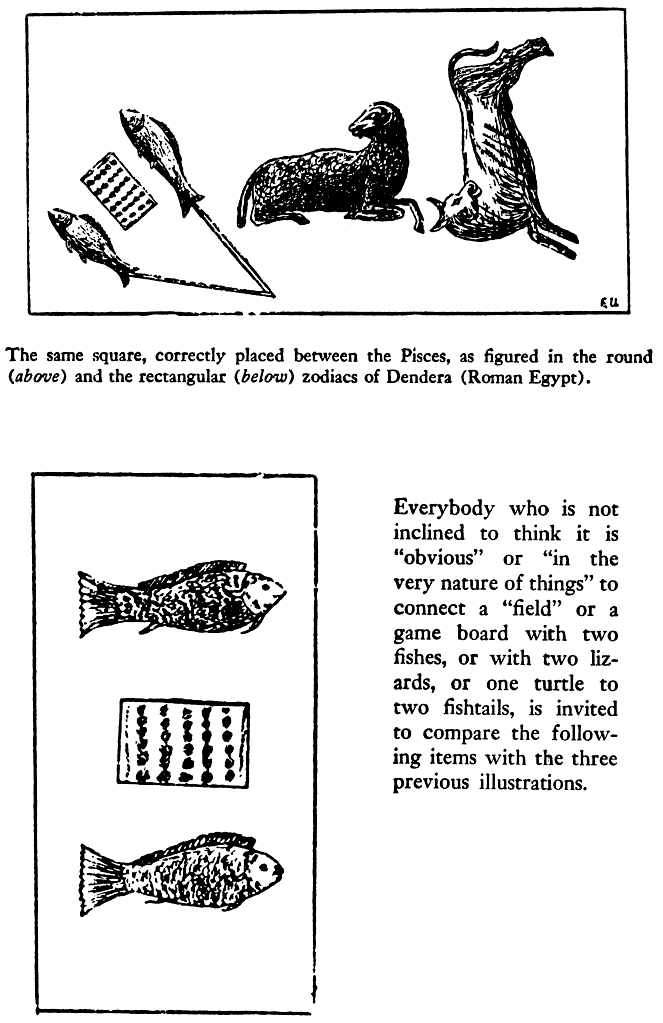


In the third place, if Bohl takes l-Iku for Aries ruling the vernal equinox, how could Jupiter enter there the "Way of Anu"? [n11 To be sure, Bohl does not say so explicitly, his wording being as unprecise as possible. He claims that at the time of New Year (vernal equinox) "the orbit of Jupiter was observed particularly carefully." "Man beobachtete—so durfen wir annehmen—wie er (wohl von der ausseren Ea-Sphare her [sic!]) in den Anu-Bereich eintrat, diesen Bereich durchquerte (eberu, itburu) und ihn dadurch gleichsam feierlich in Besirz nahm."]. The "Way of Anu" represents a band, accompanying the equator, reaching from 15 (or 17) degrees north of the equator to 15 (or 17) degrees south of it; the "Way of Enlil" runs parallel to that of Anu in the North, the "Way of Ea" in the South [n12 For these much discussed "Ways," see van der Waerden, "The Thirty-Six Stars," JNES 8 (1949), p.16; Weidner, Handbuch, pp. 46-49; Meissner, Bab. und Assyr. 2, pp. 407f.; Bezold-Kopff-Boll, "Zenit- und Aquatorialgestirne," SHAW (1913); Schaumberger, 3. Erg., pp. 321-30.]. That, due to the precessional shifting of the crossroads of ecliptic and equator, the stars standing in these three "Ways" are not the same all the time, goes without saying.
435
But, as a matter of fact, "l-Iku," darkly hinted at by Bohl, does come into play, namely, in EE 6.62, quoted above: "They raised high the head of Esagila equaling Apsu." And concerning this Esagila (or Esagil) we hear in the ritual text of the New Year festival in Babylon [n13 See Sachs translation, ANET, p. 232,1. 274f] that the Urigallu-priest "shall go out to the Exalted Courtyard, turn to the north and bless the temple Esagil three times with the blessing: 'Iku-star, Esagil, image of heaven and earth.'" "l-Iku," the Pegasus-square (= alpha beta gamma Pegasi, alpha Andromedae) is, indeed, of the utmost importance, l-Iku representing the fundamental field measure [n14 About 3,600 square meters; see Heidel, GE, p. 82, n. 173.], and Ungnad (Das wiedergefundene Paradies [1923], p. 11) understood the constellation, enclosed by Pisces, for the "Paradise," the primordial field, so to speak. More important, Utnapishtim tells Gilgamesh (GE 11.57) about his ark, which was, like the apsu, an exact cube: "One iku was its floor space." [n15 A. Schott translation: "Ein 'Feld' gross war seine Bodenflache." Compare for details, Schott, "Zu meiner ubersetzung des Gilgamesch-Epos," ZA 42 (1934), pp. 37f., 40] (Before, 11.31, Ea had ordered Utnapishtim: "Like the apsu thou shalt ceil her.") Remembering what we heard above: "Since the ark disappeared there was a stone in its place. . . which was called foundation stone," i.e., Eben Sretiyyah, that covered the abyss, this cubic ark, the floor space of which was one iku, cannot be without interest for us, the less so, when the gods "raised high the head of Esagila (= l-Iku) equaling Apsu."
To be sure, this does not teach us where Marduk was supposed to be when he received the title Nibiru—it might have been decisive for the planet to rise heliacally together with l-Iku, the celestial model of Esagil (representing the "foundation-stone-covering-the-apsu," maybe?), but when [n16 One clue, at least (probably manr more), to the situation is contained in the Cuneiform Tablet K 3476 dealing with the Babylonian New Year festival, translated and commented on by Heinrich Zimmern ("Zum babylonischen Neujahrsfest," BVSGW 58 [1906] 3, pp. 127-36), which says that "Marduk lies with his feet within Ea" (lines 20-21: "(Das ist) Marduk [ . . . ] [der (?) mit (?)] seinen Fussen innerhalb (?) Eas liegr"). In a note, Zimmern proposes to understand this line as an "allusion to a constellation connected with Marduk (Auriga?) that reaches into a constellation connected with Ea (Aries?)." S. A. Fallis, not tending to astronomical notions, made it that "Marduk lies (?) before (?) Ea"; the unmistakable presence of the planet Venus in the second part of the sentence (kakkabuDIL. BAT) forced him to the concession: "perhaps it refers to certain astronomical conditions" (The Babylonian Akitu Festival [1926], p. 217). In 1926, sufficient literature about the "Three Ways" was available.]?
436
The heliacal rising of "l-Iku"—precisely, beta Pegasi coincided with the winter solstice of 4000 B.C.; around 1000 B.C. it took place on January 25 [n17 See W. Hartner, “The Earliest History of the Constellations in the Near East," JNES 24 (1965), pp. 13, 15.]. "l-Iku," the Pegasus-square, is called "the habitation of the deity Ea, the leader of the stars of Anu [n18 Bezold-Kopff-Boll, p. 23.]" in the "Series mulAPIN" (Plow-star, Triangulum), called by Weidner "a Babylonian compendium of astronomy." [n19 "Ein babylonisches Kompendium der Himmelskunde," AJSL 40 (1914), pp. 186-208.]. According to van der Waerden ("The Thirty-Six Stars," p. 17) this series is a compilation "made about 700 B.C. or somewhat earlier [n20 See also A. Schott, "Das Werden der babylonisch/assyrischen Positions-Astronomie und einige seiner Bedingungen," ZDMG 88 (1934), pp. 331, 333.]—in which material from different periods between -1400 and -700 was used": thus, l-Iku as "leader" of the stars standing in the "Way of Anu" would rise in the end of January, quite a time away from the vernal equinox when the New Year's festival was held.
This is all very nice so far, and certainly not without highest interest, but do we know meanwhile what Nibiru, "ferry, ferryman, ford," was supposed to be? Even without worrying about Jupiter and his whereabouts? We know it not, and we feel tempted to say: "quod erat demonstrandum," namely, that the many verbose translations, eloquent articles, and books have not cleared up the decisive points of the cosmological system ruling the Enuma elish, the Gilgamesh Epic, the Era Epic and the other alleged "poems." Nibiru is only one case among many, but it is a rather significant model case for proving that no concrete problem is going to be solved as long as the experts of astronomy are too supercilious to touch "mythical" ideas—which are firmly believed to be plain nonsense, of course—as long as historians of religion swear to it that stars and planets were smuggled into originally "healthy" fertility cults and naive fairy tales only "very late"—whence these unhealthy subjects should be neglected by principle—and as long as the philologists imagine that familiarity with grammar replaces that scientific knowledge which they lack, and dislike.
But even when the different specialists would condescend to renounce their common haughtiness, we do not think that there is much chance to arrive at a satisfying solution of concrete details, and the adequate understanding of the system as a whole, without taking into account comparable systems of other parts of the earth: Mesopotamia is by no means the only province of high culture where the astronomers worked
437
with a tripartition of the sphere—even apart from the notion allegedly most familiar to us, in reality most unknown—that of the "Ways" of Zeus, Poseidon, and Hades as given by Homer. The Indians have a very similar scheme of dividing the sky into Ways [n21 See W. Kirfel, Die Kosmographie der Inder nach den Quellen dargestellt (1920), pp. 140f. At first glance, it looks as if only the circle of lunar mansions was subdivided into these three ways, but the domains are extended far beyond the limits of the "inhabited world" in both directions, north and south, as are the Ways of Enlil and Ea.] (they even call them "ways"). And so have the Polynesians, who tell us many details about the stars belonging to the three zones (and by which planet they were "begotten"); but nobody has thought it worth listening to the greatest navigators our globe has ever seen; nor has any ethnologist of our progressive times thought it worth mentioning that the Polynesian megalithic “sanctuaries" (maraes) gained their imposing state of "holiness" (taboo) when the "Unu-boards" were present, these carved Unu-boards representing "the Pillar of Rumia," Rumia being comparable to the "Way of Anu," where Antares served as "pillar of entrance" (among the other "pillars": Aldebaran, Spica, Arcturus, Phaethon in Columba).
But now, is Nibiru as important as all that? We think so. Or, to say it the other way around: once his astronomical term, and two or three more, are reliably settled, one can begin in earnest to get wise to, and to translate, Mesopotamian "poetry."
II.
The epics of Gilgamesh and Era offer too many trees for our modest demands. The several wooden individuals have, however, the one advantage that the expert's delight in uttering deep words about "the world-tree" wilts away.
There is, first, the mesh-tree, contained in the hero's name, [n22 The identity of the tree is not settled. R. Labat (Manuel d'Epigraphie Akkadienne [1963], no. 314) proposes « cèdre (?micocoulier?) [Celtis australis, "gemeiner Zurgelbaum"—Celtis occidentalis is the American nettle tree] gisMEZ-MA-GAN-(NA) musskanu-murier (?miscocoulier de Magan?)" (Cf. Labat, no. 206: «GIS, bois, arbre. Déterminatif précédant les noms d'arbres et d'objets en bois.") See also F. Delitzsch, Assyrisches Handworterbuch (1806), p. 410 s.v. miskanu, musukanu, "ein Baum . . . . wechselt mit mis-ma-kan-na, d.i. MIS-Holz von Makan." (Even this mes-wood from Magan cannot be dismissed as "not applicable" for the GE, because in the Sumerian myth "Gilgamesh and the Land of the Living" (Kramer, ANET, p. 49, 1.111-15), when the hero is allegedly admonishing Enkidu not to shrink away from Humbaba, Gilgamesh utters the most enigmatical words: "1) O thou help me [and] I will help thee, what can happen to us? After it had sunk, after it had sunk, After the Magan-boat had sunk, After the boat 'the might of Magilum' had sunk.")
See also F. Hommel, Ethnologie und Geographie des Alten Orients (1926), pp. 539, 783. According to Meissner, quoted by Weidner ("Gestirn-Darstellungen auf Babylonischen Tontafeln," SOA W 254 [1967], p. 18), gisMES = mesu is the rowan. As concerns the astrological system of connecting trees (and stones, and animals, etc.) with the zodiac, the tablets translated by Weidner put the mes-tree two times with Aquarius (pp. 18,35), once with Aries (p. 31). Wood of the mesu-tree and of the huluppu-tree occurs as building material for the chariot (narkabtu) of Ningirsu, in the Gudea Cylinder A VII, 16-18 (cf. A. Salonen, Prozessionswagen [1946], p. 6; Salonen, Die Landfahrzeuge des Alten Mesopotamien [1951], pp. 111 f.).
This tree is also part of the name of MES.LAM.TA.E3.A, taken for the oldest name known of the god Nergal (see J. Bollenrucher, Gebete und Hymnen an Nergal [1904], p. 7) and the name of the one of the Gemini, MES.LAM.TA.E.A., means "who comes forth from MES.LAM." MES.LAM was the name given to Nergal's sanctuary in Kutha, and means "the luxuriantly growing MES-tree," according to Gossmann (Das Era-Epos, p. 67), who continues with respect to the name MES.LAM.TA.E.A.: "Spater diente der Name in erster Linie als Bezeichnung eines der beiden Zwillinge (Planetarium Babylonicum, 271), bezw. als Tummelplatz philologischer Spielereien. Auf Grund solcher Philologeme wurde der Name auf Marduk und Gilgamesh libertragen (Tallqvist, 374)."
It is not in the best scientific style to dispose of difficult formulae by declaring them philological pastimes. Since MES.LAM appears to be a "fixed" topos, we can hardly expect that "to come forth from MES.LAM" has been a monopoly of Nergal-Mars. But see below p. 449.] about the location of which Marduk asks stern questions of Era, followed by the cedar of Huwawa/Humbaba which was—as we have been taught by
438
the specialists—felled by Gilgamesh and Enkidu. Yet, according to the "latest news" available to us [n23 S. N. Kramer, The Sumerians (1963), p. 277.], Huwawa is "the guardian monster of the 'land of the cut cedar.' " Admittedly, also at an earlier occasion, Kramer stressed his opinion that "the far distant 'Land of the Living' was also the 'Land of the Felled Cedar,'" [n24 In Gilgamesh et sa légende, ed. by P. Garelli (1958), p. 64. In "Gilgamesh and the Land of the Living," JCS I (1947), p. 4, he had styled it more modestly: "the far distant Land of the Living (also known as cedar land)."], but we have not yet found evidence of any thought, any consequence which should follow such alarming statements. But one cannot expect earnest thoughts to be wasted on Sumerian conceptions from a scholar who wrote about the fathers of hydraulic engineering (irrigation) that "to the Sumerian poets and priests the real sources of the Tigris and Euphrates in the mountains of Armenia were of little significance. They did not understand, as we do, that the volume of the waters of the two rivers depended upon 'feeding' from their tributaries, or that it was the melting winter snows which produced the annual overflow, or that the Tigris and Euphrates 'emptied' their swollen waters into the Persian Gulf. Indeed, their view was
439
just the opposite; it was the Persian Gulf which was responsible for the waters of the Tigris and Euphrates and for their all-important overflow. Mythologically expressed, it was Enki who filled the Tigris and Euphrates with sparkling water. and who, by riding the sea, makes its waters and those of the Tigris and Euphrates, turbulent and violent . . . In short, as the Sumerians say it, it was not the rivers that 'fed' the sea, . . . but rather the sea that 'fed' the rivers." [n25 "Dilmun, the Land of the Living,” BASOR 96 (1944), p. 28; we pass in silence the identification of this "Land of the Living" with Dilmun, as claimed in this article, and as upheld in all later publications.].
Apart from the mes-tree and the unexplained cedar of Huwawa/ Humbaba—whether it was felled by our heroes or not—the Gilgamesh Epic confronts us with the huluppu-tree, taken for a willow by Labat (nos. 371,589), for an oak by the Assyrian Dictionary (vol. 6, pp. SSf.), for a kind of Persea by Salone (Landfahrzeuge, pp. 111f.)—all the identifications decently equipped with a question mark. This specimen crosses our way in the Sumerian version of the Gilgamesh Epic, part of which was incorporated as Tablet XII in the Akkadian Epic; the Sumerian text has been translated by C. J. Gadd [n26 "Epic of Gilgamesh, Tablet XII," in RA 30 (1933), pp. 129-43.], and by S. N. Kramer [n27 "Gilgamesh and the Huluppu- tree," Assyriological Studies 10 (1938). Ct. Kramer, Sumerian Mythology (1944), pp. 33-37, and From the Tablets of Sumer (1956), pp. 222-26.]. We quote the summary given by Kramer in his first translation (1938, p. 12) for the simple reason that it is shorter than the one offered in JAOS 64 (1944), pp. 19-21. In the meantime, this text had been given a different name, i.e., "Gilgamesh, Enkidu, and the Nether WorId." The first half of the first sentence is of course, no quotation, and it is not likely to be subscribed to by the author.
On occasion of a new distribution of the "Three Ways," [n28 As concerns the beginning of this text, one shock after the other receives the reader who studies eagerly the various "translations": it is hard to believe that they are meant to render the same Sumerian original. Out of the first lines Kramer (Sumerian Mythology, pp. 30ff.) built up the Sumerian creation story which he took (and takes?) for unknown; in JAOS 64, p. 19, he stressed again: "The first thirteen lines of this passage contains some of our basic data for the analysis of the Sumerian concept of the creation of the universe." Of the following lines 14-25 he constructed a dragon-fight. By means of hitherto unpublished pieces, Kramer claimed, in 1958 (Gilgamesh et sa légende, p. 66), that "the first seven lines of the poem can now be completely restored." He added, however: "Unfortunately, the meaning of the passage is by no means certain and the mythological implications are rather obscure, as is obvious from the following tentative translation:
The days of creation, the distant days of creation,
The nights of creation, the far-off nights of creation,
The years of creation, the distant years of creation,
After in (?) days of yore everything needful had been brought into existence,
After in (?) days of yore everything needful had been commanded,
After in the shrines (?) of the land bread (?) had been tasted (?)
After in the ovens of the land, bread (?) had been baked (?)."
Nobody is likely to contradict the stated uncertainty of the meaning; it would be advisable to mind the utterance of Margarete Riemschneider (Augengott und Heilige Hochzeit [1953], p., 190): "So lange sie sinnlos sind, stimmen unsere ubersetzungen nicht." The objections raised by stern expert reviewers (T. Jacobsen, "Sumerian Mythology," JNES 5 [1946], pp. 128-52; M. Witzel, "Zur sumerischen Mythologie," Or. 17 [1948], pp. 393-415) remain throughout within the usual frame of specialists on grammar and "religion," and it is hard to decide who carries off the laurels in this race of arbitrary interpretations. The remarkable point of the new "distribution" seems to be that Ereshkigal belongs henceforward to the "nether world."
(In 1938 Kramer translated line 12: "After Ereshkigal had been presented (?) as a gift (?) to (?) the netherworld"; in his Sumerian Mythology, after having "discovered" the dragon-fight, he made it: "After Ereshkigal had been carried off into Kur as its prize." Witzel (Or. 17, p. 402) rendered the line: "Als (der) Ereshkigal mit der Unterwelt Geschenk 'aufgewartet' worden war.")
Since we do not know yet which star or constellation Ereshkigal was meant to represent, this does not tell us more than that the (unknown) asterism had "entered" the Way of Ea, i.e., that it had sunk below the 15th (or 17th) degree of southern latitude.] "on that day," it happened that "a huluppu tree (very likely a willow) which had been planted on the bank of the Euphrates and nourished by its waters was uprooted by the South Wind and carried off by the Euphrates. A goddess wandering along the bank seized the floating tree,
440
and at the word of Anu and Enlil she brought it to Inanna's [Le., Ishtar's] garden in Uruk. Inanna tended the tree carefully and lovingly, hoping to have made of its wood a throne and bed for herself. After ten years had passed and the tree had matured, Inanna, to her chagrin, found herself unable to realize her hopes. For in the meantime a dragon had set up its nest at the base of the tree, the Zu-bird had placed his young in its crown, and in its midst the demoness Lilith had built her house. But Gilgamesh, informed of Inanna's distress, rushed to her aid. Making light of his weighty armor, the giant slew the dragon with his huge bronze ax, seven talents and seven minas in weight. Thereupon the Zu-bird fled with his young to the mountain, while Lilith, terror-stricken, tore down her house and escaped to the desert. After Gilgamesh had uprooted the liberated tree, his followers, the men of Uruk, cut down its trunk and gave part of it to Inanna for her throne and bed. Of the remainder—i.e., root and crown—“Gilgamesh makes for himself the pukku and mikku, two wooden objects of magic significance."
441
(It goes without saying that there is no whiff of "magic significance" to be found in the text.) Here the summary of 1938 comes to its end, and we continue with JAOS 4, p. 20:
"Follows a passage of twelve lines which describes Gilgamesh's activity in Erech with this pukku and mikku, with this 'drum' and 'drumstick' [see below]. Despite the fact that the text is in perfect condition, it is still impossible to penetrate its meaning. It is not improbable, however, that it describes in some detail the overbearing and tyrannical acts which, according to the first tablet of the Epic of Gilgamesh, brought woe to the inhabitants of Erech, and which, again according to the Babylonian epic only, led to the creation of Enkidu."
According to this verdict, Kamer does not even try to translate literally the lines 24-35 which are allegedly in "perfect condition." Gadd (RA 30, p. 131) renders the passage as follows:
22. He makes its root into his pukku [giSRIM (ellag)]
23. Its top he makes into his ikku [gisE.AG]
24. He says "ellag," except ( ) "ellag" let him not speak
2 5. Saying. . . except (? ... let him not speak
26. The men of his city say "ellag"
27. He viewed his little company which did not. . .
28. ? ? his lament they make [a-gestin-nu a-gestin-nu]
29. He that had a mother, (she) brought bread for her son
30. He that had a wife, (she poured out water for her "brother"
31. The Wine (?) was taken away (dgestin-an-na]
32. (In) his place where the pukku was set he draws a circle
33. The pukku he raised before him and went into the house
34. In the morning his place where the circle was drawn he viewed
35. The adults (?) do not. . .
36. (But) at the crying of a little girl. . .
Kramer continues: "When the story becomes intelligible once again, it continues with the statement that 'because of the outcry of the young maidens,' the pukku and mikku fell into the nether world. Gilgamesh put in his hand as well as his foot to retrieve them, but was unable to reach them. And so he seats himself at the gate of the nether world and laments:
O my pukku, O my mikku.
My pukku whose lustiness was irresistible,
My mikku whose pulsations could not be drowned out.
[n29 In From the Tablets of Szemer (1956), p. 224, Kramer translated: "My pukku with lustiness irresistible, My mikku with dance-rhythm unrivaled."]
442
(With the following line, representing line I of Tablet XII, the Akkadian translation sets in) [n30 Thus, directly after Urshanabi's checking of the measures of Uruk (11.307), there follows as catchline line 308 = 12.1: "In those days, when..."]:
In those days when verily my pukku was with me in the house of the carpenter, [n31 A. Heidel (p. 95) translates lines 1-3: "O that today I had left the pukku in the house of the carpenter! O that I had left it with the wife of the carpenter, who was to me like the mother who bore me! O that I left it with the daughter of the carpenter, who was to me (like) my younger sister." In a footnote he explains: "Had Gilgamesh left his pukku and his mikku in the house of the carpenter, they would have been safe and would not have fallen into the underworld." He adds: "The translation of the first three lines is somewhat tentative." Of only the first three lines?]
(When) verily the wife of the carpenter was with me like the mother who gave birth to me
(When) verily the daughter of the carpenter was with me like my younger sister,
My pukku, who will bring it up from the nether world,
My mikku, who will bring it up from the "face" of the netherworld?
His servant Enkidu, his constant follower and companion, thereupon volunteers to descend to the nether world and bring them up for him . . . Hearing his servant's generous offer, Gilgamesh warns him of a number of the nether world tabus which he is to guard against. . . But Enkidu heeds not the instructions of his master and commits all those very acts against which Gilgamesh has warned him. And so he is seized by Kur and is unable to reascend to the earth."
We can do, here, without the following description of the goings-on in the "underworld," a description which is common to the Sumerian myth of the huluppu-tree, and to Tablet XII of the Akkadian Epic. Kramer (JAOS 64, p. 23) closes his inquiry on the Sumerian sources of the Gilgamesh Epic: "In conclusion, a comparison of the text of the 'twelfth' tablet of the Epic of Gilgamesh with that of our Sumerian poem Gilgamesh, Enkidu, and the Nether World, proves beyond all doubt what has long been suspected, that is, that the 'twelfth' tablet is an inorganic appendage attached to the Babylonian epic whose first eleven tablets constitute a reasonably well-integrated poetic unit." We do wish neither to consent nor to disagree; we do not like those "beyond all doubt's," and similar verdicts, considering how frightfully little we know of the Epic. (If there is something that is, really, "beyond all doubt," it is only this, that the eleven tablets of the Epic do not "constitute a reasonably well-integrated poetic unit," not the translated Epic. )
443
Of course, it would be to ur great advantage were we to know more about the objects "pukku' and "mikku," that have withstood the honest efforts of several scholars, first among whom is Sidney Smith ("b/pukk/qqu and mekku," R 30 [1933], pp. 153-68). Nets have been proposed, wind instruments (pipes and horns), and Margarete Riemschneider (Augengott, pp. 50f. voted for a particular trap, the very same rather uncanny trap which is known to us from the Pyramid Texts (representing the "palace" of Upper Egypt). Most interpreters have accepted Landsberger's first proposition "drum" and "drumstick" [n32 Marius Schneider votes for "drum" (Rahmentrommel) and "harp" or "lyre," in his article "Pukku und Mikku. Ein Beitrag zum Aufbau und zum System der Zahlenmystik des Gilgamesh-Epos," Antaios 9 (1967), pp. 280f]; there is nothing to say against this solution per se, as long as the significance of celestial drums is recognized (see chapter VIII, "Shamans and Smiths"), and under the condition that comparable celestial drums are properly investigated—e.g., those of the Chinese sphere.
For the time being there is no cogent reason to stick to "drum" and "drumstick," the less so as Landsberger dropped his earlier notion—about which he states explicitly that he never substantiated it-for the sake of "hoop" and "driving stick." [n33 "Einige unerkannt gebliebene oder verkannte Nomina des Akkadischen," WZKM 56 (1960), pp. 124-26. It is advisable to take into consideration that Landsberger does not recognize the occurrence of the word pukku in GE 1.11.22, because Schott and Schmoekel brought the alleged drum pukku into the first tablet of their translations without hesitating. At first glance, it might seem irrelevant whether or not pukku occurs in the first tablet. A little concentrated thinking will correct this impression: pukku having been made from the wood of the felled huluppu-tree, the whole timetable of the Epic, particularly the appropriate allocation of the 12th tablet and the Sumerian poem of the huluppu-tree, might hinge upon the valid answer to this very question: whether or not pukku does make its appearance in the first tablet.]. In the present situation, however, we know nothing of the function of pukku and mikku, and this fact should prevent idle speculations.
No less lamentable than the loss of these objects is the circumstance that we do not know more about Inanna's unwelcome subtenants in her huluppu-tree, about Lilith, and about the dragon at the root; that he corresponds to Nidhoggr of the Edda does not enlighten us concerning his identity. The Zu-bird, at least, is known to us: the planet Mars it is [n34 See Gossmann, Planetarium Babylonicum, 195: mul dIMDUGUDmusen.], but we do not yet risk drawing specific conclusions from this identification to the "nest" or "house" of the planet that was taken away from him.
444
The deadlock is hardly to be overcome by Mesopotamian texts alone, and this goes for the huluppu-tree, the roes-tree, Huwawa's cedar, and that tree in the Era Epic of which Era announces (Tablet 4. 123-26, Gossmann, pp. 30f.; Langdon, MAR 5, p. 144): "Irkalla will I shake and the heavens shall tremble. The brilliancy of Jupiter [ilSUL.P.A.E3] will I cause to fall and the stars will I suppress [n35 Langdon (MAR 5, pp. 144f.) points to the prophecy against Babylon and its king, in Isa. XIII, XIV, "clearly reminiscent of this passage. . . 'I will make the heavens to tremble and the earth shall be shaken out of her place.' So prophesied the Hebrew writer, and even more obvious is his borrowing from the Irra myth when he compares the king of Babylon to Helel: 'How art thou fallen from Heaven, O Helel, son of morning!' In the cuneiform text of the Irra myth Marduk is called Shulpae, the name of Jupiter in the early morning, and there can be little doubt that Helel is a transcription of a Babylonian title of Marduk-Jupiter, elil, 'the shining one.'"]. The root of the tree will I tear up and its sprout will not thrive."
In case we wished to go on this errand in the future we should start from two Indian nakshatras (lunar mansions) and the legends connected with them: mula (or mura), "the root," also called "the tearer out of the root" (see also appendices #4 and #30), and even "Yama's two unfasteners," i.e., the Sting of Scorpius [n36 The Indians claim that exactly opposite to mula was Betelgeuse, ruled by "Rudra-the-destroying-archer," whereas the Coptic list of lunar mansions (Kircher, Oedipus Aegyptiacus 2 [1653], pt. 2, p. 246) calls the Sting of Scorpius (al-Sha'ula) "Soleka statio translationis caniculae in coelum. . . unde et Siat vocatur, statio venationis," which is of the utmost importance since it elucidates the role of a "sea-star" common to Sirius and the Scorpion-goddess.], (lambda upsilon Scorpii)—in Babylonian astronomy mulSAR.UR and mulSAR.GAZ, the weapons of Marduk in the "battle" against Tiamat; and the nakshatra containing Antares (alpha Scorpii) which bears the names "the oldest," or "who slays the oldest" [n37 A. Weber ("Die Vedischen Nachrichten von den Naxatra," APA W 2 [1862], pp. 29If.) renders Jyesthaghni: "die altesten (Geschwister) todtend" which reminds us, nolens volens, of Mercer, who translates Pyramid text 399 ab: "It is N. who judges with him whose name is hidden (on) this day of slaying the eldest (gods), and N. is lord of offerings, who knots the cord."]—in Tahiti: "parent pillar of the world."
From India we should turn to the hero Tahaki of Tuamotuan texts [n38 J. F. Stimson, The Legends of Maui and Tabak;, Bull. BPB Mus. (1933), pp. 50-77.], already mentioned, because he represents the almost "professional" avenger of his father. Right from the beginning of events, Tahaki's mother laments that the hero is destined to die in a faraway country;
445
and again and again throughout the unfolding of the legend, Tahaki sings: "I go to the night-realm of Kiho, the last bourne of repose." When still a child, his cousin, with whom he plays diving for pearls, kills and dismembers him; but his foster brother saves the vital parts (unlike the case of Osiris), from which his mother revives him again. He sets out with this brother to free his father from the "goblin myriads" (see above, p. 175). When reaching the home of his grandparents, he wins the love of Hapai, daughter of Tane, the Deus Faber. When Hapai tells her father about the young man, he answers: "If he is really Tahaki go and say to him: 'Tane-of-ancient-waters told me that if you can pass before his face you must be Tahaki; if you can sit upon his four-legged stool, you must be Tahaki; if you can pull up his sacred tree by the roots then you are surely Tahaki.' Then Tahaki went to Tane-of-ancient-waters and stood beside him; and immediately he passed before his face; he sat upon his high four-legged stool—and it broke to pieces under him; the Tahaki pulled up his sacred tree by the roots—and Tahaki looked down and saw the entrance to Havaiki beneath [n39 Compare Handy, on Marquesas Bull. BPB Mus. 69, p. 132): "When Vaka-Uhi had reached a certain spot in the sea, he could see Havaiki down at the bottom of the ocean." We seem to be still circling the spot beneath the whirlpool, described by Adam of Bremen, and by the Cherokee (see pp. 106f.).]. Then Tahaki and Tane-of-ancient-waters chanted a song about the death of Tahaki." [n40 Stimson, p. 73.
The antiphony of the chant does not allow for a summary: there are "First Voice," "Second Voice," "Chorus," "Refrains" sung by Tane, and Tahaki gets some lines in between, also. Noteworthy is the mentioning of a "wayopener," but we do not know who he is, the Polynesians being more prone to "titles" and kenningar than other mythographers. Sung by (a) Tahaki, (b) the first voice, (c) the second voice, we hear (a) "It was Puga-ariki-tahi-"; (b) "The first Puga-ariki who came at last"; ( ) "To Fare-kura-templed abode of the venerated learning of the gods—there in the spirit-world where thou dwellest." This Fare-kura (fare = house, kura = red, or purple; Maori: Whare kura; Samoa: Fale ula, etc.) was, according to the "Lore of the Whare-wananga" of New Zealand, a temple "at Te Hono-i-wairua . . . in the spot where the teaching of the Wharewananga originated" (i.e., remarks. Smith, p. 82, "where man was first taught the doctrines brought down from Heaven by Tane").
The Te Hono-i-wairua (the gathering place of the spirits) was in Hawaiki, the so-called "primordial home" of the Polynesians, and the sage states (Smith, p. 101): "Whakaahu, a star (Castor, . in the constellation Gemini) was appointed (or set up) at Te Hono-i-wairua in Hawaiki . . . whilst Puanga (Rigel of Orion) was fixed at the east of Rarohenga (Hades)." Later he explains (p. 113 that "those spirits which by their evil conduct on this earth. . . left the temple [Whare kura] by the Takeke-roa (or long rapid, descent) to Rarohenga, or Hades," while the others ascended slowly to the "realm of Io the Supreme God," i.e., the same as Kiho-tumu, Kiho-the-All-Source, of Tuamotu.].
446
Nonetheless, with Tane's consent, the pair still lived together "many months until a certain day when trouble arose between them. . . So Tahaki went far far away to a distant land hoping that he might be killed there. And the land where Tahaki was slain at last was known as Harbor-of-refreshing-rain."
After an extended excursion into Mexico and the "broken tree," the symbol of Tamoanchan, "the house of descending," where the gods were hurled down for having plucked the forbidden flowers, the broken tree being claimed to be the Milky Way (W. Krickeberg, "Der mittelamerikanische Ballspielplatz und seine religiose Symbolik," Paideuma 3 [1944-49], p. 132), we should return once more to the storehouse of magnificent survivals, Finland, particularly to the many variants of the "cutting of the large oak" (K. Krohn, FFC 52 [1924], pp. 183-99). This was by no means an easy task to accomplish, but the oak had made trouble right from the start. When (in the second rune of the Kalevala) Sampsa Pellervoinen had sowed trees, it was the oak alone that would not grow until four or five lovely maidens from the water, and a hero from the ocean, had cleared the ground with fire and planted an acorn in the ashes; and once it had started, the growth of the tree could not be stopped:
And the summit rose to heaven
And its leaves in air expanded,
In their course the clouds it hindered,
And the driving clouds impeded,
And it hid the shining sunlight,
And the gleaming of the moonlight.
Then the aged Vainamoinen,
Pondered deeply and reflected,
"Is there none to fell the oak-tree,
And o'erthrow the tree majestic?
Sad is now the life of mortals,
And for fish to swim is dismal,
Since the air is void of sunlight,
And the gleaming of the moonlight."
"One sought above in the sky, below in the lap of the earth," as we are informed by variants, but then Vainamoinen asked his divine mother for help.
447
Then a man arose from ocean
From the waves a hero started,
Not the hugest of the hugest,
Not the smallest of the smallest.
As a man's thumb was his stature;
Lofty as the span of woman.
The "puny man from the ocean," whose "hair reached down to his heels, the beard to his knees," a nounces, "I have come to fell the oak tree/And to splinter it to fragments." And so he does. In several variants the oak is said to have fallen over the Northland River, so as to form the bridge into the abode of the dead . Holmberg (quoted by Lauri Honko, "Finnen," Wb. Myth., p. 369) took the oak for the Milky Way.
Considering that the same puny character was alone able to kill the huge ox—we might call it "bull' quietly—whose mere sight chased all heroes to the highest trees, we can hardly overlook the possibility that we are up to some kind of "grandson" of hairy Enkidu, and the oak would be a faint reflection of the cedar. Whereas an Esthonian variant sounds—although suffering fro atrophy—more like the story of the huluppu-tree. A damsel plants the acorn—it is typical that Krohn (p. 187) calls the versions of Russian Karelia "disfigured," where this acorn is called "taivon tahti," i.e. sky-star—the growing tree endangers the sky, trying to "tear the celestial luminaries, or to darken them." The maiden, therefore, asks her brother to cut off the tree. Out of its wood presents are made for the relatives of the bridegroom, and for the virgin herself a chest is fabricated.
Since we do not mean to undertake the expedition into comparative tree-lore here and now, we have to leave it at that. That mythical "trees" are not of terrestrial provenance, and that we cannot cope with the different specific tree individuals under the heading "the world tree"—not although, but because they are "cosmic" trees—could have been expected by everybody who has spent time and thought on the tree of the Cross; on Yggdrasil (and Ashvatta); on the "Saltwater-tree" of the Cuna Indians; on Zeus' oak, part of which was built into Argo; on the fig tree at the vortex which saved Odysseus; on the laurel which did not yet mark the Omphalos of Delphi, when Apollo slew Python ("nondum laurus erat,” Ovid)—it had to be brought from Tempe after Apollo's indenture of eight great years; on Uller's yew-tree (belonging to Sirius) by mean of whose juice Hamlet's father was
448
murdered; on—apart from the mentioned Mesopotamian tree individuals—the "dark kishkannu-tree" growing in Eridu, where no mortal is ever admitted; on the tamarisk at Be'ersheba in Genesis XXI; on the heather tree that "enfolded and embraced the chest with its growth and concealed it within its trunk," the "chest" being the coffin of Osiris (Plutarch, De Iside et Osiride, ch. 14-15, 356E-357A); and on the king of the country who "cut off the portion that enfolded the chest, and used it as pillar to support the roof of his house," until Isis carried off this "pillar." Those who prefer to overlook these items (and very many more) might recall the many times that we hear of much sighing and crying over trees cut down, sawed in two, and the like [n41 See R. Eisler, Orphisch-Dionysische Mysterien-Gedanken in der christlichen Antike (1925; repro 1966), pp. 246, 248. Compare also the "epitheton" of Ugaritic Baal, 'aliyn, and its possible derivation from Hebrew 'alion ('elon), Oak, Therebynth, holy tree, and allanati as name of the fourth month, i.e., the month of Tammuz. (H. Birkeland, Norsk Tidskrift for Sprogvidenskap 9 [1938], pp. 338-45; W. Robertson Smith, The Religion of the Semites [1957], p. 196, n.4.)]—after all, our very Yima-Jamshid was sawed in two, by Azhi Dahak—as Tammuz "the lord of the great tree, overcome by the rage of his enemies," and the numerous comparisons of Mesopotamian temples with trees (cf. M. Witzel, Texte zum Studium Sumerischer Tempel und Kultzentren [1932], pp. 37f.; Witzel, Tammuz-Liturgien und Verwandtes [1935], pp. 1 08f.).
It would be an imposition to expect the reader to listen to such endless rambling on without telling him the aim that we hope to attain, sooner or later, by digging into these trees and posts: we do want to know which "New Way" it was that has been "opened" by Gilgamesh who was "wood" from the mes-tree, and we wish to find out the chronological sequence of the celestial events as told in the Enuma elish, the Gilgamesh Epic and the Era Epic. The irrelevancy of the scholarly quest for "poets" (and who cribbed from whom) has been understood, meanwhile: it is the celestial phenomena that move and change, and not the "mythopoetic fantasy" or the "doctrines" of poets and pontiffs. We have to find out, therefore, who came first as ruler of "the underworld," Nergal or Gilgamesh, or whether these two should really be the same, which we doubt for the time being. Yet, we have already heard (pp. 437f., n. 22) that Nergal's name MES.LAM.TA.E.A. was given to Gilgamesh. As Lambert states (La Legende de Gilgamesh, pp. 39f.): "After his life on earth Gilgamesh became king of the under world, a Babylonian Osiris.
449
A formal statement of this is given in a late religious text: 'Meslamtaea is Gilgamesh, Gilgamesh is Nergal, who resides in the underworld.' This comes from one of the texts which explain the functions of deities by equating them with other gods or goddesses, a very significant type of exposition."
This "significant type of exposition" is, in fact, the technique of the Old Norse skalds, and we have some perfect kenningar from Mesopotamia, such as "Ninurta is the Marduk of strength," "Nergal is the Marduk of battle," "Nabu is the Marduk of business," [n42 Jeremias, HAOG, p. 190; see also Meissner, Babylonien und Assyrien 2, p. 133; Witzel, Tammuz-Liturgien, pp. 470f.] "Enzak is the Nabu of Tilmun." [n43 D. O. Edzard, "Die Mythologie der Sumerer und Akkader," Worterbuch de Mythologie I, p. 130.]. Now, the passage quoted by Lambert says: "dgilgames dnergal (u.gur) asib (du ) ersetimtim." In the text (quoted above) that addresses Gilgamesh as "supreme king, judge of the Anunnaki . . . you stand in the underworId and give the final verdict," it is again ersetu, and according to GE 1.56 it is ersetu that has seized Enkidu. Thus, that line might try to tell us "Gilgamesh is the NergaI of Ersetu," whereas Nergal's own "underworld" is Arallu (Aralu). Says Albright [n44 "The Mouth of the Rivers," AJSL 35 (1919), p. 165; see also K. Tallqvist, Sumerisch/ Akkadische Namen der Totenwelt (1934), p. 35.]:
"Eridu is employed as a name of the apsu, just as Kutu (Kutha), the city of Nergal, is a common name of Aralu."
Thus, it would be the very confidence in the custom of giving many names to the same topos—and in "synonyms" in general—which enforces, so to speak, distorted translations. It is a matter of course that the final decision will rest with those who know Sumerian an Akkadian, in the future: spontaneous angry refusals should not be accepted. Taught by bad experience with the Egyptian dictionary (Aegyptisches Worterbuch) that renders thirty-seven Egyptian special termini with the one word Himmel, we suspect the Assyriologists to handle their "underworld" accordingly—and their "heaven," of course. The authors of the Assyrian Dictionary do try to be as specific as possible, admittedly, so they deliver several particular significations of ersetu vol. 4, pp. 308-13):
"(1) the earth (in cosmic sense);
(2) the nether world;
(3) land, territory, district, quarter of a city, area;
(4) earth (in concrete sense), soil, ground, dry land";
but translations being a function of the expectations of the translator, the categories are bound to look fundamentally different, once several of them are expected to represent sections of the sphere.
450
But where does the proportion, Gilgamesh belongs to Ersetu, Nergal to Arallu, lead us to? This is not yet to be made out properly; too many riddles lurk behind every word. About the mes-tree, Marduk knew to tell (in the Era Epic) that it "had its roots in the wide sea, in the depth of Arallu, and its top attained High Heaven," asking Era reproachfully "Because of this work which thou, 0 hero, didst command to be done, where is the mes-tree, flesh of the gods, adornment of kings?" (S. Langdon, Semitic Mythology [1931], p. 140). Concerning the Mashu mountain (Mashu = twin) watched by the Scorpion-men, the GE says: "Whose peaks reach to the vault of heaven (And) whose breast reach to the nether world below," this "nether world" being Arallu. We knew all the time, certainly, that we were up to Scorpius (probably with a part of Sagittarius), but the huge constellation offers sufficient space for more than one way of descending. It is for this reason particularly that we hope for a better understanding from the Indian lunar mansions (1) lambda upsilon Scorpii, alias "the root," alias "the tearer out of the root," alias "Yama's two unfasteners," and (2) Antares, "the eldest," alias "who slays the eldest": in the sense of Precession, the sting of the Scorpion antecedes Antares.
If we knew the precise "extension" of the Scorpion-goddess (Ishara tamtim, Egyptian Selket) we should be better off. And this is the reason: GE Tablet 7, col. 4, l0f., dealing with Enkidu's alleged sick-bed hallucinations, makes Enkidu prophesy to that "harlot" –in the texts of Boghazkoi it is she who has the name Siduri—who had lured him into the city:" [On account of thee (?)] the wife, the mother of seven, shall be forsaken." (Speiser: "[On thy account] shall be forsaken the wife (though) a mother of seven." Ebeling, AOTAT, p. 105: "[Um deinetwillen soll] verlassen werden die Mutter der sieben, die Hauptgattin.") This "mother of seven" should be Ishara tamtim, the Scorpion-goddess whose seven sons are notorious with her [n45 Meissner, Babylonien und Assyrien 2, p. 26; Edzard, Wb. Myth., p. 90]—it is preposterous, anyhow, to associate one or the other righteous housewife in Uruk or elsewhere; but whenever well-bred scholars meet a "harlot" they accept it as their duty to discover moral lectures in the text surrounding her, very touchy they are! The first part of the line, however, is not in existence, and it is, again, their expectation that urges the philologists to supply "[On account of thee (?)]." Here, for a change, Freud would come in handy, but for the sake of the translators, not for the text.
451
The readable part of the line states nothing else but that "the wife, the mother of seven shall be forsaken." But since we do not know yet the whole extension of the Lady Ishara tamtim who was going to be forsaken, we still do not know the position of Gilgamesh’s "new way" –to ersetu, as we assume, or by way of ersetu. Ersetu might have replaced Ishara tamtim, because we learn right in the beginning of the Era Epic (Tablet 1.28-29, Gossmann, p. 8) that Anu begets "the Sevengods" (ilSIBIti) on Ersetu, translated "the Earth," as companions for Era. The one who doubts that "begetting" is done up there might begin to ponder over the Hurrian texts, where MAR.GID.DA, the Big Dipper (alias the Seven Rishis), begets twins on "the Earth." [n46 The Big Dipper does it on the order of Ea. See H. Otten, Mythen vom Goue Kumarbi. Neue Fragmente (1950), pp. 7f.]. it is evident that we are still far away from the first among the proposed goals, but we prefer to confess to this state of things rather than fall into the bottomless pit of speculation—the very many inviting pits, respectively.
(1) The idea of the Bond of Heaven and Earth is given explicitly. Dur-an-ki, was the name of sanctuaries at Nippur, at Larsa, and probably at Sippar. Also in Semitic markas same u irsiti, Bond of Heaven and Earth, is used of the temple E-hursag-kur-kur-ra and of Babylon.
(2) Idea of Bond of the Land. Probably by extension of religious use the royal palace of Babylon is called markas (bond) of the Land. An ancient Sumerian temple-name, which probably expresses an analogous idea, is "dimgal of the Land." This was the name of the temple of Der, an old Sumerian center beyond the Tigris; a name given to Gudea's temple at Lagash; a temple of Sauska of Niniveh; and probably the temple of Nippur was another "dimgal of the Land." The pronunciation and meaning of dimgal are disputed. "Great binding-post" is perhaps a fair translation. The religious terms "dimgal of the Land" and the like perhaps indicate the temple as a kind of towering landmark which was a center of unity by its height.
(3) Idea of the bond with the underworld. Gudea uses dimgal also with reference to the abzu, i.e., the waters of the underworld: he laid two tern ens, ritual foundations-the temen "above" or "of heaven" and the temen "of the abzu," and the latter is called "great dimgal." The idea may be that the temple is as it were a lofty column, stretching up to heaven and down to the underworld-the vertical bond of the world. The same passage mentions, it seems, a place of libation