|
|
|

|
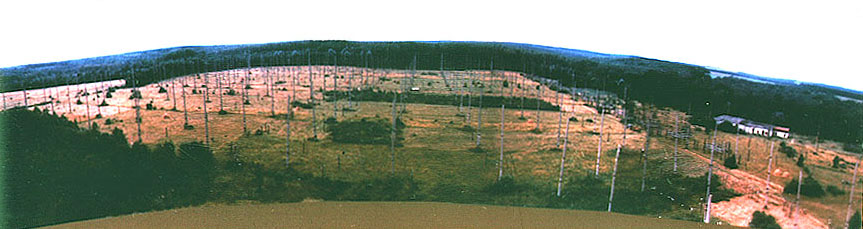
View of antenna array at Sura site.
The Sura Ionospheric Heating Facility, located near the small town of Vasilsursk about 100 km eastward from Nizhniy Novgorod in Russia, is a laboratory for ionosphere research. Sura is capable of radiating about 190 MW, effective radiated power (ERP) on short waves.
This facility is operated by the radiophysical research institute NIRFI in Nizhny Novgorod. The Sura facility was commissioned in 1981.
Using this facility, Russian researchers achieved extremely interesting results regarding the ionosphere behavior and discovered the effect of generation of low-frequency emission at the modulation of ionosphere current. [1]
At the beginning, Soviet Defense Department mostly footed the bill. The American HAARP ionospheric heater is similar to the Sura facility.
The HAARP project began in 1993.
Transmitter room at Sura facility
Technical information
The facility consists of three 250 kW broadcasting transmitters and a 144 crossed dipole antenna-array with dimensions of 300 m x 300 m.
At the middle of the operating frequency range (4.5 – 9.3 MHz) a
maximum zenith gain of about 260 (~24 dB) is reached, the ERP of the
facility is 190 MW (~83 dbW).
Secret
Meteorological Weapons from EnglishPravda Website
American meteorologist Scott Stevens
has recently brought accusations against Russia
Both Russia and the U.S. were long rumored to have been involved in the development of meteorological weapon. But those rumors seemed too wild to searching a grain of truth hidden underneath. In the meantime, some Russian politicians say the experiments have been conducted and still conducted on either side of the ocean.
Following death and destruction caused by Katrina, the Americans promptly unearthed the controversial interview by Vladimir Zhirinovsky in which he threatened to unleash floods all over the United States when,
Nobody got scared watching the drunken boss of the Liberal Democratic Party promise doom's day for the United States.
But once Katrina struck and the
southern part of the U.S. got drowned, the improbable rumors about
Russia's meteorological weapon came to light again.
Unconfirmed and patchy reports on questionable experiments with weather conducted by the U.S. and Soviet Union stirred up a number of political scandals in many countries of the world. Following a large-scale flooding in Europe in 2002, some European politicians put the blame on the "U.S. military" for disrupting EU economy.
In 2002, Committee for Defense of the
Russian Duma raised the issue about a detrimental impact on
climate caused by experiments involving disturbance of the earth's
ionosphere and magnetosphere. The deputies focused their attention
on
HAARP system that is still under construction in Alaska.
U.S.
Marines patrol the vicinity of the base. No commercial or military
aircraft are allowed to fly over the base. Air-defense systems
Patriot were installed around the base following the 9/11 terrorist
attacks.
Open information sources indicate that the facility is used for causing active influence on the earth's ionosphere and magnetosphere. The results could be fantastic, according to scientific journals.
Scientific journals claim that HAARP is capable of causing artificial aurora borealis, it can also jam radar stations of early ballistic missile detection systems, communicate with submarines in the ocean and even detect secret underground complexes of the enemy.
Radio-frequency emission is capable of piercing through the ground and examine hideaways and tunnels, it can burn out electronics and destroy space satellites. The equipment can also impact the atmosphere and thus cause changes in weather.
HAARP is allegedly used for causing natural disasters similar to
Hurricanes Katrina and Rita.
Russian politicians are head over heels debating plans of U.S. imperialists and their bloodthirsty military, man-made disasters and floods.
They are probably totally unaware that Russia has long build it own facility similar to HAARP. The facility Sura is as powerful as HAARP. It is located in Russia's central area, in a remote and desolate place some 150 km from the city of Nizhny Novgorod.
One of the leading scientific research institutions of the USSR, Research Institute of Radiophysical Studies, owns the facility.
The facility was commissioned in 1981.
Sura looks quite seasoned and a little
bit rusty. Against all odds, it still works. There are straight
lines of 20-m antennas standing in an area of 9 hectares. A giant
emitter the size of a country hut sits in the center of the field,
the emitter is used for studying acoustic developments in the
atmosphere.
However, they conduct research (on a smaller scale than in the U.S.) of interrelation between the natural disasters and perturbations in the ionosphere and magnetosphere.
Technologies of the secret research institutes that used too be classified and inaccessible become available to non-military researchers.
One of the devices was recently tested thanks to support of the Russian Academy of Natural Sciences.
from Vasil'sursk in Russia to the WIND Spacecraft of NASA
Preparing for the Future Vol. 5 No. 4 from ESAPublications Website
Introduction
Radio-astronomy measurements are restricted by the ionosphere and by man- made noise to the detriment of observations at lower frequencies, typically those below 10 MHz.
The comparatively high level of radio noise emitted by the Earth at low frequencies, was observed decades ago from spacecraft such as RAE-2 launched by the United States *.
In the context of a candidate lunar
program, ESA has initiated a study of the feasibility of locating a
radio telescope on the Moon. The advantage of a lunar sitting is the
absence of ionospheric effects and terrestrial radio noise.
During a meeting of the Science-Team concerned with the radio telescope study mentioned above, it was suggested to transmit signals from the Vasil'sursk facility and to try to receive these with the WIND spacecraft, which had been launched by the United States National Aeronautics and Space Administration.
The objective was to learn more about the effect of
the medium through which the propagation path passed and the
characteristics of the hardware elements involved in the link (both
on ground and in space).
A set of long dipoles samples the
electric field at these frequencies along each of the three
cartesian axes.
Figure 1 shows the system of 12 by 12 crossed dipole elements, which covers an area of 300 by 300 meters.
Each of the three sections has an set of 4 by 12 elements; each section can be pointed independently. The beams may be steered manually or electrically, in steps of three degrees, to point at angles between 12 and 85 degrees.
Each section has a 300-metre aperture, and its radiation pattern approximates to a sin(x)/x shape.
Radiated signals are circularly polarized.
Figure 1.
The transmitting
antenna system at Vasil'sursk
A separate 250 kW transmitter is connected to each of the three antenna sections.
Transmitter frequencies are stable to one part in 10(exp 7). Amplitude or phase modulation (or both together) are available, and external synchronization is possible. Emissions may be a continuous carrier or a pulsed emission whose shortest pulse is 50 milliseconds. The operating frequency range is 4.6-9.3 MHz.
Table 1 and Table 2 give the parameters of one antenna section whose beam points to a zenith angle of 34 degrees (the Sun position in July) and transmitting 250 kW.
Figure 2. Recording of the 9.125 MHz signal received in the spin-plane of the WIND satellite
In the presence of high cosmic background
radiation, a high effective power is needed to establish a link with
the WIND spacecraft, whose receive antennas have low gain. The use
of such high power can lead to induced instabilities in the
ionosphere and so to a subsequent scattering from such
instabilities.
With a critical frequency of 5 MHz, and the scanning capabilities of the beam, the variation in angle can be as much as 10 to 15 degrees.
The presence of the Earth s magnetic field
complicated calculations and the co-polarized circularly polarized
signal was expected to be bent Northwards (with respect to the
magnetic field direction) or Southwards if the circular polarization
was in the opposite sense.
Small scale
irregularities would cause scintillation effects of typically about
1 minute duration and a scintillation index of up to 0.5 0.7 for
angles up to 40 degrees from zenith.
At this time, WIND was near to its apogee, at about 500 000 km from Earth. Each transmitter section emitted a different frequency: 9.025, 9.075 and 9.125 MHz.
Each antenna section was pointed in a slightly different
direction, spaced by about 12 degrees in the North-South plane, with
the third section pointing closest towards WIND. This was done to
overcome the refraction effects which have been mentioned previously
and which are difficult to quantify. Transmitted signals were
circularly polarized.
The
signals received by both antennas could be measured separately or
could be summed, with or without the introduction of a 90 degree
phase shift, to permit direction-finding and polarization
measurements.
Figure 3 shows a recording taken two days later at a frequency of 9.125 MHz. The upper curve shows the output of the S-receiver and the second curve the output of the Z-antenna alone.
The (relatively) well-behaved response, clearly showing the sin(x)/x pattern of the antenna at Vasil'sursk, was not observed during other days of the experiment.
Figure 3. Recordings of signals in the plane of, and parallel to, the spin axis, and the ratio of these two
The curves show the data obtained.
The data sequence starts at 05: 07 hrs. (universal coordinated time), and the time increment between samples is 16.128 seconds. The angle between the beam pointing direction and the path to the satellite in the azimuthal plane can be computed; one time increment corresponds to 0.0672 degrees.
The total transmission time of two hours is
equivalent to a change in angle of 30 degrees.
On other days ionospheric influences prevented this.
Clearly further work is needed to gain a better understanding of the data and the behavior of the medium along the propagation path.
|