|
by Michael E. Salla, Ph.D from ExopoliticsInstitute Website
Part 1
In 1997, Col Philip Corso’s book, The Day After Roswell, appeared and quickly rose into the New York Time’s best seller list with his revelations concerning his role in a classified program to seed extraterrestrial technologies into the private sector.
Col Corso had a distinguished career as a Military Intelligence officer, serving in senior positions during the Second World War, the Korean war, and under the Eisenhower administration.
It was during his assignment as ‘Special Assistant’ to Lt General Arthur Trudeau, who headed Army Research and Development, that Corso became head of the newly established Foreign Technology Desk.
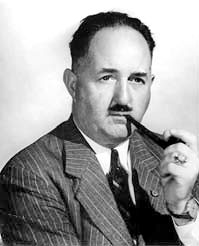
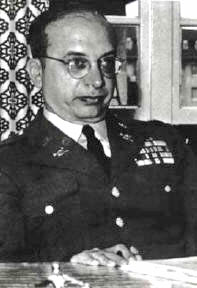
Colonel Philip Corso
During this assignment from 1961 to 1963, Corso claims to have regularly passed on to various corporations, key ‘foreign technologies’ that were in fact, extraterrestrial in origin.
This led to breakthroughs in developing
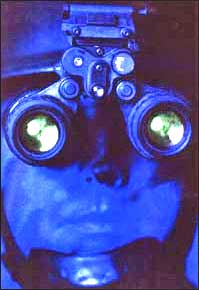
the integrated circuit, night vision technology, fiber optics, super
tenacity fibers, lasers and other cutting edge technologies. Corso’s
book details a remarkable case; a former senior military official
emerging as a whistleblower to reveal information about classified
projects involving extraterrestrial vehicles (ETVs) or
extraterrestrial biological entities (EBEs).
Those most critical of Col Corso believe that he was prone to embellishing his service record. Most criticism has centered around a number of public statements Corso made that appear to be inconsistent with what can be verified in public documentation.
The most significant of Corso’s claims that have been subjected to intense criticism are that:
Further criticisms include Corso’s claim
I will discuss each of these criticisms in order to assess their:
Corso’s credibility as a distinguished military
officer coming forward to reveal his role in such a classified
program shortly before his death, is at the center of the debate of
whether his claims are valid or not.
Nevertheless, there have been some
inconsistencies found in what Col Corso claimed and what can be
documented. This has lead to intense debate between those who
consider these inconsistencies to be minor, and those believing the
inconsistencies to be sufficiently significant to warrant dismissing
Corso’s credibility and testimony entirely.
This
invites speculation of the motivations of Corso’s critics who
undertake such a concerted debunking effort against a highly
decorated military whistleblower whose revelations do much to
clarify the UFO phenomenon.
I examine each of the most significant criticisms raised against Col Corso’s credibility as a whistleblower, and assess whether Corso’s critics cross the line between objective criticism and debunking.
First I will describe the difference between objective criticism and debunking to establish some guideline for determining when Corso’s critics cross the Rubicon and become debunkers.
1. Objective Criticism versus Debunking
Analyzing these claims requires an objective approach to the evidence not overly influenced by the investigators own prior beliefs. I attempt to distinguish between critics committed to an objective investigation of the evidence, and critics who use their criticisms to promote prior beliefs.
Dr Bernard Haiasch defines skepticism, what I will consider here to be ‘objective criticism’, as one who practices the method of suspended judgment, engages in rational and dispassionate reasoning as exemplified by the scientific method, shows willingness to consider alternative explanations without prejudice based on prior beliefs, and who seeks out evidence and carefully scrutinizes its validity.4
Dr Howard P.
Robertson
This definition contrasts with ‘debunking’ which is driven by an investigator’s prejudice based on prior beliefs, and disingenuous efforts to manipulate evidence to promote a particular conclusion.
It is worth pointing out that debunking was officially sanctioned by the Robertson Panel as a means of discrediting a great number of claims concerning UFOs. In January 1953, a group of scientists chaired by Dr Howard P. Robertson and covertly funded by the CIA, recommended that UFO sightings be debunked due to the potential for manipulation of this information by ‘foreign powers’ in a way that would undermine U.S. national security.
The panel recommended an “educational program” to deter the general public from taking interest and demanding serious investigation of UFO sightings:
Consequently, a CIA sanctioned policy of
debunking UFO reports had begun. This needs to be considered when
examining the critics of UFO related claims or witnesses.
2. Was Col Corso a (staff) member of the National Security Council?
There have been two major criticisms of Corso’s claims regarding his service with the NSC.
One, by Stanton Friedman and Dr Randle
criticize Corso for claiming to have served on the NSC itself,
rather than as a liaison officer on an NSC committee. The second
criticism by Brad Sparks claims that neither the Psychological
Strategy Board (PSB) or the Operations Coordinating Board (OCB) both
of which Corso served on, were part of the NSC. These critics all
conclude that Corso embellished his precise role with the NSC and
that his entire testimony therefore becomes unreliable. I deal with
each of these criticisms in turn.
This is consistent with an FBI Report
It can therefore be confirmed that Corso was assigned as an intelligence staff member to at least two committees that performed important psychological warfare functions within the Eisenhower administration.
Two of these committees, the PSB and OCB almost certainly dealt with managing the public response to UFO information. Friedman’s criticism of Corso stems from a sworn affidavit made by Col Corso two months before his death in July 1998.
In the affidavit Corso claimed that he “was a member of
President Eisenhower’s National Security Council.”11
This led him to dismiss Corso’s claim of serving on the NSC. This is what Friedman wrote to the author on the UFO Updates forum:
The problem in settling this issue is exactly what part of the NSC did Corso claim to be a member of?
What is the cabinet level committee chaired by the President generally known as the NSC, or one of the various interagency committees formally and/or functionally associated with the NSC and generally described as comprising the NSC system? At the apex of the NSC are cabinet level officials and heads of various departments and agencies meeting regularly to discuss national security issues.
During the Eisenhower administration, the NSC comprised the following:
Col Corso never claimed, in his book or notes, to have been a member of the NSC as described above, but that he had been on the NSC staff.
This suggests that the Affidavit, signed only two months before his death at 83 years of age, containing the reference to him having been a member of the NSC, can be attributed to human error.
The aged and ill Corso failed to
insert the qualifying word ‘staff’ before the phrase “member of
President Eisenhower’s National Security Council.”
In addition to the ‘Operations Coordinating Board’ being responsible for implementing NSC decisions it was also mandated to report to the NSC as stipulated in the executive order creating it.
While
formally independent, the OCB and the PSB were functionally part of
the NSC system, since it was required for them both to report to the NSC and implement NSC decisions.
The origin of Corso’s sworn statement that
he had been a member of the NSC related to his membership in one of
the subordinate committees - the OCB and its predecessor the PSB.
This explains why the Eisenhower Library archivist could find no evidence of Corso having been a member of the NSC or having attended NSC meetings, Friedman was looking at the wrong committee in terms of Corso’s membership and attendance.
Clearly, Corso attended meetings of the NSC Operations Coordination Board and
PSB, so Friedman’s contention that he could not find records
confirming Corso’s attendance at NSC meetings is misleading. Corso
clearly attended the PSB and OCB meetings during his four year
assignment to the Eisenhower administration and the NSC.
Dr Randle is also reaching a mistaken conclusion about Corso’s veracity as a whistleblower based on his focus on a statement made in Corso’s affidavit and taken out of context to infer something negative about Corso’s background.
Corso
had earlier cleared such a possible confusion in his book and during
subsequent interviews. Dr Randle failed to examine the precise role
Col Corso played in the NSC and the various committees he attended,
and how the NSC is a multi-tiered institution. Col Corso was clearly
assigned to the military staff of both the PSB and OCB which were
part of the NSC system developed in the Eisenhower administration.
Sparks writes:
A significant flaw in Sparks’ argument is that he is not consistent in his criticisms.
His more recent criticism against Corso is a reversal of his previous position that the PSB was part of the NSC and that Corso had been appointed to the NSC when serving in the Eisenhower administration.
In his definitive ‘expose’ of Corso’s book, written in August 1998, Sparks wrote:
The documentary and historical evidence supports Corso’s contention that he served as a staff member of the NSC while assigned to the OCB and PSB.
Furthermore, Sparks’ criticisms of Corso fail to be consistent. Sparks has been the most dismissive of all Corso’s critics when it comes to Corso’s credentials and background.
This suggests to this author that he is motivated to disparage Corso regardless of the documentary evidence supporting Corso’s claims. In the case of Friedman and Dr Randle, both try to disparage Corso by emphasizing his alleged claim in his Affidavit of having served on the NSC itself.
They ignore Corso’s repeated statements, made earlier, to having been a staffer assigned to the NSC. They put great emphasis on what is obviously an oversight on Corso’s part that can be attributed to his deteriorating health.
They ignore previous interviews and writing which consistently claim that Corso had served on the NSC staff. This suggests both Friedman and Randle are intentionally posturing to disparage the significance of Corso’s testimony by over emphasizing inconsistencies in his testimony.
The
failure of Randle, Sparks and Friedman to consider alternative
explanations for inconsistencies in Corso’s testimony; their
overblown emphasis on the significance of the inconsistencies; and
their lack of effort to reach a balanced conclusion over the pros
and cons of Corso’s testimony, suggests they have crossed the
Rubicon from objective criticism into debunking.
Dr Randle concludes that the absence of documentary support for such claim suggests that Corso was prone to embellishing his service background, therefore his testimony is unreliable. Randle dismissively writes:
Documentary evidence for a possible
official relationship between Corso and MJ-12 is found in his
official military records. Col Corso’s records point out that he
served on the Psychological Strategy Board (PSB) in 1953; and also
on its successor
Corso describes his role in the PSB/OCB and the UFO information he had access to as follows:
Corso is here claiming that while serving as a staff member of Eisenhower’s NSC, he was given access to ‘UFO’ information. Claims attributed to Corso by Dr Randle that Corso served with Majestic-12 may be explained from the precise role played by the OCB.
The OCB was the successor to the Psychological Strategy Board (PSB) that had been initially created by Gordon Gray, a former Secretary of the Army, in 1951.
According to Stanton Friedman, Gray was a member of the original Majestic 12 Group mentioned in the Eisenhower Briefing Document. 23
Gordon Gray (right) being administered the oath as the first Director of the new Psychological Strategy Board while President Harry S. Truman (center) witnesses the event.
Given the high level of security attached to all MJ-12 activities, it can be assumed that the PSB had been created to perform certain functions for the secretive MJ-12 Group.
A still to be confirmed ‘Majestic’ document, allegedly leaked
by government insiders, declares that the Psychological Strategy
Board was created by MJ-12 to develop policies on the UFO
phenomenon.24
Corso was most likely referring to his service on the PSB/OCB as the basis for his later claims to have been formally associated with MJ-12.
Corso’s background as a military intelligence officer would have equipped him well to serve on a committee (PSB/OCB) performing psychological warfare functions authorized by MJ-12 to manipulate the public response to the UFO phenomenon. The criticism against Corso that he embellished his service record in claiming to have been associated with MJ-12 is therefore not supported by the documentary evidence.
The lack of
effort of Randle to find a plausible explanation for Corso’s claim
regarding being professionally associated with MJ-12 suggests that
once again he has crossed the Rubicon from objective criticism into debunking.
Col Corso’s military record confirms that he served as Chief of the Foreign Technology Division from 18 April 1962 to 18 July 1962.
Prior to this period he was assigned as a Staff Officer in the Plans Division from May 5 to June 25, 1961, and then as staff officer in the Foreign Technology Division from 26 June 1961 to April 1962.
Furthermore, from 18 July, 1962 to his
retirement on 1 March, 1963, he was once again assigned as a Staff
Officer in the Plans Division of Army R & D. It is this entire
period of serving in Army R & D that Corso describes as the “two
incredible years” of heading the Foreign Technology Desk.
He claimed that in “Army R& D, I had the title of Chief of Foreign Technology Division…. I was always the team chief and made all decisions.”28
Corso’s claim
is supported by his close relationship with Trudeau and his former
senior positions as battalion commander at White Sands Missile Range
and Inspector General of the 7th Army.
Col Alexander discovered in his research that Col Corso had another officer nominally above him in the organizational hierarchy, but Corso was known to be effectively in charge of the Foreign Technology desk created under General Trudeau. This was confirmed to Col Alexander by senior military officials aware of Corso’s work with Gen Trudeau.
The FTD was a very small unit possibly comprising just Corso himself.
Col Alexander discovered that the FTD was created when Corso started at Army Research and Development, and the office was abolished when he retired, along with Gen Trudeau. This confirms Corso’s claim that the FTD was created for him by General Trudeau after his arrival at the Pentagon and required Corso’s various security clearances.30
This supports Corso’s testimony that he was in charge of the Foreign Technology desk over a two year period 1961-63, and not solely the ninety days confirmed in his military record. The great emphasis placed in this discrepancy between what Corso claimed and what his record establishes, once again shows how Corso’s critics fail to identify plausible explanations for this inconsistency.
A number of plausible explanations exist for this discrepancy without undermining Corso’s central claim of heading the FTD.
Consequently, the overblown emphasis on this
inconsistency between Corso’s claims and his records, once again
reveal that critics such as Dr Randle and Friedman cross the Rubicon
between objective criticism and debunking.
The civilian technologies spawned by this covert seeding program include:
Critics such as Stanton Friedman argue that:
Similarly, Brad Sparks is very critical of Corso’s claims regarding his seeding extraterrestrial technologies and concludes:
It needs to be pointed out that Corso consistently laid credit for the covert program to seed civilian industries with extraterrestrial technologies to his superior, Lt General Arthur Trudeau.
Corso wrote
that from the period 1947-58 that
As a former intelligence officer who served with Gen Trudeau, former head of the Army’s Military Intelligence (G-2), Corso was entrusted with extraterrestrial technologies to seed into civilian industries.
He likely performed this covert function with the same single minded focus that exemplified his highly distinguished military career.
Nevertheless, Corso consistently laid the chief credit for the covert extraterrestrial technology seeding program with Gen Trudeau, and not himself. Nevertheless, he is assailed by critics for exemplifying hubris.
For example, Brad Sparks claims in his ‘expose’:
Corso’s critics have attempted to lay the charge of hubris on Corso without appreciating the implications of the unique circumstances that had placed in such a sensitive role.
As the trusted personal assistant to the head of the Army R & D program, Corso was in the precise position to play his part in a covert program that could have had an enormous effect on human society. That is a statement of fact supported by documentation, rather than hubris which is based on the conjecture of critics.
Consequently, the ad hominem attacks on Corso’s reflections on the significance of his historical role in a secret Army program to seed civilian industries with extraterrestrial technologies are at best a distraction.
At worst,
such ad hominem attacks are more evidence of Corso’s critics
crossing the Rubicon between objective criticism and debunking .
6. Did Philip Corso
Witness an EBE while Stationed at Fort Riley, Kansas?
In The Day After Roswell he described how he was informed about a mysterious shipment from Fort Bliss containing remains “from some accident out in New Mexico”, Corso wrote:
Corso’s military records give credibility to his EBE story.
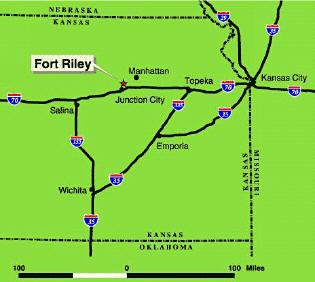
He was stationed at Fort Riley Kansas
from 21 April 1947 - 12 May 1950; with the rank of Major. Events he
described as the alleged duty officer on the night the EBE body
arrived at Fort Riley en route to Wright Patterson AFB; are
corroborated, in part, by his military record.
Friedman writes:
Friedman is mistaken about Ft Riley’s accessibility to Route 40, and misleading with his statement that Fort Riley is not the most direct route to Wright Patterson Air Field. As historic maps demonstrate, Route 40 was indeed the main thoroughfare for travel between the East and West coast - from Atlantic City to San Francisco.3
Second, Ft Riley is actually situated very close to Route 40 and is described as part of the historic Smokey Hill trail followed by U.S. Route 40:
Fort Riley is situated close to Junction City, which is exactly where US Route 40 has historically passed.5
For the majority of the State of Kansas (from Oakley Kansas, through Junction City and onward, to Kansas City, Route 40 coincides with Interstate 70; exactly where Fort Riley is situated, as indicated on current maps below.6
Consequently, Friedman’s argument that Fort Riley lies “well North of Highway 40” is a gross error.
Furthermore, Fort Riley was used as the key military staging post for maneuvers between the East and West coast, as corroborated by a report that President Eisenhower, when serving as a Captain in the pre-WWII era,
So Fort Riley was indeed on the most
direct route between the East and West coast, though not on the most
direct route from Fort Bliss.
While he acknowledges that Fort Bliss was the HQ of German scientists working at White Sands Missile base, he fails to identify the obvious answer for why the UFO artifacts were transported there.
The German Scientists, experts in advanced aviation technologies and working on the stockpile of former Nazi V2 rockets at White Sands, were called upon to identify the artifacts from the New Mexico crashes at Roswell/Corona and ‘Plains of St Augustine’.
Their knowledge of advanced Nazi aviation systems would have been vital in determining the origins of the Roswell crash material.
This is suggested in a leaked Majestic Document:
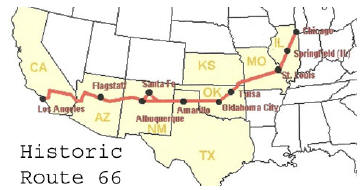
Friedman is correct however that the more direct route from Fort Bliss could have included another route, at least part of the way, such as Route 66 which was at the time another major East-West corridor.
If the convoy did come from Fort Bliss as Corso suggests, why didn’t it take the most direct route north to US 66, then East to St Louis Missouri, then on to US 40 for the remainder of the trip to the Wright Patterson?
One answer might be that Fort Riley was
a major military staging post for East-West travel as demonstrated
by Eisenhower’s pre-WWII military maneuvers. Another is that Route
66 may have not been suitable for such a sensitive military cargo.
Fort Riley undoubtedly offered a number of benefits as a major
military staging post and would have been a logical choice for the
long road trip from Fort Bliss to Wright Patterson.
The date provided by Corso is consistent with what is known about the flying saucer crash that allegedly was scattered over two sites: Roswell/Corona and the Plains of St Augustine.
According to various sources, both sites were independently discovered on July 3.9 While only vehicle debris was found on the farm of Mac Brazel, four EBE bodies were allegedly found at the second crash site at St Augustin.
This is partly confirmed by the Eisenhower Briefing Document that refers to two crash sites and states that,
Friedman posits that the bodies from the Plains of Augustin could have been picked up by July 6 as Corso claims, but suggests that it would have been more reasonable to have them studied at the nearby military base and/or flown out.
As mentioned earlier, Fort Bliss was a logical choice given that it was the HQ for German scientists and others working on the White Sands rocket program.
As for why the bodies weren’t flown from Fort Bliss rather than trucked overland, safety concerns might have dictated that a land route was preferable to air travel. The crash of a truck would lead to minimal damage to an EBE whereas an air crash may have led to the complete destruction of this valuable cargo.
Indeed, it may have been decided to sent the EBEs by both air
and road since Corso claims to have seen only one body.
Consequently, Friedman’s claim that Corso “almost certainly” concocted the Fort Riley incident, has no merit.
Friedman has again strayed from
objective criticism into the debunking of Corso’s claims.
One of the most important
inconsistencies, in Spark’s view, is Corso’s description of an
alleged confrontation with the former head of the CIA’s covert
operations
In his book, Corso described the incident where he walked into Wisner’s office and demanded that he put an end CIA agents following Corso.
This had also, according to Corso, occurred earlier while he served in the Eisenhower administration:
Sparks writes:
It is very likely that in the communication between Corso and his co-writer, William Birnes, the precise date of the alleged confrontation encounter in Spring 1962, was mistakenly implied to be mid-1961 when Wisner was based in London.
It is conceivable that it would have taken some time for Corso to realize he was being followed after taking up his new position at the Foreign Technology Desk, and to determine the person responsible for him being followed. Wisner knew Corso from the time of the latter’s service in the Eisenhower administration, where they were antagonists. It is very likely either that Wisner played a role in what was occurring with Corso, or possible that Corso mistakenly assumed this to be the case.
The important point is that Wisner was
stationed in Washington DC at the same time as Corso was at the
Foreign Technology desk. This makes it possible that the meeting
actually occurred in Spring/Summer 1962, and not during mid 1961, as
implied in the book.
Spark’s concludes:
The major problem with Spark’s criticism is that the circumstances of Wisner’s death were abstract facts that Corso was attempting to recall after more than 30 years.
As for his
alleged confrontation, Corso quite likely got the dates wrong, but
that doesn’t preclude the circumstances and dialogue at the
confrontation that he described.
The details of this conflict are still to be fully disclosed but there is no doubt that Trudeau still enjoyed the support of the US Army that ‘promoted’ him in 1958 to his new position as head of Army Research and Development.
Corso subsequently served under Trudeau in a sensitive position with the Foreign Technology Desk, which the CIA would have had interest in monitoring.
Finally, from Spring 1962 until August
1962, both Wisner and Corso were in Washington DC at the same time,
a fact Spark ignores.
This may be entirely due to the way in which Corso communicated with his co-writer, William Birnes, or insufficient details in his personal notes or his recollections.
At the time of collaborating with Birnes in writing of The Day After Roswell, Corso was approximately 80 years of age and his health was deteriorating.
He certainly would have been tested to get all the details right in his recollection and communications with Birnes, given the decades that had elapsed since his experiences. Sparks inclusion of the Wisner story as an example of Corso being a “rank literary hoaxer” is further evidence of Sparks unwillingness to consider alternative explanations for inconsistencies in Corso’s claims.
In not considering the alternative
explanation that Corso got some dates and details wrong in his
recollections due to poor health and/or sketchy notes, Sparks is
once again crossing the Rubicon from objective criticism into
debunking.
Randle says the following about Corso’s testimony at a press conference in 1997:
In his original notes Corso described himself as being,
In his book, he claims that he gained his command as a result of a promise made by President Eisenhower:
In both his book and original notes Corso clearly is claiming that he was the commander of a battalion based at White Sands Missile Range.
His military record confirms
that in June 1957 he began a new position as Battalion Commander at
White Sands Proving Ground. His military record supports the claims Corso made in his book and original notes.
While Randle claims to have repeatedly listened to the interview, he doesn’t provide the context of Corso’s discussion where he may have been referring to himself as “the Commander” of the missile battalion at White Sands, rather than “the Commander of White Sands”. If the former, then Randle is at fault for not correctly identifying Corso’s intention in making the comment and the correct context for Corso’s comments.
If Corso did refer to himself as “the Commander” at White Sands then he may have simply made a mistake in correctly identifying his former position, rather than trying to deliberately embellish his record. In 1997, Corso was 82 and his health was quickly deteriorating. His detailed recollection of events and positions would have been questionable in an interview.
Yet in his book and original notes,
there is no ambiguity here; Corso correctly identified himself as
the Battalion Commander at White Sands, rather than the Commander of
White Sands.
More importantly, Randle is claiming that Corso was deliberately embellishing his military record. Randle needs to come up with more instances where Corso is repeating such an error, rather than in one isolated interview.
Consequently, Randle’s claim that Corso
deliberately embellished his military record is not an objective
criticism, but a form of debunking.
These depictions stemmed from his involvement in rumors that Lee Harvey Oswald was a paid informant of the FBI, and for his earlier efforts in seeking to identify Fabian Socialists in various government agencies.17
Even Corso’s former boss, Lt General Trudeau who headed the Army’s Military Intelligence (G-2) during the 1950’s, received disparaging comments in the FBI Report for his and Corso’s role in seeking to identify Fabian Socialists while at G-2 and at Army Research and Development. In 1955, Trudeau and Corso had compiled a list of alleged Fabian Socialists and passed this list on to different government agencies.
This led to a serious confrontation between G-2 and the CIA that culminated in Trudeau’s eventual replacement at G-2.
Relevant passages from the FBI Report demonstrate the remarkable hostility towards both Corso and Trudeu on the part of both the FBI and the CIA in 1965:
Finally, in rejecting Corso’s efforts in
investigating the relationship between the FBI and Oswald, the FBI
dismissively referred to the “tremendous amount of work his gossip
had caused the FBI.”19
Clearly, Corso and Trudeau had created powerful enemies in various government agencies for their efforts in identifying ‘Fabian Socialists and ‘communist sympathizers’.
As part of a routine security check, the
FBI passed on this damaging information to the Immigration and
Nationalities sub-committee of the House of Representatives in 1965
that was considering employing Corso. The Report effectively stymied
his application. Some parts of the classified report were even
leaked by the FBI to a reporter who wrote a story on Corso being
blackballed by the FBI.
Corso had been told by a CIA informer, later identified as Frank Hand, that Oswald had FBI connections.20
Corso refused to divulge his CIA source. This led to strained relations with the FBI who demanded to know who was spreading such rumors. The FBI was furious that Corso would not reveal his sources. On behalf of Senator Richard B. Russell, a senate member of the Warren Commission, Corso was investigating the effectiveness of the Warren Commission’s own inquiry into the Kennedy assassination. Corso and Russell were seeking to discover evidence of a possible Cuban/Communist role in the assassination.
The FBI strenuously denied any connection with Oswald and struggled to end rumors suggesting otherwise. Indeed, the final report of the Warren Commission explicitly discussed Oswald’s being an FBI agent/informant but concluded insufficient evidence existed to support this.21
Since the FBI were acutely aware of
Corso’s belief that the FBI had Oswald on its payroll, it had a
direct interest in portraying Corso in a negative light, and to
prevent his appointment to any Congressional committee.
In seizing upon the FBI criticism of
Corso as ‘unreliable’ Sparks, Randle and other critics suggest that
this ‘impartial’ criticism casts doubt on his later UFO testimony
and supports their view that Corso ‘lied’. This ignores the context
for the FBI’s damning report on Corso, and ignores the direct
interest the FBI had in discrediting Corso due to his investigation
of the FBI-Oswald connection and his earlier work at G-2.
In not revealing the FBI’s interest in discrediting Corso, Corso’s critics perpetuated the character assassination unleashed by the FBI. Corso had an impact on the Warren Commission investigation into the Kennedy Assassination and directly threatened the reputation of the FBI.
Once again, in not considering the
alternative explanation that the FBI report was slanted to discredit
Corso, his credits have crossed the Rubicon from objective criticism
into debunking.
His
military record verifies that he did have this rank while heading up
the Foreign Technology desk, and that this was his final rank upon
leaving active service. Corso was a US Army Reserve
The Second World War had led to the greatest expansion of the US Army in history and many Reserve officers such as Corso continued to serve on extended active duty after the Second World War.
There were differences in the promotion process for Reserve officers as compared to Regular Army officers, making it more difficult for the former to rise through the ranks. In an effort to assist Reserve officers, Congress had passed the Reserve Officer Promotion Act in 1954.
According to Major David Cannon:
Under the Promotion Act, Corso was eligible and apparently received a promotion upon his retirement, to redress the lack of promotion opportunities he enjoyed while on extended active service.
Since this promotion was not part of
Corso’s active service as recorded on his DA 66, the record of the
promotion is likely to have been documented elsewhere, according to Maj General David Bockel (ret.) who is currently the Deputy
Executive Director of the Reserve Officers Association.25
This is what he claims with regard to Corso’s alleged promotion to full Colonel:
Now there are two points to be raised here.
On the surface, this appears to be a rather pedestrian military career and casts doubts on some of Corso’s claims to have been in charge of very sensitive military projects.
The problem with Randle’s criticism is that he fails to mention the more difficult promotion opportunities for Reserve officers on extended active service. More to the point, he fails to mention the existence of the Reserve Officer Promotions Act; and how under this Act Corso would have been automatically promoted upon retirement, but this would not necessarily have been recorded on his DA 66, as confirmed by Maj General Bockel.
Rather than the absence of any record of Corso’s alleged promotion to full Colonel on his DA 66 conclusively showing that Corso lied; the absence instead shows how Randle fails to consider alternative explanations. Randle jumps to damming conclusions regarding Corso’s claims that reflect Randle’s own prejudices.
So once again, the failure to consider
alternative explanations is evidence that Randle has crossed the
Rubicon from objective criticism into debunking.
For example Randle argued back in May 2001:
Similarly, Stanton Friedman wrote in 1997:
Corso’s critics have repeated this criticism that since Thurmond wasn’t aware that Corso was going to use his preface for a book on Roswell and UFOs, that Corso lacked integrity.
However this criticism was refuted by the reprinting of a release signed by Strom Thurmond in the October 2001 edition of UFO Magazine.
Here is how French UFO researcher Gildas Bourdais declared the significance of the release and the earlier criticisms that Corso had deceived Thurmond:
The fact that Thurmond had signed a release explicitly mentioning Corso’s book on Roswell refutes the criticism that Corso “had pulled the old bait and switch” on Thurmond as Randle contends.
Despite Thurmond’s release having become public knowledge in October 2001, Randle nevertheless continued to claim that Corso had deceived Thurmond and therefore lacked integrity.
For example, Randle wrote in December 2005,
In the case of Friedman, he never
replied to Bourdais public notice of UFO Magazine’s reprinting of
Thurmond’s signed release, and never retracted his criticism that
Corso had “ethical questions” over the preface episode.
So we have outstanding criticisms by Randle and Friedman against Corso on the basis of an allegation that was shown to be baseless. This demonstrates the unethical lengths to which veteran UFO researchers have gone in attempting to debunk Corso.
This conclusively demonstrates the clear
prejudices of Randle and Friedman when it comes to critiquing Corso,
their lack of objectivity and efforts to ignore evidence that is
contrary to their stated views that Corso willfully misled or lied
in his testimony.
It is this willingness to “consider alternative explanations without prejudice” that helps identify the conceptual Rubicon between ‘objective criticism’ and ‘debunking’.
My analysis of Col Corso’s critics shows that they routinely dismiss alternative explanations for a number of inconsistencies in Col Corso’s claims, and for mistakes he made.
In analyzing numerous claims made by Corso and subjecting these to detailed critique, they ignore the common sense view that mistakes and inconsistencies can easily be explained by the advanced age and deteriorating health of Corso in the twelve month period from the publication of his book in July 1997 to his death in July 1998, at the age of 83.
While Corso predictably focused on communicating the substance of his experiences and information, the details would have become increasingly blurred as poor health set in. While it is desirable to have details correct when discussing the extraordinary events Corso disclosed, it’s important to keep in mind that Corso was recalling events that occurred more than three decades earlier.
It is very likely he made mistakes in recalling details when recounting incidents and positions in his book and interviews.
This is especially the case given the
level of sensitive classified information he was revealing and the
obvious concern not to reveal anything that might negatively impact
on U.S. national security.
In dismissing alternative explanations for why Corso may have made mistakes such as the correct position titles for his appointments as a ‘staff member’ and not a ‘member’ of the NSC system under Eisenhower; as a ‘battalion commander’ and not “the Commander” at the White Sands Missile Range; Corso’s critics are not displaying objective criticism but are engaging in debunking.
Furthermore, in making erroneous statements in discussing possible routes taken by an army convey traveling from New Mexico to Wright Patterson AFB, why Fort Bliss was a logical choice for the Roswell/Corona/St Augustine wreckage, and why overland travel was a sensible security precaution, critics such as Friedman display a lack of objectivity.
Brad Sparks’ overheated rhetoric over Corso’s mistakes in recalling the correct details concerning his meeting and the demise of a former CIA antagonist in 1961-62, displays Sparks’s lack of objectivity.
The references by Randle, Sparks and others to a critical FBI report of Corso, ignore Corso’s role in investigating a link between the FBI and Lee Harvey Oswald on behalf of one of the Warren Commission’s members, and how this directly threatened the FBI’s reputation.
The final episode concerning Corso’s
alleged deception of Thurmond has been shown to be baseless. Yet
Randle continues to regurgitate this criticism as though it were
valid, and Friedman has not publicly withdrawn his comments that the
Thurmond issue raised ‘ethical questions’ about Corso.
This is no less the case for social science phenomenon such as the extraordinary claims of whistleblower testimony, and possible inconsistencies and mistakes in these claims. In routinely ignoring alternative explanations for the inconsistencies and mistakes made by Corso; Randle, Friedman and Sparks have engaged in what appears to be the deliberate debunking of a very important whistleblower.
In debunking Corso, each to varying
degrees, have displayed a remarkable degree of prejudice concerning
the usefulness of Corso’s testimony. This prejudice has led to them
concluding that Corso is a literary hoaxer, a liar and/or a fraud.
Furthermore, these veteran UFO researchers with collectively over 100 years of UFO field work experience, have deliberately ignored evidence that supported Corso’s claims as exemplified in Thurmond preface issue. Each of these researchers deserves to be censored for their willful debunking of Philip Corso, and for the great harm they have done to his reputation, and to setting back UFO research for years by ignoring the important testimony offered by Corso.
While seeking to cast doubt on Corso’s
integrity, what these critics have instead achieved is casting doubt
on their own integrity as objective researchers of the UFO
phenomenon.
Nevertheless, given the available documentation substantiating many of Corso’s claims in terms of his career positions and responsibilities, there is good reason to suppose that much of his testimony concerning extraterrestrial technology and EBEs is based on real events.
While there are certainly inconsistencies and mistakes in Corso’s testimony, these largely concern details that have little to do with the substance of his claims that he was in charge of a covert Pentagon project to seed civilian industries with extraterrestrial technologies, and that he witnessed an EBE from the 1947 Roswell crash.
Corso’s documented background inspires confidence in the credibility of his testimony. In attempting to debunk Corso in an effort to discredit his testimony, Corso’s critics deserve to be admonished for distracting UFO researchers from the task of identifying the truth in Col Corso’s remarkable testimony. What remains to be done is a truly objective and impartial analysis of Corso’s testimony, and its implications concerning a high level governmental cover up of UFO and EBE information.
I look forward to collaborating with
other researchers in this monumental task.
|


 that
states that Corso was “assigned to the Operations Coordinating Board
(OCB), National Security Council.”10
that
states that Corso was “assigned to the Operations Coordinating Board
(OCB), National Security Council.”10
 Sparks
criticism is incorrect in a number of ways.
Sparks
criticism is incorrect in a number of ways.  the
Operations Coordinating Board (OCB) from 1953-56. During Corso’s
service, these committees were both physically located at the
Department of State, and headed by the Deputy Secretary of State.
the
Operations Coordinating Board (OCB) from 1953-56. During Corso’s
service, these committees were both physically located at the
Department of State, and headed by the Deputy Secretary of State. 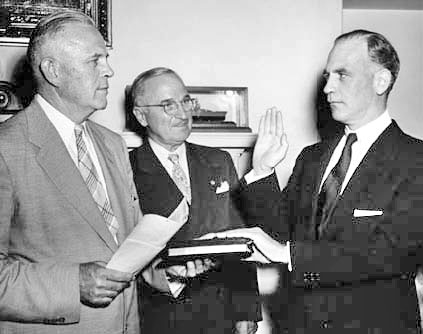
 Seventh
Army, he became “Special Assistant to the Chief of Army Research and
Development, Lt Gen. Arthur G. Trudeau”.27
Seventh
Army, he became “Special Assistant to the Chief of Army Research and
Development, Lt Gen. Arthur G. Trudeau”.27
 “military
R & D was greatly disorganized” and that it was under his superior,
Lt General Arthur Trudeau, that the “Golden Age of R & D (1958-1963
) blossomed.33
“military
R & D was greatly disorganized” and that it was under his superior,
Lt General Arthur Trudeau, that the “Golden Age of R & D (1958-1963
) blossomed.33

 Frank
Wisner some time after Corso began working under General Trudeau at
the Pentagon, in May 1961.
Frank
Wisner some time after Corso began working under General Trudeau at
the Pentagon, in May 1961. 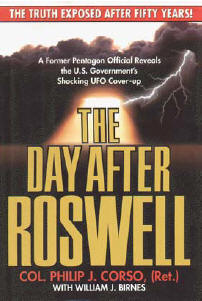
 Officer
who had been on active service for 21 years until his retirement in
1963.
Officer
who had been on active service for 21 years until his retirement in
1963.  evidence
that Corso is unethical.
evidence
that Corso is unethical.