|
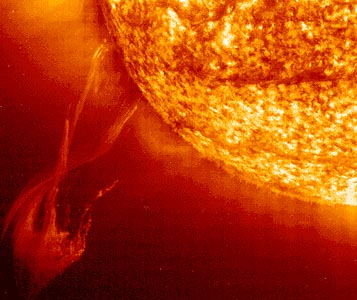
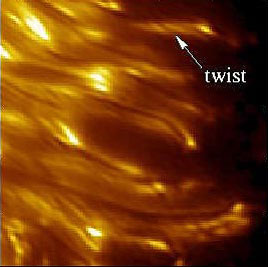
(Left) A solar flare showing the twisting motion characteristic of a
Birkeland current.
The Basics
The major properties of the "Electric Sun (ES) model" are as follows:
If the Sun were not electrical in nature this corona would not exist. If the Sun is simply a (non-electrical) nuclear furnace, the corona has no business being there at all. So one of the most basic questions that ought to arise in any discussion of the Sun is:
It serves no purpose in a fusion-only model nor can
such models explain its existence.
The 'wind' varies with time and has even been observed to stop completely for a period of a day or two. What causes this fluctuation? The ES model proposes a simple explanation and suggests a mechanism that creates fluctuations in this flow.
The standard model provides no such
explanation or mechanism.
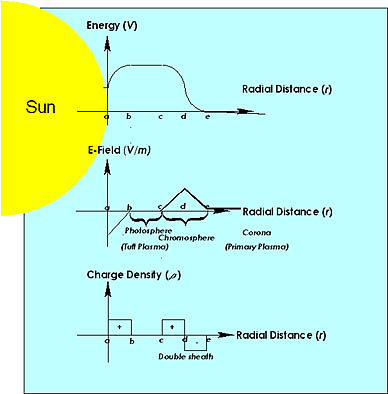
A radial cross-section taken through a photospheric 'granule' is shown in the three plots shown, below. The horizontal axis of each of the three plots is distance, measured radially outward, starting at a point near the bottom of the photosphere (the true surface of the Sun - which we can only observe in the umbra of sunspots). Almost every observed property of the Sun can be explained through reference to these three plots; for this reason, much of the discussion that follows makes reference to them.
The chromosphere is the location of a plasma double layer (DL) of electrical charge. Recall that one of the properties of electric plasma is its excellent (although not perfect) conductivity. Such an excellent conductor will support only a weak electric field.
Notice in the second plot that the almost ideal plasmas of the photosphere (region b to c) and the corona (from point e outward) are regions of almost zero electric field strength.
Energy, Electric field strength, and Charge density
All three of these plots are related mathematically. By the laws of electrophysics: E = - dV/dr, and Charge density = dE/dr.
In words: The value of the E-field, at every point r, is the (negative of) the slope of the energy plot at that point. (The reason for the negative sign in the first equation is that the force on a positively charged particle is down the potential hill, not up.)
The value of the charge density at each point, r, is the slope of the E-field plot at that point. The two layers of opposite charge density necessary to produce the compound shaped energy curve between points c and e used to be called a 'double sheath'. Modern nomenclature calls it a 'double layer' (DL). It is a well known phenomenon in plasma discharges.
Because of the DL positioned between points
c and e, a
+ion to the right of point e sees no electrostatic force from +ions
to the left of point c. The 'primary plasma' of the corona and the
'secondary plasma' of the photosphere are separated by the DL - a
well known, and often observed property of plasmas.
So the presence of the single positive charge layer at the
bottom of the tuft plasma serves as a constraint on unlimited escape
of +ions from the surface of the Sun.
Doing this enables us to visualize the 'trap' that these photospheric tufts are for incoming electrons. As the trap fills, the energy gap between b and c decreases in height, and so the tuft weakens, shrinks, and eventually disappears.
This is the cause of the observed shrinkage and disappearance of photospheric granules.
Only random thermal movement occurs due to diffusion. (Temperature is simply the measurement of the violence of such random movement.) This is where the 6,000 K temperature is measured. Positive ions have their maximum electrical potential energy when they are in this photospheric plasma.
But their mechanical kinetic energy is relatively low. At a point just to the left of point c, any random movement toward the right (radially outward) that carries a + ion even slightly to the right of point c will result in it being swept away, down the energy hill, toward the right. Such movement of charged particles due to an E-field is called a 'drift current'.
This drift current of accelerating positive ions is a constituent of the solar 'wind' (which is a serious misnomer). As positive ions begin to accelerate down the potential energy drop from point c through e, they convert the high (electrical) potential energy they had in the photosphere into kinetic energy - they gain extremely high outward radial velocity and lose side-to-side random motion.
Thus, they become 'dethermalized'. In this region, in the upper photosphere and lower chromosphere, the movement of these ions becomes extremely organized (parallel).
This is what is responsible for the high temperature we observe in the lower corona. Ions just to the right of point e are reported to be at temperatures of 1 to 2 million K. Nothing else but exactly this kind of mechanism could be expected from the electric sun (anode tuft - double layer) model.
The re-thermalization takes place in a region analogous to the turbulent 'white water' boiling at the bottom of a smooth laminar water slide. In the fusion model no such (water slide) phenomenon exists - and so neither does a simple explanation of the temperature discontinuity.
The outward force on positive ions due to this E-field causes the observed acceleration of +ions in the solar wind.
A star with a driving potential of 20 billion volts would
expel protons energetic enough to reach the Sun's surface, arriving
with 10 billion electron volts of energy to spare. Such cosmic ions,
when they collide with Earth's upper atmosphere release the muon
neutrinos that have been much in the news recently.
Of course in that solid-state device there are different processes going on at different energy levels (valence band and conduction band) within a solid crystal. In the solar plasma there are no fixed atomic centers and so there is only one energy band.
In a transistor, the amplitude of the collector current (analogous to the drift of +ions in the solar wind toward the right) is easily controlled by raising and lowering the difference between the base and emitter voltages.
Is the same mechanism (a voltage fluctuation between the anode-Sun and its photosphere) at work in the Sun? e.g., If the Sun's voltage were to decrease slightly - say, because of an excessive flow of outgoing +ions - the voltage rise from point a to b in the energy diagram would increase in height and so reduce the solar wind (both the inward electron flow and the outward +ion flow) in a negative feedback effect.
In May of 1999 the solar wind completely stopped for about two days. There are also periodic variations in the solar wind. The transistor-like mechanism described above is certainly capable of causing these phenomena. The fusion model is at a complete loss to explain them.
Transistor 'cutoff' is a process that is used in all digital circuits.
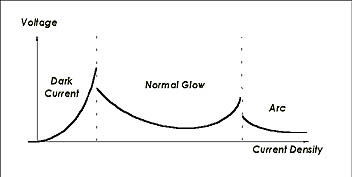
The volt-ampere plot of a plasma discharge. This plot is easily measured for a laboratory plasma contained in a column - a cylindrical glass tube with the anode at one end and the cathode at the other.
These two terminals are connected into an electrical circuit whereby the current through the tube can be controlled. In such an experiment, the plasma has a constant cross-sectional area from one end of the tube to the other. The vertical axis of the volt-ampere plot is the voltage rise from the cathode up to the anode (across the entire plasma) as a function of the current passing through the plasma. The horizontal axis shows the Current Density.
Current density is the measurement of how many
Amps per square meter are flowing through a cross-section of the
tube. In a cylindrical tube the cross-section is the same size at
all points along the tube and so, the current density at every
cross-section is just proportional to the total current passing
through the plasma.
The static resistivity of a plasma operating at any point on the above volt-ampere plot is proportional to the slope of a straight line drawn from the origin to the point. This means that, at every possible mode in which a plasma can operate, it has a non-zero static resistivity; it takes a non-zero E-field to produce the current density. Obviously the static resistivity of a plasma in the high end of the dark mode can be quite large. (The arc region and the left half of the glow region exhibit negative dynamic resistance - and the E-field can be quite small - but that is not what is in question.)
No real plasma can "freeze-in" a magnetic field. The highest conductivity plasmas are those in the arc mode.
But, even in
that mode, it takes a finite, non-zero valued electric field to
produce a current density. No plasma is an "ideal conductor".
Whatever nuclear fusion is taking place on the Sun is occurring here in the double layer (DL) at the top of the photosphere (not deep within the core). The result of this fusion process are the "metals" that give rise to absorption lines in the Sun's spectrum. Traces of sixty eight of the ninety two natural elements are found in the Sun's atmosphere. Most of the radio frequency noise emitted by the Sun emanates from this region.
Radio noise is a well known property of DLs.
The electrical power available to be delivered to the plasma at any point is the product of the E-field (Volts per meter) times current density (Amps per square meter). This multiplication operation yields Watts per cubic meter. The current density is relatively constant over the height of the photospheric / chromospheric layers. However, the E-field is by far the strongest at the center of the DL. Nuclear fusion takes a great deal of power - and that power is available in the DL.
This is expected in the ES hypothesis because the source of those neutrinos is z-pinch produced fusion which is occurring in the double layer - and sunspots are locations where there is no DL in which this process can occur.
The tufts appear and/or disappear, as needed, to maintain a certain required relationship between +ion and electron numbers in the total current. This property of anode tuft plasmas was discovered, quantified, and reported by Irving Langmuir over fifty years ago.
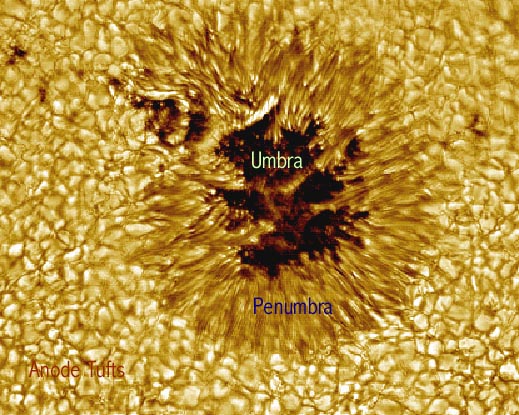
Since there is no arc discharge occurring in these locations, they appear darker than the surrounding area and are termed "sunspots". Of course, if a tremendous amount of energy were being produced in the Sun's interior, the spot should be brighter and hotter than the surrounding photosphere. The fact that sunspots are dark and cool strongly supports the contention that very little, if anything, is going on in the Sun's interior.
The center of the spot is called its umbra.
A sunspot showing the umbra, penumbra, and surrounding anode tufts
(DLs). Because there is no anode tufting where a spot is located, the voltage rise (region a to b in the energy plot above), which normally limits the local flow of positive ions leaving the anode surface, does not exist there.
In sunspots, then, a large number of ions will flood outward toward the lower corona.
Such a flow
constitutes a large electrical current - and, as such, will produce
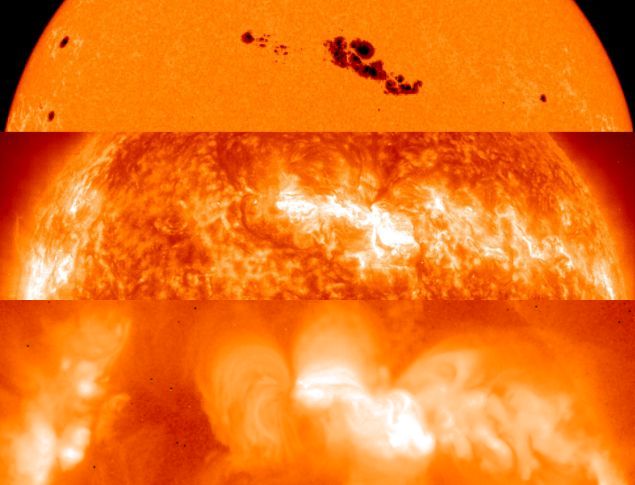
a strong localized magnetic field near the sunspot.
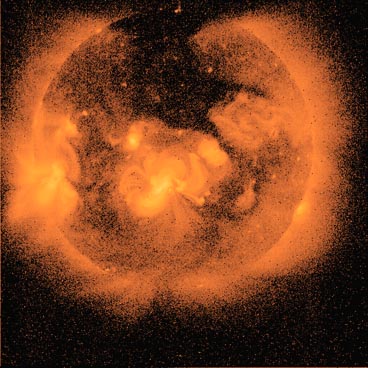
The bright
regions in X-ray images of the corona indicate hotter, more
energetic areas; these are mainly above the sunspot regions.
The effects of +ions flowing out of a sunspot. Strong electric currents also flow in and above the Sun's surface at the edge of sunspot umbrae due to the voltage difference between nearby anode tufts and the central umbrae of the spots (where there are no tufts).
This region is called a sunspot's penumbra.
These currents of course produce magnetic fields. Since, in plasmas, twisting electrical (Birkeland) currents follow the direction of magnetic fields, the glowing plasma in these regions often shows the complicated shapes of these spot related looping magnetic fields.
Remember. Brikeland currents TWIST!
(Left) The Penumbra - Birkeland currents following the voltage drop
from the photosphere down to the umbra.
Prominences, Flares, and CME's
But there are several dynamic phenomena such as flares, prominences, and coronal mass ejections (CME's) that we observe. How are they produced? Nobel laureate Hannes Alfven, although not aware of the Juergens Electric Sun model, advanced his own theory (3) of how prominences and solar flares are formed electrically. It is completely consistent with the Juergens model. It too is electrical.
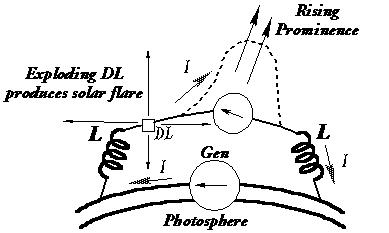
The magnetic field of the Sun sometimes, and in some places on its surface, forms an "omega" shaped loop. This loop extends out through the double sheath layer (DL) of the chromosphere. One of the primary properties of Birkeland currents is that they generally follow magnetic field lines. A strong looping current will produce a secondary toroidal magnetic field that will surround and try to expand the loop. If the current following the loop becomes too strong, the DL will be destroyed1.
This interrupts the current (like opening a switch in an inductive circuit) and the energy stored in the primary magnetic field is explosively released into space.
Hannes Alfven's Solar Prominence Circuit TRACE Image of Plasma Loops
It should be well understood (certainly by anyone who has had a basic physics course) that the magnetic field "lines"2 that are drawn to describe a magnetic field, have no beginning nor end.
They are closed paths. In fact one of Maxwell's famous equations is: "div B = 0". Which says precisely that (in the language of vector differential calculus).
So when magnetic fields collapse due to the interruption of the currents that produce them, they do not "break" or "merge" and "recombine" as some uninformed astronomers have claimed (e.g., see the quote regarding the mainstream concerns above - in 4. Acceleration of the Solar "Wind" Ions). The field simply collapses (very quickly!). On the Sun this collapse releases a tremendous amount of energy, and matter is thrown out away from the surface - as with any explosively rapid reaction.
This release is consistent with and predicted by the Electric Sun model as described above. Some astronomers have proposed that heat is routinely transported out to the lower corona by magnetic fields and released there by,
This idea is inventive but,
unfortunately, has no scientific basis whatever.
Possibly because they do not seem to be included in astrophysics curricula.
A more detailed description of the ES hypothesis as well as the deficiencies of the standard solar fusion model are presented in The Electric Sky.
The Electric Sun
model does not violate Maxwell's equations as the fusion model does.
Ralph Juergens in 1949
|